I mostly post about wine here, though I read a lot of non wine-related blogs. I also read about two dozen webcomics a day (plus things like the archived L'il Abner comics), and several other websites. The good Lord blessed me with the ability to skim things pretty quickly, so I can whip through my daily intake of 118 websites in an hour or two. (Hey, as a kid I used to read two or three newspapers a day.) One website I've enjoyed for the past couple of years is run by Joey deVilla. He's a Canadian/Filipino web programmer by day, accordion player by night. Just got married to a beautiful redhead from Boston. He's a damned good writer and has some amazing stories. He has almost convinced me to take up an obscure instrument and head downtown to get free drinks and kisses from the ladies.
Today, Joey's father passed away. His father was a doctor, a man who worked hard throughout his life and helped untold numbers of people throughout his life. By all accounts a man admired by friends, family, and everyone else. And I have to admit, though I've been following the tales of his declining health over the past few months, when I opened that tab tonight and saw the picture and text, I started to cry.
So tonight, I, like I hope many bloggers, am hoisting my glass to the memory of Joey's dad. Here's to you, and the wonderful legacy you've left.
* * *
I know I've done this in the past, but in the midst of our quibblings over various grapes, we sometimes forget that wine and other alcoholic beverages are traditionally associated with various spiritual rituals: Champagne at the marriage, a beer on the 21st birthday, wine at the anniversary, spirits at the death. Let us not forget that the beverages we celebrate are sometimes meant for joy and sometimes meant for sorrow, but will always provide markers in our memory of taste and emotion.

28 February 2006


26 February 2006
Farmer's Markets
I got an e-mail from Adam Mahler asking me to blog about a House of Representatives bill that would involve government support/funding of Farmer's Markets nationwide. I'm in a weird position, as I love Farmer's Markets but disagree with the bill. Allow me to explain.
If the idea is to use such legislation to improve the eating habits and educate the palates of the American populace, this is going to fail. You can't force people to eat good food anymore than you can force them to drink decent wine or beer. Look at the most popular wines and beers in this country, and then imagine legislation that would try to steer them towards better quality, locally produced alternatives. I'll pause for laughter.
Farmer's Markets are generally cheaper than supermarkets, but quality varies wildly depending on where you are. For instance, here in the Mid-South area, I'm limited to fruits, vegetables, and honey for local produce. The honey is great, the tomatoes are awesome (more on that in a moment), and you can't buy freshly shucked crowder peas or purple hull peas in the grocery store. During the spring, summer, and fall, I buy as much as I can from the Farmer's Market, though I tend to focus on peppers, onions, potatoes, tomatoes, melons, and various peas. Most of the other fruits and vegetables actually come from out of state and have stickers on them like you get at the grocery store. I've seen commercial Hawaiian produce at my local Farmer's Market. Outside of those items listed above, most of the offerings at the Market tend to be inferior to the supermarket varieites. Hey, we're in a cotton-growing region; what do you expect?
I don't think federal money is going to help Farmer's Markets much, nor is it going to change eating habits. But if they want to make more money, here's what I'd suggest, and it's something that I plan on trying this spring. I happen to live near a major tomato growing region. Aside from the standard Ripley tomato, it's known that these farmers also plant rows of heirloom tomatoes for restaurants and special clients. Last summer I lucked out and was able to gorge myself on incredible Brandywine tomatoes. This spring, I intend to make friends with a tomato seller (they always send their pretty daughters to market in the big city), and will offer bribes and the promise to pay double the usual rate for any heirloom tomatoes they bring me. If I could get a sampler basket of things like little yellow Tommytoes and zesty Green Zebras and other varieties I'd consider proposing marriage.
Let's note that I always overpay at the Farmer's Market. If it's just a staple item, I let them keep the change. If it's something I really like or can't get in the grocery store, I pay double or toss in a few extra bills. If I find a vendor I like, I reccomend them to friends and family. That's the way a community market is supposed to work.
Quick tips for Farmer's Markets:
1. Focus on crops that thrive in or are unique to your area, such as muscadine grapes here in the South.
2. Sell heirloom or unusual varieties that you can't get in the grocery store, and advertise this somewhere so that the gourmands in the area know about it.
3. Offer samples for God's sake. A piece of cheesecloth will keep the flies off, and don't be afraid to cook something if your local food service regulations aren't too harsh.
If the idea is to use such legislation to improve the eating habits and educate the palates of the American populace, this is going to fail. You can't force people to eat good food anymore than you can force them to drink decent wine or beer. Look at the most popular wines and beers in this country, and then imagine legislation that would try to steer them towards better quality, locally produced alternatives. I'll pause for laughter.
Farmer's Markets are generally cheaper than supermarkets, but quality varies wildly depending on where you are. For instance, here in the Mid-South area, I'm limited to fruits, vegetables, and honey for local produce. The honey is great, the tomatoes are awesome (more on that in a moment), and you can't buy freshly shucked crowder peas or purple hull peas in the grocery store. During the spring, summer, and fall, I buy as much as I can from the Farmer's Market, though I tend to focus on peppers, onions, potatoes, tomatoes, melons, and various peas. Most of the other fruits and vegetables actually come from out of state and have stickers on them like you get at the grocery store. I've seen commercial Hawaiian produce at my local Farmer's Market. Outside of those items listed above, most of the offerings at the Market tend to be inferior to the supermarket varieites. Hey, we're in a cotton-growing region; what do you expect?
I don't think federal money is going to help Farmer's Markets much, nor is it going to change eating habits. But if they want to make more money, here's what I'd suggest, and it's something that I plan on trying this spring. I happen to live near a major tomato growing region. Aside from the standard Ripley tomato, it's known that these farmers also plant rows of heirloom tomatoes for restaurants and special clients. Last summer I lucked out and was able to gorge myself on incredible Brandywine tomatoes. This spring, I intend to make friends with a tomato seller (they always send their pretty daughters to market in the big city), and will offer bribes and the promise to pay double the usual rate for any heirloom tomatoes they bring me. If I could get a sampler basket of things like little yellow Tommytoes and zesty Green Zebras and other varieties I'd consider proposing marriage.
Let's note that I always overpay at the Farmer's Market. If it's just a staple item, I let them keep the change. If it's something I really like or can't get in the grocery store, I pay double or toss in a few extra bills. If I find a vendor I like, I reccomend them to friends and family. That's the way a community market is supposed to work.
Quick tips for Farmer's Markets:
1. Focus on crops that thrive in or are unique to your area, such as muscadine grapes here in the South.
2. Sell heirloom or unusual varieties that you can't get in the grocery store, and advertise this somewhere so that the gourmands in the area know about it.
3. Offer samples for God's sake. A piece of cheesecloth will keep the flies off, and don't be afraid to cook something if your local food service regulations aren't too harsh.
25 February 2006
2003 Renwood Syrah Rosé
And for this evening's sipping wine, I'm drinking the 2003 Renwood Syrah Rosé from Amador County, California. Though it was warm and springlike yesterday, it's turned cold again and is currently below freezing. Not exactly ideal rosé weather. But I went ahead with it.
It's got good strawberry notes to it, and all around tastes like a Syrah. However, I find that it's a little strong for a rosé. In fact, it could almost pass for a CDR. I found myself wanting a little more of the full strength of a regular Syrah or more of the light fruit playfulness of a traditional rosé. I guess that's a roundabout way of saying that the balance was off. Still, not a bad wine by any stretch of the imagination, just not my favorite pink wine.
I'll also point out in this review that I recently did something stupid with a wine. I won't say which one, because honestly it didn't impact my feelings on the wine. I'd already had a glass and had written up my notes. But I was going in for a second deep sniff, and since I was watching TV at the time and not paying close attention, I treated the glass as if it were a standard one ounce sample. Force of habit from tastings. But no, it was a full glass. So I sniffed deeply as I dipped my nose into the glass and managed to snort wine up my nose. It burned, I cursed loudly, and it took a few tissues and glasses of water before I was back to normal.
For the record, I really would not recommend trying this.
It's got good strawberry notes to it, and all around tastes like a Syrah. However, I find that it's a little strong for a rosé. In fact, it could almost pass for a CDR. I found myself wanting a little more of the full strength of a regular Syrah or more of the light fruit playfulness of a traditional rosé. I guess that's a roundabout way of saying that the balance was off. Still, not a bad wine by any stretch of the imagination, just not my favorite pink wine.
I'll also point out in this review that I recently did something stupid with a wine. I won't say which one, because honestly it didn't impact my feelings on the wine. I'd already had a glass and had written up my notes. But I was going in for a second deep sniff, and since I was watching TV at the time and not paying close attention, I treated the glass as if it were a standard one ounce sample. Force of habit from tastings. But no, it was a full glass. So I sniffed deeply as I dipped my nose into the glass and managed to snort wine up my nose. It burned, I cursed loudly, and it took a few tissues and glasses of water before I was back to normal.
For the record, I really would not recommend trying this.
2004 Rock Rabbit Sauvignon Blanc
Dinner last night was vaguely Italian: campanelle (little bell shaped pasta) with roast chicken thighs, a savory cream sauce, green peas, pearl onions, and quartered campari tomatoes. However for the wine I went for something from California: the 2004 Rock Rabbit Sauvignon Blanc. Their Syrah is one of my all-time favorite wines; versatile, tasty, and affordable. The Sauvignon Blanc did not let me down.
Made in the Central Coast/Sonoma region, Rock Rabbit only produces those two wines. And while it's cool to have a dozen varietals and various price levels (table/estate/reserve/etc.), it's also amazing to find a winery that's so committed to producing two wines so well.
The Sauvignon Blanc is light and fruity, in the style of New Zealand but without the grapefruit flavors. Instead, we tasted peach and hints of lemon. It's an easy drinking wine, and while I served it chilled, it was also delicious at room temperature. And at $10, it's a classy bargain.
I think this would really shine with shellfish, pasta, and a salad including fresh fruit.
Made in the Central Coast/Sonoma region, Rock Rabbit only produces those two wines. And while it's cool to have a dozen varietals and various price levels (table/estate/reserve/etc.), it's also amazing to find a winery that's so committed to producing two wines so well.
The Sauvignon Blanc is light and fruity, in the style of New Zealand but without the grapefruit flavors. Instead, we tasted peach and hints of lemon. It's an easy drinking wine, and while I served it chilled, it was also delicious at room temperature. And at $10, it's a classy bargain.
I think this would really shine with shellfish, pasta, and a salad including fresh fruit.
24 February 2006
2003 Elsa Chardonnay Semillon
Famigilia Bianchi in Argentina is going through a label change for its entry-level Elsa wines. So a local shop managed to pick up some of the last of the old labels at a bargain price, and has passed on the savings. I was able to get the 2003 Elsa Chardonnay Semillon for a mere $6. I got it primarily for cooking purposes, but it's still a good drinking wine. When I buy wines for cooking, I generally look for something delicious under $10. It's nice to cook with something more expensive (or ideally with the wine you're serving with that dish), but that's not always the best budgetary choice. So whenver I refer to using a wine for cooking on this blog, I'm not insulting it--I only cook with stuff I like to drink, even if it is on the less expensive side.
And I got to meet the winemaker last year. From my notes I liked this wine back then as well.
One odd note: it's got a synthetic cork, which I like, but this cork is solid black. It's not bad or offputting or anything, just odd. It's classier than the neon versions, but I tend to prefer the "cork" colored synthetics.
It's 60% Chardonnay and 40% Semillon. I love this particular blend of grapes, especially coming out of Australia. It's an unoaked, slightly crisp and medium fruit wine, but it's not too heavy. It's got a lovely white gold color, and reduced down nicely for a cream sauce I'm making for some chicken.
I don't generally get excited about South American whites--I have nothing against them, but rarely seek them out. In fact, I think that these days I drink more white wine in sparkling varieties than I do in the still varieties. I'm sure this will change as summer approaches. Today it was in the 60s here in Memphis, so I'm doing chicken and pasta with a Sauvignon Blanc tonight. More on that one after I get a chance to try it.
And I got to meet the winemaker last year. From my notes I liked this wine back then as well.
One odd note: it's got a synthetic cork, which I like, but this cork is solid black. It's not bad or offputting or anything, just odd. It's classier than the neon versions, but I tend to prefer the "cork" colored synthetics.
It's 60% Chardonnay and 40% Semillon. I love this particular blend of grapes, especially coming out of Australia. It's an unoaked, slightly crisp and medium fruit wine, but it's not too heavy. It's got a lovely white gold color, and reduced down nicely for a cream sauce I'm making for some chicken.
I don't generally get excited about South American whites--I have nothing against them, but rarely seek them out. In fact, I think that these days I drink more white wine in sparkling varieties than I do in the still varieties. I'm sure this will change as summer approaches. Today it was in the 60s here in Memphis, so I'm doing chicken and pasta with a Sauvignon Blanc tonight. More on that one after I get a chance to try it.
20 February 2006
2003 Banfi Centine
When you really want a food that you haven't had in a long time, it's a powerful force. Here in my home region of the Southern United States, there's a way to phrase such a longing. For instance, I've recently had a strong desire for lasagne. So in the appropriate company I might say, "I done had a cravin' flung on me for some lasagne." (To all of my readers: please note that I don't normally talk like this. Only while inebriated and around a BBQ grill, smoker, or on a camping trip. My everyday speaking voice is neutral Midwestern.)
Of course, around here we mostly spell it lasagna, but four semesters of Italian have a stronger impact on my orthography. Lasange is quite popular here in the Mid-South, and it was certainly a staple item on my childhood dinner table. It's certainly the easiest Italian casserole out there; one of my favorite Italian dishes is crespelle, but it's hard to build enough enthusiasm to make crepes after getting home from work. My Mom always used the same recipe: lots of onion, ground beef, ricotta, mozzarella, and plenty of tomato sauce.
I was in the mood for comfort food. We had a recent ice storm here in Memphis, and I've been really wanting some hearty casserole dishes. So it was chicken thighs in savory sauce and green beans over the weekend, and I had to have some lasagne tonight. So I used a similar method to my Mom's but some alternate ingredients. I used ground turkey instead of beef; it's lighter yet still provides the texture and protein. I added in a ton of leaf spinach to the two eggs and 15 oz. of ricotta cheese. And I used two different tomato sauces: a mushroom one and a garden one. I think the added veggies help.
Though I've made lasagne many times in my life, this was my first attempt at making one without boiling the noodles first. You just layer the noodles as you normally would, but cover the dish with tight aluminum foil before baking. The result: fantastic. The noodles were perfectly al dente, and it was a hell of a lot easier to build the thing using dry noodles. And I've got leftovers for the next few days.
Oh, and the wine?
So last Friday during my wine-buying excursion I picked up a bottle of the 2003 Catello Banfi Centine. It's a red "Super Tuscan" made of 60% Sangiovese, 20% Cabernet Sauvignon, and 20% Merlot. While cooler this drinks like a Merlot, but once it comes up to temperature the Sangiovese really shines through. There's not a lot on the nose, but a slurping sip reveals some black cherry flavors and some medium tannins. It's hard to describe, but it smells like an Italian red and tastes like an Italian red, but doesn't have the heavy tannic bite and strong aftertaste of similar young Italian reds.
At this point, I've just enjoyed my second helping of lasagne and am in heaven. The wine is matching perfectly. I'm now ready to crawl into bed and call in sick for the next two days so that I can curl up next to my dogs and sleep all day.
Of course, around here we mostly spell it lasagna, but four semesters of Italian have a stronger impact on my orthography. Lasange is quite popular here in the Mid-South, and it was certainly a staple item on my childhood dinner table. It's certainly the easiest Italian casserole out there; one of my favorite Italian dishes is crespelle, but it's hard to build enough enthusiasm to make crepes after getting home from work. My Mom always used the same recipe: lots of onion, ground beef, ricotta, mozzarella, and plenty of tomato sauce.
I was in the mood for comfort food. We had a recent ice storm here in Memphis, and I've been really wanting some hearty casserole dishes. So it was chicken thighs in savory sauce and green beans over the weekend, and I had to have some lasagne tonight. So I used a similar method to my Mom's but some alternate ingredients. I used ground turkey instead of beef; it's lighter yet still provides the texture and protein. I added in a ton of leaf spinach to the two eggs and 15 oz. of ricotta cheese. And I used two different tomato sauces: a mushroom one and a garden one. I think the added veggies help.
Though I've made lasagne many times in my life, this was my first attempt at making one without boiling the noodles first. You just layer the noodles as you normally would, but cover the dish with tight aluminum foil before baking. The result: fantastic. The noodles were perfectly al dente, and it was a hell of a lot easier to build the thing using dry noodles. And I've got leftovers for the next few days.
Oh, and the wine?
So last Friday during my wine-buying excursion I picked up a bottle of the 2003 Catello Banfi Centine. It's a red "Super Tuscan" made of 60% Sangiovese, 20% Cabernet Sauvignon, and 20% Merlot. While cooler this drinks like a Merlot, but once it comes up to temperature the Sangiovese really shines through. There's not a lot on the nose, but a slurping sip reveals some black cherry flavors and some medium tannins. It's hard to describe, but it smells like an Italian red and tastes like an Italian red, but doesn't have the heavy tannic bite and strong aftertaste of similar young Italian reds.
At this point, I've just enjoyed my second helping of lasagne and am in heaven. The wine is matching perfectly. I'm now ready to crawl into bed and call in sick for the next two days so that I can curl up next to my dogs and sleep all day.
18 February 2006
Weekend Wines
I've got Fridays and Saturdays off work... So I tend to do a lot of wine shopping on Friday morning. I picked up a few bottles Friday, and here's the report:
2001 Familia Zuccardi Santa Julia Malbec. Mendoza, Argentina. I'm a sucker for $8 Malbecs from Argentina. This one was a little older than most bargain Malbecs, but despite a ton of sediment around the synthetic cork and shoulders of the bottle, it was a delightful afternoon wine. Still good and plummy, fruit forward and easily drinkable. It's not often than you can drink such a cheap wine after five years of aging and have it still be pleasing. I'd love to try a more recent vintage, or the reserve.
2003 The Lucky Country Shiraz-Cabernet Sauvignon. Barossa Valley, Australia. This is a second-tier wine from the distinguished Australian producer Two Hands. Funny story behind this one. I walked into the store eager to get a cheap Bordeaux that was on special that week. A couple of cases had been lost in the back of a warehouse for a few years and they were eager to unload it. I grabbed a bottle, and one of the seasoned employees that I know well urged me against it. I promised to buy something of equal value as thanks, and asked for a fun Shiraz. He pointed me to this little gem. For $15, this was an amazing wine. Big fruit, medium tannins, great berry flavors and an easy finish. A dear friend of mine treated the girlfriend and me to dinner. I took the bottle with us, and we had the wine over dishes like beef tenderloin and glazed pork chops and risotto. An excellent choice, and a classy looking bottle. 55% Shiraz and 45% Cabernet Sauvignon.
2004 Three Blind Moose Chardonnay. Central Coast, California. I needed an inexpensive cooking wine, and I fell in love with the label. How can you resist a name like Three Blind Moose? It's part of the giant Constellation wine conglomerate. It looks like they're marketing to a young, hip crowd, and maybe it will work... As for the wine itself, it's a fairly standard California Chardonnay, which is what I figured when looking for something to boost a chicken casserole. Lightly oaked and not buttery in the slightest. Big and fruity. Reminds me somewhat of Fat Bastard or Red Bicyclette. Sort of a baseline Chardonnay that's not going to offend the casual drinker, though I think that the tartness and heavy acidity would be a little rough if you were drinking more than one glass. Runs around $10 for a bottle, but it made the sauce taste great.
I'm also sitting on about 30 reviews from tastings that I haven't got around to posting... Maybe tomorrow?
2001 Familia Zuccardi Santa Julia Malbec. Mendoza, Argentina. I'm a sucker for $8 Malbecs from Argentina. This one was a little older than most bargain Malbecs, but despite a ton of sediment around the synthetic cork and shoulders of the bottle, it was a delightful afternoon wine. Still good and plummy, fruit forward and easily drinkable. It's not often than you can drink such a cheap wine after five years of aging and have it still be pleasing. I'd love to try a more recent vintage, or the reserve.
2003 The Lucky Country Shiraz-Cabernet Sauvignon. Barossa Valley, Australia. This is a second-tier wine from the distinguished Australian producer Two Hands. Funny story behind this one. I walked into the store eager to get a cheap Bordeaux that was on special that week. A couple of cases had been lost in the back of a warehouse for a few years and they were eager to unload it. I grabbed a bottle, and one of the seasoned employees that I know well urged me against it. I promised to buy something of equal value as thanks, and asked for a fun Shiraz. He pointed me to this little gem. For $15, this was an amazing wine. Big fruit, medium tannins, great berry flavors and an easy finish. A dear friend of mine treated the girlfriend and me to dinner. I took the bottle with us, and we had the wine over dishes like beef tenderloin and glazed pork chops and risotto. An excellent choice, and a classy looking bottle. 55% Shiraz and 45% Cabernet Sauvignon.
2004 Three Blind Moose Chardonnay. Central Coast, California. I needed an inexpensive cooking wine, and I fell in love with the label. How can you resist a name like Three Blind Moose? It's part of the giant Constellation wine conglomerate. It looks like they're marketing to a young, hip crowd, and maybe it will work... As for the wine itself, it's a fairly standard California Chardonnay, which is what I figured when looking for something to boost a chicken casserole. Lightly oaked and not buttery in the slightest. Big and fruity. Reminds me somewhat of Fat Bastard or Red Bicyclette. Sort of a baseline Chardonnay that's not going to offend the casual drinker, though I think that the tartness and heavy acidity would be a little rough if you were drinking more than one glass. Runs around $10 for a bottle, but it made the sauce taste great.
I'm also sitting on about 30 reviews from tastings that I haven't got around to posting... Maybe tomorrow?
10 February 2006
Barefoot Cellars Cabernet Sauvignon
In my continuing fascination with the bargain rack near the register, I picked up a bottle of the Barefoot Cellars Cabernet Sauvignon. Also got a Chardonnay for cooking purposes tomorrow. I've heard a lot about this wine--I've often heard it referred to as an inexpensive, non-threatening wine for newcomers.
It's non-vintage, and a little sweet. Heavy on the jam and berry flavors, too much for me. Little to no tannins. Welch's grape juice aftertaste. About what I expected for $5. And incidentally, I'm currently drinking it barefooted.
It's non-vintage, and a little sweet. Heavy on the jam and berry flavors, too much for me. Little to no tannins. Welch's grape juice aftertaste. About what I expected for $5. And incidentally, I'm currently drinking it barefooted.
08 February 2006
Links
Three new links this week. The first is from Ricardo Brizuela of Andes Wine Zone, focusing on wines of Chile and Argentina. We had a brief e-mail exchange in broken English and my terrible Spanish. But I love the wines of that region, and he's using the same Blogger.com template as me, so how could I not link him?
The second link is a little closer to home. I got an e-mail from Fredric Koeppel of Koeppel on Wine, and decided to link him here on the site, as I always love a good story. Fredric was the restaurant reviewer for the primary Memphis newspaper for most of my childhood, my teen years, and even those young adult years until the Internet managed to wean me off the daily fishwrap. (Though I've got to admit I still enjoy the Sunday editions of papers like the Boston Globe, the New York Times, and the Washington Post, particularly over a long leisurely lunch at a Mexican restaurant with plenty of chips, salsa, and beer.)
Koeppel's got a professional site, and can obviously afford much nicer wine than the stuff I drink. I also commend him for the almost 100% use of wine label photos to accompany the reviews--if only I had the time!
The third link is to the blog of the talented Alyce Mantia. She's a wonderful woman and great cook who runs a little specialty food store here in Memphis. Pretty much THE place to go for interesting cheeses, such as the lemon Stilton and the "Purple Haze" goat cheese. She's got a great food blog that showcases creative recipes involving wonderful ingredients.
The second link is a little closer to home. I got an e-mail from Fredric Koeppel of Koeppel on Wine, and decided to link him here on the site, as I always love a good story. Fredric was the restaurant reviewer for the primary Memphis newspaper for most of my childhood, my teen years, and even those young adult years until the Internet managed to wean me off the daily fishwrap. (Though I've got to admit I still enjoy the Sunday editions of papers like the Boston Globe, the New York Times, and the Washington Post, particularly over a long leisurely lunch at a Mexican restaurant with plenty of chips, salsa, and beer.)
Koeppel's got a professional site, and can obviously afford much nicer wine than the stuff I drink. I also commend him for the almost 100% use of wine label photos to accompany the reviews--if only I had the time!
The third link is to the blog of the talented Alyce Mantia. She's a wonderful woman and great cook who runs a little specialty food store here in Memphis. Pretty much THE place to go for interesting cheeses, such as the lemon Stilton and the "Purple Haze" goat cheese. She's got a great food blog that showcases creative recipes involving wonderful ingredients.
Super Bowl Wines Redux
I'm not much of a sports fan, and neither are the rest of my family. However, we gathered at my brother's house for a party. It was a little funny that we had plenty of wine and no beer, even though the latter probably would have been a better fit for the bratwurst on hoagies. Good bratwurst, though, covered in caramelized onions and mushrooms, with mustard and provolone cheese... slobber slobber...
We drank Yellow Tail Merlot and Chardonnay for a while, and I used the latter for a pan sauce for the brats. Dad brought along a bottle of the 2003 Jacob's Creek Cabernet Merlot. A really nice balance of the two grapes, I thought. Great for casual drinking and having fun. On the grill we also cooked a little meatloaf of sorts, ground venison topped with bacon and onions, wrapped in foil, and cooked over indirect heat on the fire for half an hour or so. Back when I was in Scouts, we called this a "Hobo Dinner". So now I'm going to go into storytelling mode...
Hobo Dinners were interesting yet rarely satisfying meals on camping trips. The adult leaders loved them because the boys did all the work. You'd get a half pound of low-grade, high-fat and gristle ground beef (or elk or deer or buffalo). You'd shape this into a ball or loaf on a sheet of aluminum foil. Then you'd add in some chopped carrots, onion, celery, and potato, obviously meant to simulate a beef stew. Then you'd wrap it up tight, do something with the foil to identify it as your own, and put it on a bed of hot coals. 45 minutes to an hour later, you were ready to eat.
They rarely tasted good. No one ever brought salt or pepper, and the carrots and potatoes somehow never got cooked. The beef tasted pretty bland, not picking up any smoke or caramelization from the fire. It was also easy to poke a hole in your foil and thus let all of the juices out. I even remember one time when it was raining too hard and I ended up eating a baseball-sized lump of raw ground beef and half a raw potato for dinner. In the rain, with the prospect of a night spent in a wet sleeping bag. I'd like to think that experience made me a better man.
It was generally better when we made chili or spaghetti for dinner, though burgers were always incredible. But it was breakfast that was always my favorite. I did a lot of cooking for my patrol, and I'd have multiple burners going with eggs, bacon, sausage, pancakes, toast, biscuits (in a Dutch oven, in the fire), all washed down with slightly-below-room-temperature whole milk, just like God intended. We would go through amazing amounts of food, and yet somehow we were always hungry in time for the next meal.
Man, this is bringing back some great memories. I remember being on top of a mountain in New Mexico, huddled over a one burner stove so that the hailstorm wouldn't put it out or knock it over as I reconsituted some turkey soup from a dried packet. Or the time I made tacos with ground buffalo. Roasting whole eggs in a fire. Roasting a haunch of venison and eating it with friends by just tearing out chunks with knife and hand. Making a cobbler with wild blackberries.
Good times.
We drank Yellow Tail Merlot and Chardonnay for a while, and I used the latter for a pan sauce for the brats. Dad brought along a bottle of the 2003 Jacob's Creek Cabernet Merlot. A really nice balance of the two grapes, I thought. Great for casual drinking and having fun. On the grill we also cooked a little meatloaf of sorts, ground venison topped with bacon and onions, wrapped in foil, and cooked over indirect heat on the fire for half an hour or so. Back when I was in Scouts, we called this a "Hobo Dinner". So now I'm going to go into storytelling mode...
Hobo Dinners were interesting yet rarely satisfying meals on camping trips. The adult leaders loved them because the boys did all the work. You'd get a half pound of low-grade, high-fat and gristle ground beef (or elk or deer or buffalo). You'd shape this into a ball or loaf on a sheet of aluminum foil. Then you'd add in some chopped carrots, onion, celery, and potato, obviously meant to simulate a beef stew. Then you'd wrap it up tight, do something with the foil to identify it as your own, and put it on a bed of hot coals. 45 minutes to an hour later, you were ready to eat.
They rarely tasted good. No one ever brought salt or pepper, and the carrots and potatoes somehow never got cooked. The beef tasted pretty bland, not picking up any smoke or caramelization from the fire. It was also easy to poke a hole in your foil and thus let all of the juices out. I even remember one time when it was raining too hard and I ended up eating a baseball-sized lump of raw ground beef and half a raw potato for dinner. In the rain, with the prospect of a night spent in a wet sleeping bag. I'd like to think that experience made me a better man.
It was generally better when we made chili or spaghetti for dinner, though burgers were always incredible. But it was breakfast that was always my favorite. I did a lot of cooking for my patrol, and I'd have multiple burners going with eggs, bacon, sausage, pancakes, toast, biscuits (in a Dutch oven, in the fire), all washed down with slightly-below-room-temperature whole milk, just like God intended. We would go through amazing amounts of food, and yet somehow we were always hungry in time for the next meal.
Man, this is bringing back some great memories. I remember being on top of a mountain in New Mexico, huddled over a one burner stove so that the hailstorm wouldn't put it out or knock it over as I reconsituted some turkey soup from a dried packet. Or the time I made tacos with ground buffalo. Roasting whole eggs in a fire. Roasting a haunch of venison and eating it with friends by just tearing out chunks with knife and hand. Making a cobbler with wild blackberries.
Good times.
01 February 2006
Super Bowl
I'm not a sports fan, but I've got invites to several parties for Sunday, including one from my brother. He jokingly suggested that I bring a special wine, like Boone's Farm. My reply:
Boone's Farm is actually a bit of overkill for Frito Pie. To bring out the nuanced flavors of mass-manufactured corn chips, what you really need is something along the lines of Mad Dog 20/20 Hawaiian Blue, commonly sold within easy walking distance of the hobo community. The sweet flavors of coconut and pineapple (as well as the sharp tang of the blue food coloring) complement the metallic aftertaste of canned chili and the fumes from slowly melting plastic (assuming that you're serving the treat in-bag).On a serious note, I might bring something. You'd be surprised--a sparkling white wine is the perfect match for things like hot dogs, popcorn, and general snacking. I've seen Andrea Immer on TV drink a $100 champagne with a bowl of popcorn (tossed with black pepper and shredded Parmesan). In fact, I know of a slightly sweet sparkling Chardonnay from the Savoy region of France that tastes like green apples and lemon that would be a lot of fun.
28 January 2006
Jean-Paul Trocadero Blanc de Blancs NV
Rainy afternoon, good book, why not settle back with a bargain sparkler... The Jean-Paul Trocadero Blanc de Blancs is $8 of fun in traditional packaging. It comes from the Savoie (Savoy) region in southeast France near the Alps. It's interesting how whenever we think about French wines we're thinking about regions that relate to ancient kingdoms and principalities, yet how many of us can name any of the actual departments where the wine is made? Anyway, this is all Chardonnay, a bit on the sweet side, but pleasant. The aroma and flavor are overwhelmingly comprised of green apples and lemon, sort of like when I was a kid and Mom would cut up a Granny Smith apple, squirt lemon juice over it, and put it in a bag for my school lunch. Slightly musky finish. Really begs for a firm, sharp English cheddar. An excellent wine for any fan of hard cider.
23 January 2006
2005 Roundup
A look back at 2005... In the US, "roundup" either refers to the gathering of cattle or a particularly potent herbicide used to kill weeds (and which, as a child, made my little brother break out in hives). I'm sticking to the metaphorical usage of the first definition.
A quick glance over the reviews of 2005 reveals that I wrote about some 450 wines. That's not an exact count; a couple were duplicates, yet others were wines I used for dinner parties whose reviews aren't directly linked by this blog anymore and thus weren't counted. So I think 450 is a good number, and damn, what a number! And that's not even counting the various liquors and beers that I sampled over the year... I either need to write a book or enter a 12 step program.
To concerned friends, relatives, and potential parole officers: almost all of those were tasted in one-ounce portions.
I'd like to think that the past year has been an incredible education into the world of wine. If I were referring to a language, I'd say that at the beginning I knew basic phrases, yet now I can carry on a detailed conversation. I'm by no means fluent yet, but I'm working on it.
Cheers to all of my readers, and here's to the rest of 2006!
A quick glance over the reviews of 2005 reveals that I wrote about some 450 wines. That's not an exact count; a couple were duplicates, yet others were wines I used for dinner parties whose reviews aren't directly linked by this blog anymore and thus weren't counted. So I think 450 is a good number, and damn, what a number! And that's not even counting the various liquors and beers that I sampled over the year... I either need to write a book or enter a 12 step program.
To concerned friends, relatives, and potential parole officers: almost all of those were tasted in one-ounce portions.
I'd like to think that the past year has been an incredible education into the world of wine. If I were referring to a language, I'd say that at the beginning I knew basic phrases, yet now I can carry on a detailed conversation. I'm by no means fluent yet, but I'm working on it.
Cheers to all of my readers, and here's to the rest of 2006!
2004 Rawson's Retreat Penfolds Merlot
Ah, Penfolds... Producers of the most noble Grange and the most lowly... 2004 Rawson's Retreat Penfolds Merlot. I picked up the latter for $7 at the local wine shop. I reviewed the 2003 a year ago, and wasn't impressed.
I like this vintage a little more. It's got a powerful flavor and aroma of strawberry jam, which tends to make me think of the peanut butter and jelly sandwiches of my youth. It's a little more acidic and slightly tannic than I like in a Merlot, though it's not a bad wine. I still enjoy the historical significance behind the name.
On the subject of label design, it appears as though they've added a light gray image of the original Rawson's Retreat homestead on the bottom of the label. Good on them, I say. I've had almost all good experiences with Penfolds, yet they have a pretty wide range of prices and categories, and all of them seem to use the same label. This has a certain benefit, as you can bring a bottle to a party and the host probably won't know if it's a $10 or $50 bottle. But can't they just follow the herd and throw a wombat on the label? I mean, it's a humble wine and you don't get more humble than the burrowing and tenacious wombat. Honestly, if you sold this plonk in the US and renamed the wombat the "ground koala", you could sell barrels of the stuff.
I like this vintage a little more. It's got a powerful flavor and aroma of strawberry jam, which tends to make me think of the peanut butter and jelly sandwiches of my youth. It's a little more acidic and slightly tannic than I like in a Merlot, though it's not a bad wine. I still enjoy the historical significance behind the name.
On the subject of label design, it appears as though they've added a light gray image of the original Rawson's Retreat homestead on the bottom of the label. Good on them, I say. I've had almost all good experiences with Penfolds, yet they have a pretty wide range of prices and categories, and all of them seem to use the same label. This has a certain benefit, as you can bring a bottle to a party and the host probably won't know if it's a $10 or $50 bottle. But can't they just follow the herd and throw a wombat on the label? I mean, it's a humble wine and you don't get more humble than the burrowing and tenacious wombat. Honestly, if you sold this plonk in the US and renamed the wombat the "ground koala", you could sell barrels of the stuff.
16 January 2006
Blog Template Sibling
You know, my previous post about going gonzo crazy on the Red Bull has reminded me a bit of the weirdness on my other blog, plus some of my old Usenet postings and a lot of my past and present e-mail to friends. Not that the beverage is making me wild and exxxtreme, but occasionally I miss that style of stream-of-consciousness ranting about nothing of real importance. And this is one of my little corners of the web, right? I can Jackson Pollock the walls with mustard and ketchup if I so desire. I can't do that with some of the corporate e-commerce sites I administer.
I got bored later this evening, and in my continuing, gut-churning quest to empty the cupboards, I found a packet of Pop-Tarts, again, from my roommate. The toaster pastry in question was a Frosted Brown Sugar Cinnamon Pop-Tart. I toasted it in the toaster oven, found it way too sweet and ended up discarding about half of it. That's the first time I've had one of those things in over ten years. One of my weirdest anecdotes takes place in 1983. I was six years old, in first grade, attending a strict Presbyterian elementary school. They had recently installed a microwave in the lunchroom, along with a vending machine that dispensed plastic-wrapped frozen burgers and whatnot for reheating. I decided to throw my packet of Pop-Tarts in the microwave, and I set it for two minutes.
At the time, Pop-Tarts were encased in a pouch that was foil on the inside but paper on the outside, with no printed warnings about microwaves. (The current packaging is all foil and strictly forbids microwaving.) So I stuck it in there, and pressed start. Within about twenty seconds, sparks began flying. Another twenty seconds and the whole mess was in flames. The lunch lady raced over, blasted the interior with a fire extinguisher, and my Pop-Tarts were reduced to a pile of ashes and dry chemical fire retardant. As a bonus, I got to experience some of the great "public shaming" punishment that private schools were so fond of at the time. (When I cheated on a spelling test--the word "Wednesday"--they marched me in front of the teachers in the next grade and all of them told me that they would refuse to have such a worthless student in their class. Cruel, but I'd like to think I spell pretty well these days.)
I wasn't a huge fan of them at the time, but I remember that they were unfrosted didn't contain much fake jam or whatever on the inside. I always remember enjoying the "bread" portion more than the filling. Now it seems like they're all filling and outer frosting. So in search of the great unfrosted Pop-Tart, I Googled, and then I found a blog. That reviews Pop-Tarts. And uses the same Blogger.com template as me. Behold: The Pop Tart Brigade. And thus the rant comes full circle.
I got bored later this evening, and in my continuing, gut-churning quest to empty the cupboards, I found a packet of Pop-Tarts, again, from my roommate. The toaster pastry in question was a Frosted Brown Sugar Cinnamon Pop-Tart. I toasted it in the toaster oven, found it way too sweet and ended up discarding about half of it. That's the first time I've had one of those things in over ten years. One of my weirdest anecdotes takes place in 1983. I was six years old, in first grade, attending a strict Presbyterian elementary school. They had recently installed a microwave in the lunchroom, along with a vending machine that dispensed plastic-wrapped frozen burgers and whatnot for reheating. I decided to throw my packet of Pop-Tarts in the microwave, and I set it for two minutes.
At the time, Pop-Tarts were encased in a pouch that was foil on the inside but paper on the outside, with no printed warnings about microwaves. (The current packaging is all foil and strictly forbids microwaving.) So I stuck it in there, and pressed start. Within about twenty seconds, sparks began flying. Another twenty seconds and the whole mess was in flames. The lunch lady raced over, blasted the interior with a fire extinguisher, and my Pop-Tarts were reduced to a pile of ashes and dry chemical fire retardant. As a bonus, I got to experience some of the great "public shaming" punishment that private schools were so fond of at the time. (When I cheated on a spelling test--the word "Wednesday"--they marched me in front of the teachers in the next grade and all of them told me that they would refuse to have such a worthless student in their class. Cruel, but I'd like to think I spell pretty well these days.)
I wasn't a huge fan of them at the time, but I remember that they were unfrosted didn't contain much fake jam or whatever on the inside. I always remember enjoying the "bread" portion more than the filling. Now it seems like they're all filling and outer frosting. So in search of the great unfrosted Pop-Tart, I Googled, and then I found a blog. That reviews Pop-Tarts. And uses the same Blogger.com template as me. Behold: The Pop Tart Brigade. And thus the rant comes full circle.
2004 Tisdale Shiraz
Once again, I'm trying a $4 bottle to accompany the year-end scrapings from my cupboard. Continuing with the Tisdale line--which doesn't appear to have much of a web presence--I tried the 2004 Tisdale Shiraz tonight. Odd naming there; it happens occasionally, but you don't see much use of the "Shiraz" name in California. And while it's the same grape as Syrah, I've come to think of Shiraz as somehow fun and exotic, no doubt fueled by the fruit-forward, spicy wines from South Africa and Australia. How long is it before some wag markets a Petite Shiraz?
This wine is nothing to get excited about, but isn't terrible either. It's not as good as the recent Parker Station Syrah that I had, but these two wines have reminded me that Syrah/Shiraz really makes a great everyday bargain wine. In the realm of red wines under $10, Cabernet Sauvignon and Pinot Noir are frequently undrinkable, Merlot is too much like Kool-Aid, and Zinfandels are rarely well-balanced. Typically at this price point you have to duck down to the "second tier" grapes of Southern France and Spain. At this stage in my life, it's hard to justify the $25 wine for dinner after work on a Monday.
In a related note, after dinner, I was nosing around in the fridge and found an old can of Red Bull, presumably purchased by my roommate at some point in the past. I assumed that she didn't want it, as her daily lust for carbonated beverages is satisfied by liters of Diet Coke. I decided to crack it open and see what all the fuss was about. Even at arms length, I smelled the pineapple. But not real pineapple, more that ersatz pineapple flavor (and sweetness) found in a roll of Life Savers, combined with just a bit of lemon drop. Mild carbonation on the order of a light Prosecco, just enough to tickle the tongue but not enough to foam in the mouth. Further experimentation with rum was disappointing, though that may have been due to my practice of dribbling in a mere splash of mixer into an otherwise... medicinal dose of rum. It's entirely possible that you could make a really weird pi ña colada with Red Bull, ice, condensed milk and rum. But I'm not going to try.
As for the energy aspects of Red Bull? If you see twenty-seven posts in the next couple of hours about topics ranging from Polynesian navigation to the history of Mormon cinema (up to and including Napoleon Dynamite), then you'll know that I've sprouted wings or whatever it is that's supposed to happen. But I'm doubtful. I routinely drink caffeine before bedtime without trouble, and the only stimulant that ever really affected me was Brazillian maté, which kept me buzzing and twitching for a really productive 36 hours.
This wine is nothing to get excited about, but isn't terrible either. It's not as good as the recent Parker Station Syrah that I had, but these two wines have reminded me that Syrah/Shiraz really makes a great everyday bargain wine. In the realm of red wines under $10, Cabernet Sauvignon and Pinot Noir are frequently undrinkable, Merlot is too much like Kool-Aid, and Zinfandels are rarely well-balanced. Typically at this price point you have to duck down to the "second tier" grapes of Southern France and Spain. At this stage in my life, it's hard to justify the $25 wine for dinner after work on a Monday.
In a related note, after dinner, I was nosing around in the fridge and found an old can of Red Bull, presumably purchased by my roommate at some point in the past. I assumed that she didn't want it, as her daily lust for carbonated beverages is satisfied by liters of Diet Coke. I decided to crack it open and see what all the fuss was about. Even at arms length, I smelled the pineapple. But not real pineapple, more that ersatz pineapple flavor (and sweetness) found in a roll of Life Savers, combined with just a bit of lemon drop. Mild carbonation on the order of a light Prosecco, just enough to tickle the tongue but not enough to foam in the mouth. Further experimentation with rum was disappointing, though that may have been due to my practice of dribbling in a mere splash of mixer into an otherwise... medicinal dose of rum. It's entirely possible that you could make a really weird pi ña colada with Red Bull, ice, condensed milk and rum. But I'm not going to try.
As for the energy aspects of Red Bull? If you see twenty-seven posts in the next couple of hours about topics ranging from Polynesian navigation to the history of Mormon cinema (up to and including Napoleon Dynamite), then you'll know that I've sprouted wings or whatever it is that's supposed to happen. But I'm doubtful. I routinely drink caffeine before bedtime without trouble, and the only stimulant that ever really affected me was Brazillian maté, which kept me buzzing and twitching for a really productive 36 hours.
15 January 2006
Tasting Notes for January 14, 2006
The theme for this tasting was "Affordable French", and overall it was a likeable bunch. I went with a couple of friends who don't regularly attend tastings, and they appeared to enjoy the day's offerings. Note: I wasn't able to find several of the websites--smaller French producers often don't have their own website, and sometimes the only reviews or notes come from Germany or Denmark.
Wine 1: Louis Perdrier Brut NV. Beaune, Burgundy. This is a non-vintage sparkling blanc de blancs from Beaune. Couldn't find a website, but it's a really nice little sparkler. Mellow, lightly crisp and refreshing. The flavors aren't complex, but it was a big hit at the tasting. And the price made it even more attractive. $9.
Wine 2: 2004 Chateau Larmevaille Blanc. Entre-Deux-Mers, Bordeaux. Made from Sauvignon Blanc and Semillion, this was lemony and crisp with a good balance. Not spectacular, but a great basic white Bordeaux. $15.
Wine 3: 2000 Hugel Riesling. Alsace. There's a touch of petrol on the nose, and the overall flavor is dry with just a touch of tartness. It was thin and not terribly interesting. Not a big hit at the tasting. $10 (375 mL bottle).
Wine 4: 2001 Cave de Prisse Saint-Veran. Maâcon, Burgundy. A pretty boring White Burgundy. Way too thin, flat, and no noticeable flavors. Just not enough there to keep my interest. $16.
Wine 5: 2002 George Faiveley Bourgogne Blanc. Burgundy. Some herbal, grassy aromas. Flavors of strong goat cheese. It's a pretty earthy wine, off-putting if you haven't drunk a lot of French wine. I think it could work when paired with the proper aromatic cheese. $19.
Wine 6: 2002 Jean Fournier Marsannay VV. Marsannay, Burgundy. Finally, the reds. This Pinot Noir is tart and crisp, with some berry flavors and a soft finish. Not outstanding, and not exactly a bargain either. $34.
Wine 7: 2002 Philippe Rivière Menuts Rouge. St. Emilion, Bordeaux. A bit of a red meat aroma, some cherry flavors, soft and well rounded with soft tannins. Mostly Merlot, of course. $17.
Wine 8: 2003 Chateau Damase Bordeaux Superieur. Bordeaux. This is 100% Merlot, which really surprised me--I was tasting some of the other Bordeaux grapes in there. I found it a little spicy and peppery, with medium tannins. Of course, this was the first wine with any real structure that we tasted, so it may have appeared more powerful in comparison. $15.
Wine 9: 2003 Chateau de Mattes-Sabran. Corbières, Languedoc. South of France, probably a lot of Carignan and who knows what else. Soft beginning, some black cherry flavors. Slightly unbalanced, but a good little wine. Really begs for some food. $15. Correction: Syrah, Grenache, and Mourvedre. No Carignane in this wine. The owner of the winery contacted me with the correct information. Thanks!
Wine 10: 2000 Chateau Larose-Trintaudon. Haut Medoc, Bordeaux. No information on the current vintage, but lovely splash page there. Mostly Cabernet Sauvignon, with a good dose of Merlot and a bit of Cabernet Franc. Dry, mild, and a good bargain for this region. It has some of that characteristic green bell pepper/tomato leaf aroma and herbal flavor that turn a lot of people off. I happen to like it. I had one a few years ago that was almost like smoking a cigar. $19.
Wine 11: 2000 Domaine Forest Cairanne Côtes du Rhône Villages. Côtes du Rhône. Light fruit beginning, a dark color for a CDR. Light tasting and a perfect accompaniment for grilled pork. I think it's a Grenache-Syrah-Mourvedre blend, but I think there might be something else in there. $12.
Wine 12: Abbaye Sainte-Eugenie "Ame de Pierre" NV Banyuls. Rousillon, Languedoc. The name means "Soul of Pierre" and refers to a work of French literature. Mostly made from Grenache Noir, this is a fortified wine like Port, and it fact it resembles a Tawny Port in both appearance and structure. There are flavors of molasses and raisins, but it's not syrupy or overly sweet. Excellent dessert wine, and something a little different. $26.
Wine 1: Louis Perdrier Brut NV. Beaune, Burgundy. This is a non-vintage sparkling blanc de blancs from Beaune. Couldn't find a website, but it's a really nice little sparkler. Mellow, lightly crisp and refreshing. The flavors aren't complex, but it was a big hit at the tasting. And the price made it even more attractive. $9.
Wine 2: 2004 Chateau Larmevaille Blanc. Entre-Deux-Mers, Bordeaux. Made from Sauvignon Blanc and Semillion, this was lemony and crisp with a good balance. Not spectacular, but a great basic white Bordeaux. $15.
Wine 3: 2000 Hugel Riesling. Alsace. There's a touch of petrol on the nose, and the overall flavor is dry with just a touch of tartness. It was thin and not terribly interesting. Not a big hit at the tasting. $10 (375 mL bottle).
Wine 4: 2001 Cave de Prisse Saint-Veran. Maâcon, Burgundy. A pretty boring White Burgundy. Way too thin, flat, and no noticeable flavors. Just not enough there to keep my interest. $16.
Wine 5: 2002 George Faiveley Bourgogne Blanc. Burgundy. Some herbal, grassy aromas. Flavors of strong goat cheese. It's a pretty earthy wine, off-putting if you haven't drunk a lot of French wine. I think it could work when paired with the proper aromatic cheese. $19.
Wine 6: 2002 Jean Fournier Marsannay VV. Marsannay, Burgundy. Finally, the reds. This Pinot Noir is tart and crisp, with some berry flavors and a soft finish. Not outstanding, and not exactly a bargain either. $34.
Wine 7: 2002 Philippe Rivière Menuts Rouge. St. Emilion, Bordeaux. A bit of a red meat aroma, some cherry flavors, soft and well rounded with soft tannins. Mostly Merlot, of course. $17.
Wine 8: 2003 Chateau Damase Bordeaux Superieur. Bordeaux. This is 100% Merlot, which really surprised me--I was tasting some of the other Bordeaux grapes in there. I found it a little spicy and peppery, with medium tannins. Of course, this was the first wine with any real structure that we tasted, so it may have appeared more powerful in comparison. $15.
Wine 9: 2003 Chateau de Mattes-Sabran. Corbières, Languedoc. South of France, probably a lot of Carignan and who knows what else. Soft beginning, some black cherry flavors. Slightly unbalanced, but a good little wine. Really begs for some food. $15. Correction: Syrah, Grenache, and Mourvedre. No Carignane in this wine. The owner of the winery contacted me with the correct information. Thanks!
Wine 10: 2000 Chateau Larose-Trintaudon. Haut Medoc, Bordeaux. No information on the current vintage, but lovely splash page there. Mostly Cabernet Sauvignon, with a good dose of Merlot and a bit of Cabernet Franc. Dry, mild, and a good bargain for this region. It has some of that characteristic green bell pepper/tomato leaf aroma and herbal flavor that turn a lot of people off. I happen to like it. I had one a few years ago that was almost like smoking a cigar. $19.
Wine 11: 2000 Domaine Forest Cairanne Côtes du Rhône Villages. Côtes du Rhône. Light fruit beginning, a dark color for a CDR. Light tasting and a perfect accompaniment for grilled pork. I think it's a Grenache-Syrah-Mourvedre blend, but I think there might be something else in there. $12.
Wine 12: Abbaye Sainte-Eugenie "Ame de Pierre" NV Banyuls. Rousillon, Languedoc. The name means "Soul of Pierre" and refers to a work of French literature. Mostly made from Grenache Noir, this is a fortified wine like Port, and it fact it resembles a Tawny Port in both appearance and structure. There are flavors of molasses and raisins, but it's not syrupy or overly sweet. Excellent dessert wine, and something a little different. $26.
11 January 2006
2003 Navarro Vineyards Pinot Noir
Can't believe I forgot to mention this one. Last Friday I fixed dinner for my date as well as a close friend and his date. Afterwards, we retreated to the couches to watch a movie... A good time was had by all.
The girl I'm dating went home to California for Christmas and returned with a bottle of the 2003 Navarro Vineyards Pinot Noir from the Anderson Valley in Mendocino. Retails for around $23, though it's not available here in Memphis. Her father got it from the vineyard. It was an excellent Pinot Noir, and even more fun to serve because I'd started out the evening with my old favorite, the sparkling pinot noir from Domaine Ste. Michelle. The Navarro had a light and delicate structure, with excellent raspberry and strawberry flavors. Just a hint of spice on the nose. All four of us enjoyed it.
What was for dinner? I didn't have time to put together anything too fancy, but I did coconut milk-brined pork tenderloin cooked with a plum glaze and topped with skillet-browned chopped apples cooked in butter and rum. On the side, green beans and a mushroom-leek risotto. No pictures this time, sometimes when you're impressing the ladies it's time to put such things aside and just enjoy the moment, allowing it to live only in memory.
The girl I'm dating went home to California for Christmas and returned with a bottle of the 2003 Navarro Vineyards Pinot Noir from the Anderson Valley in Mendocino. Retails for around $23, though it's not available here in Memphis. Her father got it from the vineyard. It was an excellent Pinot Noir, and even more fun to serve because I'd started out the evening with my old favorite, the sparkling pinot noir from Domaine Ste. Michelle. The Navarro had a light and delicate structure, with excellent raspberry and strawberry flavors. Just a hint of spice on the nose. All four of us enjoyed it.
What was for dinner? I didn't have time to put together anything too fancy, but I did coconut milk-brined pork tenderloin cooked with a plum glaze and topped with skillet-browned chopped apples cooked in butter and rum. On the side, green beans and a mushroom-leek risotto. No pictures this time, sometimes when you're impressing the ladies it's time to put such things aside and just enjoy the moment, allowing it to live only in memory.
Two Table Reds
Not much going on wine-wise this past week, though Saturday I get to go to the first wine tasting of the new year. The theme will be "affordable French". Very much looking forward to that one.
Last Saturday I attended a dry wedding reception with my immediate family. We left a little early and Dad took us all out to dinner--Mom, my brother and his wife, and my date and me. Dinner was phenomenal, and Dad ordered a bottle of wine, the 2004 Rosemount Cabernet-Merlot. A decent wine, even if it needs some breathing. I used to drink a lot of Rosemount ten years ago, when a magnum of the above wine or a blend like Shiraz/Grenache or Chardonnay/Semillon could be had for $10. And I still think they're good wines for BBQs and very informal occasions (even though among bargain Aussie wines, Little Penguin is my favorite).
But if you've read my recent rant on restaurants, you'll understand my bristling at, in this case, a $8 wine being sold for $25. The important thing is that we had a great meal, a good time laughing and talking to one another, and the wine helped everyone enjoy a two-hour leisurely dinner properly.
Tonight I'm working my way through a bottle of the 2004 Tisdale Merlot. This is one of those $4 bottles by the register that I've been wanting to try just for the hell of it. Hell, I was going home to a delicious dinner of spaghetti and jarred sauce (part of a New Year's resolution to clean out the cupboards). No reason to break out the good stuff.
It's not a bad wine. I don't drink a lot of Merlot--not because of Sideways, but because I have gravitated towards more powerful flavors recently. There's not much of a nose, but it's got some good berry flavors. It avoids that slightly sweet, cherry Jolly Rancher flavor you can get from some California Merlots. And I suppose that the natural character of Merlot helps avoid that tannic, acidic edge that you can get from a cheap Cabernet Sauvignon.
Last Saturday I attended a dry wedding reception with my immediate family. We left a little early and Dad took us all out to dinner--Mom, my brother and his wife, and my date and me. Dinner was phenomenal, and Dad ordered a bottle of wine, the 2004 Rosemount Cabernet-Merlot. A decent wine, even if it needs some breathing. I used to drink a lot of Rosemount ten years ago, when a magnum of the above wine or a blend like Shiraz/Grenache or Chardonnay/Semillon could be had for $10. And I still think they're good wines for BBQs and very informal occasions (even though among bargain Aussie wines, Little Penguin is my favorite).
But if you've read my recent rant on restaurants, you'll understand my bristling at, in this case, a $8 wine being sold for $25. The important thing is that we had a great meal, a good time laughing and talking to one another, and the wine helped everyone enjoy a two-hour leisurely dinner properly.
Tonight I'm working my way through a bottle of the 2004 Tisdale Merlot. This is one of those $4 bottles by the register that I've been wanting to try just for the hell of it. Hell, I was going home to a delicious dinner of spaghetti and jarred sauce (part of a New Year's resolution to clean out the cupboards). No reason to break out the good stuff.
It's not a bad wine. I don't drink a lot of Merlot--not because of Sideways, but because I have gravitated towards more powerful flavors recently. There's not much of a nose, but it's got some good berry flavors. It avoids that slightly sweet, cherry Jolly Rancher flavor you can get from some California Merlots. And I suppose that the natural character of Merlot helps avoid that tannic, acidic edge that you can get from a cheap Cabernet Sauvignon.
05 January 2006
2002 Parker Station Syrah
Here's my first real wine review of 2006. Which reminds me--I'm approaching my one year blogiversary or whatever the hell they call it. I actually maintained a completely different blog for most of 2004, in which I did reviews of every movie I watched. At the end, I started writing about wine, and decided to make a clean break with a new blog tied to my real name. The old one used a pseudonym, and contained a lot of late night angsty rants... I might post a link in the future for the amusement of my handful of readers.
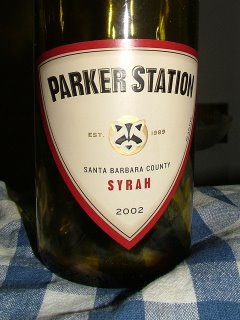 I had this sometime between Christmas and New Year's... I jotted down notes, took a photo, and kept meaning to get back to it. Without further ado, I present the 2002 Parker Station Syrah. Even though I loved the Lot 51 Red, I didn't realize that this wine was also from the vineyards of the classic TV actor Fess Parker. This Santa Barbera Syrah is touted as "The best Syrah you can afford to drink daily". I think I paid $10 for this bottle, and that's an apt tag line. There's some good berry flavors, and decently balanced tannins, but mostly it's a red wine that you could drink with damned near any meal and be happy. I don't think it's as good as the Rock Rabbit Syrah, but it's definitely a tasty little wine.
Do you want to know what really drew me in? The label. It's an attractive rounded triangle, clean 50s-era type, and a humble raccoon logo framed in a gold leaf circle. I'm not even particularly fond of raccoons (after years of camping trips and late night driving), but I still love this label. It's sort of a perfect combination of 1950s graphic design motifs set on a heraldric shield. I would have just used all caps instead of the roughly 90% small caps they use for the name, but the rest of the design is lovely. (Sorry, at times the old career overwhelms everything else.)
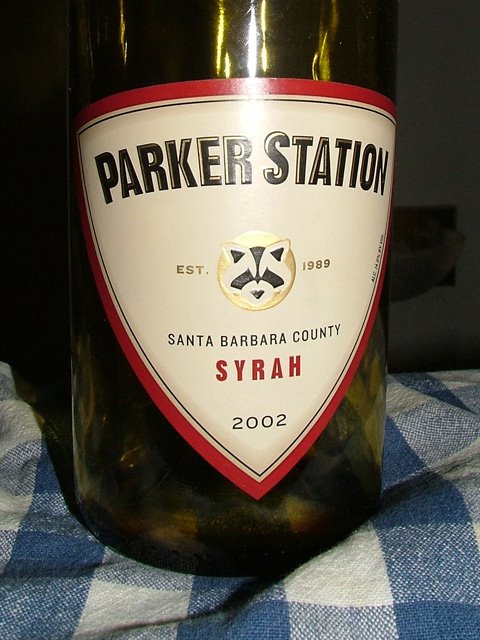 I had this sometime between Christmas and New Year's... I jotted down notes, took a photo, and kept meaning to get back to it. Without further ado, I present the 2002 Parker Station Syrah. Even though I loved the Lot 51 Red, I didn't realize that this wine was also from the vineyards of the classic TV actor Fess Parker. This Santa Barbera Syrah is touted as "The best Syrah you can afford to drink daily". I think I paid $10 for this bottle, and that's an apt tag line. There's some good berry flavors, and decently balanced tannins, but mostly it's a red wine that you could drink with damned near any meal and be happy. I don't think it's as good as the Rock Rabbit Syrah, but it's definitely a tasty little wine.
Do you want to know what really drew me in? The label. It's an attractive rounded triangle, clean 50s-era type, and a humble raccoon logo framed in a gold leaf circle. I'm not even particularly fond of raccoons (after years of camping trips and late night driving), but I still love this label. It's sort of a perfect combination of 1950s graphic design motifs set on a heraldric shield. I would have just used all caps instead of the roughly 90% small caps they use for the name, but the rest of the design is lovely. (Sorry, at times the old career overwhelms everything else.)
Subscribe to:
Posts (Atom)