Showing posts with label pizza. Show all posts

07 September 2014

2013 Domaine de la Perrière Sancerre & 3 Guys Pizza Pies

Irish mythology has a concept called geis. It's a sort of rule/curse that if the hero violates the geis, something bad will happen. It's how Cú Chulainn bit the dust, because he had two conflicting geasa: he couldn't refuse the gift of a meal, but he couldn't eat dog meat. One day he was offered some roast hound, and he was trapped in an impossible position. He didn't die right away, but by breaking the taboo he was weakened and it's all wrapped up in some love triangle drama with Emer and Lugaid and was soon killed in battle.

Editor's Note: BWR does not condone the eating of dog but the author is making a point that will become clear soon, and ancient Ireland was a weird place.

I'm not an absolutist on wine and food pairing, and I often like to mix things up to see how they work. But I do have a personal geis that I don't break. When presented with a bottle of Sancerre, I'm going to eat seafood, and preferably oysters. There's just something about that Loire valley Sauvignon Blanc that is so distinct from how the grape is expressed everywhere else on the globe, and I just love it with any seafood that actually tastes fishy or salty. No bland cod, give me marinated mackerel.

2013 Domaine de la Perrière Sancerre
Sancerre AOC
100% Sauvignon Blanc
$25, 12% abv.

This bottle is light and lemony with a gentle body and a mild finish. Faint floral notes on the nose as it warms up, but overall a subtle and well-balanced wine that delivered the reliable and enjoyable experience that I've always experienced from this little part of France. So what did I pair with it?

A local pizza place called 3 Guys Pizza Pies offers something called the Vampire Killer: red onions, feta cheese, minced garlic, kalamata olives, and anchovies. I get it without the onions, but they're one of the few places that I trust with anchovies (the fishies are always large, taste freshly opened, and are not treated as the punchline to a joke).

The photo from a month ago shows the pizza at the bar with a pint of Ghost River beer (I toured the brewery in 2009), but this weekend I picked up another and had it with the Sancerre. And the pairing was amazing. Granted, it's on the salty side, and afterwards nobody is going to want to kiss you, but the fish, olives, and cheese all work together well with a wine that has just the right amount of acidity and a hint of minerality.

Note: This wine was provided as a sample for review.

02 August 2013

A Few More Homemade Pizzas...

Inspired by my friend Fredric, I decided to revisit my old pizza-making skills, breaking out the peel and stretching the old kneading muscles. And Julia was excited to try some different pies from my home oven, so I asked her to think about what she'd like. Anything, no matter how crazy the topping.

These were all about 20cm/8 inches in diameter, and looking back, the big pools of fresh mozzarella aren't aesthetically perfect but tasted amazing. Before finding out what Julia wanted, I knew that I had to make a fresh clam pizza. My first effort in 2010 was made with canned clams, and I will say that the bag of live littlenecks I grabbed at the international market delivered a lot of great flavor. Garlic, romano cheese, fresh mozzarella, and a dash of basil that I crumbled over my slices. Just about perfect in terms of salty and savory flavors. I opened the clams just a bit in a warm skillet and then shucked them mostly raw on top of the pizza before going in the oven. Much better than the canned version.

Julia requested the following combination: fig, gorgonzola, prosciutto, and balsamic vinegar. I reconstituted the dried mission figs in a little water and balsamic, and the rest came together on top of my homemade San Marzano tomato sauce.

It's a great combination, and the figs and balsamic vinegar provide that little balancing element of sweetness to the other essential flavors. I was tempted to drizzle everything with truffle oil, but my lady does not like the fungus.

On the dough, I took Fredric's recent advice and switched from all-purpose to bread flour (sticking with King Arthur) and after much kneading, rolled out the dough with an empty wine bottle. Despite always having a half dozen empty wine bottles within easy reach of the kitchen counter, I haven't really used them as kitchen implements, and I was surprised at how well it performed for the task. I'm going to save a nice straight-sided Bordeaux bottle to keep on hand for this precise purpose.

The final pizza was built from the various leftovers, and turned out tasty in its vegetarian glory. Gorgonzola, fresh mozzarella, tomato sauce, and garlic. Pretty simple, but it came together well and was even great as leftovers the next day.

I know that my next task is to take my reawakened pizza skills and make a great quattro stagione pizza, or to get my hands on some crazy wild boar guanciale or other awesome cured meats to build something that you'd never get at your local chain pizza joint. Plus, I want to make some monstrous mushroom pizza for my own enjoyment--sliced trumpet stalks, oyster and shiitake mushrooms throughout, and topped with delicate blanched enoki mushrooms for texture. Mmmmm...

22 July 2013

One Pizza, Don't Hold the Anchovies

The humble anchovy doesn't get a lot of respect in the world of pizza (or anywhere else), but I love that tiny salty fish. However, I rarely order pizza with anchovies, because I don't know what kind they've got, how fresh the jar or can is, and frankly, if I'm going to eat anchovies I want them cooked by somebody that actually likes them.

Julia has been bugging me to make homemade pizza, and our friends Brett and Lynn gave me a pizza stone last year. I've been slow to use it and decided to do a practice pie tonight using a few ingredients I knew Julia would not enjoy.

The sauce is a can of imported San Marzano tomatoes cooked down with three cloves of garlic, half a glass of Zinfandel, and a handful of dried mushrooms. All cooked down until thick and then blended with a stick blender.

The toppings are sliced fresh mozzarella, roasted yellow cherry tomatoes, oil-packed anchovy fillets, all baked to perfection, then graced with a dash of chopped fresh basil and grated Grana Padano cheese.

I'm a little out of practice when it comes to homemade pizza, and it's really too hot to be playing this game today, but I look forward to rebuilding my skills for a future dinner party, with lots of individually designed pizzas for each guest.

16 August 2010

2009 Oberon Sauvignon Blanc

Sometime soon I'm going to publish a mass post of Sauvignon Blancs. I tried a lot of them over the summer, and am still collecting my notes. In general, I like the grape. At its most simple, I think about the grape like lemonade: tart, cold, and refreshing. But sometimes you get surprised.

2009 Oberon Sauvignon Blanc, Napa Valley, $15, 13.5% abv. Light with outstanding minerals and chalk, highly restrained aromas of jasmine and melon, with just a touch of fruit and acidity on the palate. Round mouthfeel, and just a little bit of that chalk shows up on the finish and I love it. I was seriously reminded of a Sancerre with this wine. Going into it the only thing I knew was that it was from California, and yet when it passed my lips I was stunned. And for the price? Normally you have to know a lot about French wines to get a bottle of this quality for $15, and it helps if the person on the other end doesn't know what he's selling. This is not your standard big fruit, strong acid, California SB. It's not like most of what you see from New Zealand or South America. Despite the Northern California birthplace, it is most reminiscent of the Loire Valley.

Like the Aussie Chardonnay I mentioned on Friday, this wine is partially oaked, and ever so deliciously balanced because of it. While cold it goes down smooth as silk; later, as it warms and your palate is activated from the meal, traces of oak and structure are more present. How do you decide how long to leave a particular wine in oak? Ahem... A Midsummer Night's Dream, Act II, Scene i, li. 508-509:

Oberon: How long within this wood intend you stay?

Titania: Perchance till after Theseus' wedding-day.

No idea if they pulled part of this from the barrels after Theseus got hitched, but I'm happy with the results, and frankly more happy to brush off the dust from the handy Shakespeare Concordance (St. Martin's Press, 1953).

I served it with a roasted pepper pizza... Why the potatoes in the background of the photo? For some odd reason I was reminiscing about my visit to het Rijksmuseum Amsterdam and how there would be a gigantic portrait in the northern Renaissance style, and you'd have a big wrinkly head of some Flemish peasant grimacing by the light of a window, but on the counter would be a set of lovingly rendered turnips. I always love those little background details of antique tools, dinnerware, or odd vegetables.

This wine was received as a sample.

22 February 2010

2008 Xavier Flouret Nationale 7

It was difficult for me to open this wine. Not because of the cork, but because it's just such a breathtakingly beautiful color that I didn't want to empty the bottle... But at the same time, I had to know how it tasted. Ah, the eternal conflict of wine.

This little beauty is the 2008 Xavier Flouret Nationale 7, $20, 13% abv. From the Côtes de Provence AOC, made in a spot on the coast between Marseille and Nice in the southeast corner of France. No oak, all stainless steel. 45% Grenache, 40% Cinsault, 15% Tibouren. A very light and delicate wine, and you'll want to resist the urge to serve this too cold. As it warms up a yellow cherry and violet aroma arises. Light strawberry flavors with just a bit of acidity towards the finish. If you ever talk to someone who wants a gentle transition into French wines, or maybe is trying to break out of the Pinot Grigio rut, I'd strongly recommend this wine.

I served it with a homemade white clam pizza. I haven't made crust from scratch in a while and it was a pleasure working with the dough again. A splash of olive oil, a healthy dose of garlic, a can of chopped clams, fresh mozzarella, and shredded spinach. Lovely light dinner to go along with such a beautiful wine, and the seafood/coastal wine connection seemed appropriate.

As stated above, one of the grapes is Tibouren. It just so happens that this is my 150th confirmed grape. I've tried more, but for bragging purposes I stick to those I've got documented here on the blog, minus duplicates like Trajadura/Treixadura. And coincidentally, #150 is a weird, rare, obscure grape with a confusing history.

A few hours of research in different languages revealed alternate names, such as Guesserin, Gaysserin, Lou Defiouraire, Tiboulen, Tibourenc, Antibois, Antibouren, and Antibourenc. (Some of these names only show up in an 1881 catalog of European grapes. I consider the variant Tribouren to be a persistent typo.) The latter names were useful in that they pointed towards the French Riviera city of Antibes, founded by Greek settlers in 500 B.C.E.

English sources I found claim that the grape came to France via Greece, while French sources claim it came from Chaldea (part of Babylonia near modern day Kuwait). It's possible both are true, since many grapes moved from the Middle East through Greece to the Mediterranean and then throughout Europe and later the rest of the world. It's grown primarily as a blending grape for rosés in Provence, and I didn't find evidence of it being planted anywhere else in the world. Well, a German source makes reference to a Tibouren grape grown in Armenia, but that it's unknown if there's a relationship. And the Italian take on the whole thing is just confusing and full of speculation. (If anyone wants to tackle the Niçard or Provençal sources, be my guest. Life's too short to learn the 40 minor dialects spoken in France.)

Having run out of languages, source material, and without physical grapes, leaves, or DNA to test, I have no definitive answer about the grape's origins. Perhaps some ampelographer will figure it out in the future. While the hunt was fun, perhaps I was overthinking it... After all, this is a light and refreshing wine for enjoying on a sunny afternoon, even if you're not on the expensive beaches of Saint-Tropez.


This wine was received as a sample from Cognac One.

25 January 2010

Benito vs. the Pizza Kit

I think I need to kick off BWR Year 6 with some haute cuisine.

A link from the Serious Eats blog led me to a collection of vintage pizza kit ads. While those beauties hail from the 50s and 60s (during which cheese was apparently a dangerous and scary topping), I remember the boxes fondly from the early 80s. The pizza kit occupied an interesting niche: better than the frozen pizzas of the time, but not as good as delivery/restaurant pies. They were also fun to make, since you got to play with the dough, spread the sauce, and lay on the toppings.

There was another type that I haven't seen since then, sold by some schools for fund raising. A few weeks after placing your order you got a set of blank crusts, packets of sauce, and various toppings, all of which were supposed to go in the freezer. Not only did the basic 8-pack fill up your freezer, but you inevitably ran out of cheese and sauce by pizza #6, and a bag of grey sausage pellets would linger behind the frozen corn for years.

Around high school when I was going crazy with bread baking, I made real homemade pizzas and experimented with lots of different ingredients. I still do it occasionally, though the local master in this regard is Fredric with his Saturday night pizza & movie tradition that's been going on for over 10 years.

I've had wood- and coal-fired pizza in trendy bistros, deep dish pizza in Chicago, crazy variations around the country, and I've even had it in Italy. The strangest was probably a funky Gouda/Edam pizza made at an Italian restaurant run by Ecuadorians in Amsterdam. But those goofy ads ignited a craving that had been lying dormant for nearly twenty-five years.

On my next visit to the grocery store, I grabbed a box of the Chef Boyardee Cheese Pizza Kit. I played it straight by the directions, and only added some shredded American-style mozzarella cheese since that's what we did when I was a kid and it's a permitted variation by Chef B. No artisan goat cheese, no Moroccan lamb sausage, no dash of truffle oil on the finished product. I even used the same glass bowl and banged-up stainless steel pan, part of a set of random cookware I inherited when I moved out of the house. With luck, I could recreate the exact flavor I'll always associate with trying to time the pizza to be ready just as soon as ABC would begin showing a James Bond flick on Saturday night.

The finished product faithfully replicated those memories, so much so that I managed to burn the roof of my mouth like I did every single time as a child. The crust is biscuit-like and soft, the sauce is distinctively tangy and sweet... just as I remember it. With the wisdom of experience, I do recognize that this is salted all to hell, the tragic flaw of all processed foods (which I rarely eat these days). I like salt, but I also like to control it.

What wine to serve with this meal? I needed something that would have been easy to get in Memphis in the 1980s and would be a natural match for a 50s-style pizza. Only five seconds of cogitation were required to arrive at the perfect match: Chianti in a straw basket (or fiasco bottle).

The Tuscan 2007 Bell'agio Chianti from Banfi retails for around $10, 12.5% abv. and is made from 90% Sangiovese with the remaining 10% comprised of Canaiolo Nero, Trebbiano, and Malvasia. Interesting woody nose, with cedar and pencil shavings. Medium body with a dominant black cherry flavor, firm tannins, and a long finish. Just a touch of bitterness from the tannins, but the sweetness of the tomato sauce balances that out.

It's not the greatest Italian wine I've ever had, but it's solid, drinkable, and affordable, the kind of wine that would show up in a Billy Joel song.

02 May 2008

Homemade Pizza

Years ago I used to make a lot of homemade bread. During high school and for a few years afterwards, I made all kinds of loaves: traditional baguettes, artisan European breads, sourdough, crazy experimental loaves, gargantuan Russian bread cooked in a full 5 qt. Dutch oven, and whatever else struck my fancy. It wasn't uncommon for me to keep half a dozen different flours on hand at any given time. At some point I moved on to other things, and great local bakeries have filled the need for the odder kinds of bread.

A brief mention of Mario Batali's Otto mentioned a pizza technique I'd been wanting to try. His restaurant starts pizza on a griddle and finishes it in the oven. I've read of similar ideas using a cast-iron skillet, and that's what I tried.

Making the dough was easy even though it had been forever. Recipe? We don't need no stinkin' recipe! Flour, water, salt, yeast, a dash of sugar. Allowed to rise twice, etc. While the dough was doing its thing I took some Muir Glen canned tomatoes, spiced them up a bit and reduced it all down for the sauce. The cooking method requires a bit more detail. (I've got an electric oven, so with gas this will be a bit different.)

I moved a rack of the oven to the top position and turned the broiler on, leaving the door shut. The big cast iron skillet was allowed to heat on medium high until all the metal was hot. I formed the crust into a rough disc as thin as possible (about 1/8" thick on my example but with more refined dough you can go even thinner--just cook it less). Lay out your mise en place, making sure to have everything ready. Put the pets in another room, turn off the smoke alarm, and prepare to sweat.

I spooned a bit of the homemade sauce on the dough, just enough to get the flavor and some nice chunks of tomato. Too much will make it soggy. I topped it with cut fresh mozzarella balls and a little Sriracha sauce. Dash of sea salt and pepper. I scattered a little cornmeal in the cast iron skillet and immediately slid the pizza into the skillet. Just a couple of minutes until the bottom is crispy and is flecked with a few black marks. Before the bottom burns, slide it out of the skillet (don't burn yourself) onto a plate or pizza peel. Then slide it directly onto the rack of the oven directly under the broiler. Cook until desired level of bubbling/browning/etc. For me it only took another couple of minutes.

While prep and everything took a while, the actual cooking time on the pictured pizza was less than five minutes. Five hot and busy minutes, but quick nonetheless. I threw some fresh basil and grated Parmigiano-Reggiano on top and enjoyed it mere seconds after this photo was taken. Great pizza. Light and crispy, full-flavored, and the crust had those little charred spots that do wonders for the taste.

I will warn you that the potential for screwing this up is great. Don't take your eyes off the pie at any stage of the process and be prepared for some smoke. But if you're willing to bear the heat as temperatures rise here in the South, then go for it.

27 July 2006

Combinations 4: Combos Goes Green

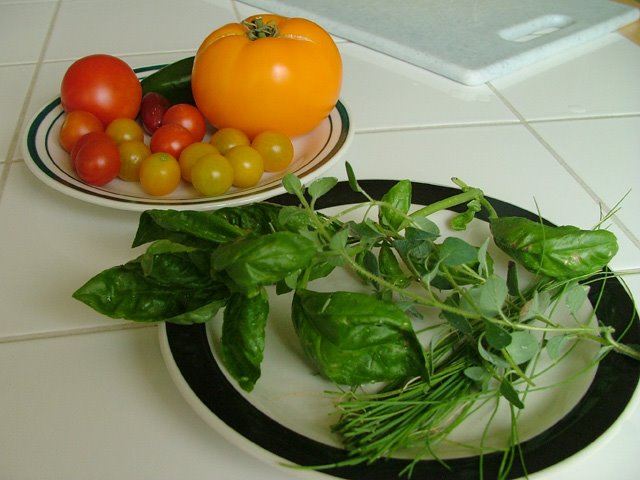
This Combinations challenge was right up my alley, because I've got plenty of fresh herbs growing in the kitchen. For this recipe I used basil, rosemary, chives, and oregano, as well as fresh cherry tomatoes and jalapeño peppers from the outside garden. And what did I choose to make?

A French bread pizza.

Now, you may scoff as you remember this dish from its frozen dinner incarnation, or perhaps as a dried-out brick of grease from the school cafeteria. Fear not! While it definitely falls into the realm of comfort food, I'd like to think that the way I make a French bread pizza elevates the meal to delicious heights. I start out with half a loaf of good French bread from the bakery. You want to go softer rather than hard here, though if it's too soft you can crisp it up in the oven before adding the toppings.

I dug out the half loaf a bit, and then added leftover spaghetti sauce, shredded mozzarella cheese, chopped basil and oregano and chives, thinly-sliced jalapeño peppers, halved cherry tomatoes (yellow and red), a healthy sprinkling of goat cheese, and a few sprigs of rosemary. I topped it with some kosher salt and freshly ground pepper, and tossed it in a hot oven until it just began to brown on top. Finally, I finished it off with a drizzle of balsamic vinegar.

This tastes great, though since I've often got all of the raw ingredients readily at hand, this has been a frequent midnight snack in the past month or so...

As for the wine, I initially wanted to go with a Viognier. When I think herbs, I think of that grape. However, with a really powerful tasting meal like this, I didn't want to confuse any herbal notes, and instead wanted a milder wine with some fruity elements to help bring out the tomato flavors. Thus I popped open a bottle of the 2005 Georges Dubœuf Beaujolais-Villages. I've heard good things about this vintage, and felt like giving it a whirl. The wine has some of the slight banana aroma you've come to expect from this producer, but it's got a good wild strawberry flavor to it, as well as surprisingly firm tannins for a Gamay. It went well with the pizza. The pizza had lots of earthy and herbal flavors, yet the wine provided a light and refreshing counterpoint. And serving it slightly chilled didn't hurt either.

I know a lot of people look down at a "pizza wine", associating it with cheap plonk drunk out of plastic cups by college students, but a good pizza with the right wine can be a lovely combination indeed.