Showing posts with label provence. Show all posts

17 March 2014

Two Wines from Cognac One

Cognac One imports an impressive array of wines from around the world, some of which are branded under specific marques like the beautifully curated Xavier Flouret line that I've had the chance to try over the years.

Both of these are exceptional bargains and are highly recommended if they are distributed in your area. Both exhibit perfect balance in a restrained yet complex Old World style. The Portuguese red will let you experience what those grapes can do if they're turned into wine instead of Port, and the perennial favorite French rosé will make you weep over every cheap White Zinfandel that ever passed your lips.

In addition the two wines are food friendly with a wide range of dishes. I could have done a better pairing with the Douro (perhaps braised pork shanks with a shallot, dried fig, and red wine reduction), but I believe I hit it out of the park with the rosé.

2010 Quinta Do Pessegueiro Aluzé
Douro, Portugal
20% vinhas velhas, 35% Touriga Nacional, 30% Touriga Francesa, 15% Tinta Roriz
$18, 12.5% abv.

Deep black fruit aroma with lots of plum, a touch of cinnamon, and rich cassis. Very low tannins and low alcohol contribute to a very mild red wine. It was perfect with a pizza topped with lots of cured pork, where the fruit and structure were boosted by the salt. Note that 20% of the grapes are listed as vinhas velhas, meaning "old vines". In Portugal, this is the name given to a vineyard that is old and not completely identified by ampelographers. I'm a big fan of old vines and field blends, but am still curious as to which varieties are included in that mix.

2013 Xavier Flouret Nationale 7
Domaine de Rimauresq - Cru Classé
Côtes de Provence
34% Grenache, 33% Cinsault, 10% Mourvedre, 7% Carignane, 5% Syrah, 5% Cabernet Sauvignon, 3% Tibouren, 3% Rolle
$17, 13% abv.

This is the third vintage of the Nationale 7 that I've had the pleasure to try. Light and delicate with the most beautiful expression of wild strawberries imaginable. Firm but not tart acidity, sort of the difference between a lemon and an orange but tasting like neither. Gentle finish and amazing balance. The Rolle in the blend is the local name for what is known as Vermentino in Italy, and the general Mediterranean expression of this wine led me to pair it with clams once again...

I had some great saffron linguine and decided to buy two pounds of littleneck clams to go along with it. I boiled the pasta and drained it, setting it aside. I heated up some olive oil and gently cooked four cloves of garlic and a healthy dash of red pepper flakes, then added in a splash of the Nationale 7 and some white vermouth. Time to steam the clams, let them open, add a pat of butter, and then toss with the cooked pasta.

It's important not to overcook any of the clams, but to let the various liquids cook down to the perfect consistency before plating and topping with toasted breadcrumbs and fresh parsley. My ratio of linguine to vongole is pretty heavy on the vongole, but it was delicious and matched perfectly well with the wine. And one great thing is that you don't really have to add salt thanks to the natural saltiness of the clams. Even though it was cold and rainy on this Sunday morning in Memphis, for a moment I could imagine that I was on the sun-kissed coast of the French Riviera.

Note: These wines were provided as samples for review.

15 April 2013

Provençal Lunch with Château d'Esclans Rosé

When three bottles from Château d'Esclans arrived at the house, my first thought was not about the right glass or temperature for the wines, but rather about what I was going to eat with them. Rosés are amazingly food friendly, but I knew these would be delicate, closer to white wines than your bolder, fruitier pinks. While my menu was made with a nod to France and the Mediterranean, it is perhaps not 100% Provençal, but delicious nonetheless.

The Château goes back to 1201, but it spent a few years in the 90s under the ownership of a Swedish pension fund. Since then, it has been purchased by Sacha Lichine who has restored the winery to its former glory and has made what is perhaps the finest rosé in the world, something that was mostly a legend to lovers of dry rosé like me: Garrus.

I've had crudo multiple times in the past two months and it's my new favorite food, which is unfortunate when you're so far from the ocean. This was my first attempt at making it myself, using a block of frozen yellowtail tuna from the international market. I know that sashimi-grade is not a legal classification, but I felt it was the best bet for what I was doing. Just a little extra virgin olive oil, parsley, sea salt, lemon zest, and thin slices of serrano pepper. So many incredible flavors and textures in such a simple dish.

2012 Château d'Esclans Whispering Angel
Côtes de Provence
Proprietary blend of Grenache, Rolle, Syrah, Cinsault and Tibouren
$20, 13.5% abv.

Due to the stainless steel fermentation, this is the most traditional rosé of the lineup. Light aromas and flavors of wild strawberry, with no tannins and low acidity providing a mild and mellow experience that melts on your tongue. An excellent bargain that is highly recommended.

Next, I served an asparagus tart. A pastry base pre-baked, then topped with a goat cheese/egg/milk mixture and the tops of some tender asparagus. At the last minute I sliced spring onions to top the tart, and baked it until just golden brown. The asparagus still had a little crunch to it, but the cheese mixture was well-set. Quite tasty, and perfect for a spring afternoon.

2011 Château d'Esclans Les Clans
Côtes de Provence
Proprietary blend of Grenache and Rolle (Vermentino)
$60, 13.5% abv.

This wine spends some time on oak, though the end result is far more like a well-crafted white Burgundy than anything red. Hints of vanilla, butter, and caramel on top are dead giveaways, and in a blind tasting this would easily pass for a French white wine. The added structure provides some additional strength, allowing it to stand up to heartier cuisine than the Whispering Angel.

I don't know why cassoulet hasn't really caught on in the US. It's dead simple and combines so many of our favorite things. I started with a fresh duck (not confit), which I butchered and roasted in the oven to render out most of the fat. Bacon, cannellini beans, tomato sauce, chicken stock, an onion, loads of garlic... A few other ingredients were combined and allowed to simmer in the enameled cast iron pot for a few hours. The resulting dish was full of deep duck flavors combined with some earthy structure from the Weißwurst. The beans held up well and did not become too mushy, and thanks to some judicial skimming during cooking, the dish was not laden with duck and pork fat.

2011 Château d'Esclans Garrus
Côtes de Provence
Proprietary blend of Grenache and Rolle (Vermentino)
$120, 14% abv.

Not a lot of this wine is made--between 2-3,000 bottles per year, and it's something I've always wanted to try. The oak elements are far more balanced in this wine, and there is a rich peach and floral nose. White fruit and berry flavors intermingle on the palate along with a round body. The finish is gentle yet long lasting, and every sip makes you come back for more. For such a rare style of wine, it is delicious and should be on the life list of every serious wine lover.

Note: These wines were received as samples.

22 February 2010

2008 Xavier Flouret Nationale 7

It was difficult for me to open this wine. Not because of the cork, but because it's just such a breathtakingly beautiful color that I didn't want to empty the bottle... But at the same time, I had to know how it tasted. Ah, the eternal conflict of wine.

This little beauty is the 2008 Xavier Flouret Nationale 7, $20, 13% abv. From the Côtes de Provence AOC, made in a spot on the coast between Marseille and Nice in the southeast corner of France. No oak, all stainless steel. 45% Grenache, 40% Cinsault, 15% Tibouren. A very light and delicate wine, and you'll want to resist the urge to serve this too cold. As it warms up a yellow cherry and violet aroma arises. Light strawberry flavors with just a bit of acidity towards the finish. If you ever talk to someone who wants a gentle transition into French wines, or maybe is trying to break out of the Pinot Grigio rut, I'd strongly recommend this wine.

I served it with a homemade white clam pizza. I haven't made crust from scratch in a while and it was a pleasure working with the dough again. A splash of olive oil, a healthy dose of garlic, a can of chopped clams, fresh mozzarella, and shredded spinach. Lovely light dinner to go along with such a beautiful wine, and the seafood/coastal wine connection seemed appropriate.

As stated above, one of the grapes is Tibouren. It just so happens that this is my 150th confirmed grape. I've tried more, but for bragging purposes I stick to those I've got documented here on the blog, minus duplicates like Trajadura/Treixadura. And coincidentally, #150 is a weird, rare, obscure grape with a confusing history.

A few hours of research in different languages revealed alternate names, such as Guesserin, Gaysserin, Lou Defiouraire, Tiboulen, Tibourenc, Antibois, Antibouren, and Antibourenc. (Some of these names only show up in an 1881 catalog of European grapes. I consider the variant Tribouren to be a persistent typo.) The latter names were useful in that they pointed towards the French Riviera city of Antibes, founded by Greek settlers in 500 B.C.E.

English sources I found claim that the grape came to France via Greece, while French sources claim it came from Chaldea (part of Babylonia near modern day Kuwait). It's possible both are true, since many grapes moved from the Middle East through Greece to the Mediterranean and then throughout Europe and later the rest of the world. It's grown primarily as a blending grape for rosés in Provence, and I didn't find evidence of it being planted anywhere else in the world. Well, a German source makes reference to a Tibouren grape grown in Armenia, but that it's unknown if there's a relationship. And the Italian take on the whole thing is just confusing and full of speculation. (If anyone wants to tackle the Niçard or Provençal sources, be my guest. Life's too short to learn the 40 minor dialects spoken in France.)

Having run out of languages, source material, and without physical grapes, leaves, or DNA to test, I have no definitive answer about the grape's origins. Perhaps some ampelographer will figure it out in the future. While the hunt was fun, perhaps I was overthinking it... After all, this is a light and refreshing wine for enjoying on a sunny afternoon, even if you're not on the expensive beaches of Saint-Tropez.


This wine was received as a sample from Cognac One.

23 September 2006

Combinations #6: Roast Partridge with Grapes and Walnuts

Andrew's hosting yet another round of Combinations... For Combinations #6, we're tasked with preparing Roast Partridge with Grapes and Walnuts and matching an appropriate wine. First off, in gathering the ingredients for this recipe, I found myself purchasing raw grapes for the first time in... I can't remember. I've eaten grapes occasionally in the past decade, but it seems I only buy them in their fermented and bottled form these days. I'm reminded of the Scotsman who, fond of the deep-fried pizza of his home, goes to Naples, is served a perfect pizza margherita, and exclaims, "D'ya expect me to eat it raw?"

Speaking of the raw grapes, I used Sable Seedless, which are black as night and taste great. I couldn't help but be curious about what kind of wine they'd make. (And yes, I know that wine grapes often don't taste all that great and that table grapes make crap wine. Still curious.)

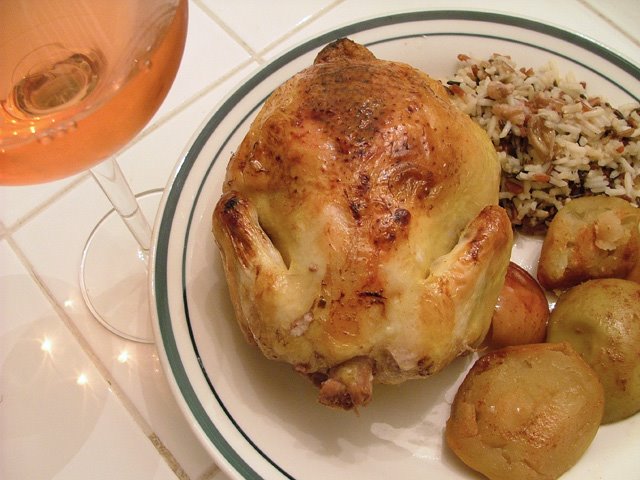
We have partridges here in the States, but they're actually a species of quail. (Couldn't get my hands on any farm-raised quail--my local supplier for farm-raised game went out of business.) Right now we're at the end of dove season, and while I wouldn't have been averse to going out and shooting a brace of doves with the trusty 16 gauge, I haven't had the opportunity to get out in the fields. Grabbing a pigeon from the street didn't seem too appetizing, and I wasn't going to try to snare one of the mourning doves out of my backyard. Doves don't really have much meat on them, though, and looking at pictures of European partridge dishes, I figured my best bet was going to be Cornish game hen, basically a very small breed of chicken.

I don't know how popular these are overseas... Here they're available everywhere, and very inexpensive (yet ridiculously expensive at restaurants/catered events). Most people get them frozen, but I was lucky to pick up some fresh ones. Some people like to cook them for small Thanksgiving dinners, because they cook rather quickly and there's not a ton of leftovers.

Brief anecdote: I first cooked Cornish game hens back in high school when I was going through my first cooking experimenting phase. I prepared them in an Italian manner with a sausage-based stuffing. They turned out delicious--I made one for each member of our family. Mom looked down at hers and almost got upset. "But it looks like a little baby chicken... I don't know if I can eat this." Surprisingly, over our lifetime, my mother has rarely had to force me to eat anything, but there's been several dishes I put in front of her that she didn't want to touch. Love you anyway, mom.

I followed the recipe closely, except I used some of the chosen wine instead of the Madeira and substituted a multicolor rice blend for the side dish. I also included some honey and cinnamon baked apples as an additional side. More on the apples in a future post, as they were an unusual variety.

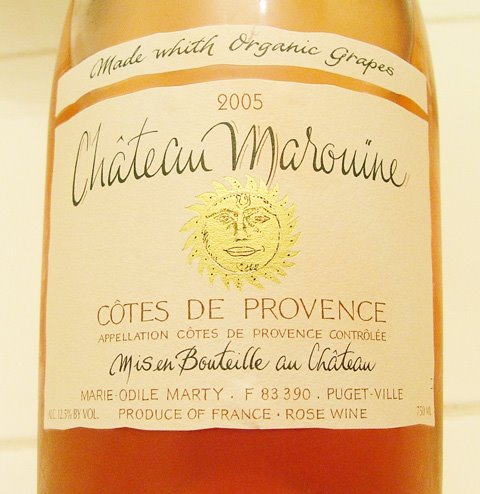
For the wine, I picked the 2005 Château Marouïne Côtes de Provence Rosé, obviously from Provence in France. Alder gave it a good score at a big rosé tasting. It's also fully organic, which is sort of amusing as none of the other ingredients for dinner were organic. 28% Grenache, 26% Cinsault, 26% Mourvèdre, 20% Carignan. Kudos to the winemaker for putting this information on the back of the label! What a lovely Southern French blend.

The first thing I thought of when purchasing the bottle was James Ivey's Extremely Pale Rose: A Very French Adventure. I haven't read this book, but saw mention of it on some wine blog and can't wait to get my hands on a copy. This is indeed a very pale rosé with just a slight orange tinge. Think of a white wine to which you've just whispered something naughty. Flavorwise, it's crisp and tart. Not sweet at all, but well balanced. Tasted blind, this could easily pass for a white wine. Very light flavors of pear. Easily drinkable, perhaps too light and refreshing for this autumnal dish. As it hit 91°F (33°C) here today, I feel entirely justified in this selection.