Showing posts with label pinot gris. Show all posts

03 October 2014

Fall Wines of Germany

Time once again for the quarterly delivery of two bottles from Wines of Germany. Over the years I've really enjoyed their sample system: always two bottles, one sweet, one dry, yet always demonstrating the impressive diversity that comes out of Germany with just a handful of white grapes.

The holidays are approaching, and low alcohol Riesling always has a place on the Thanksgiving or Christmas table. The Pinot Gris presented here is not my preferred style--I like it more austere and with a mineral focus--but is still tasty and approachable for both the expert and novice.

2013 Villa Wolf Pinot Gris
Pfalz, Germany
100% Pinot Gris
$12, 12.5% abv.

Just 75 km/45 miles from the French border, this winery was established in 1756 but revitalized by Dr. Loosen in 1996. This particular bottle is crisp and tart with tangy green apple and pear flavors. Dry and refreshing with a short finish. With a nod towards Thanksgiving, this would be my go-to bottle for a sandwich of leftover turkey and cranberry sauce on Friday while I am sitting at home reading rather than fighting with the crowds out shopping.

2011 Louis Guntrum Niersteiner Rehbach Riesling Spätlese
Rheinhessen, Germany
100% Riesling
$25, 10% abv.

The Guntrum estate was founded in 1648 and is currently managed by the 11th generation family member Louis Konstantin Guntrum. In 1945, General George S. Patton occupied the winery for the last months of WWII. I'm sure this was a purely strategic decision. This particular bottle is mild and sweet with low acidity and a round body. Round white fruit flavors with a gentle, clean finish. Good balance and a low alcohol percentage make this one an excellent candidate for the wine novices at your holiday table, while at the same time appealing to those who know a lot more about wine. I got a serious craving for baked ham and deviled eggs while sipping this one.

Note: These wines were provided as samples for review.

11 September 2013

MacMurray Ranch Wines

MacMurray Ranch began as a cattle ranch in the Russian River Valley when actor Fred MacMurray purchased the property in 1941. The star of My Three Sons and many memorable Disney live action movies focused on cattle until his death in 1991. The family sold the ranch to Gallo in 1996 to grow grapes under the MacMurray Ranch label.

I first became acquainted with this wine around 2003 when a wine shop owner told me that the wine was personally grown and made by Fred MacMurray (who had been dead for a dozen years at that point), and I thought it would be an interesting conversation starter for a dinner party. It was the first Pinot Noir I ever purchased, and at $20 it was a bit of a splurge at the time. I remember that I served it way too warm, and with a really heavily seasoned steak, which was not the way that Pinot needs to be treated. Ten years later, I get the opportunity to try it again.

2012 MacMurray Ranch Pinot Gris
Russian River Valley/Sonoma Coast
100% Pinot Gris
$20, 14% abv.

Light citrus aromas with high acidity and a bold body. A few tropical fruit notes as it opens up. This is a much bigger wine than Pinot Gris from Alsace or Oregon yet has its own unique New World expression that reminds me a bit of a few New Zealand Pinot Gris bottles. Good match for well-seasoned shellfish.

2011 MacMurray Ranch Pinot Noir
Central Coast
100% Pinot Noir
$23, 13.8% abv

This is the more recent vintage of the wine I had lo those many years ago. Initial aroma of strawberries with undertones of stewed fruit. Firm fruit flavors with a slightly tannic finish. Serve with roast lamb and a mild cream sauce.

2011 MacMurray Ranch Pinot Noir
Russian River Valley
100% Pinot Noir
$35, 13.8% abv.

This bottle was much milder than the previous Pinot Noir, with aromas and flavors that focus more on raspberry with some touches of earth. While still Californian in character, it's pointing more in a French direction with a more delicate presentation. Light enough for salmon, but also one to be enjoyed with a tender veal chop.

Note: These wines were provided as samples.

02 September 2013

Mud House Wines and the America's Cup

Mud House Wines is the official wine supplier of the Emirates Team New Zealand in the 2013 America's Cup. Having won the Louis Vuitton Cup, they will go on to challenge Oracle Team USA off the coast of San Francisco.

Starting in 1851, the Cup was won by the New York Yacht Club every year until 1983 when the crew of the Australia II of the Royal Perth Yacht Club emerged victorious. I can remember the excitement in 1987 when the US Stars & Stripes 87 defeated the New Zealand Kookaburra III. Since the 80s, there's been a lot of attention and technological development around this particular race, yet it's nice to know that there's still so much enthusiasm around wind-propelled sea vessels.

2012 Mud House Riesling
Waipara Valley
100% Riesling
$12, 12.5% abv.

The nose is dominated by light green apple and honey, while the flavor is crisp and acidic. Very similar to New Zealand Rieslings I've had in the past, and one that would be perfect with a ham sandwich on a picnic.

2012 Mud House Pinot Gris
South Island
100% Pinot Gris
$16, 13.% abv.

Rich floral aromas that also include peach and apricot. Ripe white fruit flavors and a clean, round finish. Great with a cold chicken salad full of grapes and walnuts.

2011 Mud House Sauvignon Blanc
Marlborough
100% Sauvignon Blanc
$14, 13% abv.

A standard New Zealand Sauvignon Blanc with full grapefruit peel aromas and flavors. Touch of spice on the palate and a long, acidic finish. Serve with creamy cheeses and melon.

2011 Mud House Pinot Noir
Central Otago
100% Pinot Noir
$19, 13.5% abv.

In addition to a strong overripe strawberry profile, there is a back end of green bell pepper that I wasn't expecting. It starts out a little harsh, but after an hour of breathing the wine softens considerably and is ready for fare like grilled veal chops. It's a bold enough Pinot Noir that it can stand up to some strong sauces and preparations.

Note: These wines were provided as samples.

31 July 2013

Hahn Family Pinot Gris & Pinot Noir

I've tried the wines of Hahn Winery a few times over the years, going back to 2007. Recently I had the chance to try two of their recent releases, both featuring that lovely brushstroke rooster label that I love so much.

2011 Hahn Winery Pinot Gris
100% Pinot Gris
Monterey
$14, 14.5% abv.

Lots of tropical fruit and melon on the nose with a slightly musky undertone. Bright acidity and a round mouthfeel. A short finish, and a wine that would pair quite well with grilled quail and fresh pineapple.

2011 Hahn Winery Pinot Noir
100% Pinot Noir
California
$14, 14.5% abv.

Light strawberry aromas and flavors, low acidity and a mild finish. Fairly delicate for a bargain Pinot Noir and one that I enjoyed with a roast beef and horseradish sandwich on a hot Saturday evening.


Note: These wines were provided as samples.

19 April 2013

April Alsace

My personal wine preferences shift over time. When it comes to white wine, I started out liking them sweet, then I preferred a lot of oak, and then I was all about heavy citrus, and now I'm enjoying the mild, mineral, and surprisingly complex wines of Alsace. Early in my wine education I'd found them flat and boring, but now there's so much more that I can appreciate when I open those tall, slender bottles.

I reviewed two of these Alsatian whites in January for the Super Bowl, and they remain great. But I was excited to try the third from a producer who is new to me. I hope to explore many more wines from this fascinating region in the future.

Domaine Paul Blanck & Fils goes back to 1610 when the family's Austrian ancestor purchased his first vineyard in Alsace. They have a broad product line, though this one represents the introductory level with a convenient screwcap.

2011 Blanck Pinot Blanc
Kientzheim/Riquewihr, Alsace
100% Pinot Blanc
$14, 12.5% abv.

This is probably the most German-style wine I've had from Alsace. The nose was a little musky with a hint of petrol, and might easily be mistaken for a Riesling in a blind tasting. The style is medium dry with a round mouthfeel and the darker flavors continue on the palate. I had the pleasure of serving this with Easter lunch, where I found that it was incredible with ham and deviled eggs.

Note: These wines were received as samples.

16 April 2013

BWR Classic: The Stetson Salad & Grauer Burgunder


I found myself craving this salad tonight, though I did not gather the dozen ingredients necessary to make it. I still have fond memories of this salad, and will make it again soon.

* * *

I was scrolling through Facebook when I saw that a friend named Juli Eck (who graciously invited me to a private wine tasting a while back) had posted a photo of something called a Stetson salad. It looked good even though I had no idea what was in it. It was obviously something like the famous Cobb salad, in which the ingredients are laid in stripes. The idea is that the waiter tosses the salad tableside and serves portions to each diner, but that's rare these days, and the salad plates aren't big enough for proper tossing, so you see people just eating the salad with an attitude of "Oh, here's a bit of avocado, next I get to try some bacon! Can't possibly try them at the same time..."

The Stetson salad comes from Cowboy Ciao, a Scottsdale, Arizona restaurant with an eclectic, creative menu. The salad appears to be their best-known dish and is no doubt widely imitated around the country by other restaurants, dinner party hostesses, and humble wine bloggers. I've never been to the restaurant but the menu looks solid, and the wine list weighs in at a hefty 94 pages with 3,200 different wines.

There's no bed of lettuce here, and I've seen variations that call for putting the whole mess on a bed of quinoa. There are many recipes, and the one I used seemed to be closest to the actual restaurant photos. My only substitution was the use of fresh corn kernels instead of dried kernels (not like popcorn, but more like dried green peas or other healthy snacks). I couldn't find dried corn, but I think outside of additional crunch I wasn't missing too much. If you're making this for a lot of people, put it all on a big platter, mix, and then serve. If you're dealing with multiple people who dislike or are allergic to one ingredient (but of course, it will never be the same ingredient), lay out the elements and let them build their own. I made mine with everything.

Here you have diced tomatoes, corn kernels, toasted pumpkinseeds mixed with dried currants (most recipes seem to leave out this step), arugula, Israeli couscous (I made mine with garlic and chopped shallots and chicken stock), and the final touch--smoked salmon.

But wait, there's dressing.

(Let me step aside for a moment and say that, as much as I love this salad and as delicious as it is, it's a lot of work and requires a lot of ingredients. So you either want to make this for a lot of people or be prepared to have variations of it for days afterward.)

In accordance with the dressing recipe I made a batch of aïoli and mixed it with diced shallots, buttermilk, and basil pesto (I just used jarred pesto, there were only so many things I could make from scratch before noon). Mix everything together and pour over the salad, and then take a fork and spoon and gently toss everything together. Unlike many of the creamy salads that sit in the deli counter for hours, this remains really fresh with easily distinguishable flavors and textures. And what a combination! No one element overpowers the other, and it really stands as a meal on its own. I'd intended for it to be a first course, but after an initial round of cheese and olives, the salad completely filled all three of us.

2009 Graf v. Schönborn Grauer Burgunder Spätlese Trocken
Franken (Franconia)
13% abv.
Pinot Gris

I couldn't wait too long to try this mysterious bottle from Wines of Germany. It's from the Schloss Hallburg in the Franken region northwest of Bavaria, and no, I don't know how much it costs. I don't even know if it's available in the US. I've seen prices from €16 to $45, so take from that what you will.

The vineyard is owned by the Schönborn family, an noble line that goes back to the 12th century and includes a lot of Catholic prelates, including the current Archbishop of Vienna. The Baroque castle Schloss Weißenstein in Pommersfelden was built for Prince-Bishop Lothar Franz von Schönborn in the early 1700s. The family formally registered their wine business back in 1349 and it is currently managed by S. E. Paul Graf von Schönborn, who studied banking in the United States.

It's a bronze-tinged late harvest Pinot Gris with lovely floral aromas like jasmine and white rose. Good acidity with just a touch of sweetness and a light apple flavor like a Golden Delicious. It has a firm, rich body and substantial weight . It worked well with the salad, but this is such a unique experience that I'd suggest enjoying it on its own with light appetizers of German cheeses and white sausages and a few fellow wine enthusiasts.


Note: This wine was received as a sample.

12 April 2013

Snooth PVA: Oregon Wine Board Dinner

After the Wines of Scarpa tasting, my fellow bloggers and I were dismissed for a half hour while hundreds of wine glasses were swapped out to make room for the Oregon Wine Board dinner at the Peking Duck House in Manhattan. We were joined by three winemakers, one at each big table. There was the mystic bearded Brian O'Donnell of Belle Pente, the quick and verbose Jim Bernau of Willamette Valley Vineyards, and I was sitting with Earl Jones of Abacela. Earl reminded me a lot of some of my great uncles. His background is in the sciences, he's got a passion for Spanish grapes, and his Twitter handle is @EarlofLaMancha. More on them in a bit.

The restaurant is a monument to the old style 1950s Americanized Chinese cuisine. Waiters in tuxedos, all the well-known dishes served in a classy manner, and the big production and display of Peking duck complete with the head thrust up in the air with a nod to A Christmas Story. My own attempt at making Peking duck at home was not a success, but I was happy with the result at the restaurant. The skin was crazy delicious. The rest of the dishes are something of a blur, as I hadn't eaten in 24 hours, had been up since 4 a.m., and was enchanted by the great storytelling from the winemakers. I was a little disappointed that most of the meal could not be eaten with chopsticks--there's a whole branch of my family that's Chinese and I've been versatile with 筷子 since the age of six. There was that residual fear of "I'm a southerner in New York and I need to demonstrate that I know what I'm doing, also, thanks to the Civil War I had to apply for a visa to enter the state". Once the bowl of fried rice arrived I engaged in a little Guangzhou-style shoveling between sips of Pinot Noir.

One blog post can't contain everything that we experienced at this dinner. You'd really need to write a book to truly communicate all of the tasting notes, background details, and stories shared that evening. One I will mention is that Brian talked about the winemaker Jimi Brookes who died before harvest at the tender age of 38. Six other Oregon winemakers pitched in and devoted one day per week to make sure that all of the grapes got picked and processed properly, and a trust was set up for his young son. You'll find similar stories around the wine producing regions of the world, but Oregon is unique in America for being mostly comprised of this particular communitarian group of small family wineries that help each other out.

Among my favorites of the night were the Abacela Albariño, the WVV Estate Pinot Noir, and the Cliff Creek Syrah. I had a few one-on-one conversations with Earl, mostly about cotton farming in Missouri and the labeling laws for American "Port". We also bumped into each other a few times throughout the weekend at the Snooth PVA event and on a random street corner in the city. These guys were so friendly and engaging, and they all welcomed us to come and visit their wineries and offered the use of a few beater cars around the farms if we needed transportation. Like my trip to Preston in Sonoma, I fear that if I go out there I might drop all of my Memphis ties and settle down as a cook and goat-herder for some small Oregon winery.

Oregon is also unique in a few other regards. You've got winemakers making serious Vermentino and Albariño far from their home soils. There are temperature swings that are much broader than California, and when you drill down to microclimates you've got mountains and valleys and deserts and other biomes in a relatively small area. It's also the only region in the world where Pinot Gris is the most-planted white grape--Friuli is #2 and Alsace is #3.

Overall I was impressed with the wines, and while I could share a ton of technical details I found this particular tasting to be the most meaningful of all that I attended during that weekend in New York. The winemakers opened their hearts and souls to share their love of winemaking and stewardship of the earth. Likewise, by that point in the evening all twenty of us had been together just long enough to start having some real conversations, and what is amazing is that we've had lots more communication between each other since then. You can read their stories about this same tasting through the following links below these micro reviews of the wines:

Check out these other great reviews of the same tasting! Vindulge "Meeting Abacela Winery — 3,000 miles east of Oregon", VineSleuth "Collaboration in Oregon Wines", Reverse Wine Snob "Oregon Wine - Pinot Noir and Much More", Wine Julia "#SnoothPVA: Oregon Wine Out Shines the Lights of New York City", My Vine Spot "#SnoothPVA: Oregon Wine Board Dinner", Brunello Bob "Oregon Wine Dinner Makes a Great Impression"

Note: This trip was provided by Snooth.

20 March 2013

March Alsace

The past year has been blessed by a veritable pipeline of fermented grape juice from the verdant fields of Alsace to my own humble abode here in the mid-South. I've enjoyed dry and sweet, still and bubbly, white and pink... And in so sampling, I've found great joy in the few grapes grown in this region between France and Germany. Likewise, the wines have been good pairings for hearty and seasonally appropriate dishes of sausages and baked beans and thick, rustic bread.

2011 Domaine Zind-Humbrecht Pinot Gris
Alsace AOC
100% Pinot Gris
Biodynamic
$20, 14% abv.

Half of this family has been making wine since the 17th century Thirty Years' War, a Protestant-Catholic conflict that involved the great Swedish king Gustavus Adolphus and the Hapsburg General Albrecht Wenzel Eusebius von Wallenstein, who had his horoscope written by the brilliant astronomer Johannes Kepler, and well, I'm getting too deep into the history of northern European science and war following the Reformation. This wine is lightly sweet with rich overripe peach flavors and aromas and a tart acidity. Long finish. A perfect match for mild seafood with steamed greens.

2011 Willm Pinot Gris Réserve
Alsace AOC
100% Pinot Gris
$12, 12.8% abv.

In an interesting note, the house of Willm began exporting their light white wines to the US shortly after Prohibition was lifted, and yet had that partnership disrupted by the events of World War II. This particular bottle has a deep amber color with mild pear aromas and flavors and a gentle, lightly sweet finish. No acidity to speak of, leading to a soft and relaxing Pinot Gris. Quite enjoyable and good with a ham and Swiss sandwich topped with stone-ground mustard.

2011 Pierre Sparr Pinot Gris
Alsace AOC
100% Pinot Gris
$15, 13% abv.

An important Alsace producer since 1680, though the vineyards were completely destroyed during WWII. However, I've found that they have done an exceptional job of rebuilding since then. This Pinot Gris has a touch of honey and nectar, followed but a clean, smooth, and round body. Low acidity and a long finish. Perfect for trout served with a wilted arugula salad.

Note: These wines were received as samples.

15 October 2012

Alsatian Quartet

I'm so happy that fall is here, with darker skies and cooler winds. I've come to figure out that folks in the north view hot summer days the way that we in the south view snow: when you don't get it very often, it's a lot of fun. When you have to deal with it for half of the year, it's terrible. I'll still be mowing my yard well into November, but I know I'll get excited if we get a light dusting of snow in January. When I was working in Cleveland, I discovered that a long winter means that dirty, nasty snow just piles up for months into mountains on the sides of roads and in parking lots, and in the spring, all the garbage is spread out again with the March melt. It really destroyed the magic and wonder of snow for me. Let's get back to happy topics.

All of these wines are 100% Pinot Gris from Alsace, and the publicist suggested mushroom pairings for each wine. This presented me with a conundrum, because I love mushrooms but Julia and The Roommate are not fans. Unable to just have a fungus-themed dinner party without them, I am including the suggested pairings at the end of each review, and I like all of them, but in some cases I had different ideas. My actual pairing for the tasting was a rerun of this memorable lunch, thinking that sandwiches with ham and pears and smoked cheddar (plus all the appetizers) would be perfect with these gentle Alsatian wines.

2011 Willm Pinot Gris Réserve
$13, 13% abv.

The first sentence on the back really encapsulates the French-German heritage of the region: "The Willm vineyard, combining Grand Cru Kirchberg de Barr and the well-known Clos Gaensbroennel, was planted in Barr in 1896". This one pours a dark golden color, making me suspect that those grapes have little flecks of red on the skins. This one is silky smooth and incredibly mild, with very low acidity. Very pleasant and a slow sipper. Suggested pairing: Steamed Halibut with Chanterelles and Shallots

2009 Schlumberger Pinot Gris Les Princes Abbés
$20, 13.5% abv.

Spicy quince and lemon curd notes on the nose. Bright acidity and a crisp, short finish. Definitely the most acidic and sharp of the selections. I'd match it with grilled shrimp, but... Suggested pairing: White Truffle Risotto with Freshly Grated Parmesan Cheese

2009 Meyer-Fonné Pinot Gris Réserve Particulière
$22, 13.5% abv.

Rich and mildly sweet with apple and pear flavors. Medium acidity and a body that's just begging for some slow cooked veal sausage and beans. Slight element of freshly cut grass on the nose. Suggested pairing: Pan-Seared Scallops with Morel Cream Sauce

2011 Domaine Mittnacht Frères Pinot Gris "Les Petits Grains"
$22, 14% abv.

The text on the front "...pour que tes yeux scintillent comme une étoile" translates as something like "for your eyes sparkle like stars", which is delightful. By far the driest and mildest of the group, this one has exceptional minerality and a slightly earthy edge. Dark aromas of wet stone and straw. Slightly bitter edge and a long finish. Highly recommended. Suggested pairing: Portobello Turkey Burgers with an Apricot Chutney.


Note: These wines were received as samples.

26 March 2012

Stetson Salad & Grauer Burgunder

I was scrolling through Facebook when I saw that a friend named Juli Eck (who graciously invited me to a private wine tasting a while back) had posted a photo of something called a Stetson salad. It looked good even though I had no idea what was in it. It was obviously something like the famous Cobb salad, in which the ingredients are laid in stripes. The idea is that the waiter tosses the salad tableside and serves portions to each diner, but that's rare these days, and the salad plates aren't big enough for proper tossing, so you see people just eating the salad with an attitude of "Oh, here's a bit of avocado, next I get to try some bacon! Can't possibly try them at the same time..."

The Stetson salad comes from Cowboy Ciao, a Scottsdale, Arizona restaurant with an eclectic, creative menu. The salad appears to be their best-known dish and is no doubt widely imitated around the country by other restaurants, dinner party hostesses, and humble wine bloggers. I've never been to the restaurant but the menu looks solid, and the wine list weighs in at a hefty 94 pages with 3,200 different wines.

There's no bed of lettuce here, and I've seen variations that call for putting the whole mess on a bed of quinoa. There are many recipes, and the one I used seemed to be closest to the actual restaurant photos. My only substitution was the use of fresh corn kernels instead of dried kernels (not like popcorn, but more like dried green peas or other healthy snacks). I couldn't find dried corn, but I think outside of additional crunch I wasn't missing too much. If you're making this for a lot of people, put it all on a big platter, mix, and then serve. If you're dealing with multiple people who dislike or are allergic to one ingredient (but of course, it will never be the same ingredient), lay out the elements and let them build their own. I made mine with everything.

Here you have diced tomatoes, corn kernels, toasted pumpkinseeds mixed with dried currants (most recipes seem to leave out this step), arugula, Israeli couscous (I made mine with garlic and chopped shallots and chicken stock), and the final touch--smoked salmon.

But wait, there's dressing.

(Let me step aside for a moment and say that, as much as I love this salad and as delicious as it is, it's a lot of work and requires a lot of ingredients. So you either want to make this for a lot of people or be prepared to have variations of it for days afterward.)

In accordance with the dressing recipe I made a batch of aïoli and mixed it with diced shallots, buttermilk, and basil pesto (I just used jarred pesto, there were only so many things I could make from scratch before noon). Mix everything together and pour over the salad, and then take a fork and spoon and gently toss everything together. Unlike many of the creamy salads that sit in the deli counter for hours, this remains really fresh with easily distinguishable flavors and textures. And what a combination! No one element overpowers the other, and it really stands as a meal on its own. I'd intended for it to be a first course, but after an initial round of cheese and olives, the salad completely filled all three of us.

2009 Graf v. Schönborn Grauer Burgunder Spätlese Trocken
Franken (Franconia)
13% abv.
Pinot Gris

I couldn't wait too long to try this mysterious bottle from Wines of Germany. It's from the Schloss Hallburg in the Franken region northwest of Bavaria, and no, I don't know how much it costs. I don't even know if it's available in the US. I've seen prices from €16 to $45, so take from that what you will.

The vineyard is owned by the Schönborn family, an noble line that goes back to the 12th century and includes a lot of Catholic prelates, including the current Archbishop of Vienna. The Baroque castle Schloss Weißenstein in Pommersfelden was built for Prince-Bishop Lothar Franz von Schönborn in the early 1700s. The family formally registered their wine business back in 1349 and it is currently managed by S. E. Paul Graf von Schönborn, who studied banking in the United States.

It's a bronze-tinged late harvest Pinot Gris with lovely floral aromas like jasmine and white rose. Good acidity with just a touch of sweetness and a light apple flavor like a Golden Delicious. It has a firm, rich body and substantial weight . It worked well with the salad, but this is such a unique experience that I'd suggest enjoying it on its own with light appetizers of German cheeses and white sausages and a few fellow wine enthusiasts.


Note: This wine was received as a sample.

24 October 2011

3rd 35th Birthday Dinner

This is the third dinner party celebrating my birthday (after dinners 1 and 2) and the first in which I didn't lift a finger or bring a bottle. It also had by far the most impressive wine lineup of them all. The legendary Mike Whitfield and his wife Darlene invited my parents and me over for dinner. I brought along The Roommate, and when I saw the chalkboard menu outside the house wishing me a happy birthday and listing the courses, I knew I was in for a magical evening.
Mike and my father have been friends since the 60s, and in the 80s and 90s Mike was responsible for introducing me to good wine. Over the past few years he's given me the opportunity to try some incredible bottles, such as the tasting of Barolos from 1967-1996.

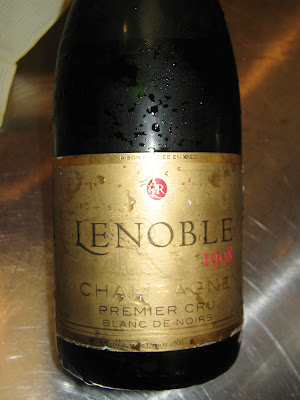
We started the cheese and fruit course with a 1998 Domaine A.R. Lenoble Blanc de Noirs. With all due respect to Chardonnay, my favorite sparklers come from the red grapes. And I hope that this selection meets with Samantha Dugan's approval, given my usual routine of Prosecco and Cava. This bubbly had nice notes of yeast and toast with just a touch of dried apricot aroma. Good acidity and tiny bubbles, a well-constructed Champagne all around. I particularly enjoyed it with the Comté and Cranberry Wensleydale.

Oh yes, that's some capicola in the background. Love the cured pig cheeks and jowls. There's also a tumbler of Kentucky whiskey back there, but I'm saving the spirits for another post.

The first course was an unbelievably smooth cauliflower soup made with vegetable stock and topped with truffle oil. Rich and savory, and Mike did a great job of coaxing maximum flavor out of the humble vegetable. I did have to admit that the last time I had cauliflower soup, my grandfather heated it up on the engine block somewhere in northeastern California during a road trip.

He paired this course with an Amontillado that I neglected to photograph or jot down, but it had a deep and meaty beef broth profile, and did not overwhelm the soup. In fact, it amplified the flavors and went particularly well with the truffle oil.

Have you ever seen an Alsatian magnum? I hadn't before last night. It is freakishly tall and messes with your sense of proportion and depth perception. This bottle is 48cm/19 inches tall, and carrying it by the neck feels like you're swinging a baseball bat. It is a bottle format that doesn't fit in anything. Back at the house, it won't even go under the cabinets. For storage purposes you have to get creative, sliding it in sideways or diagonally.

That being said, this 1998 Trimbach Pinot Gris Reserve was out of this world. The winery was established in Alsace in 1626, and I got an instant craving for choucroute garnie. It's always fascinating to see what happens when a wine region is in a transitional area between two countries and two different wine traditions. The wine has turned a dark golden color but the mild peach aromas and flavors have survived. Dry with a round mouthfeel, and any acidity has disappeared by now. Just a little hint of petrol and minerals.

The dish served with the Pinot Gris was a complete surprise to me: fish korma. I love Indian food, but that's a bad way to explain it. If you say you love American cuisine, are you talking about Cajun jambalaya, Maine lobsters, Hawaiian poi, or fried chicken? Korma comes from the Mughal years and is associated with northern India, Pakistan, and Bangladesh. And of course, the Indian seafood traditions take advantage of the subcontinent's long coastlines.

The biggest compliment I can say about this dish is that The Roommate loved it. She enjoys Indian food but can shy away from anything too hot. This was heavily spiced, but not hot, a distinction that a lot of people miss. The fish was tender and flaky, and the sauce was just thick enough to scrape up with a fork and slide on the fish. The Pinot Gris was a nice match.

1995 S. Anderson Cabernet Sauvignon. Napa, Stags Leap. Great Bordeaux style wine with classic Napa character. Mild and soft at this point, but not too delicate. It maintains a full flavor with dark plum and a little whiff of bell pepper.

The whole evening was like this: Mike bringing various treasures out of the cellar. I can remember going to some wine and cheese parties with my parents and Mike 15 years ago, and someone would pull out a bottle and everyone would ooh and aah. At the time, I really didn't understand what constituted a great wine, and didn't know all the names and grapes and regions. This time, I could recognize the bottles from across the room and already start drooling in anticipation.

(Take note of the dinner table that has panels from wooden wine cases under glass. A few bear the numbers scrawled on there by the late John Grisanti.)

For the main course, a savory fall dish: braised short ribs over polenta with green beans and brown mushrooms roasted in red wine. We had been smelling this dish throughout the entire evening and it was great to finally tuck into it.

The meat was tender and fell apart, and the polenta had the perfect consistency--not too thick or thin, just standing up properly on the plate. I will confess that I did not finish this, because I started waxing poetic about all sorts of things and neglected my food. But it was wonderful and something that I hope to recreate soon.

The pièce de résistance, and the final surprise of the evening that almost brought me to tears: a 1976 Faiveley Morey-Saint-Denis. I've always wanted to try a wine from the year of my birth, and over the years Mike has been on the lookout for one. We don't really have a lot of auctions or old bottles for sale in this area, so such an acquisition involves private collections or travel. I don't know how or where Mike got this, but it was very special to me.

I opened it without any cork issues, but at first I was a little concerned. A garnet color, the nose hadn't opened up yet... I was fearing oxidation. Mike encouraged me to let it wake up, and in about fifteen minutes the wine showed its true profile. Complex and slightly tart with dried figs and bright red cherry, smooth and a really long finish. I took a photo of my parents together with the wine, and just relished in the experience of touching the past, wondering where that bottle had been during its 35 year journey from the vineyard to my lips.

Over the years, my father and Mike and I have eaten hot dogs and Cokes, BBQ and beer, and some of the highest cuisine and finest wines on the planet. Yet the jokes and stories and friendship have remained the same, and with luck will continue well into the future. Thanks to everyone who made this special night happen, and I hope it's not too long before we pull some more corks together in fellowship.


P.S. Blogger now presents photos in a convenient slideshow. Click on any photo for a bigger version, and you can go through all the pictures for that post.

22 September 2010

Forefront Wines

The line of Forefront Wines is made by the Andrus family from a number of regions throughout the west coast. Famous for their Pine Ridge winery in Napa, the Forefront wines explore some interesting blends. (Correction 02/15/11: The Forefront brand was produced by Pine Ridge Vineyards to pay tribute to the Andrus family; the original founders. The Andrus family did not have a hand in the wine making or brand production.)

2008 Forefront Cabernet Sauvignon
$24, 14.1% abv
The vineyard makeup is 84% Napa, 9% San Luis Obispo, 7% Lake Counties, while the grape proportions are 78% Cabernet Sauvignon, 11% Merlot, 5% Syrah, 3% Petit Verdot, 2% Malbec, 1% Cabernet Franc.

It has nice blackberry aromas and flavors, though not overly jammy or fruit forward. Peppery undertone with a touch of chocolate, medium tannins, and a long black cherry finish. It is a rich and easy drinking Cabernet. I paired it with a steak (briefly air-dried in the freezer) and assorted vegetables, where it performed admirably.

The next day it was time to sample the 2009 Forefront Pinot Noir (not pictured on its own).
51% Santa Barbara, 41% San Luis Obispo, 8% Monterey Counties, all Pinot Noir.
$24, 14.5% abv.

At cellar temperature, it's soft with overripe strawberry aromas and flavors, short finish. As it warms, it becomes more tart and the tannins are more prevalent. There's a touch of brambles about it, but it's not heavy and provides a nice herbal undertone. I served it with grilled lamb.

I chose to serve the two white wines together with some seafood: fried grouper and stuffed quahog clams.

2009 Forefront Sauvignon Blanc
50% Sonoma, 32% Napa, 18% Mendocino, pure Sauvignon Blanc
$16, 13.5% abv

Tart with touches of grass and grapefruit, similar to a New Zealand style but not as acidic. Crisp and refreshing, and best at colder temperatures. Excellent match for the seafood, and better than hitting everything with a squeeze of lemon.

2009 Forefront Pinot Gris
Willamette Valley, Oregon
95% Pinot Gris, 5% Gewürztraminer
$16, 14.1% abv

I think this was my favorite out of all four wines. Smooth and well balanced, with a little green apple aroma and floral elements. Nice minerality and a short, clean finish. Great blend of round and tart, dry but just a hint of honey sweetness in the back. It was a lovely contemplative wine to enjoy both during and after dinner.


Note: These wines were received as samples from Forefront.

05 March 2010

2007 Wine by Joe Pinot Gris

A lot of foodbloggers are attempting to do a better job of eating fresh foods and leftovers before they go bad, getting to the frozen Ziploc containers before the contents become unidentifiable, and deliberately reaching into the back of the pantry to clean out those old cans, boxes, and bags. For instance, I recently had a late night snack made from two gifts that had been rattling around for far too long: TUC paprika crackers from Germany and a tin of sardines in mustard sauce. Sardines are kind of trendy these days (pretty healthy, lower in mercury than tuna, etc.), and mashed up with the mustard sauce in the tin the spread was great on the spicy, salty, buttery crackers that taste like Ritz plus paprika. Granted, you don't often encounter a spinal column wrapped in fish skin sticking out of your cracker spread, but hey, it's a good source of calcium.

In a similar desire to knock out some old stuff, I grabbed another fistful of angel hair pasta (why do I have so much of this?) and a can of minced clams. I figured it was a good excuse to make a simple spaghetti alla vongole. Yes, I could have read my Marcella Hazan books, translated a recipe from La Cucina Italiana, or even utilized Gwenyth Paltrow's recipe because when it comes to authentic Italian cuisine, you really want to trust a Hollywood actress who isn't Italian. But I mostly freestyled it with fresh garlic, red pepper flakes (also from the pantry!) and a good bit of olive oil.

The end result was good, but obviously fresh clams would make for a better and more attractive dish. I don't mind cleaning and tending to live clams for a day or two, but for some reason I have a hard time convincing my friends that they're worth eating. Also, next time I'll use regular spaghetti or linguine; angel hair just makes a mess here.

Anyway, I paired this dish with the 2007 Wine by Joe Pinot Gris from Oregon, $14, 13.5% abv. Light pear aroma with floral notes, smooth and round with a rich pear flavor. Dry but surprisingly fruit-forward and medium-bodied, with a short finish and low acidity. I might have been a little aggressive with the garlic and red pepper flakes, but this wine held up admirably. A few years ago after trying a few dozen Pinot Grigios I got tired of the whole style, thinking of it as boring and flavorless. But recent experience with amazing Pinot Gris from the Pacific Northwest and New Zealand is leading me to reconsider this grape. It doesn't have to be watery and thin, it can be rich yet delicate and have a lot of character.

Tip of the hat here to Joe from Suburban Wino. He didn't recommend it, but with a name like "Wine by Joe" I had to mention him. Joe has suggested some great blogs for WITS and has been helpful in promoting this blog via Twitter and Facebook. Thanks Joe, and I hope you get to try this wine at some point.

03 March 2010

2007 Nobilo Pinot Gris

I love keeping a couple of light white wines around, and will occasionally move one to the fridge if I think it might go well with dinner. Recently I dug out the 2007 Nobilo Pinot Gris from Marlborough. $15, 14% abv. Light citrus aroma with some of that classic New Zealand grapefruit peel. Grapefruit and melon flavors follow through, with a creamy finish. Not too tart, very food friendly.

I served it with a roasted chicken thigh and a little angel hair pasta tossed with sautéed mushrooms, cherry tomatoes, and spinach. Pretty easy to make--start with the mushrooms, eventually add the other vegetables. Deglaze with a bit of the wine, crush the tomatoes, and then add the barely-cooked angel hair to the skillet with a half cup or so of the starchy pasta water. Mix thoroughly with tongs, add grated hard cheese, and enjoy. Although it was cold and rainy outside a meal like this helps you look forward to spring.

UPDATE: This post originally identified this wine as a Sauvignon Blanc. Thanks to commenter Anonymous for the correction!

26 October 2009

Wines From Down Under Part 1

This week I'll be looking at a series of wines from Australia and New Zealand. 10 wines from a few different regions, tasted on their own, with food, and with a handful of friends. There were several things I liked about these wines as a group:

1) All were enclosed with screwcaps. Not only does this make it easier for your friendly neighborhood wineblogger to evaluate ten in a row, but these are all casual, drink-now wines in the $20-30 range that aren't intended for long term cellaring.

2) All were balanced alcohol-wise, 12-14.5% abv. Even those on the higher end were not hot or overpowering; no 16% monsters here.

3) All but one had fairly traditional labels; while some featured animals, it was not done in the "line of koalas dancing the Macarena" style. I'm happy with all sorts of label design, but since so many Australia/New Zealand wines went with goofy labels to distinguish themselves from the other wines in the market, you're now seeing more "serious" labels emerging to differentiate themselves from the surrounding kangaroos and penguins. For instance, while I enjoyed the Ass Kisser Shiraz a few months ago, there's no way I'd serve that at a wedding reception or business dinner. There's a time and place for everything.

To begin with, we'll start with the two from New Zealand.

Maude wines are made on the southern end of the South Island of New Zealand, a region called Otago. I tasted both of the wines made by this small family operation, and was impressed with both.

2008 Maude Pinot Gris, 14% abv.
Medium sweet, full-bodied. Don't think about the light European versions, this Pinot Gris has firm, fruit-forward flavors of peach and apricot. I would recommend this with a good roast chicken with lots of rosemary.

2008 Maude Pinot Noir, 13.5% abv.
Classic strawberry aromas, but with a touch of spice underneath. The body and feel of this wine was most impressive: light and smooth, mild but not weak, and wonderful for slow, methodical sipping. This was a huge hit among the various tasters I'd assembled, some of whom hadn't had a proper New Zealand Pinot Noir before. Highly recommended. This one is so nice that it seems a shame to pair it with food, but I'd suggest grilled salmon and soft white cheeses like brie. That's not to say that it doesn't go well with food; just some wines are so wonderfully delicious on their own you don't want them to have to share the spotlight.

In accordance with the new regulations imposed by the Federal Trade Commission, I publicly disclose that these wines were received as samples from The Country Vintner. No additional gifts or compensation were provided.

03 July 2009

Blackened Grouper and an Oregon Pinot Gris

Yankees (a group that, due to my Southern upbringing, includes everyone north of Kentucky and west of Arkansas) typically don't understand that there are lots of different kinds of Southern cooking. For instance, I love Louisiana cuisine, but I've never been there, and it's not a strong part of my local culinary tradition. I appreciate the difference between Cajun and Creole even if I don't often cook much of either style. But I got a hankerin'* the other day for blackened fish...

I took things back to basics with the original Paul Prudhomme recipe. I consulted the 1982 New York Times article, as this was faster than digging up the family's first edition of Prudhomme's cookbook. Again, I feel the need to clarify for the sake of Yankee readers: blackened ain't burnt, it's merely seared at high heat.

The cooking method is pretty simple: heat a cast iron skillet to hellish temperatures, slop the filets through some melted butter, coat with spice mix, and throw in the skillet. Flip once, pull out before it's burned. If you're using filets that are thicker in the middle (like the grouper I had), you may want to transfer them to a warming sheet in the oven for ten minutes or so. For the sides I prepared some speckled butter beans and turnip greens, the latter of which benefitted from some pepper vinegar.

This is the kind of meal that would traditionally be paired with sweet tea or a really cold beer, but I felt it was appropriate to slingshot over to the other end of the country and pick an Oregon white. The 2007 King Estate Signature Pinot Gris is $17, 13% abv. Overall profile of Golden Delicious apples, with hints of lime and a full body. Stronger acidity than one would expect from a Pinot Gris. Wines like this are making me want to move to Oregon, home of a few of my ancestors.

The crisp acidity of the wine matched up beautifully with the buttery flavors of the wine and fish, and the Pinot Gris was strong enough to stand up to the peppers in the blackening spice and the vinegar. Oregon Pinot Gris might not work with every N'Awlins recipe, but I was quite happy with the experiment.

*hankerin': abbreviation of HANK•er•ing, colloquial term for craving or longing from the Dutch hankeren. My own favorite usage is related to someone or something that inspires such a craving. For instance, reading Peter Mayle's A Year In Provence could trigger a desire for roast lamb. I might then remark, "That book done flung a hankerin' on me for some gigot d'agneau."

22 May 2009

2007 Cooper Mountain Pinot Gris

When the market is full of a lot of big, buttery, and full-fruit California Chardonnays, it's nice to step back and try something with some restraint and delicacy. Oregon is well known for its great small-production Pinot Noir, but don't forget about their whites. For example, I got to try the 2007 Cooper Mountain Pinot Gris Reserve from the Wilammette Valley of Northwest Oregon. 13.5% abv, and an absolute steal at $15. It's Certified Organic and Biodynamic, and was the first winery in the Pacific Northwest to grow all of its grapes under those certifications.

Let's also celebrate the fact that as of July 1, Tennessee residents will be able to order this wine and many others via the Internet! Hallelujah!

Light body, mineral flavors and a touch of wet stone aroma. Nose of violets and other florals, and a mild fruit flavor that includes a touch of lemon on the finish. Excellent all-around balance as regards flavor and acidity. Stainless steel fermentation lets you focus on the wine and its natural flavors instead of oak, which would overwhelm a wine like this.

I've really been craving mussels recently, but I've had bad luck lately trying to get them at my local Costco. There are some other sources around town, but $10 for a 5 lb. bag of good quality mussels from Prince Edward Island is a deal that can't be beat. This past Friday I was successful in my quest! In scrubbing and scrutinizing the mussels before dinner, I only had to toss out three for broken shells, and the few that didn't open might not have cooked long enough.

I turned to Anthony Bourdain's Les Halles Cookbook, which features five classic preparations for mussels. I picked the one that seemed best for a hot day: moules à la portugaise, which is flavored by cilantro, onion, garlic, and chorizo. Serve with some nice crusty bread and a few ears of roasted corn with chile-lime butter, and you're in business. I used fresh, raw chorizo here, which provided great spice and savory flavors.