Showing posts with label alsace. Show all posts

04 September 2014

August Alsatian Pinot Blanc

I've written surprisingly few articles about Pinot Blanc over the years, though I love it more and more as time goes on. It's often confused as a variant spelling of Pinot Grigio, and while both grapes are light-skinned mutations of Pinot Noir, Blanc/Bianco is golden and Gris/Grigio is pink.

Gris is everywhere in varying levels of quality, while Blanc is not as widely cultivated but if you find a bottle, it is likely to be of the middle to higher tiers. I've had great Pinot Blanc from Oregon's cool climate, but these three come from Alsace. A delightful grape from one of my favorite regions is a great combination.

As summer winds down, these wines are absolutely wonderful with picnic fare and quiet weekend lunches on the patio.

2012 Louis Sipp Pinot Blanc
Alsace AOC
100% Pinot Blanc
$14, 12.5% abv.

Gentle ripe apple aromas with a dry flavor and a gentle mouthfeel. Balanced acidity, just beautiful.

2012 Emile Beyer Pinot Blanc Tradition
Alsace AOC
100% Pinot Blanc
$17, 13% abv.

Bartlett pear, just a touch of sweetness. Low acidity and a round mouthfeel. Fruit forward. I enjoyed it with a ham sandwich and potato salad, which, going by ingredients, is fairly authentic for the region.

2011 Maison Keuntz-Bas Pinot Blanc Tradition
Alsace AOC
100% Pinot Blanc
$16, 12.5% abv.

Light and mineral with a tiny hint of citrus peel. Medium acidity and a delicate finish. Highly recommended if, like me, you're a fan of the restrained style.

Note: These wines were provided as samples for review.

25 August 2014

Trio of August Rieslings

Recently I joined an online Twitter tasting focused on Riesling from three different countries: Germany, France, and Austria. During the tasting I pointed out that it was nice to be living in a time when people from all three countries could sit down and enjoy wine together in peace. Lots of people applauded and talked about Riesling being the wine that brings everyone together, but the historian in me notes that these regions were still drinking the same wine while fighting with each other over the past thousand years.

This has a lot to do with my curious fascination with the Thirty Years' War, a Catholic vs. Protestant conflict that ripped apart Europe for three decades in the 17th century and resulted in the deaths of 8 million people. It doesn't get talked about a lot here in the United States because it is not well understood and doesn't have a direct influence on the founding of our country. In Germany alone, a third of the population died. It throws a lot of modern conflicts into perspective. For anyone keeping score, France and the regions now known as Germany were on the Protestant side while Austria was on the Catholic side. Obviously allegiances changed over the centuries, but I am glad that now they merely argue about EU regulations that define bent and straight bananas.

2011 Weingut Brandl Riesling Heiligenstein Erste Waches
Kamptal, Austria
100% Riesling
$20, 14% abv.

Light pear and quince aromas. Just a touch of sweetness. Highly mineral. Austria is best known for Grüner Veltliner but some amazing Rieslings are made there as well, and this is a great bargain. Highly recommended.

2011 Erbach Marcobrunn Schloss Schönborn Riesling Kabinett
Rheingau, Germany
100% Riesling
$24, 9.5% abv.

This one opens up with a scent of green apples and a touch of lemon. It is the sweetest of the three and while an excellent example of the kind of sweet, low-alcohol German Riesling, I just happened to not be in the mood for it that evening. Later in the year with some Thai food, this would be a perfect pairing.

2010 Domaine Paul Blanck Schlossburg Riesling
Alsace, France
100% Riesling
$34, 13% abv.

Enchanting nose of golden delicious apple and ginger with a hint of flowers in the background. Light and balanced with just the right amount of acidity, and my favorite of the group. Serve with cheese and crackers on a hot summer day while watching a movie and avoiding the sweltering humidity of Memphis. As I type these words, it is 38ºC/100ºF here in the River City and I, like many of my fellow citizens, am ready for fall to arrive.

Note: These wines were provided as samples for review.

07 July 2014

Crémant d'Alsace

There's really no wrong time of year to drink Crémant d'Alsace. It's tasty and affordable, so I often recommend it for weddings or winter holiday parties where you're serving a large group. Here in the summer, it shines with BBQ and picnic foods. Bubbles never have to be saved for a special occasion, and if you've never experienced the joy of fried chicken and sparkling wine on a breezy summer afternoon, you're really missing out.

All four of these are dry and tart, and I was glad to be able to sample two rosés and two blancs.

NV Dopff & Irion Rosé Brut
Alsace, France
100% Pinot Noir
$20, 12% abv.

Think of this as raspberry lemonade with little nutty undertones and large bubbles. Outstanding with a pressed Cuban sandwich but it would pair well with any platter of olives and cured meats.

NV Charles Baur Rosé Brut
Alsace, France
100% Pinot Noir
$20, 12.5% abv.

This bottle presents a dominant profile of crisp ripe strawberry. The tart acidity zips away with a quick finish. On the picnic front, you'll find it fun to taste this with creamy sides like deviled eggs and potato salad where it provides a nice contrast.

NV Lucien Albrecht Brut Blanc de Blancs
Alsace, France
80% Pinot Auxerrois, 10% Pinot Blanc, & 10% Chardonnay
$20, 12% abv.

Lean and mineral with light notes of green apple. A classic that I highly recommend for sipping while mingling in a crowd.

NV Gustave Lorentz Brut
Alsace, France
Proprietary Blend of Chardonnay, Pinot Blanc, and Pinot Noir
$17, 12% abv.

I found this to be the most tart of the group, with a shot of lemony acidity and a milder pear flavors underneath. Take a wheel of brie, top it with honey and walnuts, and bake until runny. Pour the wine, grab a baguette, and you can waste away a delicious hour or two with friends.

Note: These wines were received as samples.

18 April 2014

A German Grape Takes a Tour of Europe

I've always been interested in studying transitional geographical regions--places that have changed hands over the centuries and today contain elements of the various cultures that have occupied the physical area. Granted, a lot of that involved war, religious persecution, or other horrible things, but they remind us that national borders are not firm laws set down from time immemorial, but often redrawn when one side has more power, and endure when the other side doesn't feel like fighting back for the dozenth time.

I've written a lot about Alsace and how I feel it is its own unique European region nestled between Germany and France, hence the reason for using the flag of Alsace rather than the tricolore. In today's post, I'll extend the same courtesy to the Alto Adige region of Italy, an autonomous state that borders Austria and Switzerland. I make these decisions not for political reasons but more for cultural ones--Trentino-Alto Adige (or Südtirol) was part of the Austro-Hungarian Empire until after WWI, and German is still spoken there. In both cases, you've got German-speaking folks living on the borders of other countries, growing their grapes for a long, long time.

Although this particular quartet of Gewürztraminer presents a fun orthographical dichotomy: Italy uses the umlaut, France doesn't. I'll respect the choices for the names of the wines, but since the grape is more commonly spelled with the umlaut, I'll use that for the varietal name... So ist das Leben.

2011 Hugel Gewurztraminer
Alsace, France
100% Gewürztraminer
$23, 14% abv.

This bottle showed up sweet and spicy, round with low acidity. Really a classic Gewürztraminer and one that would fall in well with both German and New World versions.

2008 Domaines Schlumberger Les Princes Abbes Gewurztraminer
Alsace, France
100% Gewürztraminer
$28, 13% abv.

I found the Schlumberger similar to the above, but more earthy and with a honey element. Obviously it has aged quite well without becoming cloying. There's a lot of depth here as well as structured acidity, which almost pushes this into dessert wine territory. A great bargain for a well-aged wine.

2013 Elena Walch Selezione Gewürztraminer
Alto Adige, Italy
100% Gewürztraminer
$20, 14.5% abv.

It showed great apricot and floral notes, almost perfume-like, but in contrast to the Alsatian wines this was quite dry with low acidity and a round mouthfeel. Good minerality. Excellent wine made in the Austrian style.

2012 Elena Walch Kastelaz Gewürztraminer
Alto Adige, Italy
100% Gewürztraminer
$32, 14.5% abv.

Coming to the end of the quartet, I've got to say that Alto Adige won me over, and this particular bottle was my favorite of the four. It has many of the attributes of the former Elena Walch wine but with a luscious honeysuckle aroma that captures my heart every time. However, this bottle had better acidity, firmer body, making it a more serious wine all around. Serve this with roast quail and a winter vegetable purée and you've got a magical combination during this lingering cold weather.

* * *

Thanks for reading, and remember that you can still follow GrapeCollective.com and register to win two Riedel wine glasses:

a Rafflecopter giveaway


Note: These wines were provided as samples for review.

18 October 2013

Riesling Trio Tour

There are cycles in the life of a wine lover, and the Riesling cycle is not a Wagner opera but rather the fact that so many of us start out with Rieslings early on. They're sweet, fruity, low in alcohol, and fairly inexpensive. The tall, elegant bottles of Riesling from Hogue of Washington and V. Sattui of California were two of the first wines that I could identify by name and sight as opposed to just "random bottle of fermented grape juice". Bear in mind that we're talking about the mid-90s here, long before I started to seriously study the subject.

I eventually left behind those west coast Rieslings (as well as the various German bottles I chose based solely on price). I lost my sweet tooth, and got interested in more dry white wines or even aged white Burgundy. Years later, I circled back around to Riesling when I got the chance to try serious examples from Germany and beyond.

This particular triplet of samples represents three classic Riesling regions: Germany, Austria, and Alsace in Eastern France.

2011 Schlossgut Johannes Selbach Riesling Dry
Mosel, Germany
100% Riesling
$15, 13% abv.

Pleasantly dry with a touch of lemons. It is a great casual sipper, and as the piscine label indicates, it's a great pairing for gentle seafood dishes. A good bargain, and also an excellent introduction to the fact that Riesling does not have to be sweet but can focus on other facets as well.

2011 Domaine Ehrhart Riesling Vieilles Vignes
Wettolsheim, Alsace
100% Riesling
$16, 12.6% abv.

I'm so enamored of Alsatian wines these days, and this one did not disappoint. It opens up with Granny Smith apples on the nose. On the palate it is a little sweet with lots of bright acidity. Bring on the sausage, beans, and cabbage and enjoy the fall flavors.

2011 Salomon Undhof Steiner Kögl Riesling Erste Lage ÖTW
Kremstal, Austria
100% Riesling
$30, 13.5% abv.

Austria is better known for Grüner Veltliner but they can also make elegant Riesling. This one is crisp and austere with excellent minerality and those great wet stone notes on top. It is gentle and well balanced with lots of subtle elements that show up as it warms.

Note: These wines were provided as samples for review.

05 July 2013

June Rieslings of Alsace

While I've sung a lot of praises for Alsatian Pinot Gris in the past year, it would be wrong to deny the German grape's influence in this hybrid region of France and Germany. This online tasting (through Twitter) provided us with an opportunity to sample four recent bottles of Riesling from Alsace.

2011 Meyer-Fonné Riesling Reserve
Alsace, France
$15, 12% abv.

The family behind the Domaine came to Katzenthal from Switzerland in 1732, but the winery is a more recent operation. The body is light and mild, while the flavors are dry pear with crisp acidity.

2011 Domaine Ostertag Riesling
Alsace, France
$24, 13% abv.

The name of this winery means "Easter Day" in the local dialect. The wine has a nose of ild peach with low acidity, round body, and a gentle finish. Quite an elegant summer sipper.

2010 Trimbach Riesling
Alsace, France
$15, 12.5% abv.

The venerable Trimbach estate has been around since 1626 though the center of operations has moved around due to the ravages of war over the centuries. This little Riesling has just a touch of citrus but lots of minerality. The most austere and most Germanic of the tasting.

2011 Domaine Weinbach Cuvée Theo Riesling
Alsace, France
$25, 13.5% abv.

This Domaine was established in 1612 by Capuchin monks (the same order whose distinctive cloaks gave us the word cappuccino). I found this Riesling to be the most mysterious of the group, with dark floral aromas and a very mild body. It is one that did not give up its profile easily when chilled, but opened up over time and with warming to reveal gentle white fruit flavors and just a hint of acidity.

Note: These wines were provided as samples.

19 April 2013

April Alsace

My personal wine preferences shift over time. When it comes to white wine, I started out liking them sweet, then I preferred a lot of oak, and then I was all about heavy citrus, and now I'm enjoying the mild, mineral, and surprisingly complex wines of Alsace. Early in my wine education I'd found them flat and boring, but now there's so much more that I can appreciate when I open those tall, slender bottles.

I reviewed two of these Alsatian whites in January for the Super Bowl, and they remain great. But I was excited to try the third from a producer who is new to me. I hope to explore many more wines from this fascinating region in the future.

Domaine Paul Blanck & Fils goes back to 1610 when the family's Austrian ancestor purchased his first vineyard in Alsace. They have a broad product line, though this one represents the introductory level with a convenient screwcap.

2011 Blanck Pinot Blanc
Kientzheim/Riquewihr, Alsace
100% Pinot Blanc
$14, 12.5% abv.

This is probably the most German-style wine I've had from Alsace. The nose was a little musky with a hint of petrol, and might easily be mistaken for a Riesling in a blind tasting. The style is medium dry with a round mouthfeel and the darker flavors continue on the palate. I had the pleasure of serving this with Easter lunch, where I found that it was incredible with ham and deviled eggs.

Note: These wines were received as samples.

20 March 2013

March Alsace

The past year has been blessed by a veritable pipeline of fermented grape juice from the verdant fields of Alsace to my own humble abode here in the mid-South. I've enjoyed dry and sweet, still and bubbly, white and pink... And in so sampling, I've found great joy in the few grapes grown in this region between France and Germany. Likewise, the wines have been good pairings for hearty and seasonally appropriate dishes of sausages and baked beans and thick, rustic bread.

2011 Domaine Zind-Humbrecht Pinot Gris
Alsace AOC
100% Pinot Gris
Biodynamic
$20, 14% abv.

Half of this family has been making wine since the 17th century Thirty Years' War, a Protestant-Catholic conflict that involved the great Swedish king Gustavus Adolphus and the Hapsburg General Albrecht Wenzel Eusebius von Wallenstein, who had his horoscope written by the brilliant astronomer Johannes Kepler, and well, I'm getting too deep into the history of northern European science and war following the Reformation. This wine is lightly sweet with rich overripe peach flavors and aromas and a tart acidity. Long finish. A perfect match for mild seafood with steamed greens.

2011 Willm Pinot Gris Réserve
Alsace AOC
100% Pinot Gris
$12, 12.8% abv.

In an interesting note, the house of Willm began exporting their light white wines to the US shortly after Prohibition was lifted, and yet had that partnership disrupted by the events of World War II. This particular bottle has a deep amber color with mild pear aromas and flavors and a gentle, lightly sweet finish. No acidity to speak of, leading to a soft and relaxing Pinot Gris. Quite enjoyable and good with a ham and Swiss sandwich topped with stone-ground mustard.

2011 Pierre Sparr Pinot Gris
Alsace AOC
100% Pinot Gris
$15, 13% abv.

An important Alsace producer since 1680, though the vineyards were completely destroyed during WWII. However, I've found that they have done an exceptional job of rebuilding since then. This Pinot Gris has a touch of honey and nectar, followed but a clean, smooth, and round body. Low acidity and a long finish. Perfect for trout served with a wilted arugula salad.

Note: These wines were received as samples.

02 March 2013

February Cremant d'Alsace

I think I've had more Alsatian wine in the past two years than I've had in my entire life, and that is a good thing. While I'd sampled some in the past, I mostly thought of them as pale versions of German Rieslings and not as important as French Burgundies.

With age and experience, you learn to appreciate the subtleties in certain regions. Alsace famously sits in a region that has variously been part of France or Germany or various factions of the Holy Roman Empire, but when we drill down to terroir we're not talking about politics or language but rather the fact that this long and thin region sits between the Vosges mountains and the Rhine river.

Thanks to longtime family friend Mike Whitfield, I got to try some spectacular Alsatian wines when he cooked dinner for my family on my 35th birthday. I started taking the region and its wines far more seriously at that point, and since then I've been lucky to sample bottles from the great producers of Alsace. Lately I've gotten a lot of requests for advice on wedding wines. I keep recommending Cremant d'Alsace as the perfect combination of elegance, class, and affordability for a big gathering. Plus, if you're a wine lover, it's something that you'll actually enjoy alongside your guests. Let's take a look at two examples that I tried in February...

NV Clément Klur Crémant d'Alsace Brut
Katzenthal, Alsace
Pinot Blanc and Auxerrois
$19, 12% abv.

"A version of the traditional crémant, but without added brimstone." They're talking about the fact that there are no added sulfites, but I love this translation. Lovely notes of quince with a crisp, medium acidic flavor and a bright finish. Try this with a dinner of blackened catfish because it will stand up well to the spices and strong flavors in the dish.

NV Pierre Sparr Crémant d'Alsace Brut Rosé
Haut-Rhin, Alsace
100% Pinot Noir
$16, 12% abv.

Alsace doesn't grow a lot of Pinot Noir, but what is grown is light and mostly used for rosé or sparkling wines. This one has great aromas of wild strawberries and watermelon with a crisp finish. Just a touch of fruit on the palate, and firm acidity. I served this with a bunch of appetizers where the salty snacks brought out the best in the wine.

One interesting side note to these bottles... I noticed a tiny and unfamiliar logo on the bottle of the Klur. Because that winery does organic and biodynamic wine production, and because the incomplete gold stamping was vague, I thought that it was either a map of the Earth or a map of the Moon. I took a photo close up with the macro settings on the camera and discovered that it was a picture of a pregnant woman drinking with a bar through the circle.

Later, I found a Washington Post article about the labeling law on certain French products. Not being female and not ever having been pregnant, I was not aware of this symbol, but will keep it in mind along with all of the various Kosher and recyclable symbols for future reference.

Note: These wines were received as samples.

30 January 2013

Super Bowl & Alsatian Pinot Blanc

I get a lot of press releases and wine samples asking me to endorse a certain holiday or event, but one that I agreed with wholeheartedly was the pairing of Alsatian white wines with the Super Bowl. Alsace is a part of France that is all about sausage, bacon, beans, and sauerkraut. Not only are these foods wonderful during the winter with the right wine, but you're likely to encounter such ingredients at any reputable Super Bowl party spread and I think you'll find that Alsatian wines (still and sparkling) go great with them. I tasted some of these with a traditional party dish incorporating tiny Frankfurters ("Li'l Smokies") braised in BBQ sauce.

Some of these white wines might seem a little austere on first sip, but add a little pork fat and salt and suddenly you can taste all of the great layers designed by the traditional family winemakers of the region. And if you read the company tasting notes in the original French, you'll see pairing suggestions for salted meats and cheese and other goodies.

Before I go any further, I'm not a huge fan of American football, but due to my year spent working in Cleveland I always root for the Browns. And thus, despite no particular interest in the San Francisco 49ers, I have to cheer against the Baltimore Ravens. (Explanation here)

2011 Domaines Schlumberger Pinot Blanc Les Princes Abbés
Alsace, France
70% Auxerrois, 30% Pinot Blanc
$14, 12.5% abv.

Light and thin with a little green apple. Probably the true textbook Alsatian Pinot Blanc, with a mild body that allows for pleasant and gentle sipping over the afternoon.

2009 Trimbach Pinot Blanc
Alsace, France
80% Auxerrois, 20% Pinot Blanc
$14, 12.5% abv.

Light and creamy with just a touch of lemon on the finish. Low acidity with a round mouthfeel. While not sweet, it reminds me a lot of a lemon meringue pie. This one goes exceptionally well with potato chips, where the crunch and salt activate the palate.

2009 Cuvée Les Amours "Hugel" Pinot Blanc
Alsace, France
100% Pinot Blanc
$16, 12% abv.

Very mild and restrained, mineral and a little earthy, well-aged. Aromas of wet stone and just the tiniest hints of red apple peel. This is what I consider a perfect Alsatian white, a tremendous bargain, and I'm going to go on a mild rant here about art. If you give a chimpanzee a brush and some paint, he might make something interesting if you grab the canvas at an opportune moment. Otherwise, Bonzo is going to keep going until the substrate is covered completely with a dark smear of paint and potential angry simian flingings. What separates human art from animal art is the decision to stop when it is right. I could take a wine and keep making it fruitier, more acidic, higher in alcohol, hell, I could end up with a bracing cordial if I kept to it. But the judicious decision to stop at some point is what truly separates us from the animals. The Beatles didn't need fifth or sixth musicians. The Mona Lisa didn't need some cherubs around her quizzical gaze. My wine doesn't have to go crazy in every direction in every glass.

Wines from France aren't the only ones that do subtlety and restraint, and there are plenty from Gaul that violate those concepts. But often I'll encounter wines like this one that remind me why that one country is so highly regarded in the realm of wine writing and criticism.

Note: These wines were received as samples.

07 January 2013

Crémant d'Alsace from Lucien Albrecht

In 1425, Romanu Albrecht began winemaking in the Alsatian town of Thann. Later in 1698, Balthazar Albrecht moved the family and operation to Orschwir, which is still the center of operations today, led by the 18th-generation Jean Albrecht.

Lucien Albrecht is the current name of the winery, which makes a wide range of Alsatian still wines, but here I'm focusing on two Crémants d'Alsace, made in the méthode champenoise. Crémants throughout France are often a tasty and more affordable alternative to Champagne while still maintaining high quality. Additionally, the blended French-German heritage of the region means that the wines are well suited to dishes involving sausage and potatoes, or similar hearty fare that you'll find on Midwestern dinner tables here in the US. Yes, I love Crémant d'Alsace with bratwurst and sauerkraut and a cold potato salad. Way better than beer.

NV Lucien Albrecht Crémant d'Alsace
Brut Blanc de Blancs
80% Pinot Auxerrois, 10% Pinot Blanc, & 10% Chardonnay
Alsace, France
$20, 12% abv.

I've always found Crémant d'Alsace to have a lovely green apple profile, but this one gets a little more rounder feel from the Pinot Blanc and Chardonnay. Still crisp and slightly tart, but with a nice mellow finish. Touches of honey and lemon on the aftertaste, and a great all-purpose sparkling wine.

NV Lucien Albrecht Crémant d'Alsace
Brut Rosé
100% Pinot Noir
Alsace, France
$24, 12% abv.

The rosé is my favorite of the two, but then again, I'm a little biased towards sparkling Pinot Noir in general. I prefer the slightly deeper flavors and the strawberry notes. Medium sized bubbles with a dry flavor and lovely finish. The beautiful salmon color is wonderful to look at while you're dining, and I found that the leftovers the next day were just as good. Bring this one to a party, because it will be a crowd pleaser but if you love wine, you'll get to enjoy it as well. Strongly recommended.

Note: These wines were received as samples.

15 October 2012

Alsatian Quartet

I'm so happy that fall is here, with darker skies and cooler winds. I've come to figure out that folks in the north view hot summer days the way that we in the south view snow: when you don't get it very often, it's a lot of fun. When you have to deal with it for half of the year, it's terrible. I'll still be mowing my yard well into November, but I know I'll get excited if we get a light dusting of snow in January. When I was working in Cleveland, I discovered that a long winter means that dirty, nasty snow just piles up for months into mountains on the sides of roads and in parking lots, and in the spring, all the garbage is spread out again with the March melt. It really destroyed the magic and wonder of snow for me. Let's get back to happy topics.

All of these wines are 100% Pinot Gris from Alsace, and the publicist suggested mushroom pairings for each wine. This presented me with a conundrum, because I love mushrooms but Julia and The Roommate are not fans. Unable to just have a fungus-themed dinner party without them, I am including the suggested pairings at the end of each review, and I like all of them, but in some cases I had different ideas. My actual pairing for the tasting was a rerun of this memorable lunch, thinking that sandwiches with ham and pears and smoked cheddar (plus all the appetizers) would be perfect with these gentle Alsatian wines.

2011 Willm Pinot Gris Réserve
$13, 13% abv.

The first sentence on the back really encapsulates the French-German heritage of the region: "The Willm vineyard, combining Grand Cru Kirchberg de Barr and the well-known Clos Gaensbroennel, was planted in Barr in 1896". This one pours a dark golden color, making me suspect that those grapes have little flecks of red on the skins. This one is silky smooth and incredibly mild, with very low acidity. Very pleasant and a slow sipper. Suggested pairing: Steamed Halibut with Chanterelles and Shallots

2009 Schlumberger Pinot Gris Les Princes Abbés
$20, 13.5% abv.

Spicy quince and lemon curd notes on the nose. Bright acidity and a crisp, short finish. Definitely the most acidic and sharp of the selections. I'd match it with grilled shrimp, but... Suggested pairing: White Truffle Risotto with Freshly Grated Parmesan Cheese

2009 Meyer-Fonné Pinot Gris Réserve Particulière
$22, 13.5% abv.

Rich and mildly sweet with apple and pear flavors. Medium acidity and a body that's just begging for some slow cooked veal sausage and beans. Slight element of freshly cut grass on the nose. Suggested pairing: Pan-Seared Scallops with Morel Cream Sauce

2011 Domaine Mittnacht Frères Pinot Gris "Les Petits Grains"
$22, 14% abv.

The text on the front "...pour que tes yeux scintillent comme une étoile" translates as something like "for your eyes sparkle like stars", which is delightful. By far the driest and mildest of the group, this one has exceptional minerality and a slightly earthy edge. Dark aromas of wet stone and straw. Slightly bitter edge and a long finish. Highly recommended. Suggested pairing: Portobello Turkey Burgers with an Apricot Chutney.


Note: These wines were received as samples.

16 May 2012

Crémant d'Alsace

I've always wondered why Alsatian cuisine hasn't really caught on in America. Choucroute garnie combines sauerkraut, hot dogs, sausage, bacon, and potatoes. It's like the entire 1950s middle America on a plate. Add in the pizza-like tarte flambée and a love of fruit pies, it doesn't seem that exotic. German heartiness with French names and a few regional twists.

Wine follows the same pattern, with an emphasis on white wines but a different varietal makeup when it comes to the grapes. Alsatian wines are often great bargains, are easy to introduce to newcomers, and the sparkling wines--the Crémants that make up this post--are exceptional values and are highly recommended for parties and weddings and other festive occasions where you want to serve good bubbly to lots of people but don't want to spend $40-50 per bottle for traditional Champagne.

I'm particularly happy that I enjoyed all of these with meals, not as bottles opened at parties or other special occasions. The prices are reasonable and over four or five meals I never found something that didn't match well. Plus, a decent sparkling wine brings a touch of class to an otherwise simple dinner.

2008 Domaine Albert Mann Brut
60% Auxerrois, 40% Pinot Blanc
$20, 12.5% abv.
Lovely floral aroma with a lot of green apple character. Wonderful balanced acidity and a good mineral base. This one reminded me the most of white wines I've had from the region.

NV Pierre Sparr Brut Reserve
80% Pinot Blanc, 20% Pinot Noir
$16, 11.5% abv.
Crisp and refreshing. Pear aroma with medium acidity. A little lighter than the former wine, and an outstanding "Champagne replacement" if you're looking for something to serve at a big gathering.

NV Willm Brut Rosé
$17, 12% abv.
100% Pinot Noir
I was so excited to try this one, based on my love of dry rosé. It surprised me with a nose of crabapple! I don't think I've ever encountered that before. Bright acidity, dry but fruity, touch of toast on the nose and a lovely salmon color. This one is just a lot of fun, and I'd love to start off dinner parties with this wine for months to come.


Note: These wines were received as samples.

24 October 2011

3rd 35th Birthday Dinner

This is the third dinner party celebrating my birthday (after dinners 1 and 2) and the first in which I didn't lift a finger or bring a bottle. It also had by far the most impressive wine lineup of them all. The legendary Mike Whitfield and his wife Darlene invited my parents and me over for dinner. I brought along The Roommate, and when I saw the chalkboard menu outside the house wishing me a happy birthday and listing the courses, I knew I was in for a magical evening.
Mike and my father have been friends since the 60s, and in the 80s and 90s Mike was responsible for introducing me to good wine. Over the past few years he's given me the opportunity to try some incredible bottles, such as the tasting of Barolos from 1967-1996.

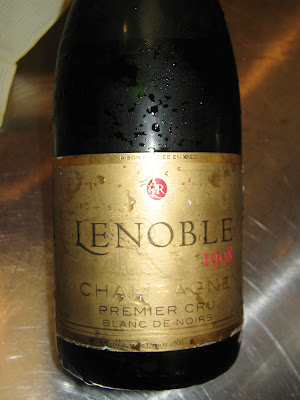
We started the cheese and fruit course with a 1998 Domaine A.R. Lenoble Blanc de Noirs. With all due respect to Chardonnay, my favorite sparklers come from the red grapes. And I hope that this selection meets with Samantha Dugan's approval, given my usual routine of Prosecco and Cava. This bubbly had nice notes of yeast and toast with just a touch of dried apricot aroma. Good acidity and tiny bubbles, a well-constructed Champagne all around. I particularly enjoyed it with the Comté and Cranberry Wensleydale.

Oh yes, that's some capicola in the background. Love the cured pig cheeks and jowls. There's also a tumbler of Kentucky whiskey back there, but I'm saving the spirits for another post.

The first course was an unbelievably smooth cauliflower soup made with vegetable stock and topped with truffle oil. Rich and savory, and Mike did a great job of coaxing maximum flavor out of the humble vegetable. I did have to admit that the last time I had cauliflower soup, my grandfather heated it up on the engine block somewhere in northeastern California during a road trip.

He paired this course with an Amontillado that I neglected to photograph or jot down, but it had a deep and meaty beef broth profile, and did not overwhelm the soup. In fact, it amplified the flavors and went particularly well with the truffle oil.

Have you ever seen an Alsatian magnum? I hadn't before last night. It is freakishly tall and messes with your sense of proportion and depth perception. This bottle is 48cm/19 inches tall, and carrying it by the neck feels like you're swinging a baseball bat. It is a bottle format that doesn't fit in anything. Back at the house, it won't even go under the cabinets. For storage purposes you have to get creative, sliding it in sideways or diagonally.

That being said, this 1998 Trimbach Pinot Gris Reserve was out of this world. The winery was established in Alsace in 1626, and I got an instant craving for choucroute garnie. It's always fascinating to see what happens when a wine region is in a transitional area between two countries and two different wine traditions. The wine has turned a dark golden color but the mild peach aromas and flavors have survived. Dry with a round mouthfeel, and any acidity has disappeared by now. Just a little hint of petrol and minerals.

The dish served with the Pinot Gris was a complete surprise to me: fish korma. I love Indian food, but that's a bad way to explain it. If you say you love American cuisine, are you talking about Cajun jambalaya, Maine lobsters, Hawaiian poi, or fried chicken? Korma comes from the Mughal years and is associated with northern India, Pakistan, and Bangladesh. And of course, the Indian seafood traditions take advantage of the subcontinent's long coastlines.

The biggest compliment I can say about this dish is that The Roommate loved it. She enjoys Indian food but can shy away from anything too hot. This was heavily spiced, but not hot, a distinction that a lot of people miss. The fish was tender and flaky, and the sauce was just thick enough to scrape up with a fork and slide on the fish. The Pinot Gris was a nice match.

1995 S. Anderson Cabernet Sauvignon. Napa, Stags Leap. Great Bordeaux style wine with classic Napa character. Mild and soft at this point, but not too delicate. It maintains a full flavor with dark plum and a little whiff of bell pepper.

The whole evening was like this: Mike bringing various treasures out of the cellar. I can remember going to some wine and cheese parties with my parents and Mike 15 years ago, and someone would pull out a bottle and everyone would ooh and aah. At the time, I really didn't understand what constituted a great wine, and didn't know all the names and grapes and regions. This time, I could recognize the bottles from across the room and already start drooling in anticipation.

(Take note of the dinner table that has panels from wooden wine cases under glass. A few bear the numbers scrawled on there by the late John Grisanti.)

For the main course, a savory fall dish: braised short ribs over polenta with green beans and brown mushrooms roasted in red wine. We had been smelling this dish throughout the entire evening and it was great to finally tuck into it.

The meat was tender and fell apart, and the polenta had the perfect consistency--not too thick or thin, just standing up properly on the plate. I will confess that I did not finish this, because I started waxing poetic about all sorts of things and neglected my food. But it was wonderful and something that I hope to recreate soon.

The pièce de résistance, and the final surprise of the evening that almost brought me to tears: a 1976 Faiveley Morey-Saint-Denis. I've always wanted to try a wine from the year of my birth, and over the years Mike has been on the lookout for one. We don't really have a lot of auctions or old bottles for sale in this area, so such an acquisition involves private collections or travel. I don't know how or where Mike got this, but it was very special to me.

I opened it without any cork issues, but at first I was a little concerned. A garnet color, the nose hadn't opened up yet... I was fearing oxidation. Mike encouraged me to let it wake up, and in about fifteen minutes the wine showed its true profile. Complex and slightly tart with dried figs and bright red cherry, smooth and a really long finish. I took a photo of my parents together with the wine, and just relished in the experience of touching the past, wondering where that bottle had been during its 35 year journey from the vineyard to my lips.

Over the years, my father and Mike and I have eaten hot dogs and Cokes, BBQ and beer, and some of the highest cuisine and finest wines on the planet. Yet the jokes and stories and friendship have remained the same, and with luck will continue well into the future. Thanks to everyone who made this special night happen, and I hope it's not too long before we pull some more corks together in fellowship.


P.S. Blogger now presents photos in a convenient slideshow. Click on any photo for a bigger version, and you can go through all the pictures for that post.