16 April 2006

Microgreens Photoessay

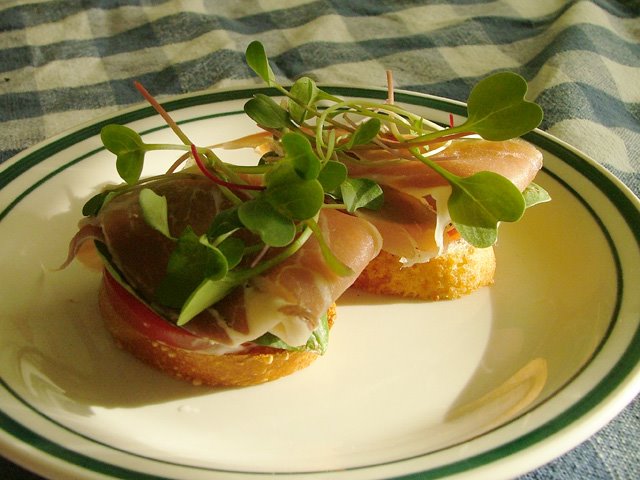
Earlier this month, I got a packet of seeds for growing microgreens, the little infant versions of tasty lettuce varieties. At right is what I made with the first harvest after twelve days of growth, sort of a gourmet appetizer version of the classic BLT sandwich.

On my personal site, I've posted my Photoessay on Microgreens. Enjoy!

15 April 2006

Correction

This review was originally published back in January. The original post is as follows, with the correction in bold.
Wine 9: 2003 Chateau de Mattes-Sabran. Corbières, Languedoc. South of France, probably a lot of Carignan and who knows what else. Soft beginning, some black cherry flavors. Slightly unbalanced, but a good little wine. Really begs for some food. $15. Correction: Syrah, Grenache, and Mourvedre. No Carignane in this wine. The owner of the winery contacted me with the correct information. Thanks!

11 April 2006

Tasting Notes for April 8, 2006

All of the wines listed below came from either Rudolf Müller or Dr. Thanisch, in the Mosel region of Germany. The winemaker for both vineyards is the elegant and charming Barbara Müller, who was there to answer questions. Even though I don't drink a lot of Riesling, I liked just about every wine at the tasting. At the end, I complimented her on the wonderful wines, shook her hand, and then in my most formal Hochdeutsch, I nodded and said, "Danke Schön, Frau Müller." She actually bowed slightly and replied with a smiling "Bitte."

Hey, two years of high school German had to pay off eventually.

Note: Keep in mind that except for one notable exception, all of these wines were of the same grape and of the same vineyards. So a lot of these tasting notes are going to look similar, but there were subtle differences that are sometimes hard to put into words for the amateur blogger and general non-enthusiast of Riesling. Also, these are listed in the order of the printed note sheet, but they were actually tasted in a different order arranged by Frau Müller.

Wine 1: 2004 Rudolf Müller "Bishop of Riesling". This is their most well-known offering, from what I understand. I found it a little thin, but not sweet. Clean and tasty. $12.

Wine 2: 2004 Rudolf Müller Kabinett. Mild and smooth, with some honey flavors involved. $13.

Wine 3: 2003 Rudolf Müller Piesporter Goldtröpfchen Kabinett. Honey sweet, tart beginning and smooth finish. $15.

Wine 4: 2003 Dr. Thanisch Bernkasteler QBA "Classic". Light and lemony, dry and tart. $18.

Wine 5: 2003 Dr. Thanisch Bernkasteler Badstube Kabinett. Musky and sugary, sticky and just a little too sweet for my tastes. $21.

Wine 6: 2004 Rudolf Müller Spätlese. Some lemon, thin yet sweet. $14.

Wine 7: 2003 Dr. Thanisch Gracher Himmelreich Spätlese. Tickles the tongue, some medium acidity. Really enjoyed this one. $24.

Wine 8: 2003 Dr. Thanisch Bernkasteler Graben Spätlese. Similar to the previous wine, but with more fruit flavors. $28.

Wine 9: 2003 Dr. Thanisch Bernkasteler Doctor Spätlese. Very sweet but with a dark flavor, reminded me of peach nectar. Even though I don't normally seek sweet wines these days, I loved this wine. $53.

Wine 10. 2002 Dr. Thanisch Pinot Noir. Actually the first one we tasted, followed by a rinsing of the glasses. What's this? A German Pinot Noir? The next thing you know polar bears will be waddling through the Sahara. Seriously though, this was an awesome wine. Berries all over, slightly tart and ultimately delicious. Assistance provided by a winemaker from New Zealand. I would definitely recommend this wine for a blind tasting to completely screw over your friends. $23.

Wine 11. 2004 Rudolf Müller. Good and well rounded. Honey flavors, but a little too sweet for me.

Wine 12. 2004 Rudolf Müller Eiswein. Not that sweet, but with elements of petrol and minerals on the nose. Delightful dry-style Eiswein. $23.

Wine 13. 2002 Dr. Thanisch Bernkasteler Doctor Auslese. Actually the last wine tasted. Wow. Honeysuckle, firm acids, lemon tart... Utterly wonderful. I was sniffing my glass for a few minutes after I'd wrung out the last drop from the sample. $46.

08 April 2006

Wine Blogging Wednesday #20

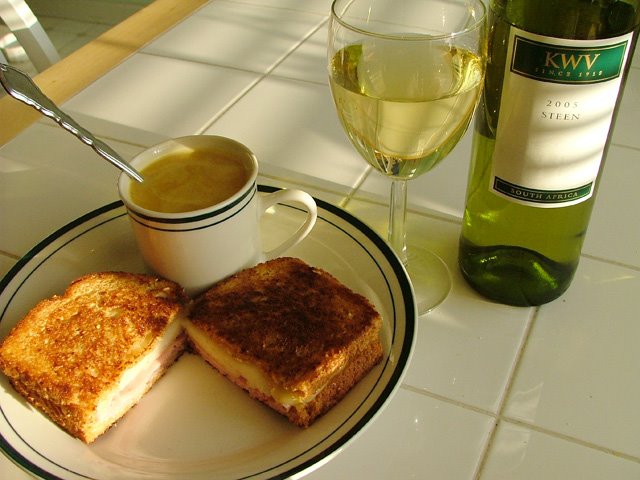
The theme for Wine Blogging Wednesday #20 is to pick a white wine outside of the big three (Chardonnay, Sauvignon Blanc, and Riesling), or any blend using those three. I was going to be a smartass and grab some obscure Hungarian white or perhaps one of the foxy Native American varieties. But instead, I was lured away by something that just came on sale at one of the local shops. For my entry, I present the 2005 KWV Steen, which I picked up for around $7.50.

KWV is the giant wine cooperative of South Africa, and Steen is what they call Chenin Blanc in those parts. There's not much on the nose here--in that respect, it's almost like Pinot Grigio. However, it has a much stronger presence in the mouth. The overwhelming element is firm acidity, with medium tartness and a short finish. No dominant flavors other than the baseline "white wine" taste. The wine on its own isn't that impressive, but it paired quite nicely with dinner: a cup of butternut squash soup and a grilled sandwich containing havarti cheese, thin slices of d'Anjou pears*, and smoked ham.

Not a bad little wine for the beginning of spring.

*A somewhat appropriate pairing, as the Chenin Blanc grapes originally come from around Anjou in France.

07 April 2006

Memphis Zoo Wine Benefit

Tonight I was fortunate to receive some tickets to the "Wild World of Wines & Beer" benefit at the Memphis Zoo. Now, I've got a membership to the zoo and go there often. It's celebrating its 100th birthday this year, but the past twenty years have been amazing, as they decided to upgrade from the "concrete and cages" model to more natural habitats for the various animals. Over the years they've built Cat Country (all major large cat species), Primate Canyon (everything from lemurs to gorillas), the China Exhibit (pandas and more), and recently they've added the Northwest Passage exhibit (polar bears, black bears, etc.). At the right is a photo I took of one of the polar bears last month.

In honor of the Pacific Northwest theme, most of the wines came from that region. I skipped a few, as I had tried some of them before and they were pouring rather generously. I had to drive myself home, plus I really didn't want to fall in the baboon pit. Also, I was wondering beforehand if my notes would include things like, "this Merlot smells like elephant dung", or "this Riesling has the musky undertones of the tiger habitat". But all of my wine drinking happened indoors, so no outside olfactory influences were involved.

Wine 1: 2003 Foolish Oak Chardonnay. Columbia Valley, Washington. Light and fruity with a crisp finish. Great way to start off the evening. $11.

Wine 2: 2004 Hedges CMS White. Columbia Valley, Washington. I've had this before, but I was able to appreciate it more with a bigger sample. Very crisp, with a clean feel and herbal tones. Mix of Chardonnay, Marsanne, and Sauvignon Blanc. $15.

Wine 3: 2004 Ste. Michelle Riesling. Columbia Valley, Washington. Drier than I expected. Crisp with firm acids. Slightly bitter aftertaste. $10.

Wine 4: 2003 Columbia Crest Two Vines Chardonnay. Columbia Valley, Washington. Oaky and buttery, with some cream and vanilla highlights. $10.

Wine 5: 2003 Foris Pinot Noir. Illinois River Valley, Oregon. Mild cherry and strawberry flavors, with strong tannins and a short finish. $20.

Wine 6: 14 Hands Merlot. Columbia Valley, Washington. Black cherry, spice. Fortified by 22% Cabernet Sauvignon, so it's a surprise on the tongue. $12.

Wine 7: 2002 Red Diamond Shiraz. 3% Viognier blended in there. Berry and pepper flavors with a dry finish. A great little wine. I'm definitely going to give this one a second try when I can really focus on it and enjoy it. $12.

Of the three remaining wines that I didn't try, one was a White Merlot I skipped on purpose, one was a Cabernet Sauvignon I'd had before and enjoyed, and the last was a Fumé Blanc that looked promising, and I'll see if I can find it around here.

Unibroue Maudite

The local wine shop has begun offering "big beers" from the esteemed Quebec brewery Unibroue. A pack of four 12 oz. (355mL) bottles runs around $7.50, which is a good deal for a well made beer. This isn't the kind of thing that you throw back after a long day of yardwork. This is something you pour into the appropriate glass in the Belgian style and savor for a long time.

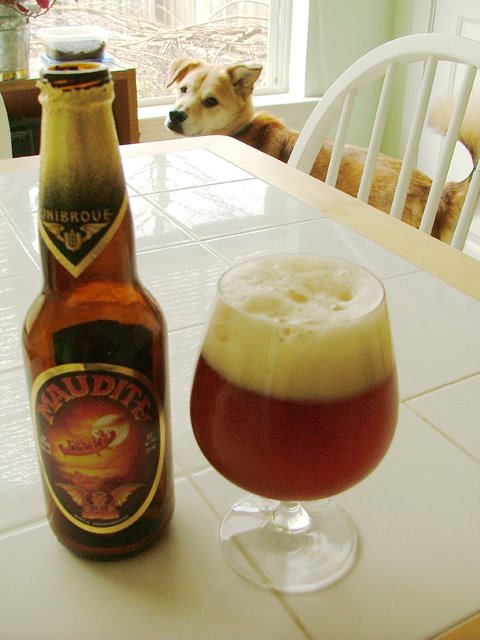
Pictured at the left is the Unibroue Maudite, a strong dark red beer. My dog Wolfgang looks on approvingly. What's fun with a beer like this is that you can close your eyes and try to pick out all of the subtle flavors and aromas. The Maudite (French for "The Damned") has a lot of nutmeg, with a little orange peel and maybe just a touch of cinnamon. More than anything it reminds me of a really well spiced tea blend. It's mildly bitter, and despite the 8% alcohol, not as strong as you might think.

You can't easily see this in the picture, but the beer itself is a little cloudy. This is due to the presence of yeast, which permits a secondary fermentation in the bottle and will allow the beer to improve with age, much like a fine wine. I'm probably going to do some more reviews of beers like this (including some amazing barleywines I've tried). Seriously, these are beers that a wine lover is really going to appreciate, and there are certain meals where beverages such as the Maudite are going to be a better fit than a particular wine.

05 April 2006

Combinations #1

As a quick followup to the previous post, Andrew has thrown down the gauntlet with the first Combinations challenge:

Baked Mackerel With Rhubarb Sauce

Make the dish and pair it with a wine, and send the results to Andrew by April 24.

As for me, I'm looking forward to trying out this unusual recipe, but I might not be able to get my hands on fresh, small mackerel. If the culinary gods will forgive me, I might have to substitute fresh rainbow trout, which is pretty much the only one-pound full body fish that I see around here on a regular basis. Granted there's some Asian markets where I can get a live catfish or bullfrog butchered on the spot, but the mackerel is going to take a bit of work.

02 April 2006

Combinations

Wine- and food-blogger Andrew left a comment in one of my posts below, and we continued the conversation via e-mail. Andrew has a vision for a new monthly participatory project in the vein of Wine Blogging Wednesday. But instead of a themed wine, the idea is to post a recipe, then everyone cooks it and pairs it with a wine, and reports on how well that wine matched the dish. Andrew calls it Combinations, and has blogged about it here and here.

I think it's important to look at this not only for foodbloggers to think more about wine, but also for winebloggers to think more about food. In the words of Rogers & Hammerstein, "The Farmer and the Cowman Should Be Friends". We've all got the opportunity to learn a lot, broaden our horizons, and have some damned good food and wine in the process.

I fully support this project, will promote it to the best of my ability, and look forward to participating in it in the months to come.

01 April 2006

Segura Viudas Aria NV

So I bought an inexpensive Spanish cava a couple of weeks ago and served it last night. And in doing so, I made some sort of a statement about Spanish politics. Andrew mentioned this a while back, and pointed to an informative article on the subject. Though I'm enchanted by the Catalan language, I really don't have any opinions about the autonomy question and wouldn't stop drinking delicious, affordable cava because of it.

The wine in question was the Segura Viudas Aria, which is a Pinot Noir-based sparkling wine. 100% Pinot Noir, grown in Catalonia and sold just for the American market. It's made by Segura Viudas, but there's nothing about this wine on the website. It's a pretty deep pink, almost red color. Some hints of strawberry, but for the most part it's light, crisp, and refreshing. To be honest, I didn't get to drink much of it--the sparkler was served along with a spread of cheeses and a traditionally prepared Caesar salad, and the ladies drank up most of it before I was able to sit down and think about the various attributes. So for that reason alone the wine gets an A in my book.

27 March 2006

Wine Library TV

I think this might be the first wine-related video podcast out there... Gary Vaynerchuk of the New Jersey-based Wine Library (online and brick & mortar store) puts out a series of informational videos on various wine topics. In an e-mail, I told Gary that watching the videos felt like the conversations I have with the more experienced personnel at my local wine shops.

So without further ado, I present Wine Library TV. Check it out and let Gary know what you think in the comments.

Side note: Wine Blogging Wednesday is a lot of fun, but I've always thought it would be cool to do a sort of "book club" thing. Announce a widely available wine, have everyone buy it ahead of time, and then at some designated date and time, everyone uncorks the bottle and starts posting their opinions in the same thread.

26 March 2006

2004 Chalone Vineyard Monterey County Chardonnay

I'm reading Jeremiah Tower's California Dish : What I Saw (and Cooked) at the American Culinary Revolution. Like Anthony Bourdain's Kitchen Confidential: Adventures in the Culinary Underbelly, it's a look at the sex, drugs, and rock & roll atmosphere of fine dining back in the late 70s and 80s. Bourdain's book was angrier; Tower's book is somewhat more fun, and even includes recipes featuring marijuana. Bourdain's book goes all over the place, Tower focuses mostly on the birth of California Cusine.

Anyway, there's a brief passage about trying to start a culinary arts program at Antioch College in Ohio in 1980, and he mentions the committee going through a case of Dick Graff's Chalone Chardonnay, Graff being the founder and chairman of Chalone Vineyard. He didn't say much about the wine, but I'd been impressed with other wines he'd mentioned that I've tried.

A few hours after reading that, I was doing the regular trip from grocery story to wine shop, and while browsing around the racks I came across the 2004 Chalone Vineyard Monterey County Chardonnay. I've always enjoyed serendipity, and for $12 it was hard to pass up.

I cracked it open today, and served it with a French bread pizza. No, I'm not talking about the Stouffer's frozen variety we all loved as kids. I took about a foot of a French bread loaf and sliced it lengthwise. On each half I smeared a generous portion of pesto, topped it with shredded mozzarella, sautéed cremini mushrooms, grilled orange bell pepper strips, and topped off with a healthy portion of herbed goat cheese. Bake at 350° F for ten to fifteen minutes, and slide it under the broiler for a few minutes if desired. I'm in heaven right now, and my breath is atrocious.

I did sample the wine before the garlic bomb, and found it to be quite nice. It's not overly oaked, but instead has a crisp and firmly acidic flavor to it. It's a Chardonnay with some body and sass that will leave your lips tingling for a few seonds after every sip.

The Pour

I've added a blogroll link to Eric Asimov's The Pour. I've enjoyed reading his wine articles and restaurant reviews over the years in the New York Times, and I'm anxious to see how he does in a more relaxed environment.

Of course, the first thing I think of is that I'd like to see Arthur C. Clarke's nephew start a competing wine blog so that the friendly rivalry could survive in this generation.

47 Wine Reviews

That's how far behind I am in typing up my notes from tastings. In order to keep the recent posts here at top, I'm backposting these reviews in one huge post. I realize these laundry lists of wines with brief reviews aren't that exciting to read--I use them more for my own reference that I can check anywhere I've got web access. So if you're interested, click here.

P.S. It took 3 hours to write those up... Good incentive to keep up to date in the future.

24 March 2006

2003 Grizz Red

Here's a wine that's been popping up all over town, generally sold near the register for around $10. It comes in a white variety, but tonight I opened a bottle of the 2003 Grizz Red, a Washington State blend. The bottle doesn't say anything about the contents, but looking at the website reveals the following unusual breakdown: 41.5% Cabernet Franc, 39.5% Cabernet Sauvignon, 10.6% Syrah, 6% Pinot Noir, 2.2% Merlot. Quite an unusual blend. You never see Pinot Noir mixed with anything (unless we're talking Champagne), and it's rare to see that much Cabernet Franc in anything at this price level. I honestly expected a fairly powerful, tannic red (and naming it after a large and dangerous predator suggests a strong wine). Yet I was surprised at how smooth it was.

A lot of the vegetal characteristics of the Cabernet Franc come through on the nose, as well as providing a deep color. Prominent dark berry flavors abound, with some peppery tones, medium tannins that dissipate quickly, and a medium aftertaste. Very easy going down. I'm still amazed that something with only 8.2% "soft grapes" is this smooth at such a young age.

I served it along with some Wisconsin goat cheese I recently acquired--a nice little sampler pack of four 4 oz. buchettes from Montchevre. I was really impressed with the cheese as well. Very creamy and savory. In fact, the guests have left and I'm writing this while drinking the last of the wine and snacking on some more goat cheese and crackers. Had I been thinking, I could have incorporated agricultural products from Wyoming and West Virginia to cover all of the "W" states.

Oh, and why is Grizz wine being sold all over town? Well, this is Memphis, home to the Memphis Grizzlies NBA team, formerly of Vancouver. I'm not much of a sports fan, but they are quite popular around here (Memphis is a basketball town), and though the wine is completely unrelated, I'm sure that the name connection hasn't hurt sales. And speaking of basketball, the team from my alma mater has reached the Elite Eight and tomorrow night goes up against UCLA for a spot in the Final Four. So for what it's worth, GO TIGERS!

Beef Stew, North African-style

This post doesn't involve wine, but is one of my briefer food photoessays. My North African Beef Stew isn't purely authentic--the use of bacon and beer are notable breaks from tradition--but making the broth really savory and spicy and serving the resulting stew with couscous certainly makes it stand above a can of Dinty Moore. Some variations are offered in the article.

22 March 2006

The Mystery of The Four Emus

Astute New Zeland blogger Barbara pointed out in the last post that the Four Emus wine is from South Australia. I could have sworn that the website and promotional literature said Western Australia, so I went back to check. And sure enough, I was right. But I happen to do e-commerce work for a living, have an international user base, and have seen many strange things happen. So I logged back into the site, but picked Australia as my country of origin rather than the USA. Sure enough, the Australian website talks about South Australia complete with pictures and text about the region, while the American website has a similar profile of Western Australia. It's more than a mere typo, they're markedly different. And in case anyone is curious, the UK login is identical to the Australian one.

I find this kind of odd--Western Australian wine is kind of a niche product in the States, and someone really interested in that region probably wouldn't be buying an inexpensive table wine. I'd reckon that the majority of Americans (and even those that enjoy bargain Aussie wines) aren't aware of the different states and territories of Australia, much less the specific wine region names. So why would the winery market the wine differently? Is it actually sourced from different regions for different markets, or is it blended from all over?

I've e-mailed the winery for more information--I'll let everyone know what I find out.

16 March 2006

2003 Four Emus Cabernet Sauvignon Shiraz Merlot

Here's a review of yet another novelty bargain wine that's hit the local shop... Tonight I'm quaffing the 2003 Four Emus Cabernet Sauvignon Shiraz Merlot with a vegetarian pizza. How long will the "cute Australian animal" trend continue with wine? I think it's marketing genius and am glad that it's helped demystify wine and make it seem less threatening. The first time someone comes out with "Thundering Wombat Shiraz" I'm buying a case. I fear that "Bandicoot Barbera" and "Numbat Nebbiolo" might not look as adorable on a label.

It's made in Western Australia, is connected to the Constellation conglomerate, and is made up of 58% Cabernet Sauvignon, 27% Shiraz, and 15% Merlot. Personally I think they should have switched the Cab Sav and Shiraz. As it is, it suffers from the inexpensive Cabernet Sauvignon curse, which means very simple "red wine" aroma, big mouth-drying tannins, and little flavor. Don't get me wrong, it's not bad, it just reminds me of one of dozens of generic red wines that fail to stand out of the crowd. For $7, it wasn't a bad deal, but I probably won't be getting it again.

This wine is also a screwcap, which was sort of amusing to me on the way home. Not that I have anything against screwcaps--in fact, I love them more and more every day. But after work I first stopped off to buy a new rabbit-style corkscrew. The old rabbit died recently, since it was an early model made with some stress-bearing plastic parts. So I got a new all-metal one, and decided to grab an inaugaral bottle of wine to go with it. So what did I do? I bought a screwcap wine.

13 March 2006

2003 Hayman & Hill Meritage

Does the word Meritage rhyme with heritage or triage? According to the Meritage Association, it rhymes with heritage. In any event, it's basically a Bordeaux or claret blend made in California. Typically a Meritage starts at around $20 and goes up, but tonight I found one for $12 from a producer I've enjoyed in the past: the 2003 Hayman & Hill Meritage. (No website found.)

This Monterey County blend is 41% Merlot, 38% Cabernet Sauvignon, 10% Cabernet Franc, 7% Petite Verdot, and 4% Malbec. There's a little tobacco on the nose, good black cherry flavors on the tongue, and surprisingly firm tannins. I think it could do with another year in the bottle, but it's definitely drinkable now. Good to go with a steak, a burger, or similar hearty fare. I really love Bordeaux-style blends but don't always feel like spending $20-40 to satisfy that craving. This is a nice alternative.

I still prefer their Shiraz-Viognier, but this is a close second.

04 March 2006

47 Wine Reviews - Long Post

Tasting Notes for Saturday, January 28, 2006
Theme: "Wines from Places Where It's Warm"

Wine 1: Finca La Linda Brut NV. Argentina. Made by Luigi Bosca. This is the second time I've had this, and I wasn't as impressed. Yeasty and crisp, but too tart for my tasts. Ashy aftertaste. Very well could have been an off bottle or a bad temperature. $19.

Wine 2: 2004 La Bamba Chenin Blanc-Riesling. Argentina. What an odd combination. It's got a Riesling nose, though it's very thin and slightly tart. Not sweet, but overall dull. $8.

Wine 3: 2004 Redbank Sauvignon Blanc. Victoria, Australia. Some grapefruit flavors, but thin for a Sauvignon Blanc. Tastes more like a Pinot Grigio. $11.

Wine 4: 2005 Elderton Unwooded Chardonnay. Barossa, Australia. This white had more body than the previous bottles, but very acidic. I found it off balance, and I generally like unoaked Chardonnays. $14.

Wine 5: 2004 White Knot Chardonnay. McLaren Vale, Australia. Better balance, mild acids. Good fruit flavors, probably great for fish. Well rounded finish. Good little wine. Also, this is the first wine I've seen in person that featured a Zork enclosure. $12.

Wine 6: 2005 Craneford Viognier. Adelaide Hills, Australia. Hints of spice cake on the nose, bold fruit flavors on the tongue. No touches of grass or herbs, but I liked it a lot. Almost like a Riesling. $18.

Wine 7: 2004 Kim Crawford Pinot Noir. Marlborough, New Zealand. Strawberry and cream aromas, light and fruity, tart and delicious. $16.

Wine 8: 2004 Boekenhoutskloof "The Wolftrap". Franschhoek, South Africa. Get this: a combination of Merlot, Grenache Noir, Malbec, Syrah, Ruby Cabernet, Cabernet Sauvignon, and Cinsault. We were all pretty excited about tasting this oddball, but I was a little disappointed. It had a woody, toasty aroma, a surprisingly light beginning and slight bite on the finish. Ultimately thin tasting. $11.

Wine 9: 2004 Terrazas Alto Malbec. Argentina. From the Argentine outpost of Moet Hennessey. Plum flavors, mild tannins. Well balanced with a slightly bitter finish. A great bargain Malbec. $12.

Wine 10: 2000 Bleasdale Cabernet-Shiraz. Langhorne Creek, Australia. Light mint aromas, full bodied with black cherry flavors. Well rounded and balanced--an excellently crafted wine. $18.

Wine 11: 2003 Antis Cabernet Sauvignon. Argentina. Roast beef aromas, slight peppery flavor and a short finish. Interesting and affordable Cabernet Sauvignon. $15.

Wine 12: 2001 Bellevue Estate Tumara Titan. Stellenbosch, South Africa. Deep cherry aromas, forward fruit and mild tannins. Really wonderful. A Bordeaux blend, broken down as 66% Cabernet Sauvignon, 15% Merlot, 4% Cabernet Franc, 10% Malbec, and 5% Petit Verdot. $17.

Tasting Notes for February 11, 2006
Theme: Valentine's Day

Wine 1: Villa Giada Moscato d'Asti. Piedmont, Italy. Not too sweet, some honeysuckle and apple flavors. Moscato d'Asti was one of the first wines I fell in love with, and though I don't drink it much these days it always brings a smile to my face. $18.

Wine 2: 2001 Argyle Brut. Oregon. Sparkling wine made from 45% Pinot Noir & 55% Chardonnay. No real nose, little bitter, tart and crisp. Not overwhelmed, particularly at the price. $23.

Wine 3: Bouvet-Ladubay Rosé Excellence NV. Loire, France. Made from Cabernet Franc. Herbal and bitter, not great. This was my second tasting of this wine, and my opinion has remained the same. $16.

Wine 4: 2004 Solitude Chardonnay. Carneros, California. Butter and oak, a little vanilla and cake. A classic California Chardonnay. $28.

Wine 5: 2003 Georges Dubœuf Borgogne Aligoté. Burgundy, France. I sampled this back in November, but today it was served as a Kir, with a splash of Crème de Cassis. Odd flavor, I wasn't really impressed. I wasn't a fan of the wine on its own either. $14.

Wine 6: 2003 Georges Dubœuf Saint-Amour Domaine de la Pirolette. Beaujolais, France. Some strawberry flavors, soft tannins, mild and drinkable. Good example of a Cru Beaujolais. $15.

Wine 7: 2004 Queen of Hearts Pinot Noir. Santa Barbera, California. Soft tannins, light berry flavors, really not bad for a bargain Pinot Noir. $15.

Wine 8: 2002 Raymond Reserve Merlot. Napa, California. Raspberry flavors, thin, not exciting. Very short finish. $20.

Wine 9: Folie à Deux Menage à Trois Red. Amador, California. A blend of Zinfandel, Cabernet, and Merlot. Strawbery jam dominates, though this isn't as sweet as previous years. Better balance. $12.

Wine 10: 2001 Terra Valentine Spring Mountain District Cabernet Sauvignon. Napa, California. Black cherry nose, deep composition, dry and with lovely tannins. A spectacular wine. $35.

Wine 11: 2003 Novelty Hill Syrah. Columbia Valley, Washington. Peppery aroma, very light tannins for its age, delicious berry flavors. Wonderful wine. $20.

Wine 12: Le Rive Birbet Frizzante NV. Piedmont, Italy. Made from Red Muscat, this is sweet, almost like grape juice, slightly syrupy. Apple and cranberry flavors were lovely. I found myself really liking this unique wine. $18.

Tasting Notes for Saturday, February 25, 2006
Theme: Blends

Wine 1: 2004 Kitfox Foxy White. Salado Creek, California. An interesting white blend of 50% Chenin Blanc, 20% Chardonnay, 15% Viognier, 10% Sauvignon Blanc, and 5% Orange Muscat. Muscat on the nose, some pear flavors. I found it a little too sweet. Short finish, medium tartness. $13.

Wine 2: 2004 Basa. Rueda, Spain. Combination of Sauvignon Blanc, Verdejo, and Viura. Very grassy nose, taste, and finish. Some lemon, very herbal. Fascinating wine. $10.

Wine 3: 2003 Chateau Bonnet Entre-Deux-Mers. Bordeaux, France. A white Bordeaux made from Semillon, Sauvignon Blanc, and Muscadelle. Very mild, soft and with a short finish. Not exciting, too thin. $14.

Wine 4: 2004 Hedges Cellars CMS. Columbia Valley, Washington. Chardonnay, Marsanne, Sauvignon Blanc. Bigger fruit flavors than the previous wines. Tastes mostly of Chardonnay. Short finish. $13.

Wine 5: 2001 Louis Bernard Châteauneuf-du-Pape. Rhone, France. I think this might be the first white Châteauneuf-du-Pape I've had. Made from Grenache Blanc, Rousanne, Marsanne, and Viognier. Odd aroma of candied peel and fruit, apple cider. Unique flavor and full bodied feel. Quite nice. $29.

Wine 6: 2001 Chateau de Callac. Bordeaux. France. Merlot, Cabernet Sauvignon, Cabernet Franc. Lovely deep color, crisp cherry flavors, tart and mouth-drying tannins. $20.

Wine 7: 2002 Ferrari-Carano Siena. Sonoma, California. Interesting combination of Sangiovese, Malbec, and Cabernet Sauvignon. Deep plum and dark fruit aromas, succulent fruit forward flavor, mild tannins and easy finish. Well crafted wine. $20.

Wine 8: 2003 The Lucky Country GSM. Barossa, Australia. Grenache, Syrah, Mourvedre. Not much of a nose, but full fruit flavor. Easy drinking and not too heavy, but I thought it needed more Syrah. $15.

Wine 9: 2002 Hendry Meritage. Napa, California. Cabernet Sauvignon, Merlot, Malbec, Cabernet Franc, and Petite Verdot. Inky dark purple, full fruit with lots of dark plum and some cherry. Good claret-style wine. $33.

Wine 10: 2004 Boekenhoutskloof "The Chocolate Block". South Africa. Syrah, Grenache, Cabernet Sauvignon, Cinsault, Viognier. Deep full colors, little too bitter and tannic for me. Something is off balance, but it might be better with food. $33.

Wine 11: 2002 Ridge Geyserville. Sonoma, California. Great combination of Zinfandel, Carignane, and Petite Sirah. Cranberry juice nose, black currant flavors, deep dark color. All in all a wonderful wine. I'd really love to just sit and enjoy this for an hour or so after dinner. $30.

Tasting Notes for Saturday, March 25, 2006
Theme: Italy (and I forgot to jot down the years on every one of these)

Wine 1: Vernaccia di San Gimignano S. Quirico. Tuscany, Italy. Made from Trebbiano, supposedly the favorite wine of Michelangelo. Slight lemon flavor, barely tart. Nice and refreshing. Makes me long for summer. $15.

Wine 2: Principessa Gavia Gavi. Piedmont, Italy. Made from Cortese. A little grapefruit, but otherwise a clean, thin white. $15.

Wine 3: Giovanni Almondo Roero Arneis. Piedmont, Italy. Arneis is the grape. Clean and fruity, not tart but a little bitter. $20.

Wine 4: Bollini Pinot Grigio. Trentino, Italy. Mild lemon flavors, some minerality, ends up like a flat mineral water with a slice of lemon in it. $13.

Wine 5: Di Majo Norante Cabernet Sauvignon. Osci, Italy. Jammy Zinfandel-style nose. Mild tannins, creamy flavor with good spice notes. Fun wine. $13.

Wine 6: A Mano Primitivo. Puglia, Italy. The ancestor of Zinfandel. Black cherry, good fruit forward wine. Medium tannins. $13.

Wine 7: Virna Dolcetto d'Alba. Piedmont, Italy. I think this is the first Dolcetto I've had, and it wasn't anywhere near as sweet as I'd heard. Mild and dry, with plum peel flavors. The host suggested serving it with Indian food. $15.

Wine 8: Dante Rivetti Barbera d'Alba. Piedmont, Italy. Mild, a little thin, not really complex. I was left wanting more. $24.

Wine 9: Monte Antico. Tuscany, Italy. 100% Sangiovese. Nice dark color, big tannins and mild fruit flavor. $13.

Wine 10: Falesco Vitiano. Sangiovese, Merlot, and Cabernet Sauvignon. Raspberry aromas, medium tannins, well balanced. $17.

Wine 11: Colognole Chianti Ruffina. 95% Sangiovese and 5% Colorino. Smoky tones on the nose, dark berry flavors. Well balanced. $17.

Wine 12: Castello di Lucignano Chianti Classico. Tuscany, Italy. 95% Sangiovese and 5% Canaiolo. Nice and dry, good fruit with medium tannins. $23.

01 March 2006

Montepulciano Profile

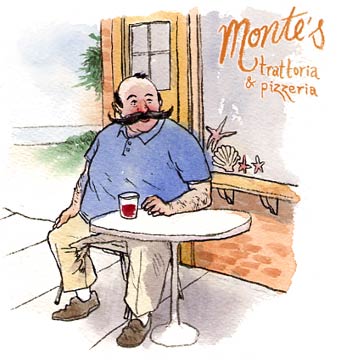
Several months ago I submitted a brief description of the grape Montepulciano for the website Appellation America, comparing the grape to the proprietor of a little family restaurant in Italy. And the profile is up with a fitting illustration to boot. I like how the guy looks like a friendly Tony Soprano.


Which puts an odd thought in my head... It wouldn't really fit with the idea of the show, but imagine if Tony and crew met at a cellar housing old and incredible Italian wines instead of Satriale's butcher shop. And instead of talking about the quality of the mortadella, they were arguing with one another over the Barolo. Actually, they could have done something like this and have it fit in with the Furio character that was on for a while. Mainly I'm just glad that the Sopranos is coming back on the air, and even though the series is ending I can't wait to see it.