09 November 2009

Larry Gonick's Cartoon History

In the fall of 1990 a 14-year old Benito read about something called The Cartoon History of the Universe in the science magazine Discover. He asked for it for Christmas, and received it. He read it over and over again.

That was the first step in a 20-year journey that ended last week.

Now, for those of you that are beginning to smirk at the idea of me reading "comic books" as a teenager and grown adult, I will kindly ask you to kiss my Scots-Irish ass. The first book in this series was edited by Jacqueline Kennedy Onassis (she saved it from the reject pile at Doubleday) and the work was praised by Carl Sagan among others. In a college World History course, I recognized the inferior quality of the assigned texts, and used TCHOTU I & II as my source material for exams. I was one of two people to get an A; the other being a girl that I was courting and with whom I was sharing a lot of that great cartoon history. (Young gents out there: the right kind of lady loves a literate man.)

Who is the genius behind all of this? None other than Larry Gonick, a Harvard mathematician who decided to draw cartoons about science and history. I'm going to focus entirely on his historical contributions here, but he's written similar guides to statistics, genetics, and many other topics. Pictured at right you can see my first editions as I collected them over the past two decades:

The Cartoon History of the Universe I, Vol. 1-7: From the Big Bang to Alexander the Great (1990)

The Cartoon History of the Universe II, Vol. 8-13: From the Springtime of China to the Fall of Rome (1994)

The Cartoon History of the Universe III, Vol. 14-19: From the Rise of Arabia to the Renaissance (2002)

The Cartoon History of the Modern World, Part 1: From Columbus to the U.S. Constitution (2006)

The Cartoon History of the Modern World, Part 2: From the Bastille to Baghdad (2009)

I hate that the books got smaller over time, but cost becomes an issue and these aren't exactly Spider-Man comics we're talking about. The quality and style has been consistent over the twenty years, and I've savored every minute that I've spent reading each of the five books. Things I love about these:
  • Beautiful black and white pen and brush work reminiscent of Pogo and Asterix. Examples here, here, here, here, and here. These little images don't do the work justice.
  • The books are heavily footnoted (with an amusing icon of a foot drawing an asterisk or a musical note). They also contain extensive bibliographies at the end, referencing both established works in the field as well as primary sources when applicable.
  • While it's not possible to list every historical figure and the detail of every society on earth in a space that takes up less than 20 linear centimeters on the bookshelf, Gonick does a great job of covering histories that are frequently ignored in modern western life unless you choose to specialize. Namely the histories of China, India, the Middle East, and north Africa.
  • There are big gaps. Only the briefest mentions are given to Russia, Korea, Thailand and the rest of southeast Asia, sub-Saharan Africa, and Australia. South America drops off the radar around 1900. Antarctica also gets short shrift, but not much of significance has happened there. For my part, those gaps encourage me to do the research on my own.
  • Because a truly comprehensive history of the world would have required a book for every modern nation, there are points at which Gonick draws a map of the world and gives a quick synopsis as to what is happening where. It's an easy way to get the "big picture" of a specific decade.
  • If it's not already obvious, the whole endeavor was produced with a lot of love and humor. When was the last time you laughed while reading history? And for those of you who have reached the bottom of this post, desperate for food or wine content... He did a great series of cartoon recipes for Serious Eats.
Why do I bring all of this up now? These books will make great Christmas gifts for the curious youngster in your family. If you prefer a geocentric universe that began 6,000 years ago you probably won't like it, but if you want a kid to be able to intelligently argue about the ostracism of Themistocles or the politics of Byzantium at any point from sixth grade to grad school, these books are for you--or more appropriately, for that weird little relative that obsesses over dinosaurs, space, math, and eventually, wine. Though I'd prefer that you give it to the child with a few cracks in the spine and some dogeared pages. We could all use a refresher course in world history.

06 November 2009

2007 Rio Seco Malbec

I love inexpensive Malbecs for their bold flavors and easy pairing. Here I enjoyed the wine with a vegetarian pizza, but it would work well with BBQ, steak, lamb, etc.

The 2007 Rio Seco Malbec is from Mendoza, Argentina. $12, 13% abv. Black cherry, full plummy flavors with a big mouthfeel, medium tannins, long finish. This is a great table wine, and I'm glad that we're getting better and better access to inexpensive but decent selections.

In the background you can see one of my less-noted wine glasses: a polycarbonate tumbler. While I love proper crystal and try to pick the right glass to go with the right wine, for everyday bottles I'm sometimes less discriminating, especially when it comes to leftovers on the second day. This is also my travel glass: it's rigid, indestructible, perfectly clear, easy to wash in a hotel sink, and works well enough for casual tasting. You can do a swirl and sniff on this easily enough, and with its short squat shape you're not going to easily tip it over and destroy your laptop.

There's not a great solution for traveling wine lovers when it comes to glassware. Yes, you can construct a special package for your beloved Riedel glass and keep it in the luggage, but it could always disappear in the hotel room if someone mistakes it for a room service glass. Some suggestions from my personal experience, based on spending a week or more in one place and finding fun curiosities in different wine markets:
  • The $2 Wal-Mart Wine Glass: Ugly, clunky, and thick, but you can buy just one anywhere in the US and leave it behind when you depart.
  • The Room Service Deception: Late night reports have to be filed and you're stuck ordering room service? A lot of hotels use goblet-style water glasses with whatever you order. Rinse it out and stash it in one of the drawers. Before you check out, be sure to put the glass somewhere visible, and leave a tip in it.
  • The Friendly Bartender: If you're not willing to actually ask the hotel bartender if you can borrow a glass for the evening (and be sure to purchase a cocktail or something and tip handsomely first), there's the introverted option of slowly wandering off with the glass until you can duck into the elevator. Again, be sure to return it later.
  • The Scavenger: I do not recommend swiping a used wine glass off a random room service tray in the hallway and ducking back to your room like my dog Wolfgang stealing a chicken carcass from the trash can. The glass will probably have lipstick on it and if you get caught there's no respectable way to explain what you were doing.

04 November 2009

Benito vs. Peru: Tallarin Verde con Bistec y Pisco Sour

I stared at a group of random ingredients in the kitchen and thought, "I could make a Peruvian Dinner with this." It was a rare flash of inspiration, as opposed to the usual observations of "that lettuce has gone sideways", "I need to write about those sardines eventually", and "why do I own so much mustard?"

This dinner needed an authentic cocktail, and the Pisco Sour was an easy choice. While I didn't like it as much as some other egg white cocktails, it was an interesting alternative and one that I had to eventually cross off my list.

Pisco Sour
2 oz. Pisco
1 oz. fresh lime juice
¾ oz. simple syrup
1 egg white
Angostura bitters

Combine everything but the bitters in a shaker with ice cubes, and shake until the beverage starts making dull thudding noises and it's become so cold that you can't feel your hands anymore. Pour into tumblers and dash a few drops of bitters on top of the foam. It's tangy, creamy, and yes, sour.

The Don César Pisco Puro is widely available in the United States, and I grabbed a bottle months ago. As often happens, other interests and commitments got in the way, and I sort of forgot it was there. I also have a large Civil War atlas and a cheap Mexican cookbook written by a Brit, and I don't know where those came from. I think the ephemera of my life is beginning to crossbreed during the late night hours, producing new and wondrous items.

Pisco is a clear brandy distilled from grapes invented in South America over 400 years ago. Which grapes? This was probably made from Muscatel. And while my Pisco came from Peru, others are made in Chile. The two nations fight over which truly owns the name. No comment on that disagreement here, but the Don César has a sort of grainy, wheatish aroma with a background of raisins. On its own, you can feel the pisco travel down your esophagus with the curious aftertaste of, again, raisins. I guess the best way to describe it would be to imagine white rum dosed with a bit of Muscat wine.

With my pile of odd ingredients I decided to make tallarin verde con bistec. Often translated as "green spaghetti", it's usually made with flatter noodles like fettuccine. There are lots of different recetas out there, but it couldn't be simpler. Take your favorite basil pesto recipe or pre-made variety. Add in a few handfuls of baby spinach leaves (or even a full bag if you wish), half a cup of evaporated milk, blend it all together, and slowly warm it on the stove. Toss it with the cooked pasta and you're done. It's about as complicated as Hamburger Helper®. It's often served with some bit of meat, and I settled on spicy broiled cube steaks (hence con bistec). Grilled flank steak would have been better, but the New York Times informs me that cube steak is trendy again, and I didn't want to be behind the Times.

The pasta was unique; not even remotely Italian-tasting, but the ingredients are all available in Italy. It's creamy and vegetal without being gloopy or bitter. Something about the evaporated milk gives it a lovely texture without the weight of cream, and the color is an almost otherworldly green. The cube steak was simply seasoned and broiled, and while not terribly attractive in the photo, it was tasty enough and well-received by my fellow diners.

We skipped the wine on this dinner--it was more of a beer occasion. And when it comes to Peruvian food served in the United States, the most logical choice was a hoppy Czech pilsner brewed in Mexico: Bohemia. Crisp, cold, bitter, and great for washing down a load of protein and carbs.

02 November 2009

Thoughts on Australia

I got a great comment from an Australian reader on Friday's post. I'm going to excerpt some of his points and address them below, but I thought that first a quick geography lesson was in order. I feel certain that if I asked any of you to map a route from Adelaide to Darwin without going through Alice Springs you could do so as easily as you could give directions to the nearest Starbucks. But on the off chance that someone is less familiar with the land down under...

I wanted to clarify Australian population density and wine regions for the benefit of the average American. Unless you decide to study the topic yourself, or have some connection to the country, few of us understand that continent. Since there's no existing map that explains these two topics well, I built my own non-scientific, mostly factual* map from scratch. I call it "Benito's Bruised Mango Map of Australian Wine & People" (click for big glorious version). First off, the "Lower 48" (all of the US minus Alaska and Hawaii) is about the same physical size and shape as Australia, but the population is totally different:

US Lower 48 = 8 million km2
Australia = 7.6 million km2

US Population = 307 million
Australia Population = 22 million

The US population (99% in the Lower 48) is concentrated in the eastern third of the country bordered by the Mississippi River, but we have 30 million people in California and 24 million in Texas--the latter group is bigger than Australia, and that's just one state. In Australia the population is almost entirely coastal, with the vast majority in the southeast and smaller groups in the southwest. Imagine taking the population of Texas and spreading them out from North Carolina to Florida, and taking a handful to San Diego and Seattle.

Now that we've got that out of the way, let's look at Hieronymous' discussion points:

As an Aussie wine-lover I always find it fascinating to read international reviews of our wines. For a start many of the wines that make it out of the country are barely known here - there is a distinct segment of the market who produce for the export market only, some of which have trashed the brand internationally.

We had a great set of comments on this issue back in August from American retailers and distributors. I'm curious as to what all of you are drinking down there--I see reviews occasionally in magazines, but as you say, some bottles just don't make their way onto a boat or plane. What sort of American wines show up on Australian shelves and menus?

Yellow Tail is certainly available here in Oz, but is very much a budget brand that no-one of my acquaintance would dream of drinking. Likewise, there are a lot of elegant reds now being produced, but our rep has been tainted by the disproportionate proportion of 'fruit bombs' heading overseas.

Yellow Tail, Little Penguin, and others are hugely popular here, and I think the sales help keep wine shops running on a day-to-day basis. There are a lot of arguments in wine circles over these type of bottles. I don't really drink them anymore, but I did when I was freshly legal to purchase wine. I think that they're decent introductory material for novice wine drinkers. As I've said many times, a label full of confusing French or German can be scary to the neophyte; a cute animal is reassuring.

I was delighted with the wines I tried last week because I felt many of them broke the mold of the "standard Aussie wine" that shows up on American shelves. I hope they are successful and that as Americans, we don't develop a one-dimensional attitude towards an entire nation's industry.

That little rant over I'm glad to see some of the more diverse wine growing areas of the country getting some exposure. WA is certainly an up and coming area, and I would direct your readers to wines from Mornington and Yarra Valley in Victoria, and some of the Tassie wines. Orange is another region worth keeping an eye on.

I'm sad to say that I've only seen and tasted one Tasmanian wine in my life, but I loved it. Victorian wines are a bit easier to find around these parts. Western Australia wines are becoming more common, and I'll almost always grab one if I find it. But of course the vast majority of Oz juice is from the powerhouses of South Australia.

* * *

I think it's always helpful to examine your own prejudices and preconceptions. I know my own selection of wines reviewed here is skewed in several weird ways. I tend to ignore Germany unfairly due to the dominance of Riesling. Italy's vast and varied grapes fascinate me. Looking back over my notes I have a strong preference towards California red blends that I could not have recognized without analyzing the data. Not everybody has the time or inclination for such reflection, but if you've found yourself in a rut with Australian wines or any other category, step back and look for the under-appreciated wines and regions within that country.


*I started with a vector map of the continent to establish the basic design. For the wine and populations, I overlaid maps of major wine regions and population and painted over the main points to achieve the Mango Map. While it doesn't do proper service to the island of Tasmania, I think it does a decent job of showing population and wine densities in the southwest and southeast, the sources of most Aussie wine and people.

30 October 2009

Wines From Down Under Part 3

For the final four wines, I present the remaining bottles that didn't fit in directly with the first two groups, as well as being those that I found superior from a design standpoint.

2008 Wagtail Cabernet Sauvignon, 14.5% abv from Coonawarra, South Australia. Black plum, dark cherry flavors, with a rich cocoa undertone. Mild for a 2008, and well-balanced in terms of fruit/tannins/acidity. Really impressed overall with this wine and it needs a grilled steak topped with a bit of blue cheese.

Now this is the kind of animal I like to see on a bottle of wine. The beloved Willie Wagtail is a little bird that runs around shaking its tailfeathers. It's the kind of critter I'd see on a nature special, not as the mascot of an energy drink or hero of a Saturday morning cartoon. I had to learn to identify birds in Scouts, and even to this day if I see a bird I don't recognize I'm liable to pull over the car and jot down some notes so I can look it up later. No, I'm not a serious birdwatcher, but I understand the thrill of seeing a new bird with your own eyes. I was so excited when a little kestrel built a nest in my neighborhood...

Another set of animal wines! This time using seahorses. Again, not the first thing that would spring to mind, but it's a classy heraldic layout with a maritime theme that would be appropriate as the logo of a major shipping conglomerate. Or a Bond villain. Or both.

West Cape Howe is based out of Denmark, Western Australia. (I imagine that name gets confusing at times. I live in Memphis, a town named after a city in ancient Egypt, and West Tennessee also has Milan, Moscow, and Paris.) The grapes come from the Great Southern Region, the largest wine region by area in Australia. I was excited to try two wines made from grapes I don't normally associate with Australia:

2008 West Cape Howe Tempranillo, 14% abv. Dusty strawberries and seeds, ashy with a strong earthy nose to it. Very unusual for a Tempranillo, and it would be hard to guess this was from Australia.

2008 West Cape Hope Viognier, 13.5% abv. Spicy, touch of grass, dry and full bodied, good fruit. I say bring on the shellfish: I'd love to try this with scallops, shrimp, and oysters. I like Viognier but this is the first time I've felt it would go really well with seafood.

The last wine of this eclectic lineup is the 2009 Vinaceous Divine Light Verdelho, 13% abv from Pemberton, Western Australia. Grapefruit, light, bright acidity, mineral, crisp. Dry and delightful. I was expecting something sweeter and this was a pure joy. Serve with cured meats and fresh fruit before a meal.

The four wines in the Vinaceous line are all laid out with a nod to Victorian circus posters. The ringmaster, fire breather, snake charmer, and this delightful little angel sitting on the trapeze. From a design standpoint this wine stands out from the other nine I've reviewed this week, but I like it. It's unique, it's catchy, not silly, and has the unrelated potential to make an interesting tattoo.

* * *

That wraps up our week-long salute to wines from Down Under. Keep an eye out for new and interesting bottles arriving from Australia and New Zealand, there's a lot more out there than the big guys like Yellow Tail. Currently these wines are available in about half of the states in the US, with full national distribution expected soon.


In accordance with the new regulations imposed by the Federal Trade Commission, I publicly disclose that these wines were received as samples from The Country Vintner. No additional gifts or compensation were provided.

28 October 2009

Wines From Down Under Part 2

The second installment of wines in this series comes from Pikes Vintners of South Australia.

I was initially amused by the names of these wines, as the pike resembles our local alligator gar, a prehistoric monster that can grow to 10 feet/300 lbs. and take off your hand. OK, so maybe all the stories about injured fishermen are myths, but most folks I know will cut the line rather than take a chance with one of those beasts. The second fish related amusement comes from the mullet wines. Obviously this is a common fish around the world, but around here it's a popular rural hairstyle. As the saying goes: business in the front, party in the back.

Neither of those associations are meant to criticize the winery or the wines; I find branding and design fascinating, as well as the various paths that the English language has followed once it escaped the shores of Dear Old Blighty. Australia gets a lot of teasing for its colloquialisms, but can you believe that we in the American South get the same treatment? Fair dinkum, y'all.

2009 Pikes Traditionale Dry Riesling, 12% abv. This Riesling is really amazing. It doesn't smell or taste like your stereotypical Riesling--it's more like a Sauvignon Blanc. Perfectly dry and crisp, with apricot aromas and a main flavor of green apples. Great crisp acidity. This was my favorite out of the Pikes lineup, and a really enjoyable surprise. I'd love to try it again with grilled fish and mango salsa.

2008 Pikes The White Mullet, 12% abv. 60% Riesling, 16% Viognier, 16% Sauvignon Blanc, 8% Chenin Blanc. A full fruit, full-bodied white blend. Pears, a touch of floral notes, and low acidity. I think there's a little too much going on with this blend, too many different grapes competing for attention. It could do well with a cheese platter, because you've got a lot of different elements working with all the different grapes involved.

2007 Pikes The Red Mullet, 14.5% abv. 68% Shiraz, 13% Tempranillo, 11% Grenache, 8% Mourvèdre. Raspberries, black tea, black pepper, firm tannins. Better balanced than the white version, and enough interesting stuff going on to keep you thinking. This would be a great pizza and burger wine.

2006 Pikes Shiraz, 14.5% abv. Nice and dry, with red berry aromas, red cherry flavors, firm tannins. A solid, standard Australian Shiraz. While on its own it's a bit strong, I feel that paired with grilled meat this would be a real winner. Even better, a nice Greek kebab would be delightful.

In accordance with the new regulations imposed by the Federal Trade Commission, I publicly disclose that these wines were received as samples from The Country Vintner. No additional gifts or compensation were provided.

26 October 2009

Wines From Down Under Part 1

This week I'll be looking at a series of wines from Australia and New Zealand. 10 wines from a few different regions, tasted on their own, with food, and with a handful of friends. There were several things I liked about these wines as a group:

1) All were enclosed with screwcaps. Not only does this make it easier for your friendly neighborhood wineblogger to evaluate ten in a row, but these are all casual, drink-now wines in the $20-30 range that aren't intended for long term cellaring.

2) All were balanced alcohol-wise, 12-14.5% abv. Even those on the higher end were not hot or overpowering; no 16% monsters here.

3) All but one had fairly traditional labels; while some featured animals, it was not done in the "line of koalas dancing the Macarena" style. I'm happy with all sorts of label design, but since so many Australia/New Zealand wines went with goofy labels to distinguish themselves from the other wines in the market, you're now seeing more "serious" labels emerging to differentiate themselves from the surrounding kangaroos and penguins. For instance, while I enjoyed the Ass Kisser Shiraz a few months ago, there's no way I'd serve that at a wedding reception or business dinner. There's a time and place for everything.

To begin with, we'll start with the two from New Zealand.

Maude wines are made on the southern end of the South Island of New Zealand, a region called Otago. I tasted both of the wines made by this small family operation, and was impressed with both.

2008 Maude Pinot Gris, 14% abv.
Medium sweet, full-bodied. Don't think about the light European versions, this Pinot Gris has firm, fruit-forward flavors of peach and apricot. I would recommend this with a good roast chicken with lots of rosemary.

2008 Maude Pinot Noir, 13.5% abv.
Classic strawberry aromas, but with a touch of spice underneath. The body and feel of this wine was most impressive: light and smooth, mild but not weak, and wonderful for slow, methodical sipping. This was a huge hit among the various tasters I'd assembled, some of whom hadn't had a proper New Zealand Pinot Noir before. Highly recommended. This one is so nice that it seems a shame to pair it with food, but I'd suggest grilled salmon and soft white cheeses like brie. That's not to say that it doesn't go well with food; just some wines are so wonderfully delicious on their own you don't want them to have to share the spotlight.

In accordance with the new regulations imposed by the Federal Trade Commission, I publicly disclose that these wines were received as samples from The Country Vintner. No additional gifts or compensation were provided.

23 October 2009

2006 Shoofly Aussie Salute

Shoo, fly, don't bother me
For I belong to somebody


I have no idea where I first heard that little song, and while it's probably been 20 years since I've even thought about it, I can still remember the exact tune. There were a ton of songs, rhymes, poems, and stories that connected the Civil War generation to kids 100 years later, but I don't know how well these things are surviving today. At some point the oral tradition gets replaced by TV, radio, and the internet, and little kids might not be interested in obscure old culture that mostly revolves around death, despair, and disaster. That's what the moody teenage years are for!

Here's the 2006 Shoofly Aussie Salute from South Australia, $13, 14.5% abv. 70% Shiraz, 25% Grenache, 5% Viognier. The name of the wine is even connected to the song: an Aussie salute is a motion to flick away an annoying fly. Another solution is the Australian cork hat, which Wikipedia tells me is worn by jackaroos, swagmen, and ockers. I believe that these are some sort of marsupials. Regardless, if you have spare corks lying around and don't know what to do with them, you need look no further.

The little fly logo you can barely see here looks like one of the alien ships from Galaga*. The Shiraz black cherry and pepper is blunted somewhat by the Grenache, while the Viognier smooths it out further and provides a small floral note. It's an interesting blend; you see GSM wines from Rhone and Australia frequently, but dropping out the Mourvèdre for Viognier is an inspired choice. Will the GSV** blend catch on? I'd like to see some further experimentation here.

Stay tuned, wine fans... There are 10 bottles from New Zealand and Australia coming up next week!


*If you get the craving for some old school arcade action, you can play Galaga online. I will always associate this game with the surroundings and smells of Pizza Hut.

**Ah, the dear old GSVs. Who wouldn't love a starship named GSV Unfortunate Conflict Of Evidence, GSV Wisdom Like Silence, or GSV Just Another Victim Of The Ambient Morality?

21 October 2009

Dogfish Head Trio

There's the strict German beer law, the Reinheitsgebot, which only allows the use of water, barley, and hops for beer production. There are many other brewing traditions around the world that will incorporate various locally grown ingredients.

And then there's Dogfish Head.

Based in Delaware, this brewery is named after a place on the coast of Maine, and a dogfish is a small shark. They make some of the most unusual and creative beers in the country, and are willing to experiment with practically anything. Some are winners, some are failures, but they're always trying something new and interesting. The brewers are willing to chew corn kernels and spit them into the pot prior to fermentation. (Only for that one beer, don't worry. You're not drinking Delaware spit if you try the beers reviewed below, or anything other than the Chicha.)

Recently we got together for a guys' night and tried three Dogfish Head beers along with steaks, creamed spinach, and roasted potatoes. Despite the obscure nature of some of these bottles, they are quite easy to find around the country. I picked these up from Joe's Wines & Liquor here in Memphis, where I got to shoot the breeze with Michael for a bit. (In Tennessee, these higher alcohol "big beers" are only available at liquor stores. Joe's has an excellent selection.)

While I've tried several more mainstream Dogfish Head beers, the inner anthropologist in me is particularly interested in their Ancient Ales series using recipes that are, to quote my father, "older than dirt". First up was the Dogfish Head Midas Touch. $4 per 12 oz. bottle, 9% abv. Based off archaeological evidence from the 2,700-year-old tomb of King Midas in Turkey, this falls somewhere between beer, wine, and mead. It's made from barley, Muscat grapes, and honey, and flavored with saffron. While not overly sweet, this would make a great dessert beer, or go well with a series of blue-veined cheeses. It's more like a wonderfully complex Muscat wine rather than a beer.

The second Ancient Ale is inspired by South America: Dogfish Head Theobroma. $13 per 750 mL bottle, 9% abv. This 3,200-year old recipe involves cocoa nibs, honey, and chiles. Unlike some chocolate stouts or other chocolate-flavored beers, there's nothing sweet or creamy about this. It's a tangy, bitter, and spicy beer. Not a great match for this dinner, but alongside roasted pork with a mole sauce this would be incredible. I loved the slightly hot finish--not hot as in alcohol, but that delightful chile burn.

Back to the marriage of beer and wine, here's the Dogfish Head Red & White. $13 per 750 mL bottle, 10% abv. While this was actually the second beer we tried, I had to save the best for last. This is a Belgian wheat (wit) beer, but with a twist. Part of the batch is aged in used Oregon Pinot Noir barrels, and the rest is aged using bare oak staves. Truly one of the most smooth and refined beers I've ever had, one that could stand up to the best of Belgium. It has a rosy color, light wine aromas, a sparkling wine mouthfeel, and a wheat beer finish. While this may sound confusing, it's really a great drinking experience if you love both wine and beer. Like a dry rosé, this would pair with practically anything, but a bottle like this deserves a meal that's a step up from Buffalo wings and nachos. I'd serve this with lobster, a truffled risotto, or roast veal. Hell, maybe all three at once. If you've got a snobbish wine friend that claims to hate beer, serve him this. It will blow his mind.

19 October 2009

2005 Château d'Escurac

I've been blessed to receive many bottles of wine as gifts over the years, and a large number have come from Dave R. and his collection amassed during his military service.

He was once again kind enough to pass along yet another delicious French wine, in this case the 2005 Château d'Escurac Cru Bourgeois from the Médoc AOC of Bordeaux. It's about ⅔ Merlot and ⅓ Cabernet Sauvignon. 14% abv. Leather and tobacco, with a touch of smoke and earth. Deep cherry flavors and a wonderful cherry finish that lasts for minutes afterward.

I fixed this with thick grass-fed ribeyes, topped with sautéed portobello mushrooms enhanced with a splash of the wine and a few spoonfuls of drippings from the ribeyes. A little side of roasted acorn squash, and we were in business for a hearty meal.

A good bottle of wine always makes me thoughtful, and this was one that was perfect for lingering conversation after dinner.

16 October 2009

Halloween Cocktail: Boulevardier

In France, a boulevardier is a man-about-town, a gentleman who enjoys strolling along the street and visiting the most fashionable locales. It's also a classic cocktail that falls between the Negroni and Manhattan in composition and flavor.

In anticipation of Halloween, I wanted to suggest a good cocktail that would pour well into a novelty glass like my new $1.99 Champagne flute pictured here*. The Campari gives it such a lovely blood red color. And if you decide to dress up like Robert Smith or another member of The Cure, please try not to get your black lipstick all over the glass. It's a real pain to clean off.

The Boulevardier
1 part Bourbon or Rye Whiskey
1 part Campari
1 part Sweet Red Vermouth

Combine ingredients in a shaker with ice; stir and strain to serve.

The Campari is balanced out well by the other two ingredients (Red Vermouth will smooth out anything), and it's a very enjoyable if somewhat strong cocktail. Those particularly sensitive to bitter flavors (such as six year old girls) may wish to dial back the Campari a bit, but that's totally your call. I won't question your manliness, and I promise not to call you Princess and ask to see your collection of My Little Ponies if you're afraid of Campari. I'm sure there's a wine cooler or Smirnoff Ice around here somewhere that will be easier on your palate, Tinkerbell.

Bourbon vs. Rye? Paul Clarke weighed in on this, and he seems to prefer the Rye. My opinion? Both versions are quite good, but the Bourbon one is sweeter and the Rye is spicier. Also, since Rye is a little harder to come by and often more expensive, you may wish to save it for cocktail aficionados.

*Typically there are public Champagne tastings as Christmas approaches... I am so tempted to carry this glass with me to one of those events.

14 October 2009

2007 Musto Carmelitano Serra del Prete

This is one of those wines that makes me wonder about the specifics of the new FTC regulations. I promise I won't harp on disclosure in every post, but take this unique situation:

I got this bottle from Fredric Koeppel as a gift. However, he got it from Terry "Strappo" Hughes. Strappo works as an importer in New York for Domenico Selections. The company got the bottle from the producer in Italy.

So... the Southerner in me issues thanks to everyone involved, but legally which party is promoting this wine? Damn it all, let's pop this open and just enjoy the wine.

This is the 2007 Musto Carmelitano Serra del Prete from Basilicata. Looking at the southern end of Italy, with Puglia as the heel and Calabria as the toe, Basilicata is the arch between the two (or more accurately, the cuboid, navicular, and cuneiform bones). This area is full of rich volcanic soil from the extinct Mount Vulture volcano, which gives its name to the grape variety: this is 100% Aglianico del Vulture, unoaked, 14% abv. Black plum, black cherry, a little tart with aggressive tannins that make you stand up and take notice. With rest you get some more subtle flavors of chocolate and fig, even approaching stewed fruit at times.

When you're at a wedding and see a beautiful woman, you don't want to ask her to dance during the ceremony. Be patient and your luck will improve. This is a roundabout way of saying that this wine needs to breathe a bit. Try it immediately after opening and it's like a slap in the face, but even fifteen minutes later it's a far more suave experience.

On its own this is a big, strong wine, but serve it with something equally big and flavorful and it takes on a softer character. I had it with some of the leftover lamb chops and liver-flavored rice from the Grace Restaurant dinner as well as a little smoked beef brisket the following day. You'll want something earthy like game, wild boar, goat, etc. This is a wine that I'd love to try, say, every two years to see how it ages. I don't know that I'll get the opportunity, but this has the kind of firm youthful structure that seems to lend itself to graceful cellaring.

Strappo has full details on this wine on his company blog as well as his personal blog. Check out his sites for details on his exciting trips to Italy, random musings, and occasional Italiano-English lessons.

12 October 2009

Dinner at Grace

Ben and Grace had dinner at Grace, which is run by Ben, but Grace wasn't there.

Wait... That doesn't make any sense. Fortunately Renaissance theatre shows the way: a comedy of errors like this demands a proper dramatis personæ!

Ben Carter - Me
Ben Vaughn - Chef and founder of Grace Restaurant
Original Grace - My friend
Grace Restaurant - The restaurant
la fille Grace - Chef Vaughn's young daughter, for whom the restaurant is named
Marshall "Mars" Sanchez - Original Grace's significant other and general manager of the restaurant (there's not another Mars in this story, but I just wanted to clarify that the Roman God of War wasn't stopping by our table to check on things in the little-used deus ex culina literary device)

All we need is a little cross-dressing and a marriage proposal and we've got ourselves a Shakespearean classic. And yes, the temptation to write this tale in iambic pentameter was strong.

ACT I

Original Grace invited me out to dinner as a belated birthday present. And frankly it was getting to the point that if I didn't eat at the restaurant soon, I was going to be kidnapped by her and forcibly taken there blindfolded. As much fun as that might have been, I accepted her... gracious invitation and sat down to an 8 p.m. table at 938 S. Cooper. We placed ourselves in the skilled hands of the chef, and the following is what we ate.

Note: I'd suggest a starter ($10-12) followed by an entrée ($25-30) and dessert. We tasted through a bunch of plates here, due to the various webs of friendship involved, and the fact that the restaurant is still in a soft open phase: testing recipes and waiting on its liquor license. So maybe this isn't purely objective on my part, but it was an amazing dinner and I had a lot of fun. Why not share it with the readers? Plus it was a birthday present from the lovely and generous Original Grace. If the descriptions of the individual dishes don't inspire you to call for a reservation... wait a week and there will be a whole new menu incorporating local, seasonal ingredients wherever possible.

I took the photos handheld with ambient lighting; they are blurry in places, but I didn't want to disturb other diners with the flash. Plus I was pretty excited to dig in to each new and amazing course. As always, click the thumbnails for larger versions.

ACT II

As stated above, at the time of writing, the restaurant does not have their liquor license. Beer is available, and you're welcome to bring your own wine. Hopefully the license will come through soon, so be sure to ask about the status when you call to reserve a table. I got to take a sneak peek at the wine list, and while it's still in progress the focus will be on France, Italy, and Spain, with a handful of prominent Californians. I brought a bottle of a well-rounded Italian white that I felt would go with a wide range of ingredients.

The $15 2007 Santi Soave Classico Vigneti di Monteforte comes from northeast Italy and is comprised of Garganega with a bit of Trebbiano. There's an initial earthy, funky aroma that gives way to a spicy, full-bodied white with an apricot profile. Dry, not too tart, not flabby, a pretty well-rounded wine. Soaves have been getting some more attention recently, but they're not so popular that the prices have risen. Yet another fun, delicious, and affordable wine from the boot.

The first course is pictured here with a split-open brioche roll. The Grace brioche is becoming pretty well-known through word of mouth. It's crispy and crusty like a good roll, but on the inside it's soft and delicate, and there's so much butter involved in the production that it tastes more like a croissant than anything else.

We started out with the seared bigeye tuna, accompanied by skinned heirloom cherry tomatoes and a basil gelato. We had multiple gelati throughout the evening--a machine was inherited from the prior occupants, a dessert restaurant. Instead of purely sweet applications, Grace Restaurant has developed a series of herbal and savory gelati. The tuna was amazing, the tomatoes were bursting with tart juice, and the gelato provided a pure essence of basil along with a creamy texture that you couldn't get from a simple emulsion of herbs and sour cream, for instance.

For the second course, the chef sent out portions of Apalachicola oyster bread pudding. It's sort of like a cross between oyster stuffing and a crab cake, but distinct and delicious in its own way. Served with a rémoulade sauce and garnished with--to my pure joy--a slice of spicy pickled okra.

This had the consistency of bread pudding combined with the seasoning of a crab cake, and the oysters were just barely cooked. Oyster stuffing tends to get overcooked and the bivalves become tough and rubbery, but these were still soft, tender, and distinct as big chunks of oyster. My wine was holding up well here, but this really called out for a good sparkling wine. Though a beer would go well if you were having this for lunch.

ACT III

I'll take a moment to point out here that for a new restaurant, everything was running smoothly and efficiently in the dining room. I got to see a couple of cycles of diners, and even witnessed a few moments like a customer breaking a wine glass handled with deft attention. Courses appeared with military precision, Mars kept an eye on the comings and goings of the customers, and best of all, I saw a lot of happy faces leaving even happier. I've eaten at restaurants that had terrible food and great service, as well as vice versa. It's wonderful when both parts are working harmoniously.

With a loosening of the belt and an additional glass of water, it was time for the third course. From the bottom up: a corn cake, thicker than a johnnycake but thinner than a corn muffin; a layer of cheese (Gruyère?); a prawn the size of a small lobster tail; a bit of flaky cod around the edges, and a light lemon-butter sauce. A garnish of microgreens on this and other courses. I enjoyed growing the little plants a few years ago and love the peppery, green flavor.

This far from the coast we're not accustomed to shrimp the size of a baby's fist, so I was pretty excited to see this on the table. The prawns were perfectly cooked, buttery and rich with a flavor closer to shrimp than lobster. The corn cake was great as well, and the whole combination was a savory pleasure.

ACT IV

We had a brief intermezzo of more basil gelato in a tiny stemmed glass, just a bit to cleanse the palate before the fourth course. And what a course it was...

I am a lamb fanatic, and while I appreciate the shank after a long stew and a quickly grilled leg, the rack is my longtime favorite. But I've never had it smoked. This half rack (four ribs) was lightly smoked and cooked to a beautiful medium rare. In this, the worst of my photos but finest food of the evening, I've cut the "ribeye roast" off in order to expose the texture of the meat. It was some of the best lamb I've ever had, but the sides were great as well: an insanely rich low-country dirty rice made with mushrooms and foie gras, and a fennel gelato. (I know this sounds like a lot of gelato, but keep in mind most folks aren't going to be running a gastronomic marathon through this many courses.)
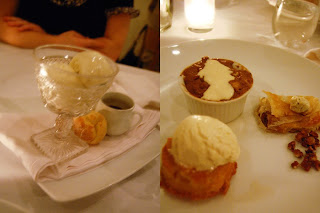
While I'd admitted defeat halfway through the lamb, there was one more course awaiting us... dessert. Between the two of us we sampled several of the treasures from the restaurant's talented pastry chef. Original Grace had a bit of homemade ice cream with knots of puff pastry and a small pot of fresh, warm chocolate sauce. I was presented with the trio of a dark bread pudding (broken and topped with a sweet vanilla cream sauce by the waiter); upside-down peach cake with homemade ice cream, and homemade baklava topped with Roquefort and a few caramelized nuts. Lord have mercy, I did not have the strength for all of this. I tried a bit of each and begged for a to-go box so that I could enjoy it at a later time.

ACT V

I spent a rainy Friday night with a dear friend, and several new friends, in the setting of a cozy candlelit restaurant in the heart of Cooper-Young. This neighborhood already feels like a world away from Memphis... While I was dining, I was chatting with the manager, and the chef and his wife were both there, working together and talking to the diners. With a small but constantly adapting menu based off local ingredients and seasonal quality, I really felt like I was in Europe, in some little bistro or trattoria. I love this city. It's my home, and when I walk into a BBQ joint there's no illusion as to where I am on this planet. But part of the magic of proper dining out is stepping into a fantasy world for a couple of hours. If you'd like to enjoy some of that feeling, give Grace Restaurant a try. I can't wait to see what sort of dishes are going to emerge from that kitchen as the afternoons darken, the ground hardens, and we slide into winter.

09 October 2009

1999 Mastroberardino Taurasi Radici

Welcome readers of the Memphis Flyer! For those of you outside of the mid-south, my Q&A with Hungry Memphis has been posted on the Flyer website.

Lately there's been a lot of collaboration and shared bottles/posts between Fredric and me. It's not a planned media strategy, just a confluence of occasions when we were able to sit down and enjoy some wines together. Since Fredric's wife is not a fan of veal, and The Roommate forbids it in our house, we took an opportunity to hang out over at Paul's and, beyond scorn, tuck in to some thick, well-marbled veal chops. Sort of a secret dining club, as it were. I need to get my hands on a suckling pig for the next such meeting.

These were chops of beauty, much like ideal ribeyes but far more tender and mild. Paul made an excellent selection, and I slow roasted them for an hour before searing them off in a skillet. (Alas, a pan sauce was not in the cards, as the olive oil ignited and sent a thin gray cloud throughout the house. We all screw up sometimes.) I served the lovely chops with white hominy grits cooked in chicken broth and flavored with Vlaskaas, a Dutch cheese traditionally made for field workers during the flax harvest. I topped the grits with sautéed garlic and wilted watercress; a far cry from instant grits with butter.

For the wine, I uncorked and decanted a bottle of the 1999 Mastroberardino Radici. 13.5% abv, 100% Aglianico from the Taurasi region just north of Naples. This was a gift from a US Naval officer stationed in Naples for several years, and the wine aged well in a variety of storage environments over the past decade. How's that for disclosure? This guy risked his life defending American security interests on a nuclear sub, and was kind enough to give me a bottle. Sorry if that conflict of interest makes you cry in your Cheerios, Federal Trade Commission. We all know that the greatest threat to freedom comes in the form of undocumented wine reviews.

The Aglianico grape has been grown in southern Italy for over 2,500 years, when Greek settlers planted it. Of course, the Greeks got it from the Phoenicians a few centuries earlier. Finally it arrives in my glass... This is definitely an Old World wine, full of earth and aromas not common to our California-Australia trained palates. Aromas of licorice, plum, a touch of ash, and and underlying soil scent. Flavors are tart, with deeper black cherry flavors but more earth and ash on the finish. I had the opportunity to serve this to half a dozen people, and the reactions were all over the place; some like that rustic European style and some don't. But those that liked it really liked it. And it was an excellent match for the veal: not overpowering, but not too mild either. It could really shine with wild game, organ meats, or other curious flavors... Since I've got another Aglianico waiting in the rack, I'll have to see what interesting dish I can find to pair with it.

07 October 2009

Benito vs. Poland: Polmos Bialystok Żubrówka

Yet another Eastern European treasure thanks to Dave R.! I first tried this a couple of years ago at his mom's house and he recently gave me the remainder of the bottle, with a few ounces left. Brought in from Germany, this is the authentic Polish liquor. More on that in a bit.

Żubrówka is a Polish rye vodka flavored with buffalo grass. (As you can see in the photo, this company includes a stalk of the grass inside the bottle for decorative purposes.) It has a wonderful aroma to it--not necessarily fresh green grass, but more the scent of a grassy field in autumn when most of it is brown. There's a powerful lavender aroma, tinged with vanilla and almond. Despite being so fragrant, it is mild and smooth and goes down easily. I can't possibly imagine how you might mix this for a cocktail, but it is very lovely on its own. Really just half a shot is perfect--you can sit back and sniff it for a while before slowly sipping the barely sweet vodka.

If you haven't seen a bottle like this recently, well, there's a reason for that. The authentic product shown here has been illegal in the US since 1978 due to trace amounts of coumarin (which occurs naturally in the grass), but like absinthe, a separate version that conforms to FDA regulations has been introduced to the US market. There are fierce arguments in the Polish-American community over these new products; I don't know enough about the issue to speak definitively on it.

Also... The bison is a symbol of the American prairie, right? What's it doing on a strange Polish vodka? There's also a European species of bison, the rare wisent. It was nearly eradicated between WWI and WWII, with less than 50 animals left in captivity and none in the wild. Since then there have been efforts to rebuild the population. For a similar tale, take note of the aurochs, the ancestor of our modern cattle and valuable domesticated food source for the past 8,000 years. The last one died out in 1627.

* * *

Quick Note About the New Rules

Thanks to the new FTC regulations concerning bloggers, I will begin posting disclaimers when I've received a bottle of wine, a book, or other product for review. A lot of the wines featured here arrived as free samples--I've never promised a positive review or even that I'd write about it. Nor have I ever received compensation or other gifts in exchange for positive reviews. All of the winemakers and public relations companies that I've dealt with have been professional and above board. While I haven't made big public statements about this, I do have a strong sense of ethics that has not been called into question in the nearly five years I've been doing this.

I haven't previously mentioned disclosure in posts because I think it looks clunky (imagine every movie review including a statement about who paid for the tickets, or the precise contents of the gift bag given at a premiere). It states right there below my photo that I accept samples for review. The decision handed down today only concerns new media--blogging, tweeting, etc. Old media writers are not impacted. There's a lot of confusion about this new policy, and the FTC has not made it clear what the precise requirements are for disclosure.

So here goes: at the moment I am writing this from my friend Paul's house. I'm currently enjoying a Coke Zero from his fridge. One of the freebies offered to me during my stay over here is access to the food and beverages in the kitchen. The Coke Zero was offered without expectation and will not impact my opinion of the quality of Paul's house should I choose to write about it in the future. The soft drink is crisp and somewhat bitter, with a flavor that is closer to Coke Classic than Diet Coke. Marketed at guys who don't want the calories but who might view Diet Coke as being a "female beverage", Coke Zero was introduced in 2004 and is sweetened with acesulfame potassium and aspartame.

05 October 2009

Benito vs. the Cold and Rain: Bœuf Bourguignon

Following a wine tasting with Fredric, I snagged a couple of leftover bottles of Mazzocco Zinfandel. We tasted through eleven bottles, and I've written previously about the wines during my visit to the winery. I'm not going to go into detail on the wines here, but I will note that fresh out of the bottle many of them are hot and hard to appreciate--15-16% alcohol on all of them, with a few creeping up a bit above 16%. However, with a day of rest after opening, or a few hours of decanting, they're really quite pleasant.

If you find yourself in possession of a pint of leftover red wine, then it's a good excuse to make the classic French dish Bœuf Bourguignon. I roughly followed the recipe from the New York Times, and in the attached article it was noted that the Julia Child recipe, while popular with the success of the recent movie, is too much for the residential kitchen. This is originally a peasant dish that is simply made in a single cooking pot.

I'm not bashing dear Mrs. Child here, nor am I slighting those loyal fans that have gone home and faithfully recreated her recipe. I'm sure it's delicious. But I've made demi-glace from scratch. It took 12 hours. I've made traditional Sauce Robert that took two days. I've helped cook a whole hog that required 24 hours of slow roasting. Sometimes I want the challenge and wish to dirty up every pot and pan in the kitchen. Other times I just want to make dinner.

Served over a bed of broad flat noodles and enhanced with a double quantity of mushrooms, the one-pot dish provided a satisfying dinner for the three of us at the table. Two went back for seconds, always a good sign. With cold weather right around the corner, this is a perfect fall/winter recipe that is even better as leftovers. As with many savory stews, the flavors mingle and improve with a day or two of rest in the refrigerator.

02 October 2009

Baked Ziti

Note: the Memphis area recently experienced two straight weeks of rain and cloudy skies. I had begun constructing a large boat out of gopher wood in the backyard, but fortunately the sun finally emerged. Hence the recent focus on slow-cooked comfort foods.

Baked ziti is mostly associated with Americanized Italian food, but there are similar recipes made in the old country. This dish had a starring role on The Sopranos, showing up after every funeral and appearing in every refrigerator. Who can forget such lines as "Where's the &#*@&#! ziti?" and "Who ate all the &#*@&#! ziti?"

Every family has their own "perfect" version of this dish, but as I'm unencumbered by actual Italian heritage and will not be disowned for deviating from Nonna's recipe, I decided to slap something together the other night.

I made a marinara sauce from scratch using whole peeled Muir Glen tomatoes. Great quality canned tomatoes, and the whole ones are the best for making any sort of sauce. (As tomatoes get damaged or bruised, they are processed as crushed or diced, and the lowest quality tomatoes end up in purées and pre-made sauces.) I blended the tomatoes, added a little garlic, some spices, and let it simmer for an hour to concentrate the flavors.

For pasta I used rigatoni, as the ridges help grab the sauce. I poured the cooked, drained pasta in with the sauce and then in the oiled casserole dish. Stir in some big dollops of ricotta (not enough to completely blend in), add some slices of cooked salsiccia, a layer of mozzarella and grated parmesan, and throw it all in a hot oven for half an hour.

It tasted great, but one of the true joys of baked ziti is that, like many casseroles, it improves with a day or two in the fridge. If you have some extra marinara lying around, you can add a bit to the pasta as you heat it up, but it's fine on its own.

The condensed recipe, more or less:

Baked Ziti
1 lb. tube-shaped pasta (rigatoni, penne, etc.)
30-40 oz. pasta sauce, canned or homemade
1 small tub ricotta cheese
1 cup shredded mozzarella
1/2 cup shredded parmesan

Boil the pasta, heat up the sauce. Drain the pasta, add to the sauce and gently mix. Throw it all in a greased 9x13 dish and lightly mix in a few big dollops of ricotta. (If you want, you can add in some cooked sausage here, or leftover shredded chicken, or vegetables/mushrooms/whatever.) Sprinkle the mozzarella, sprinkle the parmesan, bake at 400°F for half an hour... Done!

30 September 2009

A Late Night Snapshot

Much like Gallia, this post est divisa in partes tres.

The Cigar
I recently picked up a solitary Hoyo de Montoya Dark Sumatra Media Noche, 5.7" x 54, from Honduras. Ecuadorian wrapper, Connecticut binder, and a blend of Dominican and Honduran filler. While being nearly black in color, this is a mild and smooth cigar with wonderful spice aromas and a rich, savory flavor. The construction is impeccable and I don't think I've ever had a cigar that burned this evenly. Plus, I'm a sucker for cedar-wrapped cigars. It looks classy and I like the flavor/aroma that comes from such contact.

The Beverage
Ever since Sam turned me on to Madeira, I try to keep a bottle in the house. In the current rotation is the Sandeman Fine Rich Madeira. Retailing for around $15, this is an excellent introductory Madeira that has the complex spices, raisin qualities, and slight sweetness indicative of the style. It is a bit more tart and harsh than the more well-aged varieties, but it hits the spot when an after-dinner splash of fortified wine is required.

The Book
One little treasure of my eclectic home library... The Schwa World Operations Manual. It's been out of print for years and pristine copies can fetch upwards of $150*. What is it? The Schwa Corporation was a graphic design project by Bill Barker. This book, which came out in 1997, details an alien takeover of the earth and how the human population will be controlled through dummy companies, advertising, and propaganda. The entire book is designed in stark black and white--no gradients or shades of gray. On top of that the only font used is Gill Sans, though often manipulated in interesting ways.

The book was an underground hit at the time, and a source of confusion for many others as there's no plot or apparent logical organization. It was also repeatedly vandalized at bookstores; if you're buying a copy make sure that it has the membership card, postcards, and stickers in the back. I've been carrying around my Schwa Planet Operator ID for over a decade now.

Barker fell off the radar for a while, but was recently the subject of a search at BoingBoing during which he was successfully located and appears to be working on a new project.

*I bought my untouched first edition for $1 at a Friends of the Library sale in 1998.

28 September 2009

2005 Barón Balch'é Reserva Especial

The Roommate doesn't drink, but she was kind enough to snag me a bottle of Mexican wine during a summer trip to Cancún. I told her, "I don't really care what it is, I just want to be able to say I've tasted a Mexican wine." She found a shop with a helpful proprietor. To use a baseball metaphor, I was expecting a foul ball or perhaps a single. Instead, The Roommate knocked it out of the park.

The wine she got was the 2005 Barón Balch'é Reserva Especial from the Valle de Guadalupe in Baja California, Mexico (just south of the US border). This is a beautifully restrained 12% abv--it drinks like silk. I've had similar low alcohol wines from places like Israel and Turkey, which runs counter to the conventional wisdom that the closer you get to the equator, the higher the alcohol must be.

It's a proprietary blend of Cabernet Sauvignon, Merlot, Cabernet Franc, and Syrah, much like a lot of the creative blends coming from California in the US. It's got a blackberry nose with a touch of leather. Good berries: cherry and blackberry, with a lingering cassis flavor on the finish. For a hotter climate this is surprisingly smooth and mild, far more delicate than you would imagine. I served it with a Tex-Mex dinner of turkey tacos and baked beans (trio of black, kidney, and pinto--good flavor combination). However, this could be outstanding with any grilled or roasted meats.

Food & Wine has an informative article on the wines of Baja California. And as that writer points out, Mexican wines are difficult to find outside of the country, but I would strongly suggest trying some of the more European-styled wines like the Barón Balch'é. You can add another wine country to your merit badge sash, and get to enjoy a delicious bottle in the process.

The name is unusual, and on first glance it looks more Hebrew than anything else. But it's actually a combination of Spanish and Mayan, meaning roughly "noble ceremonial beverage".

Now for the fun part... I had this with dinner the night before I was going to meet up with Fredric Koeppel for a wine tasting, and couldn't resist the opportunity to give him a blind pour. You can read his full writeup on his blog. Part of it was just the joy of sharing an obscure wine with a friend, but I also needed to, in some small way, get revenge for his classic Blind Petite Sirah Tasting that stumped a room full of wine lovers, retailers, and certified experts.

P.S. Lots of people ask me, "Should you sniff the cork when you open a bottle of wine?" I've never learned anything useful from smelling a cork, but looking at it closely can be helpful. The cork on this one was constructed well, no leakage, mold, or other problems, but it was a 2004 cork in a 2005 wine. Is this a big deal? Not for this wine. There's not a big collector market in Mexican wine and it's a pretty recent vintage. Most likely they just had extra 2004 corks lying around and wanted to use them up. If you're shelling out a lot of money for a special bottle, it's a different story. If the cork is from a different region, different winery, or substantially different year, then you might have a counterfeit bottle on your hands, the restaurant might be committing fraud, or other foul play is afoot. Check out the New York Times Freakonomics blog for a story on the trade in empty wine bottles from highly collectible vintages.

25 September 2009

Noilly Prat, Before and After

Back in January I read a terrifying article in the Wall Street Journal: the formulation of my beloved Noilly Prat dry white vermouth was changing. I socked away a few bottles and ignored the new stuff for a while, putting off the inevitable switch as long as possible. As has been discussed many times here and elsewhere, martini drinkers are stubborn creatures and a change to the most delicious, widely-available white vermouth struck fear in many hearts.

Eventually it was time for a new bottle, and I figured that I should give the new and old formulas a fair taste test. It couldn't really be blind--one is obviously sweeter and darker than the other. But I sought to evaluate them fairly.

Things may get a bit confusing here, as the "new" vermouth (pictured on the left) is actually the original European version that has been made on the other side of the Atlantic for 200 years. The "old", brighter, drier version (on the right) was a separate product developed for the American market around the 1940s and sold until this year. I'll just use the terms European and American to avoid confusion.

I tried both straight (if your vermouth tastes bad on its own, you're using cheap, nasty, or stale vermouth) as well as in a 4:1 ungarnished martini made with New Amsterdam gin.

American Version
Tasted on its own, it is light and tangy, like a Bordeaux Blanc made mostly from Sauvignon Blanc (although it's actually made from southern French grapes, mostly Picpoul de Pinet and Clairette). Crisp and herbal. In a martini... well, this is the house martini here at Casa de Benito and I've had it too often to be objective. But it provides a dry, bracing flavor to the cocktail.

European Version
Just like the new 2 liter Coke bottles, curves were apparently necessary. The WSJ is correct in that the flavor is closer to Lillet Blanc, though nowhere near as sweet. It is easier drinking as a strait apéritif where it has lower acidity. Made into a martini, it smooths out the gin considerably for what I felt was a great drink. If you want the additional acidity, a twist of lemon or a dash of lemon bitters will take care of that quickly.

Neither version is really superior to the other, but they are different. I will still be on the lookout for another, purely dry white vermouth, but for the meantime I'm happy to have this in the bar. I think the WSJ assessment (and my own initial reaction to the news) was unfair, and I would highly recommend trying out this European version if you get the chance.

23 September 2009

Drinking Local: Bluff City Brewing

Recently I got a chance to meet up with fellow Memphis blogger and home brewer Brett Donnals of Bluff City Brewing. Not only does he make his own beer, but he's growing his own hops! He was kind enough to pass along some samples of his brews, and I was really excited to give them a shot.

A note on home brewing: You can make wine in your kitchen, but it's probably going to be worse than 99% of the wine available in the store. On the flipside, it's possible to make beer in your kitchen that is better than 99% of the beer available in the store. Because of the shorter fermentation period and the fact that you're not constrained by the seasons, it's quicker to learn how to make decent beer and the production is not dependent on sunlight, weather, geology, etc. Unlike Coors or Budweiser, you can change your recipe every week to suit your tastes without alienating millions of customers.

Plus beer is pretty forgiving of additional flavorings and ingredients. Want to make a pumpkin, blueberry, strawberry, or cardamom-star anise beer? Want to use a recipe from the Revolutionary War, Medieval Germany, or Ancient Egypt? Go for it! This creativity, innovation, and rediscovery is happening in garages and basements all across the United States. Some of your neighbors are likely into the hobby.

The numbers given for each of the beers reviewed here are IBUs, or International Bitterness Units. The higher the number, the more bitter the beer, though other flavorings and methods can impact the final taste and balance.

From left to right as pictured:

American Pale Ale, 53.3 IBUs.
Crisp and light, with medium bitterness and an overall refreshing quality. This one tasted best cold, straight out of the fridge, and had a short but tasty finish. Try this with a natural-case bratwurst that has a good "snap" to it and you'll learn why beer and sausage were meant to go together.

American Brown Ale, 62.8 IBUs.
Similar in style to Newcastle, but more bitter and with a lighter body. A great all-around beer for many different kinds of food. It stood up well to both white and supreme pizzas from Memphis Pizza Cafe. I can imagine this beer being great for Thanksgiving, preferably served from half-gallon growlers.

American Stout, 75.6 IBUs.
This pours an almost black color with a dark brown head, and has elements of coffee and chocolate. This one I felt was best as an after-dinner beer, particularly after it had come up to near room temperature. Cold it was difficult to get all the flavors; warmer it opened up and made for a smoother drink. Despite the highest IBU rating, it was well-balanced and delicious.

* * *

Homebrewers are fun people to know, and a lot of times there's a few extra bottles or experimental batches rattling around in the back of a fridge somewhere. Check out Brett's blog, where he posts photos of the beermaking process as well as providing information on other microbreweries and local beer events.

21 September 2009

Chicken Tikka Masala & Southampton Altbier

A British dish, influenced by India, paired with an American beer, influenced by Germany. It's like a complicated wedding right on the table.

Like anyone else that's been to an Indian restaurant in the United States or Great Britain, I've enjoyed the big plate of chicken tikka masala from time to time. It's pretty well known by now that this is not an authentic Indian recipe; although its precise origins are unclear, it was developed in the UK as an attempt to adapt Indian food for the British palate.

I looked at several dozen recipes online, and none of them matched up. I'm not talking about a difference of a certain spice or cut of chicken. The only consistent part of any chicken tikka masala recipe is... chicken. For instance, the red color can come from food coloring or tomatoes. (And it doesn't have to be red; varieties from yellow to deep crimson exist.) For the tomatoes, the quantity required for a recipe serving four varied from a tablespoon of tomato paste to a 28 oz. can of crushed tomatoes. Adding a creamy texture? Optional, but cream, milk, yogurt, or coconut milk are used, all of which behave differently when cooked.

I decided to ditch the recipes and just freestyle it. Half a stick of butter, an onion, a bell pepper, all sautéed. Add in some garam masala and a healthy dose of cayenne pepper. Throw in a big can of crushed tomatoes. Blend, allow to simmer. Add yogurt. Mix in leftover chicken and let simmer for a while.

The result wasn't perfect, but it was definitely edible. Not quite like what I've had in restaurants, but it worked OK. I made some basmati rice and picked up some naan from the grocery store. (Yes, it is easy enough to make naan, but I was using up leftovers and trying to keep things simple.)

When it comes to Indian food, I prefer beer to wine, though you could probably crack open a Gewürtztraminer. I picked up a sixer of a beer I'd never seen before, the Southampton Publick House Altbier brewed on Long Island in New York. It pours a dark amber color with a head that disappears quickly. It's lightly hopped and has a bittersweet quality to it--well balanced. Slight roasted quality, but what I love most about this beer is that it's got a great malt flavor, something I haven't had in a beer in a while. In fact, this Düsseldorf-style beer is similar to the Germantown Alt I cut my teeth on at the dearly departed Bosco's in Saddle Creek. Don't get me wrong, I love the beers at the Midtown location, but I miss having a brewpub on this side of town.