Paul and I were hanging out with the girls, and Plan A for take out fell through, so I suggested we run to the store and grab some steaks. A local chain had a sale on Porterhouses (around $8.75/lb), so I had the butcher cut a pair of 1½ pound steaks from a fresh primal, which would then be dusted with Kosher salt and ground pepper, grilled over fire and sliced up for the table: the tenderloins for the ladies, the New York strips for the guys. Worked out quite well, particularly when topped with a little soft Danish bleu cheese and caramelized onions.
The Porterhouse is one of my favorite cuts of beef, though I hate to see it sliced into thin, half pound steaks and stacked in the meat case. I really prefer to serve it like I listed above, because the thicker cut provides the most flavor and allows proper caramelization on the outside and lovely rare pink inside. And if you get one that's three or four inches thick, you can effectively cook it as a roast and carve off pieces for an entire table.
For the wine, I brought along the 2004 Pannotia Malbec, a $10 bargain from Argentina. Not the best Malbec I've ever had, but definitely workable. Blackberry and blueberry flavors dominated, with a whiff of leather on the nose. Medium tannins, easy drinking. Malbec is one of my favorite "pizza & burger" wines, though the right one can be the match for much more sophisticated fare.

20 December 2006


18 December 2006
2005 Bell Rosé
One of my holiday traditions is to cook a Thanksgiving/Christmas dinner on some day that's between the two official holidays. I do this for two reasons: 1) it's a good way to celebrate with friends without keeping them from their families and 2) I get plenty of leftovers, which is something you don't get when attending big family gatherings.
Since The Girlfriend was out of town for Thanksgiving and will be out of town for Christmas, Saturday served as our intermediate "Festivus" get-together. I roasted a smallish turkey (glazed with apple cider, mustard, and honey), made some homemade cranberry sauce, roasted some acorn squash with brown sugar (her favorite), and rounded out the list of solidly American ingredients with some wild rice cooked in chicken broth.
 For the wine, we had the 2005 Bell Rosé.
Very dry, but with a full, fruity mouthfeel. It's almost like a white wine in most of its profile. Subtle aromas, but with some cherry flavors on the palate. 62% Syrah, 27% Zinfandel, 6% Cabernet Sauvignon and 5% Viognier. (The previous version was mostly Zinfandel.) Best way to describe it: imagine something like a Sauvignon Blanc with some of the berry flavors of a good Syrah but with none of the tannins.
Just an aside, and I have no way of proving this, but when I met founder and winemaker Anthony Bell at a local tasting, I was sipping one of his delicious Syrahs and casually asked if he ever blended in some Viognier like a Côte Rôtie. He laughed and said that such mixes were increasingly popular in Australia, but no, he hadn't tried it.
Now here it is in 2006, and I'm drinking a Bell wine that's mostly Syrah with a little Viognier...
14 December 2006
Stargazing
Wednesday night, I stayed up to watch the Geminid meteor shower. We had a good cold crisp and clear sky, but unfortunately, the meteor activity visible from Memphis was not spectacular. I spent a couple of hours in the backyard with a few mugs of hot tea and saw maybe a dozen meteors. I wasn't able to get any photos of shooting stars, but while I was out there I caught a couple of famous constellations (as always, click for full-size):


Pleiades

Orion

And a couple of years ago, I shot this photo of the moon:

13 December 2006
Benito vs. the Produce Section: Napa Cabbage
 When you choose to focus on the weirdest parts of your local grocery store, you sometimes wonder how long certain products have been lingering beneath your unknowing gaze. For instance, the vegetable for this installment is Napa Cabbage, yet another ingredient that goes by many names. And hey, it's been cultivated for 6,000 years!
I was lucky enough to encounter this interesting vegetable at the same time as my desire to try traditional Korean kimchi. It's sold in glass jars at some grocery stores, yet I've never got around to purchasing any.
 I love sauerkraut and spicy food, so I'm bound to like kimchi. A conversation with a Korean friend of mine over Thanksgiving inspired me to make my own. So I looked up many recipes, and found many wildly divergent methods. I ended up picking Bobby Flay's recipe. I had all of the ingredients on hand, and it looked like fun.
For this particular recipe, the ingredients mixed in the blender smelled and tasted like a really incredible salad dressing. Sadly, Napa cabbage doesn't taste all that great raw. (I always try these odd ingredients raw and cooked/prepared.) It's sort of like bitter regular cabbage, even though the bunch looks like a slightly more bulbous version of romaine lettuce. (I did remove the hard core at the center.)
 Here's what the jar looked like on day one, right after combining the ingredients. I really had to pack all of the cabbage in the jar, but after only a few minutes wilting had begun and I was able to stir the mixture with ease.
Over several days it condensed down to a third of its original volume, and developed a lovely aroma. Granted, my roommate wasn't thrilled by the smell, but after I tightened the lid it didn't permeate the entire kitchen... er, house. (Kimchi-scented ice cubes turned out to be a unique addition to a glass of water over the past week, but I wouldn't recommend it on a regular basis.)
So what to eat with it? I considered making bulgogi or kalbi tang, but compromised and made some braised beef short ribs (with a little honey, soy sauce, and pepper flakes added). This dinner is just Korean-inspired, and does not aim to be authentic.
 The beef was braised in, and the dinner served with the Schlafly Coffee Stout from St. Louis, Missouri (scroll down to the October seasonal beers). Why not wine? Granted a sparkling wine or Riesling might have matched well, but I find a cold one tends to be a better match for certain dishes. The beer does in fact smell and taste like really good coffee, yet has the mouth feel of a creamy dark beer. Imagine Guinness with a coffee flavor and you've got a good idea. The coffee flavor is provided by Kaldi's Coffee using Fair Trade beans. It made an incredible broth for the beef and was a good pair with the meal. For future use, I'd suggest it as an after-dinner beer served in small cups.
As for the kimchi? Mind-bogglingly delicious. A perfect balance of sour, tart, sweet, spicy, with a pleasant crunch to it. Mine isn't as red as some kimchi--I skipped the paprika or powdered red pepper, but it tastes great. It has a flavor somewhere between a vinegar-based slaw and sauerkraut with lots of heat (keep in mind this recipe used a full quarter cup of red pepper flakes like you see at pizza joints). I'll also point out that it worked well with the meal, even if it wasn't exactly Korean. The bright, tangy nature of the kimchi balanced against the buttery rich short ribs and the starchy rice.
Verdict: Kimchi rocks. I'm anxious to try some more traditional preparations.
11 December 2006
New Blog + Memphis Blogs
Fredric Koeppel has a new blog that launched last week, called Bigger Than Your Head. He will be continuing his work on his more formal site, Koeppel on Wine. For those outside of the Memphis area, Fredric's been writing in the newspapwer about restaurants, food, wine, and the arts for The Commercial Appeal since... I don't know how long. Let's just say that I'm 30 and remember reading his reviews in the Friday Playbook section when I was 9 and started reading the paper regularly. In fact, he probably has the distinction of being the first food or wine writer that I ever read. In the past year, we've enjoyed a friendly e-mail correspondence. He's been a frequent commenter here, and I'm glad to welcome his new blog.
 And while I'm posting this, why not point out a couple of other Memphis wine and food bloggers? Sprinkled throughout are some photos I've taken Downtown.
Note: some of these folks I've written, and some have linked to me but I haven't heard from them. Drop me a line, and certainly if I hear of any more Memphis wine or food blogs, I'll add them to this post and to the eventual blogroll on the left.
Presented in no particular order...
 Mantia's Musings by Alyce Mantia. Alyce is the proprietor of Mantia's, a local shop that is the best source of proper cheese and paté in the city. Plus, they host cooking demonstrations and let you bring your own wine. In fact, the first $100+ wine I had was at a cooking demo/wine party at her establishment back when I just turned 21.
Dining With Monkeys by Stacey Greenberg. I've written about this site before, but it reviews local restaurants with a focus on what it's like to eat there with small children. Often amusing, and Stacey shows up occasionally in the local alternative paper, The Memphis Flyer.
 Midtown Stomp. Written by a local guy who recently completed his Sommelier certification. Includes writing about food, wine, and recently, a trip to the California wine country.
See Sip Taste Hear by Collin. Wine reviews from a local blogger, and he's got a sister site that lists upcoming wine events--currently down for maintenance, but I'm sure it will return.
Rachel and the City by Rachel Hurley. I think we went to high school together, albeit a couple of years apart. Some posts on food, but is focused on much broader social activities in the Memphis area.
 Squirrel Squad Squeeks. Local restaurant reviews.
Dr. Hoo's Memphis Restaurants. More local restaurant reviews!
Please check out these great blogs, and following the links of related blogs will take you to other local writers covering all sorts of topics here in the River City.
08 December 2006
Peking Duck: Attempt #1
One of the joys of cooking is that, in our modern age with access to all sorts of varied ingredients, as well as the ability to grow just about anything in this rich Delta soil of southeast Tennessee, if you've got the knowledge, time, and inclination, you can try dishes from all over the world without spending a lot on a plane ticket.
Now, I'm not going to admit that I can in any way replicate the sheer pleasure found in eating baby octopus freshly caught off the Ligurian coast of Italy and either flash-fried or cooked in a sort of bouillabaisse. There are certain local, fresh ingredients that don't travel well. But there are plenty of others that do, and more importantly, techniques can be learned and applied worldwide.
For instance: Peking Duck. Never had it in a restaurant. I've had duck in various Chinese joints, but not that particular dish. And with fresh ducks cheap and plentiful these days, I decided to try it out... Though I didn't quite succeed. For those of my readers who think that I do everything perfect on the first try, this is an example to the contrary.
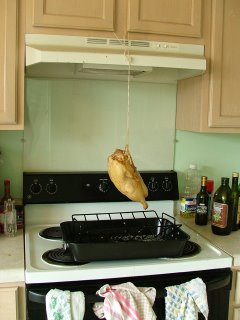 The bizarre photo to the right is of my humble stove in la cucina di Benito. I trimmed the duck (saving all of the scraps for stock), boiled it for a while, dried it, rubbed the interior with salt and sugar and the exterior with molasses, and then hung it to dry with the roasting pan to catch anything that fell. Yes, that's a trussed duck hanging from the partition between two cabinets above my stove.
Normally you hang a duck like this for hours or days in a cool room (preferably with the head and feet on, and you need to be working a busy stall in Kowloon smoking a cigarette and wondering if you're going to sell enough dried jellyfish to make the evening worthwhile). I was impatient and had a dinner guest on the way. So I cheated and used a blow dryer. Yes, for half an hour I worked over the bird, discovering that if it's hanging like this, you can make it spin just with the force of air from the hair dryer. From here the duck went on the roasting rack and then baked at 375° for just shy of an hour.
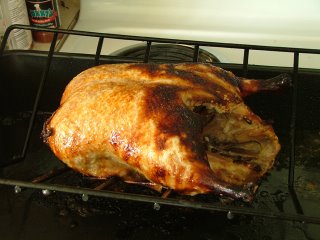 The final product, certainly not the crisp and lovely mahogany bird of legend. However... The skin around the thighs and legs was perfect, nicely dry, crispy, and caramelized. And the meat throughout was wonderful, if a little more on the medium-well side. At home, I generally eat the breast in a genteel manner with fork and knife, and then consume the leg and thigh by hand. I served it with some couscous, freshly steamed broccoli, and the 2004 Francis Coppola Claret, a wonderful wine that isn't being made anymore.
What have I learned from this experiment? Apparently part of the secret of crispy duck skin is to remove as much fat as possible beforehand, and the thighs definitely had less fat than the breasts. Once it gets nice and cold and bugs aren't an issue, I might try this again and hang the duck in a mesh bag in a dark corner outside for a day or so and see how it dries out.
Now, I'm not going to admit that I can in any way replicate the sheer pleasure found in eating baby octopus freshly caught off the Ligurian coast of Italy and either flash-fried or cooked in a sort of bouillabaisse. There are certain local, fresh ingredients that don't travel well. But there are plenty of others that do, and more importantly, techniques can be learned and applied worldwide.
For instance: Peking Duck. Never had it in a restaurant. I've had duck in various Chinese joints, but not that particular dish. And with fresh ducks cheap and plentiful these days, I decided to try it out... Though I didn't quite succeed. For those of my readers who think that I do everything perfect on the first try, this is an example to the contrary.
 The bizarre photo to the right is of my humble stove in la cucina di Benito. I trimmed the duck (saving all of the scraps for stock), boiled it for a while, dried it, rubbed the interior with salt and sugar and the exterior with molasses, and then hung it to dry with the roasting pan to catch anything that fell. Yes, that's a trussed duck hanging from the partition between two cabinets above my stove.
Normally you hang a duck like this for hours or days in a cool room (preferably with the head and feet on, and you need to be working a busy stall in Kowloon smoking a cigarette and wondering if you're going to sell enough dried jellyfish to make the evening worthwhile). I was impatient and had a dinner guest on the way. So I cheated and used a blow dryer. Yes, for half an hour I worked over the bird, discovering that if it's hanging like this, you can make it spin just with the force of air from the hair dryer. From here the duck went on the roasting rack and then baked at 375° for just shy of an hour.
 The final product, certainly not the crisp and lovely mahogany bird of legend. However... The skin around the thighs and legs was perfect, nicely dry, crispy, and caramelized. And the meat throughout was wonderful, if a little more on the medium-well side. At home, I generally eat the breast in a genteel manner with fork and knife, and then consume the leg and thigh by hand. I served it with some couscous, freshly steamed broccoli, and the 2004 Francis Coppola Claret, a wonderful wine that isn't being made anymore.
What have I learned from this experiment? Apparently part of the secret of crispy duck skin is to remove as much fat as possible beforehand, and the thighs definitely had less fat than the breasts. Once it gets nice and cold and bugs aren't an issue, I might try this again and hang the duck in a mesh bag in a dark corner outside for a day or so and see how it dries out.
03 December 2006
Tasting Notes for December 2, 2006
With the holidays and other commitments, it's been a while since I've been to a proper wine tasting. What better way to get back in gear than with a sparkling wine tasting?
Note: All of these wines are Non Vintage unless otherwise specified. Also, I've had about half of these wines before, but it's always interesting to give something a second try.
Wine 1: Louis Perdrier Brut Blanc de Blanc. Beaune, Burgundy. There's a little toasted bread on top, and the flavor is slightly tart with a short finish. A little bit of an odd aftertaste, but it's still a great bargain if you're making cocktails or just want a bottle of bubbly to open. $9.
Wine 2: Segura Viudas Aria. Catalonia, Spain. A lovely sparkling rosé made of Pinot Noir. Definitely a fun wine to drink. Strawberry flavors and aromas are present though subtle, with a fruity nose and crisp mouth feel. $12.
Wine 3: Nino Franco "Rustico" Prosecco. Valdobbiadene, Italy. The sheet provided at the tasting notes that this is the wine used to make the first Bellini at Harry's Bar in Venice. (A Bellini is just sparkling wine mixed with either a fresh peach puree or peach juice.) There are some apple aromas, clean with a crisp flavor and fairly neutral but not bad. Dry and refreshing. $18.
Intermission: On Wine #4 and Wine #12, I got an aroma of roast duck right off the bat. It's the first time I've encountered this in a wine, and though the first one could have been a fluke, the second time confirmed it. Maybe it's just because of the amount of duck I've had in the past month, but it was spot-on. I'm guessing that it's a combination of the toast aromas you often get in sparklers, combined with a little gaminess and maybe just a hint of sulfur. I don't want it to sound like a flaw--it was wonderful, just surprising.
Wine 4:
Gloria Ferrer Sonoma Brut. Sonoma, California. Aside from the roast duck aroma, it's got solid fruitiness, a little tart, dry and with a clean finish. $18.
Wine 5: 2003 Bailly-Lapierre Crémant de Bourgogne Rosé. Burgundy, France. Creamy cherry aroma, some bright berry flavors. Soft finish, a nice fun wine. And I'm always up for a roseé. $20.
Wine 6: Schramsberg Blanc de Noirs. Napa, California. Fresh bread dough aromas, some vegetal and slightly herbal flavors, with a crisp finish. A well balanced and mature sparkling wine. $35.
Wine 7: Nicholas Feuillatte Brut Champagne. Champagne, France. Very mild and smooth, dignified. Dry and properly balanced. $40.
Wine 8: Louis Roederer Brut Premier Champagne. Champagne, France. From the producer of the famous Cristal. Strong toasted bread aroma, light citrus elements, wonderful aftertaste and crisp bubbles. Pretty amazing for the price. $45.
Wine 9: 1995 Perrier-Jouet Fleuer de Champagne Brut. Champagne, France. Dark and musky aroma, almost like a Muscat-based wine. Lemon custard flavors, with a little spice cake on the finish. Probably the star of the tasting. $140.
Wine 10: Mumm Cuvée M. Napa, California. Light aroma, creamy mouth feel, with a slightly sweet finish. $20.
Wine 11: Schramsberg Crémant. Napa, California. Lovely, light sweetness, creamy flavor and utterly delicious. $35.
Wine 12: Chandon California Rosé. Napa, California. Again, I got roast duck on the nose. The flavor was full fruit, but pleasantly dry and not sweet. Also, the wine isn't anywhere near as bright pink as it looks on the website. $20.
01 December 2006
Benito vs. the Produce Section: Chayote
I'm fascinated by ingredients that are native to the American continents. Where would world cusine be without the tomato and pepper? I love finding fusion recipes for things like wild rice and bison and cactus. Today I'll be focusing on another New World family, that of the squash.
 The chayote is a pear-shaped and -sized squash that goes by many names. My favorite is the one used in the French Caribbean islands: christophene. Oddly, the Larousse Gastronomique uses the English term "custard marrow", akin to the use of the word marrow when referring to a large zucchini.
Back in 2003, I was on a major squash kick. I'd had yellow summer squash, cucumbers, and zucchini before, but had somehow skipped the various winter squash. Except for pumpkin, but those are generally used around here in the canned variety or as simple decoration in the fall. I went through acorn and butternut and turban squash, as well as a few unnamed hybrids that would show up from time to time at the farmer's market.
 For the preparation of the chayotes, I found a recipe that suggested softening them in hot oil and then cooking with some cream for a bit, followed by a topping of sliced green onions. Most chayote recipes seemed to use them just for bulk, and I wanted to really focus on the flavor of the squash. I'd heard it referred to as "mild" before, but it's pretty flavorless. In general, I'd compare it to a cross between a cucumber and a honeydew melon, yet watered down. It's clean and crisp, and ever-so-slightly sweet, but more confusing than anything else.
Final verdict: I don't know if I'll be incorporating chayotes into any dishes in the future. Maybe some raw diced pieces in a salsa fresca over seafood. Maybe as a mystery ingredient in a salad. It doesn't taste bad, there's just not enough flavor there to make it a significant ingredient. They are, however, quite easy to peel with a standard vegetable peeler. The skin is only about as thick as that of an apple or potato, unlike the thicker rind of some squash varieties.
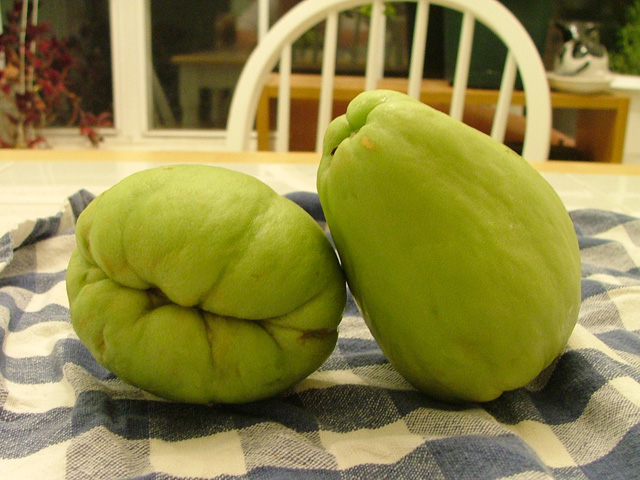 The chayote is a pear-shaped and -sized squash that goes by many names. My favorite is the one used in the French Caribbean islands: christophene. Oddly, the Larousse Gastronomique uses the English term "custard marrow", akin to the use of the word marrow when referring to a large zucchini.
Back in 2003, I was on a major squash kick. I'd had yellow summer squash, cucumbers, and zucchini before, but had somehow skipped the various winter squash. Except for pumpkin, but those are generally used around here in the canned variety or as simple decoration in the fall. I went through acorn and butternut and turban squash, as well as a few unnamed hybrids that would show up from time to time at the farmer's market.
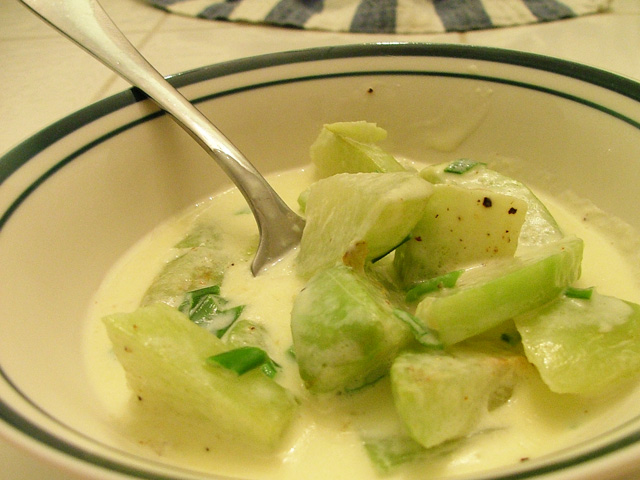 For the preparation of the chayotes, I found a recipe that suggested softening them in hot oil and then cooking with some cream for a bit, followed by a topping of sliced green onions. Most chayote recipes seemed to use them just for bulk, and I wanted to really focus on the flavor of the squash. I'd heard it referred to as "mild" before, but it's pretty flavorless. In general, I'd compare it to a cross between a cucumber and a honeydew melon, yet watered down. It's clean and crisp, and ever-so-slightly sweet, but more confusing than anything else.
Final verdict: I don't know if I'll be incorporating chayotes into any dishes in the future. Maybe some raw diced pieces in a salsa fresca over seafood. Maybe as a mystery ingredient in a salad. It doesn't taste bad, there's just not enough flavor there to make it a significant ingredient. They are, however, quite easy to peel with a standard vegetable peeler. The skin is only about as thick as that of an apple or potato, unlike the thicker rind of some squash varieties.
29 November 2006
2000 Campo Viejo Tempranillo Reserva
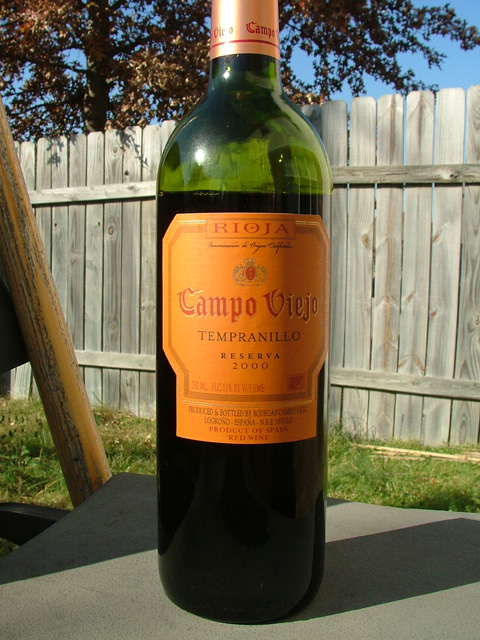 Sometimes you have to wait until after a meal to make a good wine match.
I had lunch at a little Mexican joint here in Memphis--La Guadalupana if you're interested. It's one of those great little places that breaks out of the tacos & fajitas structure you see in the more mainstream Mexican restaurants. Those items are on the menu, but you also get a wide range of soups and seafood options, as well as dishes incorporating more authentic (but scarier to your average gringo) ingredients like tripe and tongue.
I was in the mood for something different, so I went for the barbacoa de chivo, goat braised in a rich broth made with guajillo peppers. Served with some fresh corn tortillas and the standard beans and rice, though the refried beans had a wonderful smoky flavor that hinted they had been made from scratch with love.
Goat, in case you haven't had it before, is somewhere between lamb and pork in flavor and generally has to be cooked for a while before it gets tender. The food was fantastic (particularly with the thick green hot sauce on the table), though when I got home I helped myself to a glass of Spanish wine while the taste was still lingering in my mouth. The 2000 Campo Viejo Tempranillo Reserva is from the Rioja region of Spain. (Today's Spanish lesson: Campo Viejo means "old country" or "old field".) Still some strong fruit and tannins for a six year old wine. I get some dried strawberry flavors, with that sort of ashy finish you get with some Old World wines. Occasionally reminiscent of spiced cider at Christmas.
Next time I might just have to get the goat to go.
27 November 2006
Benito vs. the Produce Section: Brussels Sprouts
 I'm amazed at all of the various members of the cabbage family that are essentially the same plant, much in the same way that a Great Dane and a Chihuahua are the same subspecies of wolf: broccoli, kale, cauliflower, collard greens, kohlrabi... There's a dozen more, but today I'm focusing on the Brussels Sprout.
I never had to eat this as a child, which meant that I never had any particular love or hate for it. Maybe my parents didn't like the sprouts, or they just never got around to fixing them, and I've never seen them in restaurants, but I've made it almost three decades without tasting the little green orbs. I say almost because last year I boiled up some, tried to eat them, and found them horrendous. However, I recently learned that some Yankees enjoy Brussels Sprouts as a Thanksgiving side dish. The secret: bacon.
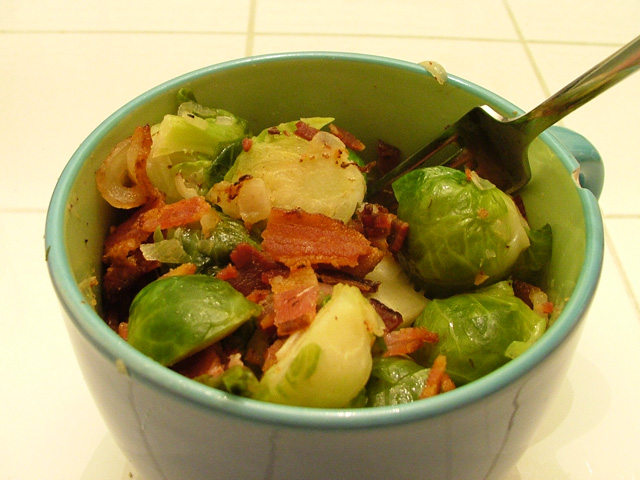 Going by a Yankee recipe, I cooked three strips of bacon and set aside the meat for topping at the end. (A note on this: my local grocery store has incredible thick-cut bacon at the butcher counter. I'm notorious for buying only three or four strips at a time. It's more expensive per pound, but the quality is much better and I don't normally buy bacon unless it's for a recipe.) A shallot went into the bacon fat until clear, and then I tossed in the sprouts (washed, trimmed, and halved on the longitudinal section). Cooked for a while, added some chicken broth, and let simmer until tender.
Wow. Granted, the salt and savory flavors from the bacon and broth really help, but something about the preparation brings about an essential sweetness of the Brussels Sprouts that's rather nice. While these were cooking, I made a batch of turkey meatballs... ground turkey, breadcrumbs, sautéed mushrooms, egg, a dash of the leftover fennel & tomato soup, and a little soy sauce. Baked until nice and brown.
I know it's an odd dinner. I had this for a late meal and found it pleasantly filling and delicious.
25 November 2006
Thanksgiving Roundup
I attended Thanksgiving over at Paul Jones' place. He had a bunch of family and friends coming over, and I tagged along. In addition to the incredibly moist turkey prepared by Paul and the dozen side dishes and casseroles brought from afar, I supplied two fresh cranberry sauces (one traditional, one with orange and mint) and a roast pork loin (braised in hard cider, glazed with apple jelly, mustard, and Bourbon).
Paul enlisted my help in the search for wines, and a trip to the wine shop yielded a half dozen bottles. Those actually consumed have all been mentioned on this blog at one time or another: Kim Crawford Sauvignon Blanc, Beaujolais Nouveau (got to introduce a few folks to their first sip of Beaujolais!), and the Hayman & Hill Chardonnay. I don't obsess over wine pairings with Thanksgiving; there's too many dishes with too many conflicting tastes, and I figure it's best to go with something fun and easy-drinking that will appeal to a broad range of palates and wine experience.
After dinner, the gentlemen retired to the back porch to take advantage of a few treasures brought back from Brazil by Paul Schwartz: Pousada 10 Year Old Tawny Port (made by a subsidiary of Poças in Portugal) and Dona Flor cigars. The Port was great on its own, but didn't fully develop until paired with the Maduro Robusto style cigar. The time span from the first glass of wine to the last stogie died was around six hours, definitely a pleasant way to spend Thanksgiving.
On the following day, instead of fighting the crowds at the shopping malls, Paul and I regrouped with Schwartz and his lovely family to take advantage of leftovers and another treasure from the Southern Hemisphere: cachaça, the clear sugar cane spirit that is somewhere between rum and tequila. The favored preparation is in a cocktail called a caipirinha, which has become somewhat trendy in a few parts of the US. Here's how they were prepared on Friday:
Caipirinha de Senhor Schwartz
Bright, fruity, and surprisingly smooth.
Paul enlisted my help in the search for wines, and a trip to the wine shop yielded a half dozen bottles. Those actually consumed have all been mentioned on this blog at one time or another: Kim Crawford Sauvignon Blanc, Beaujolais Nouveau (got to introduce a few folks to their first sip of Beaujolais!), and the Hayman & Hill Chardonnay. I don't obsess over wine pairings with Thanksgiving; there's too many dishes with too many conflicting tastes, and I figure it's best to go with something fun and easy-drinking that will appeal to a broad range of palates and wine experience.
After dinner, the gentlemen retired to the back porch to take advantage of a few treasures brought back from Brazil by Paul Schwartz: Pousada 10 Year Old Tawny Port (made by a subsidiary of Poças in Portugal) and Dona Flor cigars. The Port was great on its own, but didn't fully develop until paired with the Maduro Robusto style cigar. The time span from the first glass of wine to the last stogie died was around six hours, definitely a pleasant way to spend Thanksgiving.
On the following day, instead of fighting the crowds at the shopping malls, Paul and I regrouped with Schwartz and his lovely family to take advantage of leftovers and another treasure from the Southern Hemisphere: cachaça, the clear sugar cane spirit that is somewhere between rum and tequila. The favored preparation is in a cocktail called a caipirinha, which has become somewhat trendy in a few parts of the US. Here's how they were prepared on Friday:
Caipirinha de Senhor Schwartz
- 1 highball glass
- 1½ limes (in large pieces, interior white pith removed)
- ¼ cup sugar
- ice
- shot of cachaça (we used Cachaça Brasiliana--this is the only photo I could find online, no luck on the producer)

Bright, fruity, and surprisingly smooth.
19 November 2006
Duck à l'Orange
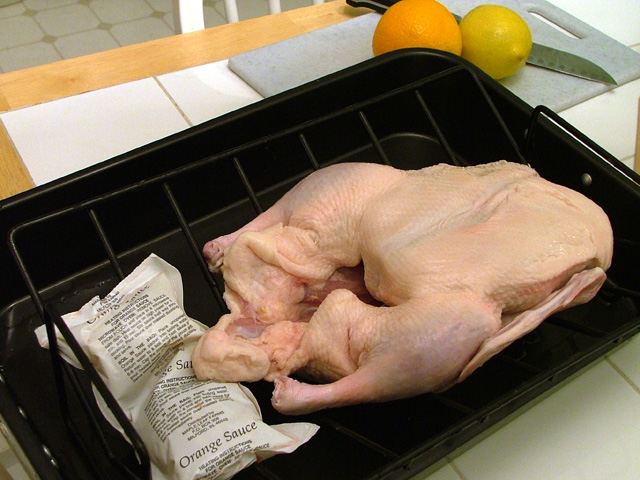 The girlfriend came over for dinner tonight, and I decided to make the classic French dish Duck à l'Orange. It was hugely popular in the 60s and 70s yet seems to have fallen out of favor. I'm cooking it simply because fresh ducks are on sale right now for $10 a bird and I've never made (or eaten) this particular dish. Plus, it's another one I can check off from the Les Halles Cookbook. This project has been loads of fun, and delicious as well. The inspiration comes in part from Julie Powell's book Julie and Julia: 365 Days, 524 Recipes, 1 Tiny Apartment Kitchen. I haven't actually read it, but followed the project online and in news reports. Parker spent a year methodically cooking her way through Julia Child's Mastering the Art of French Cooking, Volume One. Anthony Bourdain isn't Julia Child, and I'm not going to cook everything in his cookbook, but I'm picking up a lot of new techniques and flavor combinations that I look forward to incorporating in future dishes.
Back to the duck. The picture above is our five pound White Pekin, fresh and never frozen. You'll notice that this bird came with a packet of pre-made orange sauce. This was tossed out unopened. No cheating here. This is also before trimming. I cut off all the excess skin (and rendered out the fat--more on that in a bit), cut off the wing tips and set them aside with the liver and neck. Without any duck stock on hand, I boiled down a quart of chicken stock with those scraps in there for flavor and body.
 Here's what the final roasted duck looked like, stuffed with cut up lemons and oranges, trussed up and dusted with salt and pepper. Total roasting time was around two hours, a half hour at a lower temperature and one and a quarter at a higher temperature. While the bird was roasting, I was pretty busy. The sauce was quite complex, involving many different steps and ingredients, and on top of that, I had decided to render down duck fat for use in roasted potatoes. I'm not going to get into all of the details of the sauce right now, but for the potatoes, I cut up two russet potatoes and coated them in salt, pepper, fresh rosemary, and tossed them with a half cup of freshly rendered duck fat, one of the most delicious substances known to mankind. I've roasted potatoes with butter and olive oil before, but the duck fat is sublime. (If I were taking a photo in the 70s, this duck would have been coated and glazed in the thickened sauce; it would be surrounded by piped rosettes of mashed potatoes, a ring of orange slices, and perhaps some vegetables slightly glistening in aspic. My copy of the Larousse Gastronomique is full of such presentations.)
 Here's the final plate. Typically whenever I take pictures like this, it's of the plate I actually eat. I serve my guests first, then set my plate, take a picture, and then get down to business. Here I've got myself a breast and a leg, covered in the orange sauce (plenty of long strips of orange zest visible on top), the roast potatoes, and a stalk of steamed broccoli. The sauce was thinner than I expected, but rich and savory considering everything that went into it (my improvised stock, red wine vinegar, orange liqueur, orange and lemon juice, orange zest, the pan drippings from the roasting pan, butter, and other things I'm forgetting). Everything was delicious, and I froze all the bones and scraps for use in making stock at a later date.
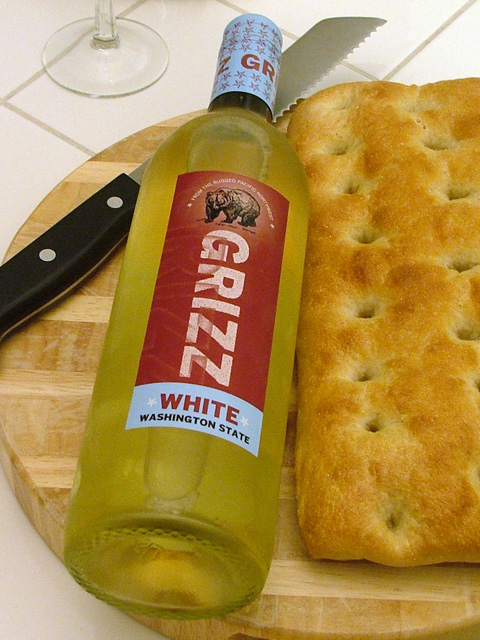 The wine tonight was nothing terribly special, a $6 bargain picked out of the closeout rack. I enjoyed the Washington State Grizz Red back in March, and decided to give the white version a try. The 2004 Grizz White is made from 90% Chardonnay and 10% Semillon grown in the Columbia Valley. Screwcap enclosure. It's rather full-bodied and fruity, with medium acidity. Some fizz clings to the side of the glass. A little apple and honey linger on the palate, but otherwise it's an uncomplicated, simple Chardonnay. I remember one of the first non-sweet white wines I really liked was a Chardonnay-Semillon blend from Columbia Crest. It's pictured with a loaf of pain rustique from the grocery store, though honestly it's just a big piece of focaccia.
Final thoughts: this dish was a lot of work, and at the end of the night I'm covered from head to toe in a fine film of duck grease. However, dinner was fantastic, and the entire house smells like Christmas. We never ate duck when I was a kid, so maybe I'm just conflating descriptions I read in old Victorian stories, but the smell of roast duck and oranges provides a warm, succulent, and slightly spicy aroma that is perfect for the holidays.
17 November 2006
2006 Georges Dubœuf Beaujolais Nouveau
 Le Beaujolais Nouveau est arrivé!
Every year when this comes up, there's a mixed response... Some serious wine drinkers avoid it entirely, not giving into the marketing hype over an admittedly simple wine. And then there's the Beaujolais fanatics, who dislike Nouveau but obsess over the crus (and to be honest, I love a good Fleurie or Brouilly). And then there's those who say, yes, Beaujolais Nouveau is nice, but not until February or so.
As for me? It's a fun seasonal beverage, a way to celebrate the harvest with one of the first wines of the year. Granted, I'm not a French grape picker receiving my ration of quickly made mild wine, but a feller can imagine.
I've been to Nouveau tastings before, but I generally just stick with the old standby: 2006 Georges Dubœuf Beaujolais Nouveau. Once again we get the classic whiff of bananas on the nose with a little cherry behind it. Last year's edition was pretty tart, but this year shows a much smoother profile, with characteristic light tannins and a short finish.
Random thoughts: when are they going to start shipping this with a screwcap? It comes with a short plastic cork, so it's not like they're standing on tradition. I think it would definitely help with the casual and spontaneous way in which this wine is consumed.
13 November 2006
Fennel & Tomato Soup
 Yet another Les Halles recipe... As winter draws near, it's getting colder, and it's time for soup. I used canned tomatoes for this recipe, and while it was simmering away I was working in the garden, cutting down my tomato vines and preparing the former patch as a compost pile in order to enrich the soil for next year.
It's a pretty simple soup that begins with an odd mirepoix: a small onion, a small potato, and a big bulb of fennel. I've run into some problems buying fennel around here--not in finding it, but the people working checkout never know what it is. One local chain has it labeled as "anise", which is fine, but once after telling the checker to look for fennel or perhaps finocchio, she finally found a little tag on the bulb with a number, keyed it in, and said, "For future reference, it's called 'anise'". Except she pronounced it anus, which drew some strange looks from the other folks in line.
Beyond that, the rest of it is just chicken stock with a little dash of herbs. Let it simmer for an hour, and then blend before serving. Couldn't be simpler.
 Here's the final product, with a little cheese toast (grated Sonoma Dry Jack) and a bottle of Hornsby's Crisp Apple Hard Cider. There's not much information out there about this cider--it's made by a Gallo company, and I'm pretty sure it's made with Golden Delicious apples (or something close), but it's a nice little hard cider. It avoids the vinegar aromas that you sometimes get with hard cider, and instead focuses on a bright and sunny flavor.
The soup was a big success, especially since the dominant flavor is fennel with tomato as a supporting flavor. Fennel's not something I eat all the time, but I crave it once in a while. I really wanted to leave out the potato from the recipe, but it turned out to serve two important functions: it provided texture as well as a creamy appearance even though no cream was used in the recipe.
Postscript: I often publish these articles a couple of days after I write them or fix the dish. I like to have some time to look over what I wrote, and also I appreciate the "leftover quotient" of certain dishes. As a bachelor with a roommate of limited palate, I often end up eating my own cooking for days afterwards. This soup holds up quite well on the second day, though I elected to freeze a liter of it for use later in the winter. I've still got a bowl's worth sitting in the fridge, and look forward to consuming it alongside a club sandwich or similar fare.
10 November 2006
Moules normande
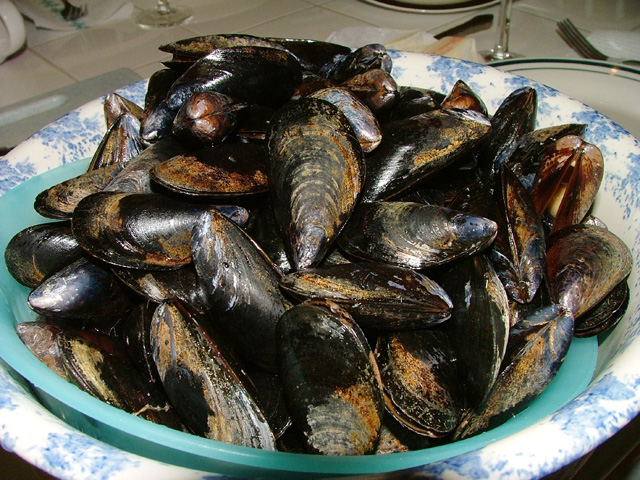 Lately I've been craving mussels. I've never lived near the ocean, though whenever I'm near the coast--regardless of state or country--I try to eat fresh seafood as often as possible. While the modern era of food shipped by plane means that the coasts are closer than ever, it's still nice to eat seafood that's as fresh as possible, and the cheapest way to do that is with mussels. Pictured at right are four pounds of live mussels picked up at Costco for $9 American. I brought them home, gave them a scrub, ditched the cracked or dead ones, and left the live ones to hang out for an hour before dinner. You've got to love the smell of live mussels; it's just like being on the beach right after a rain storm.
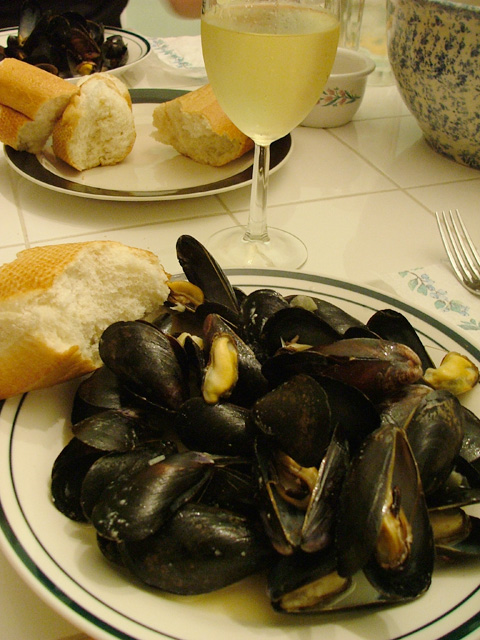 Previously when I've cooked mussels, I merely steamed them, and served them with a little butter and lemon. Nice, but not awe-inspiring. As part of my continuing personal education in French bistro cooking, I consulted the Les Halles Cookbook and picked the first mussels recipe, moules normande or Mussels Normandy. The French joke that the cooks of Normandy put butter, cream and apples in everything, but what's wrong with that? This recipe starts off with half a stick of butter in a large pot, followed by a shallot, an apple (I used a Johnathan), 3 slices of chopped cooked bacon, a cup of cream, a splash of Calvados (I used a little brandy and apple juice), and finally the load of mussels. Cook for 10 minutes, shaking occasionally. Serve when all the mussels are open.
The finished product was incredibly delicious. Paul and I sat there for an hour working through the mussels, sopping up the savory sauce with big chunks of French bread. The bacon really made the dish--with a little determination you could get a big mussel, a chunk of bacon, and a piece of apple, all drenched in the cream sauce. Maybe a half dozen mussels were left over at the end, when we were too full to continue.
 While hard apple cider would have been the most authentic Norman companion, and I really wanted a creamy white Burgundy, I opted for the 2004 Hayman & Hill Russian River Chardonnay. Pleasantly fruity, with abundant pear flavors. Hints of honey on the nose. Nice and unoaked, not sweet at all, but the fruit flavor makes it a delightful match for the savory dish served. For $11, not a bad wine, and it definitely hit the spot with this simple yet rich dinner. I look forward to trying the other four classic mussel recipes.
05 November 2006
2005 Rex Goliath "47 Pound Rooster" Chardonnay
 2005 Rex Goliath "47 Pound Rooster" Chardonnay from Monterey County, California. A nice and fruity California Chard, with lots of apple and pear flavors. Slightly floral aroma and a barely sparkling mouth feel, and some lemon notes on the finish. I'm pretty sure it's unoaked.
For $6, it ain't a bad wine.
I served it with a recipe from Rachael Ray... A modified turkey paprikash. The end result was OK, but not that far off from Hamburger Helper. Which is to say, quite delicious for a cold winter night but not anything particularly special. The Girlfriend loved it, and The Roommate has been gobbling up the considerable leftovers. I served it with some peas, steamed with a touch of olive oil and a few sprigs of fresh mint, cooked just until tender. (Mint really helps with peas--trust the French here.)
Last year I made an authentic paprikash, using chicken thighs and with traditional spaetzle dumplings, again made from scratch. The end result was incredible, but my dining companion and I only had a small bowl apiece and then we retired to separate couches and spent the next four hours not moving and only groaning occasionally. It was good, but damned heavy.
31 October 2006
2004 Bogle Pinot Noir
I've always enjoyed the products from Bogle, and decided to try out the 2004 Bogle Pinot Noir from the Russian River in California. Runs for around $14.
There's very little nose on this wine, but the taste is fine and full. Some strawberries, plum, a little spice. Tiny bite right on the finish. Medium-strength tannins that disappear rather quickly. It retains that light mouth feel that is so prized in Pinot Noir. It doesn't taste like a Burgundy or a North California/Oregon Pinot Noir, but is good in its own right.
 For dinner, I was faced with a bit of a quandary. I really wanted some cheese ravioli, but the girlfriend isn't eating tomatoes right now. And a simple cream sauce would be boring. So I turned to this recipe found on Taste Everything Once: A Pumpkin Cream Sauce for Pasta. Follow the link for the recipe, it's very simple. I don't have any sage, but substituted fresh oregano with good results. (Next year every windowsill in my house is going to have one or more herbs growing on it.) Just one critical note: if using canned pumpkin, make sure you get the pure pumpkin, and not the pumpkin pie filling. Though if you like your sauce sweet, knock yourself out.
It's really tasty, and the pumpkin flavor is very light and mild. The wine may have been a bit strong, but with the good salty ricotta inside the pasta and the little punch from herbs and black pepper, it held up wonderfully. There's something comforting about mashed squash; I don't know if it has to do with baby food or comfort food during the winter. Whether pumpkin or turban or acorn or butternut squash, it's bound to make you feel good. On several dinner party occasions, I've had one of the participants come up to me, see the pile of acorn squash, and get all excited and hug me. I don't think that the squash, one of our Native American delicacies, gets enough respect in the realm of haute cuisine.
Pictured is some of the leftovers, kicked up with some more fresh oregano, some black pepper, and a little grey sea salt. Much better the second day.
There's very little nose on this wine, but the taste is fine and full. Some strawberries, plum, a little spice. Tiny bite right on the finish. Medium-strength tannins that disappear rather quickly. It retains that light mouth feel that is so prized in Pinot Noir. It doesn't taste like a Burgundy or a North California/Oregon Pinot Noir, but is good in its own right.
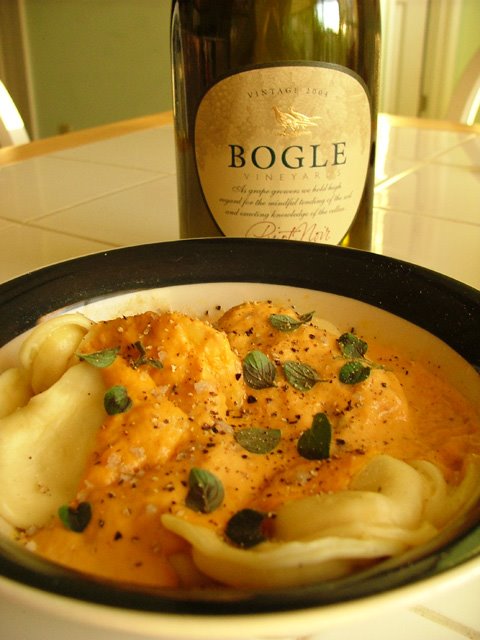 For dinner, I was faced with a bit of a quandary. I really wanted some cheese ravioli, but the girlfriend isn't eating tomatoes right now. And a simple cream sauce would be boring. So I turned to this recipe found on Taste Everything Once: A Pumpkin Cream Sauce for Pasta. Follow the link for the recipe, it's very simple. I don't have any sage, but substituted fresh oregano with good results. (Next year every windowsill in my house is going to have one or more herbs growing on it.) Just one critical note: if using canned pumpkin, make sure you get the pure pumpkin, and not the pumpkin pie filling. Though if you like your sauce sweet, knock yourself out.
It's really tasty, and the pumpkin flavor is very light and mild. The wine may have been a bit strong, but with the good salty ricotta inside the pasta and the little punch from herbs and black pepper, it held up wonderfully. There's something comforting about mashed squash; I don't know if it has to do with baby food or comfort food during the winter. Whether pumpkin or turban or acorn or butternut squash, it's bound to make you feel good. On several dinner party occasions, I've had one of the participants come up to me, see the pile of acorn squash, and get all excited and hug me. I don't think that the squash, one of our Native American delicacies, gets enough respect in the realm of haute cuisine.
Pictured is some of the leftovers, kicked up with some more fresh oregano, some black pepper, and a little grey sea salt. Much better the second day.
28 October 2006
Demi-Glace
Note: The following describes a more modern interpretation of demi-glace. At some point I'll make the classical version using sauce espagnole.
Last Sunday I attempted to prepare some demi-glace and thought that I could sleep a few hours on the final steps. That turned out to be a pretty bad mistake, as I got up at five AM with a mass of tar and carbon in the pot.
I tried it again this past Saturday, starting at around eleven in the morning. And at eleven at night, I poured the finished demi-glace into the bowl. All of my efforts yielded about a cup of demi-glace.
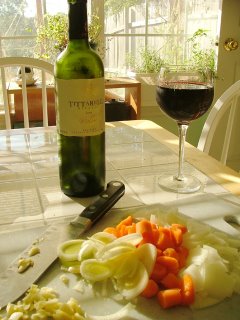 What went into it?
Finally around 9:00 at night, after a full nine hours of simmering, I strained the stock and kept it in a separate bowl. After scrubbing the Dutch oven, I reduced down a half bottle of red wine and a minced shallot. After about a 50% reduction, I introduced back the beef stock. Over the next two hours, there were three or four additional strainings, involving wire mesh and paper towels to remove any solids or flotsam.
At 11:00, too tired to watch it any longer, I poured the demi-glace into a bowl, covered it, and let it cool in the fridge while I cleaned up the kitchen. The end product tastes pretty good (and gelled nicely), but in the past when I've done this using high-quality organic beef stock from the store, the result was quite similar.
However... I've got a ten gallon stock pot that I never use, and if I ever come across a load of decent bones, I might spend a whole day making enough demi-glace to last me an entire year.
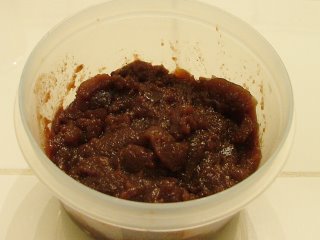 Final analysis: it's not too attractive here in the plastic container, just waiting for a liner of plastic wrap to lay over the sauce and send it on its way to the freezer. The final product, after cooling, was the consistency of jelly, hence the lumpy appearance in this photo. But once again, it smells and tastes incredible. Just taking a pea-sized portion and letting it melt on your tongue is like enjoying a good steak and a glass of wine.
Last Sunday I attempted to prepare some demi-glace and thought that I could sleep a few hours on the final steps. That turned out to be a pretty bad mistake, as I got up at five AM with a mass of tar and carbon in the pot.
I tried it again this past Saturday, starting at around eleven in the morning. And at eleven at night, I poured the finished demi-glace into the bowl. All of my efforts yielded about a cup of demi-glace.
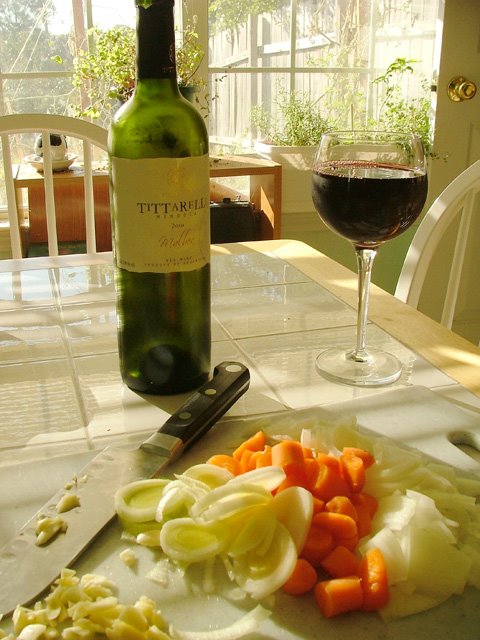 What went into it?
- 4 lb soup bones (not much meat)
- 1½lb onion
- ¾lb celery
- 1 leek
- ¾lb carrots
- couple of cloves of garlic
- some peppercorns
- a gallon of filtered water
- a little flour and tomato paste
- a handful of crushed garden tomatoes I wanted to get rid of
- 1 shallot, minced
- ½ bottle red wine--I used the 2004 Tittarelli Malbec from Mendoza, Argentina
- lotsa hard work
Finally around 9:00 at night, after a full nine hours of simmering, I strained the stock and kept it in a separate bowl. After scrubbing the Dutch oven, I reduced down a half bottle of red wine and a minced shallot. After about a 50% reduction, I introduced back the beef stock. Over the next two hours, there were three or four additional strainings, involving wire mesh and paper towels to remove any solids or flotsam.
At 11:00, too tired to watch it any longer, I poured the demi-glace into a bowl, covered it, and let it cool in the fridge while I cleaned up the kitchen. The end product tastes pretty good (and gelled nicely), but in the past when I've done this using high-quality organic beef stock from the store, the result was quite similar.
However... I've got a ten gallon stock pot that I never use, and if I ever come across a load of decent bones, I might spend a whole day making enough demi-glace to last me an entire year.
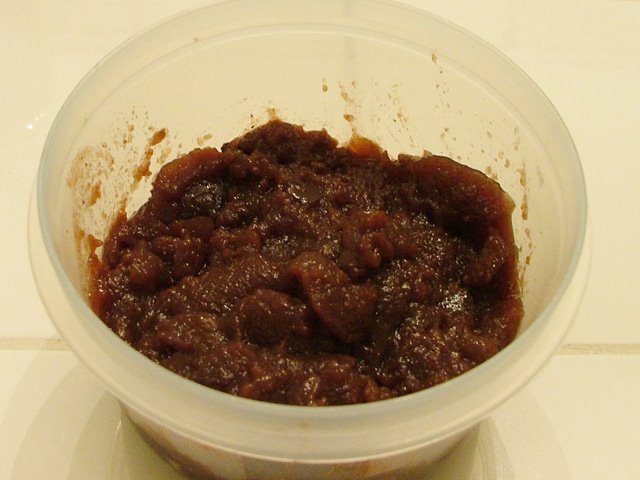 Final analysis: it's not too attractive here in the plastic container, just waiting for a liner of plastic wrap to lay over the sauce and send it on its way to the freezer. The final product, after cooling, was the consistency of jelly, hence the lumpy appearance in this photo. But once again, it smells and tastes incredible. Just taking a pea-sized portion and letting it melt on your tongue is like enjoying a good steak and a glass of wine.
24 October 2006
Rôti de porc au lait
A few weeks ago, I ordered a used copy of Anthony Bourdain's Les Halles Cookbook: Strategies, Recipes, and Techniques of Classic Bistro Cooking. I've read a couple of books by Bourdain, and I really admire the theory behind Les Halles: serve good food at a reasonable price and make it taste awesome. And the kicker is that he's often using low-cost ingredients, just cooked properly and with attention to bring out the proper flavors of the dish in question.
(Side note: this book is gorgeous. It's printed on really heavy stock--I checked it with a micrometer, and the paper is .18mm thick. For comparison, regular copy paper is .09mm thick.)
This is the first cookbook that I've ever read straight through. I mean, I didn't read it all in one setting, but I read it over the course of a few days from cover to cover. It's also the first cookbook I've ever read that cussed at me, insulted me, and threatened me if I didn't do things a certain way. But he backs it up by proclaiming that the majority of the cooking in his restaurants is done by Mexican immigrants with no formal restaurant training who started out as dishwashers. As any good football coach will tell you, it's good to focus on fundamentals.
I've decided to try and cook my way through this book. I won't hit all of them--there's just a few critical ingredients that aren't available or affordable around here, but everything in the book looks like it tastes great.
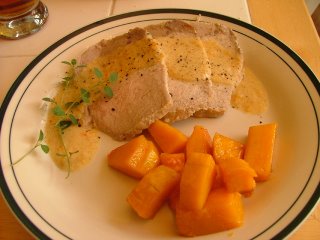 Here's my first attempt at one of the recipes... Rôti de porc au lait. Literally translated, roast pork in milk. That doesn't sound really appetizing, but it's quite good. You take 3 lbs of pork loin, sear it in a Dutch oven, add in a mirepoix of vegetables, pour in some whole milk, add a bouquet garni, and then cook the loin for an hour. Remove the pork, blend the sauce, and serve over slices of the pork, but only after the loin has rested for fifteen minutes.
I opted to add roasted chunks of butternut squash as a side item. For beverages, Paul brought over some of the Flying Dog "Doggie Style" Pale Ale from Colorado. An excellent, hoppy pale ale. Nice and bitter, a good counterpoint to the savory dish and slightly sweet squash. I also had some toasted sourdough bread on hand to help sop up the sauce.
My opinion: the pork was awesome, but the sauce needed a little more. Paul had seconds and thirds, but for my leftovers I'm going to ignore the sauce (already dumped down the drain), and use one of the half dozen mustards that grace my fridge. The pork loin was the most tender and delicious specimen that I've ever been able to get out of this particular cut, and really want to put a few cold slices on pumpernickel with hot mustard and a bit of sauerkraut and Swiss cheese. (Side note: I wrote this article a couple of days ago and just enjoyed such a sandwich, heated up in the old George Foreman grill. It was quite delicious. I think I might cook pork loin more often now!)
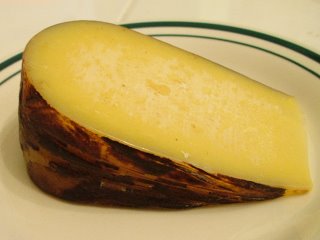 Afterwards, we had some Sonoma Dry Jack, a relative to the more well-known Monterey Jack and much closer to the original "Jack" recipe as opposed to the modern "white cheddar" incarnation. Think about a cheese that's somewhere between smoked Gouda and Romano. A thin, smoky rind, and a great firm cheese underneath. We ate it in slices, but I'm sure it would be good grated in certain dishes.
While I was serving the main course, I was explaining the whole cooking pork in milk thing, and said, "It's damned hard to get decent pig's milk in this city." I enjoyed the few seconds of terror on my diners' faces, and then explained that I used normal cow's milk. However... If you've ever wondered why you can't find pig's milk in the store, here's the reason.
(Side note: this book is gorgeous. It's printed on really heavy stock--I checked it with a micrometer, and the paper is .18mm thick. For comparison, regular copy paper is .09mm thick.)
This is the first cookbook that I've ever read straight through. I mean, I didn't read it all in one setting, but I read it over the course of a few days from cover to cover. It's also the first cookbook I've ever read that cussed at me, insulted me, and threatened me if I didn't do things a certain way. But he backs it up by proclaiming that the majority of the cooking in his restaurants is done by Mexican immigrants with no formal restaurant training who started out as dishwashers. As any good football coach will tell you, it's good to focus on fundamentals.
I've decided to try and cook my way through this book. I won't hit all of them--there's just a few critical ingredients that aren't available or affordable around here, but everything in the book looks like it tastes great.
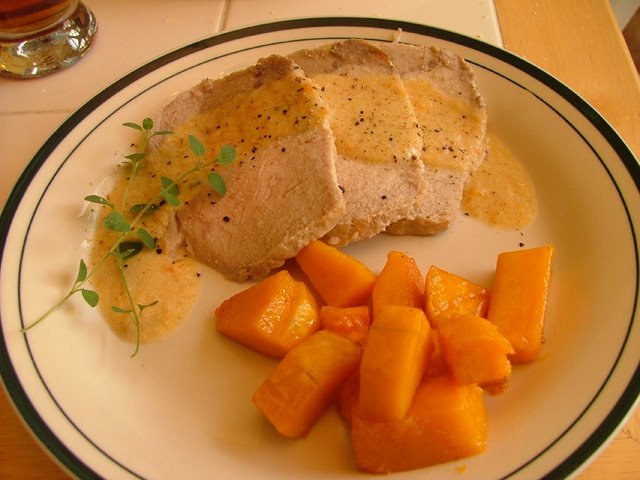 Here's my first attempt at one of the recipes... Rôti de porc au lait. Literally translated, roast pork in milk. That doesn't sound really appetizing, but it's quite good. You take 3 lbs of pork loin, sear it in a Dutch oven, add in a mirepoix of vegetables, pour in some whole milk, add a bouquet garni, and then cook the loin for an hour. Remove the pork, blend the sauce, and serve over slices of the pork, but only after the loin has rested for fifteen minutes.
I opted to add roasted chunks of butternut squash as a side item. For beverages, Paul brought over some of the Flying Dog "Doggie Style" Pale Ale from Colorado. An excellent, hoppy pale ale. Nice and bitter, a good counterpoint to the savory dish and slightly sweet squash. I also had some toasted sourdough bread on hand to help sop up the sauce.
My opinion: the pork was awesome, but the sauce needed a little more. Paul had seconds and thirds, but for my leftovers I'm going to ignore the sauce (already dumped down the drain), and use one of the half dozen mustards that grace my fridge. The pork loin was the most tender and delicious specimen that I've ever been able to get out of this particular cut, and really want to put a few cold slices on pumpernickel with hot mustard and a bit of sauerkraut and Swiss cheese. (Side note: I wrote this article a couple of days ago and just enjoyed such a sandwich, heated up in the old George Foreman grill. It was quite delicious. I think I might cook pork loin more often now!)
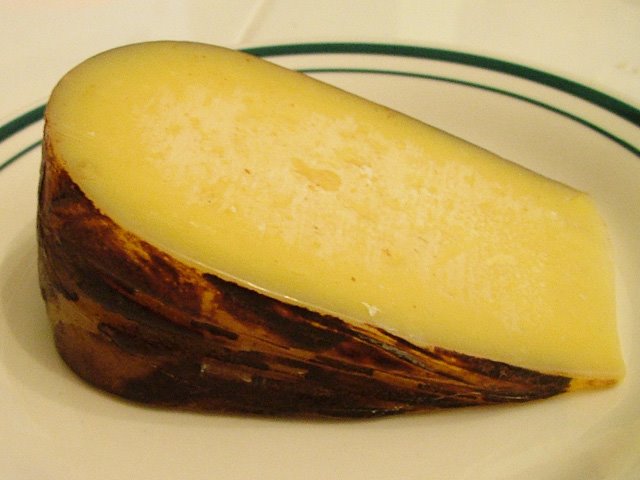 Afterwards, we had some Sonoma Dry Jack, a relative to the more well-known Monterey Jack and much closer to the original "Jack" recipe as opposed to the modern "white cheddar" incarnation. Think about a cheese that's somewhere between smoked Gouda and Romano. A thin, smoky rind, and a great firm cheese underneath. We ate it in slices, but I'm sure it would be good grated in certain dishes.
While I was serving the main course, I was explaining the whole cooking pork in milk thing, and said, "It's damned hard to get decent pig's milk in this city." I enjoyed the few seconds of terror on my diners' faces, and then explained that I used normal cow's milk. However... If you've ever wondered why you can't find pig's milk in the store, here's the reason.
22 October 2006
Beer Tasting for October 17, 2006
On Tuesday, I attended a charity beer tasting for the Harwood Center, a local Memphis school for kids under three with special needs. A friend's son used to be a student, and when she said there was a beer tasting fundraiser... She had me at "beer".
More importantly, this tasting was being held at The Fresh Market, a chain of gourmet grocery stores. I've found some amazing stuff there, and was intrigued by the note of appetizers on the invite.
I was not disappointed.
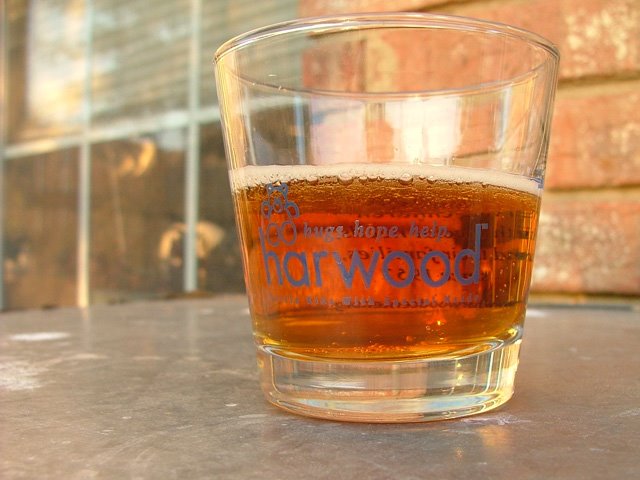
 I even got a commemorative tasting glass, with a line drawn at the exact 3 ounce mark, which turns out to be rather perfect for a beer tasting. There were two or three appetizers and four or five beers per station. And the staff on hand were well educated on the particular beers that were being served. Over 30 beers were available, and I was glad to see American microbrew pioneers like Sierra Nevada and Anchor Steam represented in full. As is my usual practice with massive tastings, I chose to try those beers I'd never had before, plus a few that I really enjoy.
The entire store was closed off to the public for the evening, though they kept a couple of registers open if the guests wanted to buy anything.
Among the appetizers I sampled:
More importantly, this tasting was being held at The Fresh Market, a chain of gourmet grocery stores. I've found some amazing stuff there, and was intrigued by the note of appetizers on the invite.
I was not disappointed.
 I even got a commemorative tasting glass, with a line drawn at the exact 3 ounce mark, which turns out to be rather perfect for a beer tasting. There were two or three appetizers and four or five beers per station. And the staff on hand were well educated on the particular beers that were being served. Over 30 beers were available, and I was glad to see American microbrew pioneers like Sierra Nevada and Anchor Steam represented in full. As is my usual practice with massive tastings, I chose to try those beers I'd never had before, plus a few that I really enjoy.
The entire store was closed off to the public for the evening, though they kept a couple of registers open if the guests wanted to buy anything.
Among the appetizers I sampled:
- Caprese Salad on Baguette Slices
- Mini Crabcakes
- Mushroom Vol-au-Vent
- Cambozola Cheese and Sun-dried Tomatoes on Crackers
- Salami and Smithfield Cream Cheese
- Sushi (including my first taste of tilapia sashimi)
- Cubes of Ribeye Steak with Olives
- Some savory dish using squid ink angel-hair pasta and fresh basil
- Warsteiner Dunkel from Germany. Light and slightly bitter. The first beer of the evening, and not a bad one.
- Flying Dog Old Scratch. Colorado. An old favorite.
- Flying Dog In Heat Wheat Beer. Colorado. A pleasant unfiltered wheat beer.
- Sleeman's Cream Ale from Canada. Light and refreshing. I'm consistently amazed by Canadian beers. And I'm not talking about Molsen's or Moosehead.
- Avery White Rascal from Colorado. A Belgian style white beer, unfiltered and seasoned with orange peel. One of my favorites from the tasting, and it went really well with the sushi.
- Sierra Nevada Wheat from California. Lovely little wheat beer.
- Sierra Nevada Porter from California. The reason why the porterhouse steak was invented.
- Samuel Smith Pure Lager from England. When you're drinking Samuel Smith, you're drinking history. Kudos to the antiquated label design. Pleasing notes of yeast and hops on this one.
- Woodchuck Pear Cider from Vermont. I still enjoy the tart and refreshing Woodchuck Granny Smith hard cider when the mood strikes, but I'd never tried the pear cider before this tasting. Enjoyable, and definitely something different. Would be interested to serve with my beloved dessert of pear slices, goat cheese, and honey.
- Lindeman's Framboise Lambic from Belgium. I reviewed this back in August, and it still brought a smile to my face. So much fun, and much more like a sparkling dessert wine than a beer.
Subscribe to:
Posts (Atom)