Showing posts with label chicken. Show all posts

11 January 2012

Cornish Game Hen Lunch

I've always enjoyed cooking and eating Cornish Game Hens, but I got dissuaded in 2009 during a dinner party. It was my last time making them, and instead of ridiculous little baseballs, I had pretty hefty chickens. I noticed that local grocery stores weren't carrying them as much, and the ones that were tended to be enormous. And while I don't mind using stranger smaller chickens, I figured that the days of individual servings were over.

As is often the case when you get irritated about a certain food, you stop looking at it and then it becomes invisible. But in my continuing joy of cooking things that are new to Julia, I decided to give the game hen another try. And surprisingly, the local Super Target had a bunch of them in the freezer for around $3 a pop. And more importantly, they were small. Not frail like quail, but the stocky little bantams I'd come to love years ago.

I was going to do simple salt and pepper for the ladies, followed with something spicier for myself, but I rolled the dice and ground up a little mole sauce using dried guajillos, cocoa powder, walnuts, garlic, olive oil, and a few other bits of magic. I thoroughly coated all three birds and roasted them in a hot oven. For sides, a little red cabbage and apples, some multicolored baby potatoes, and suddenly we've got a simple winter meal that's packed full of flavor. The game hens and potatoes were a big hit, with mixed reviews on the cabbage. Now I'm wishing I'd added a lot more vinegar to that particular dish, but I'm happy with the way everything turned out.

While possibly not the ideal pairing, the margaritas from Monday's post turned out to be a very fun and tasty accompaniment to lunch on a rainy Saturday afternoon in January.

27 July 2011

Cooking Improvisation

Cooking isn't so much about being able to follow a recipe as it is being able to make do with what you've got and work around the complications that arise. I know people that have refused to cook a certain dish because they had everything except for a quarter teaspoon of ground nutmeg. I prefer a more improvisational approach.

Case in point: I felt like smoking some chicken quarters, and had everything I needed. Yet when I got a chance to start, I realized that I'd mistakingly bought a bag of lump mesquite charcoal. Unlike the compact briquettes pressed from charcoal dust, lump charcoal is made using chunks of wood that have been cooked in an oxygen-free environment. I like the flavor of mesquite, but it's much better for grilling (over flame or hot coals) as opposed to smoking (using indirect heat over a longer period of time). If you do a long smoke on mesquite the food will be nasty. Some woods work better than others for smoking, and if you use pine you deserve the ass-kicking your dinner guests will surely deliver.

So... I wanted to do a slow cook because I was using thigh/leg quarters of chicken, but only had lump mesquite and an assortment of chips (hickory/oak/alder/etc.). What to do? I took about two kilos of lump mesquite, prepped it in the chimney starter, and built my fire in the trusty old Weber kettle. The chicken quarters were marinated in Wicker's* for a while, and then I used a combination of grilling and smoking, including a set of old ceramic grill briquettes** that I've got from way back when. Hot fire, chicken is browned over flame, and moved to cold side of grill. Wood chips in a foil pouch are added, and then the whole mess is covered for a while. Flip, baste with more Wicker's, and then smoke a while longer. I did about 90 minutes of alternating grilling and smoking, just enough to get some good flavor without getting the resinous bitterness of mesquite. Then it was time to take a baking dish and the chicken and cover it with foil, and drop it in a warm oven for another hour. This isn't cheating--it's a common tactic, prompted by weather or the need to kick up the heat and grill something over high flame or you've just run out of fuel and can't finish it all on the grill/smoker/etc. (There's a fun trick involving an ice chest, towels, and hot bricks, but we'll save that for another post.)

I was very happy with the results, but during the final roasting I felt the need to make a slightly unusual sauce. In most of the US, barbecue sauce is basically ketchup and corn syrup with some added seasoning. Often it includes liquid smoke so that those without testicular fortitude can pretend that they've cooked something using the most ancient of methods. Some regions have thin vinegar-based sauces, North Carolina has a yellow mustard sauce, but I decided to go with northern Alabama's weird white sauce, made from mayonnaise and vinegar and some other goodies. It's a classic with BBQ chicken, though the sauce itself is odd: it's not a cream sauce, it's not one derived from béchamel, and it's not ranch dressing. It is its own unique little snowflake. But if you've ever had Buffalo wings with bleu cheese sauce, you're most of the way there. It is really tangy, and some preparations go as far as a 1:1 ratio of mayo to vinegar, sometimes with some added lemon juice to boost the acidity.

I served the chicken simply with some greens and fruits/vegetables, and the white barbecue sauce plus the chicken juices made for a delicious dressing for the greens. Try it out sometime--you've probably got the ingredients lying around the kitchen, and it might be a creative solution sometime when you're dans la merde.


*I have to give additional mention to Wicker's, made in Hornersville, Missouri. That's where my great-grandparents settled, and where my grandmother and my great-uncles were born. My father spent part of his youth there, and I have many happy memories of that small town of barely 700 people. Wicker's marinade is made of "vinegar, salt, spices". Nothing else, and it's been a mainstay in our family for decades.

**Gas grills often use lava rocks or ceramic briquettes in the bottom of the grill. The idea is that the stone retains and radiates heat, resulting in more even cooking. With a good setup you can turn down the flame quite a bit so that most of your cooking is coming from the slow roast of the stones rather than the direct heat of the flame. I've thrown some in the bottom of my charcoal grill to serve the same purpose. It's a very energy efficient method, but don't use random rocks from your yard--they might contain dangerous elements or can even explode when heated.

11 October 2010

Canadian Thanksgiving, German Riesling, and French Chicken

Happy Thanksgiving, or joyeux jour d'action de grâce, to our neighbors in the True North strong and free. I've always thought that those of us below the 49th parallel ought not to limit ourselves to one Thanksgiving. We're harvesting year round, so I think we ought to have at least quarterly celebrations in which friends and family gather 'round to celebrate the bounty of the land.

In honor of Canadian Thanksgiving, this weekend I made a French/German recipe with a couple of German wines in the company of assorted mutts from all over.

I found this interesting Coq au Riesling recipe via Serious Eats. It's similar to the traditional classic coq au vin, but made with Riesling instead of red wine. It gives it a little lighter look, and allows for a stronger contribution from the onions and mushrooms. I skipped the butter--it's a bit ridiculous to add butter when you've got so much pork and chicken fat involved in the recipe. I served it with some tiny thin asparagus and bowtie pasta that had been tossed in Chilean olive oil and fresh parsley. Big hit at dinner, and while the dish is a little time consuming (there's a lot of moving the chicken in and out of the dish at varying stages of doneness), I was very happy with how it turned out.

I added 175mL/¾ Cup of each Riesling to the recipe. They worked well, but here's how the wines tasted on their own. And I'll say that this is a recipe where using the same wine that you're drinking really helps make the meal sing.

2007 Josef Leitz Riesling Kabinett
Rüdesheimer Rosengarten, Rheingau
$22, 8.5% abv.
This was the sweeter of the two, full of fruit. It has tiny little bubbles clinging to the side of the glass, with lots of apple and pear. As it warms up you almost get a little pineapple acidity. It's not terribly sweet, and manages not to be heavy or cloying. Great Thanksgiving wine, and I'm talking about the turkey and sweet potatoes kind of Thanksgiving we're more familiar with down here. And such a low alcohol content means that folks who don't drink much wine can enjoy a glass or two without getting tipsy.

2008 Weingut Peter Jakob Kühn Riesling Trocken
Jacobus, Rheingau
€8.60, 11.5% abv.
Hasn't quite made it to the US, but this is the entry-level wine in the Kühn profile. This biodynamic and VDP wine is dry and light. It has two elements that I love in good Riesling: minerality and a hint of petrol. The latter is barely noticeable, and mainly what you have is a very mild wine with just a touch of lemony acidity and light green apple flavor. Consider this one for mild dishes like poached trout or vichyssoise.

The other big event of the evening was the very special dinner guest, Bella. Paul adopted Bella last week--she's a five month old Jack Russell terrier mix, found via Tri County Animal Rescue of Horn Lake, Mississippi. It was funny to see the older dogs playing with such a young pup, and they all got along pretty well together. Welcome to the pack, Bella, and to everyone else, remember that there's a lot of dogs out there that need good homes.


Note: These wines were received as samples.

19 March 2010

Honduran Dinner

A friend of mine is headed to Honduras on a church trip, and I was inspired to fix her a Honduran meal. Of course, I knew nothing of Honduran cuisine, so it was mostly an excuse for me to do some research and play around in the kitchen.

I don't really know that there's a distinct Honduran culinary tradition, rather it's more a point on a general Central American/Caribbean continuum. That is in no way a criticism of Honduran food. It's more like talking about Southern food here in the United States. There are subtle variations as you travel from Tennessee to Mississippi to Alabama to Georgia, but most of the native cuisine is fundamentally similar.

My reading didn't deliver any unique dishes or ingredients, but rather a few exceptions and caveats: tamales are wrapped in banana leaves and tend to have bones in them; don't serve rice and beans if you're serving plantains; use white corn instead of yellow corn for tortillas and other applications. (I'm sure someone will come along to point out that all three of these are wrong, and I welcome the clarification.)

But I did find a couple of recipes that were written by Hondurans, and gave them a shot. For starters, I made a salsa with mangos, avocados, red onion, ancho chiles, and tomatoes. Nothing particularly special here, though you can juggle the proportions around to produce a guacamole or a pico de gallo or even a garnish. (If I'd had it on hand, some fresh cilantro would have been very nice).

For the main dish, I made a batch of chicken thighs. I cooked them the night before and then for lunch made a sofrito and added the poultry to the Dutch oven. Then it was time for a can of unsweetened coconut milk, and I let everything stew for about half an hour before serving. While the aroma is amazing, the finished product has little in the way of coconut flavor. It tastes great, but it's a surprisingly subtle seasoning. It's an interesting yet equally viscous substitute to the can of "Cream of Chicken" or "Cream of Mushroom" soup used in so many shortcut recipes. To go along with it all I made a pot of short-grain rice and red kidney beans flavored with chorizo. It was tempting to turn the gallo pinto into something like New Orleans red beans and rice, but I tried to keep things vaguely authentic.

Overall a success. The salsa was amazing, and the main course, while simple, was pretty tasty and made for delicious leftovers. I've done stewed pork in coconut milk before (I even shaved and boiled the coconut meat myself), but I think I'll be experimenting with this ingredient some more and might even tackle a Thai curry. What about the wine? I served the Hay Shed Hill Chardonnay mentioned last week, though part of me was craving an ice cold Red Stripe with a sliver of lime jammed down the neck.

07 December 2009

2008 Whitehaven Sauvignon Blanc

Costco sells these gigantic chicken pot pies: 2.5 kg/5.5 lbs, enough to feed a good ten people. I've always walked past them with a mix of curiosity and regret. It's a common blend of emotions at Costco, as you pass by five gallon jugs of mustard and 50 lb. bags of rice. But I thought, what the hell, it's only $15, I can grab a few friends and gnaw on the leftovers for a couple of days. In case you're curious, the crust is delicious but the rest is pretty basic. The sauce in particular needs more oomph, with reduced chicken broth and white wine, but hey, it works for simple comfort food.

I decided to serve the 2008 Whitehaven Sauvignon Blanc, $20, 13.9% abv. Marlborough, New Zealand. Golden delicious apple aromas, with a touch of flowers and Meyer lemon. Balanced acidity with full citrus fruit flavors. There's a touch of cedar and minerals on the finish. (Had I served a South Australia wine, I would have put the pie upside down in 16 litres of pea soup for the ultimate pie floater.)

I was very impressed with this wine, and it delivers additional complexity as it reaches room temperature. A great white wine tastes good but subtly different whether it's cool or at room temperature; a bad one only tastes good when it's near freezing. Oddly, this rule holds for beer as well. But I purchased the wine not based on its merits or land of origin. No, I noticed it years ago in an ad because the winery shares its name with my home neighborhood in Memphis.

Whitehaven is a little suburb on the south side of Memphis. It would be otherwise unremarkable, but this patch of earth where I was born and raised is also home to the world's busiest cargo airport (MEM, thanks to FedEx), as well as Elvis Presley's Graceland, which gets more than a half million visitors a year from all over the world. On the modern food front, Whitehaven is also the birthplace of Bryant Terry, pioneer of vegan soul food.

Still, despite the fond memories of my childhood it's not a part of town that I generally associate with wine. Poll a hundred random people in Memphis to come up with the name for a classy Sauvignon Blanc and nobody is going to answer "Whitehaven". But this is a damned good wine, and I'd encourage any current or former residents to try this out. And yes, a slightly crisp, full-fruit white wine like this will be an incredible pairing with many of the southern/soul food options available in the Whitehaven area.

* * *

As a followup to the Thanksgiving post last Monday, this wine was felt by many to be the best wine at the gathering. The above post was a test run about a week before the holiday to check it out. The other more serious wine served was the Höpler Grüner Veltliner, though I don't have pictures or detailed notes to go along with it. Suffice it to say that the Höpler is a great way to get into Austrian wine, and I've found that it is a delicious pairing with shellfish like seared scallops. I'll revisit it in a couple of weeks.

28 August 2009

Flygande Jakob & Murphy-Goode's "The Fumé"

I've invoked the late Hunter S. Thompson a few times on this site, and I'll do it again here. As Raoul Duke he described Dr. Gonzo as "One of God's own prototypes. Some kind of high powered mutant never even considered for mass production. Too weird to live, and too rare to die."

That's kind of how I feel about Flygande Jakob, a bizarre bit of Swedish comfort food that involves mostly non-Swedish ingredients, and is the kind of dish so stupidly easy that it's the one dish incompetent young men will cook for their girlfriends, like similar American guys with spaghetti. (I've hung out with some Swedish dames in my day, and didn't take them for being that easy to impress. I suppose long hours of darkness during the winter lead to desperation...)

Here's a recipe for "Flying Jacob", named after the Swedish air freight employee who is credited with inventing the recipe in the 1970s. For those of you that don't speak Svenska*, this is an unholy mishmash of chicken, cream, bananas, and Heinz Chili Sauce, topped with bacon and peanuts.

If you can wrap your mind around the ingredient list and the visually unpleasant, splotchy, pink sauce created by the cream and Heinz, it's actually pretty tasty. It's definitely odd, and eating chicken with bananas sounds more like a piece of performance art. But the bacon and peanuts add salty, savory flavors, and something about a creamy casserole tends to shut down the more critical parts of your brain. Traditional sides are rice and salad; I did rice and corn, because I had a bag of frozen corn I wanted to cook and was nodding towards Scandinavian frugality.

My fellow diners, Paul and The Roommate, liked it well enough but the consensus was "Don't make this again."

And because I always celebrate the strange over the ordinary, I thought this was the perfect occasion to showcase a wine from Murphy-Goode. When they picked brother man Hardy Wallace as their Wine Country Lifestyle Correspondent, I celebrated by going out and purchasing my first-ever Murphy-Goode wine, the 2007 "The Fumé" Sauvignon Blanc, $13, 13.5% abv. Pure Sauvignon Blanc from the North Coast of California. Lovely aroma of lime peel, melon, and grapefruit, with flavors of grapefruit flesh and a lovely finish reminiscent of lemon meringue pie.

It made a great pairing for the dish, but I don't expect to see "Goes well with Flygande Jakob" on the back label of future releases. I will, however, suggest to keep this in mind as a wine that goes well with casseroles and lots of competing flavors, meaning that it could be a great Thanksgiving or Christmas wine.


*Here's an English recipe using metric measurements. But there's nothing complicated about this recipe and the various proportions differ from recipe to recipe. Cook some chicken breasts, chop them up, layer in a dish with banana slices, and pour in a 1:3 mix of chili sauce (or ketchup) and cream. Top with chopped nuts and crumbled bacon, and cook at 350°F until warmed through.

12 August 2009

2007 Lost Angel Muscat Canelli

I felt like returning to the chicken and mac & cheese theme from the recent dinner party, but scaled back for a casual lunch. The pasta is pretty much the same as last time, minus the lobster and substituting cavatappi for elbow macaroni. This corkscrew shape is more fun to eat and holds on to the sauce better due to the tiny ridges along the sides. Lightly steamed broccolini for the tasty vegetable side. Pretty simple dinner, yet I did something interesting with the chicken.

I brined the chicken legs overnight using a slapdash mixture of pomegranate juice, allspice berries, mustard seeds, honey, salt, and water. The next morning, I smoked them using alder chips for about two hours before serving. The color was gorgeous--looked more like a cherry/walnut wood varnish. Great flavor, the kind that can't be duplicated merely by slapping on McSmokehouse BBQ Sauce™. In fact, this chicken needed nothing else added to it. I even left the hot sauces in their respective hazmat containment units.

I opened a random purchase, the 2007 Lost Angel Muscat Canelli from Eos Estate Winery in Paso Robles, California. $14, 11.5% abv. Honey and apricot aroma, with a touch of pineapple. The flavor is medium sweet, and a veritable fruit salad: peach, cantaloupe, a little banana, and a final burst of lemony acidity. It's sweeter than what I normally prefer, but was a fun change of pace, and an interesting contrast after trying a dry implementation of the grape.

10 July 2009

Benito vs. the 烏骨鷂: Silkie Chicken Soup

Since this has inadvertently turned into "Week of the Weird" here at BWR, I thought I'd wrap things up with one of the most unusual looking animals I've ever cooked.

This is not a crow. This is not a baby dragon, or a demon, or some sort of burned lizard. This is a silkie chicken that has a number of unique features: feathers that turn into fine, silk-like fur; black skin, bones, and dark meat; and five toes instead of the customary four. When unfolding the bird out of its plastic package, I wasn't expecting the feet, and one of the claws gripped my finger. The dogs, alas, are not used to me yelling expletives at food, and were perplexed.

They're popular as pets and show chickens, have an interesting history, and are useful to poultry enthusiasts for the fact that the hens will happily sit on any eggs that need hatching, regardless of origin. Because there's very little meat or fat, these aren't eaten often in the West but are popular as the main ingredient of medicinal soups in China. Some modern research has been done in regards to these health claims.

There's no one recipe for such soups, in fact there are hundreds. Most of them read like something out of a Harry Potter novel, and the list of ailments that can allegedly be cured by this chicken is huge and often embarrassing. My favorite is "inducing labor".

Without a standard recipe, I followed the only common theme (put a whole silkie in a pot of water) and added a few traditional ingredients that sounded good. A whole head of garlic, a cubic inch of shredded ginger, peppercorns, salt, and a little sliced green onion for garnish. Let everything simmer for a few hours, strain if you want but be sure to return some of the flesh, skin, and bones back to the bowl. You don't want anyone to think you're serving fake silkie soup, do you?

The meat is a little dry and not particularly flavorful--think about a cross between the breast meat of turkey and something like pheasant. It's not something I'd really recommend unless you're into Traditional Chinese Medicine, or like me, you treat your kitchen as a sort of culinary Noah's Ark. There might be other uses... Do you have a picky child at home? Throw down two plates, one with a whole silkie on it and load up the other with vegetables. Suddenly broccoli never looked so good.

01 December 2008

Benito vs. the Eunuch: Capon

Quick Thanksgiving Recap: I assisted Paul with his big Thanksgiving, which swelled to nearly 20 people. To help feed the masses while leaving the kitchen free for casseroles and the turkey, I set up the Weber grill with lump mesquite coals on either side and an aluminum trough in the middle, which allowed me to roast a pork loin with indirect heat for a few hours. Halfway through I added a boneless leg of lamb and had both ready for carving right after the blessing was said. Both were a big hit with the various families assembled, and the smoky flavor wasn't strong enough to overpower the savory casseroles provided by the many guests and tender roast turkey Paul got from Fresh Market. For wines we had a Domaine Ste. Michelle Blanc de Noirs and a lot of the leftover Carmenere from the previous weekend. Several of the menfolk retired to the deck with cigars and Port afterward.

Skip ahead to Sunday...

Every year after Thanksgiving, I roast a small turkey at home and make some side dishes so I can have leftovers (the lack thereof is the only downside of attending a big holiday gathering), but something different caught my eye. A capon is a male chicken who was castrated at an early age and raised as a plump, non-aggressive, and ultimately tasty bird. I first heard about this oddity sometime in high school--it was either a footnote in a history book or a Scrabble word, I don't recall. The Elizabethan delicacy was mentioned in Shakespeare a few times*, and I remember thinking that you'd have to be pretty decadent to even think up such a dish, like Roman emperors eating pickled hummingbird tongues. Of course, now I've got four different salts and five vinegars in my kitchen. You've come a long way, baby.

After picking it up from the Schnuck's freezer section (about $15), it took a few days for Farinelli to thaw out, and I prepared him for roasting the same way you'd season a hen. (And for the gigglers in the back row, no, the testicles are not included in the giblet bag. Though I did consider serving two de-breaded McNuggets on the side to frighten my fellow diners.) Just a little salt, pepper, some lemon and onion in the cavity, fresh rosemary under the skin, and fairly high heat.

A capon tastes somewhere between a chicken and turkey but is a lot juicier due to the added fat. I think it's a great compromise between the two, especially since a small turkey has a lot of heavy bones versus the available meat. I served it simply with fresh cranberry sauce and fingerling potatoes roasted in brown butter.

For the wine I followed my own Thanksgiving advice with an Italian rosé. The 2007 Cavalchina Bardolino Chiaretto from Verona in North Central Italy. $20, 12.5% abv. 55% Corvina, 35% Rondinella, 10% Molinara. It's light and restrained, with just a slight nose of wild strawberries. As it warms up more structure and lemon-tinged acidity is present, so resist the temptation to overchill this bottle. It is a delicate wine that melts on your tongue and would go well with quail or game hen. And while it has the least to do with the flavor, I love this particular shade of rosé: an orange/salmon that you see more often from Spain.

With a successful Thanksgiving behind me and a refrigerator full of leftovers, I'm a happy lad. Sandwiches and enchiladas and other tasty dishes await...


*And by "a few" I mean eight times in six different plays, twice as an insult:
  • "Wherein is he good, but to taste sack and/ drink it? wherein neat and cleanly, but to carve a/ capon and eat it?" ... "Item, A capon,. . 2s. 2d./ Item, Sauce,. . . 4d./ Item, Sack, two gallons, 5s. 8d." - King Henry IV, Part I Act 2, Scene 4
  • "The capon burns, the pig falls from the spit," - The Comedy of Errors Act 1, Scene 2
  • "Mome, malt-horse, capon, coxcomb,/ idiot, patch!" The Comedy of Errors Act 3, Scene 1
  • "Stand aside, good bearer. Boyet, you can carve;/ break up this capon." - Love's Labour's Lost Act 4, Scene 1
  • "I' faith, I thank him; he hath bid me to a calf's/ head and a capon; the which if I do/ not carve most/ curiously, say my knife's naught." Much Ado About Nothing Act 5, Scene 1
  • "And then the justice,/ In fair round belly with good capon lined," As You Like It Act 2, Scene 7
  • "You are cock and capon too; and you crow,/ cock, with your comb on." Cymbeline Act 2, Scene 1

07 November 2008

2002 Botromagno Gravina

After weeks of fiddling around with game, organ meats and arguing in Spanish about whether or not the package contains gizzards and hearts, I felt like taking things back to basics. Roasted chicken with creamed spinach, cornbread, and macaroni and cheese, the sides coming from Fresh Market.

I used the "Stretch's Chicken" recipe from the latest issue of Saveur, which involves putting a hard cheese/herb paste on a cut-up chicken and browning the parts in a cast-iron skillet before roasting it all at high temperature in the oven. For simplicity and because it's my favorite for this kind of cooking, I just used a pack of leg/thigh quarters. Defat the pan and deglaze with red wine vinegar and you've got a tangy sauce to go with the chicken. It's ridiculously simple but really flavorful.

For the wine I took a gamble with the 2002 Botromagno Gravina from the bootheel of Italy in Puglia. $15, 12% abv, 60% Greco, 40% Malvasia. I'm not sure how long this wine was supposed to age, but it's become amazing over the years. There are rich aromas of dates and golden raisins as well as violets. Flavors of dried apricots with a foundation of lemony acidity round out the package, and it's got a beautiful amber hue to it.

Looking at this plate, you could easily find the ingredients in a TV dinner or cafeteria lunch menu. Just put a little love and attention in the preparation and find the right wine to make it special. And, of course, eat it at the table surrounded by friends.

10 October 2008

2007 Bouké White

"New York City?"

Much like the old Pace Picante commercial, that was the reaction a lot of my friends had when I told them I had a New York wine to try. "No," I'd reply, "it's not made in the city, it's out on Long Island. I've heard there are great vineyards out there. There's even a blogger named Lenn Thompson that covers the area almost exclusively."

I'm ashamed to admit that I've never been to New York, either the upstate areas or the city so nice they named it twice. Chalk it up to a residual Southern fear of Yankees. There's some weird phobia about the city, like getting mugged, or just knocked around in the bustle. That I would stick out like a hayseed. This is wholly irrational, as I've easily slid into Chicago, Denver, Dallas, Amsterdam, Rome, Milan, and a dozen other cities larger than my home of Memphis, which has worse violent crime problems than all of the above.

Lately my thoughts towards New York are that if I ever go there I'll move in and never look back, but I'm hoping to at least visit sometime in the next year.

Without further ado, the first Empire State wine I've ever tried is the 2007 Bouké White (pronounced "bouquet"), $18, 12.5% abv. 40% Chardonnay, 32% Pinot Gris, 18% Sauvignon Blanc, 10% Gewürztraminer. Made by Lisa Donneson on the North Fork of Long Island. It's unoaked (hurrah!) and has a floral aroma that immediately makes me think of spring in my grandmother's garden. It's full-bodied with light pear flavors and has a nice splash of acidity from the Sauvignon Blanc. The Gewürztraminer doesn't make it sweet but contributes a spicy finish. While it worked admirably with grilled chicken and homemade cole slaw (as well as a chicken salad sandwich made from leftovers the next day), this wine begs for pasta, shrimp, garlic, and a light cream sauce.

From a graphic design standpoint, I really like the label. It reminds me of awnings, or of this skirt a pretty girl wore back in 10th grade English. It's difficult to pull off the multicolored stripes motif well, and by incorporating white space between the colors the designer avoided vibrating boundaries. And the reversed-out name of the winery is set in something like Beton Extra Bold that I can't quite identify, but it all comes together with good balance.

If you get a chance to try this I'd highly recommend it, and I can't wait to explore more of the Long Island wine world.

07 July 2008

Jerk Chicken for the Fourth

Last week I read an article in the New York Times about traditional Jamaican jerk chicken. Faced with an Independence Day full of yard work and house cleaning, I figured the attached recipe would be fun.

I started the afternoon of the third by making the jerk marinade. Lots of ingredients, and I saved the habanero peppers for the end. As you can tell from the Scoville chart, habaneros are high up on the list, closer to pepper spray than jalapeños. I don't normally wear gloves when working with peppers, but this time I did. I followed the common wisdom such as "don't touch your eyes", as well as the lesser-known but far more important advice to "be careful going to the bathroom". I slathered the marinade over four chicken leg quarters, all sides and under the skin. The quarters were then placed (under tight plastic) to rest for 24 hours.

I used natural charcoal, alder chips and whole allspice on the fire. This recipe is all about flavor, so the smoke needed a lot of seasoning. The leg quarters were smoked for half an hour with the lid on, then I pumped up the flames and finished them off with about another half hour of turning and adjusting. (The photo was taken in the dark after the smoking stage.)

Sweet Lion of Zion! The final product was probably the closet I've ever come to making Indian food. It tasted like good jerk should, but with the intensity of flavors and the way the spice had penetrated to the bone, it reminded me of great tandoori chicken. While the heat from the habaneros was present, it wasn't painful and kept the dish tingling, like the piccolo part in the 1812 Overture. I served it with some black beans and a little mesclun salad.

While a Red Stripe would have been appropriate, I decided to go with a domestic wine for dinner. The 2006 Vino Con Brio Passione Rosé is from Lodi, California. $11, 12.8% abv. 89% Sangiovese, 11% Petite Sirah. Crisp and tart with luscious ripe peach and strawberry flavors. While I had it chilled with dinner, it holds up remarkably well at room temperature where it can be savored a little more slowly.

06 June 2008

2004 E. Guigal Côtes du Rhône Blanc

A salute to the south of France with a plucky white that's held up well over the years... The 2004 E. Guigal Côtes du Rhône Blanc. $10, 13% abv. 55% Viognier, 20% Roussane, 10% Clairette, 5% Marsanne, 5% Bourboulenc, and 5% Grenache Blanc. Fruity, slightly lemony nose with a very round mouthfeel and short finish. Slight touch of vanilla on the aftertaste. This is a wine that's not spectacular, has no obvious flaws, yet remains alluring: a girl-next-door wine. Red or white, I think that Côtes du Rhône is an excellent way to introduce people to French wine.

Back in my wine novice days I latched on to Rhône. Despite my curiosity and desire to learn more, I still felt that French wines were too expensive or complicated for a neophyte. The Rhone taught me that there were accessible flavors and price points available everywhere if you're willing to look. All those little treasures of Sancerre and Banyuls and Savoie that get ignored by the mainstream American wine drinker as well as the covers of glossy wine mags.

I paired this wine with an odd little dish that popped up in my head while mowing the yard. Half a toasted croissant, a seasoned and roasted chicken thigh, sauce béarnaise, chopped shiitakes, steamed asparagus, and on the side some roasted nectarines with a Port/balsamic vinegar reduction. Great balance of flavors here. My béarnaise was thinner than I desired but it performed its role flavor-wise. You had savory, sweet, salty, tangy, and an impressive range of textures all in what was a relatively simple dish.

12 November 2007

Roast Chicken with a Glass of Pure Evil

Some people say that hunger is the best sauce. For me, it's when someone else cooks. Don't get me wrong, I love cooking, and as has been demonstrated numerous times on this blog, the harsher the circumstances, the more interested I am. Hell, I'm marginally famous for going to bizarre lengths to make a salade niçoise in a hotel that had that very dish on the room service menu. However, I'm always delighted when other people cook and I'm the guest.

On a recent occasion Paul and Grace and The Girlfriend and I were able to get together for an evening. I had to work and show up right before the invite time, preventing me from my usual two or three hours of prep and slow roasting and sauce-making.

Grace prepared a huge lemon-roasted chicken, complete with roast squash and zucchini on the side as well as some mashed red potatoes. By choice, the ladies took the white meat and the gents feasted on the dark meat. The bird was succulent and delicious, with crispy brown skin and a deep, savory flavor. Two whole lemons shoved up the caboose were a fun addition. I usually use wedges of apple and orange, but the lemon was great.

For the wine, I brought along a bottle of the 2005 Pure Evil, a South Australia Chardonnay from the Grateful Palate that can be found for under $10. It had—zut alors!—a nice lemon aroma along wiht a bright, fruity citrus flavor. It's a simple wine yet entirely quaffable. It went along well with the poultry and the veggies.

After this we were all pretty full, but a sumptuous dessert was to follow... and follow it shall in the next post! Along with a review of a rare and delicious red wine. Stay tuned!

10 September 2007

Benito vs. The Farmers Market: Polenta

"Pasta has become so universally accepted as the national dish of Italy that it is difficult to believe that not much farther into the past than two generations ago, pasta was as foreign to certain Italian regions as it might have been to, say, Lapland. For a quarter of a millennium, in the Vento and Friuli, as well as in much of Lombardy, it was polenta, more than any other food, that sustained life. Preparing it was a ritual, eating it was like receiving a sacrament." —Marcella Hazan, Essentials of Classic Italian Cooking, 1973.

I love polenta, but I don't think I've written about it here before. I've had it both in Italy and back home negli Stati Uniti, but I was delighted to see it offered at the Downtown Farmers Market on Saturday. While at the stand for Delta Grind (purveyors of many wonderful ground corn products), I bumped into Papa Squirrel. He introduced me to the proprietors and I went home with a container of masa as well. Tamales soon to come—watch this space!

When it came time to cook I ignored dear Signora Hazan and followed the interesting recipe on the back of the Delta Grind container. It's unique but quite tasty. To find out the secret, go to the Farmers Market and buy some for yourself. I topped the polenta with cremini mushrooms and Swiss chard, and braised some chicken thighs in beer, broth, and onions.

For the wine, I stuck to Italy and poured a glass of the 2006 Campo al Mare Vermentino di Toscana, around $14. It's got a light citrus fruit aroma with an almost fizzy crispness. It's an uncomplicated wine but is a great Italian white and should pair with a wide range of dishes. Overall the dinner was simple but a success. One of the diners had never had polenta before but ended up asking for seconds. While that's often one of the best compliments a cook can get, I'm really looking up to forming the leftovers into discs and pan-frying them tomorrow.

23 June 2006

Combinations #3: Flatbreads with Spiced Chicken, Pistachios and Roasted Peppers

It's time for Combinations #3, hosted by the chaps from Leeds. I missed the second one--a combination of work and forgetfulness got in the way, but Andrew was kind enough to remind me about it this month.

Speaking of which, if you go to Andrew's site, you can see the official Combinations logo, which I designed. I submitted a handful of designs to Andrew, he picked one, I refined it, and you can see the final result:


And here's my favorite alternate:


And the one that was probably a bad idea from the start:


On to the food! I managed to find most of the ingredients, even though I came up dry on my first visit to my favorite Persian-Turkish place. The lady of the shop gave me directions to another supplier, and in thanks I bought some baklava and assorted desserts. (I felt bad since upon seeing me enter she almost started making my standard döner kebab.) Upon arrival at the next place, I asked for lavash and za'atar. She didn't know what I was talking about, despite being from the region. I walked down the aisles with her, and found the za'atar. In the frozen section, she pulled out what looked like a baguette, and I said, "No, it's a flat bread." She began to hand me a bag of rolls when I found a few dozen flat bags filled with lavash, and with the word "Lavash" in big letters on the front. At the shop I also picked up some pisatchios sans shells. I couldn't find any sumac, but I could see plenty of the little red bits in the za'atar. I'll be giving the rest of the huge jar of this spice to my Syrian friend.

Way back in the day, my mother and grandmother used to occasionally brew sumac to make a sort of tea or "Indian lemonade", due to it's acidic and bitter flavor before adding sugar. Sumac grows wild all over the Mid-South, and everybody takes it for granted. Though the occasional hippie or art student will grab some for an herbal cure or pigment.

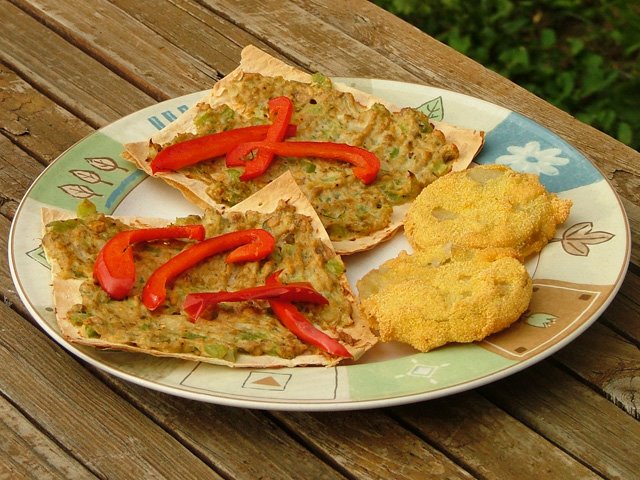
I made some slight modifications to the recipe: I used my homegrown chives instead of green onions, and I used minced green pepper for the chicken mixture rather than red. The original recipe from the New York Times suggests squares of six inches or fifteen centimeters. This provided me with twelve squares, and Paul and I consumed two each. Also, for the yogurt sauce (not pictured), I added a handful of my fresh mint, which provided a nice kick. And just because I could, I decided to pair the meal with fried green tomatoes.

Despite doubling up on all the spices and adding a lot of Tabasco sauce, I still found the meal dull. It wasn't bad, and it was definitely filling, but somehow the chicken mixture just didn't work for me. I really found myself craving a bit of tomato sauce and cheese to help it be more like a pizza. That may have something to do with my childhood friends of Lebanese descent, whose parents used lavash to make all sorts of fun fusion cuisine. (I also think this dish would have been better with lamb than chicken--it just needed more oomph.)

The wine I chose was actually a gift from my friend Tom, who dropped it off on his recent visit. I speak here of the 2005 Knobstone Traminette from Huber Winery in Indiana. Traminette is a Gewürztraminer hybrid. My previous experience with the grape was not pleasant, but this is fantastic. It tastes very much like a classic Gewürztraminer, but with a drier, crisper, and more lemony taste to it. As something of a random choice, it paired quite nicely with the Middle Eastern fare. The aroma is floral and mild, and the taste aside from the aforementioned spice and lemon has good elements of honey, with just a hint of acidity to keep things interesting. An excellent wine all around.