Showing posts with label lodi. Show all posts

13 May 2015

Markus Wine Co.

Markus Wine co. is a side project of Borra Vineyards in Lodi, California, run by Borra winemaker Markus Niggli. Niggli is from Switzerland, and given the dizzying number of grapes that we tried over that week, I asked him over dinner if he was growing any Chasselas. The laughing answer was "no". Apparently it's not a good fit for the region, and demand is decidedly low here in the US. However, the winemaker is producing some milder, lighter, European-style whites that once again change everything that you think you know about Lodi wine.

The labels featured on this series are the result of a collaboration with Michael Leonard and the University of the Pacific in Stockton. I'm particularly fond of the pure text design of the Nativo, because that's how I'm wired. All three of these wines can be purchased from the Borra website.

2014 Markus Wine Co. Nuvola
Lodi, California
100% Gewürztraminer
$19, 13.2% abv.

Dry and herbal with touches of honey. I know that sounds odd but it is possible for a wine to have some of the aromas of honey without the sweetness. Outstanding with a tuna salad sandwich on a croissant during these mild spring days.

2014 Markus Wine Co. Nativo
Lodi, California
75% Kerner, 19% Riesling, 6% Bacchus
$19, 13.1% abv.

Hurrah! I get to try another new grape for the first time (or the first time I've logged it). Bacchus brings me to 195 on the life list, and this particular bottle was light and floral with a touch of lemony acidity. I enjoyed it with a simple appetizer of steamed shrimp, lightly seasoned.

2014 Markus Wine Co. Joey Insieme
Lodi, California
95% Torrontes, 5% Riesling
$19, 12.8% abv.

Light citrus aromas pop up with a mild body and a slightly mineral flavor. Much more depth as it warms up. My favorite out of the three, and a unique expression of the Torrontes grape. Highly recommended with a large platter of raw oysters.

Note: These wines were provided as samples for review.

24 January 2015

2012 Scotto Family Cellars Malbec

This is my third review of a wine from the Scotto winemaking family of Lodi. First I tried the 2011 50 Harvests Cabernet Sauvignon, followed by the 2012 50 Harvests Meritage. Though it was also fun to try the younger generation's hard cider (and one of those guys, Paul Scotto, made this wine). This is also a continuation of my exploration of the wines of Lodi. While I'd obviously enjoyed Lodi juice for years (whether I knew it or not), my perspective changed a lot after my visit to the region last April. There are so many interesting things going on there right now, and it's amazing to watch as Lodi makes a push for national recognition and achieving the true potential of their historic vineyards.

This particular bottle is of a specific category that always makes me do a double take, or check the label carefully: California Malbec. Granted, the grape was widely used for table wine production in pre-Prohibition days, but modern domestic production didn't really start ramping up until Argentina made the grape popular in the 1990s. It's still not something you see a lot of despite the more traditional use of Malbec for blending Meritage.

Much has been said about the trendiness of Malbec, but hipsters have a unique opportunity to carve out a niche when perusing the wine list. "Sorry, but do you have any... California Malbec in the cellar?"

2012 Scotto Family Cellars Malbec
Lodi, California
97% Malbec, 3% Cabernet Franc
$15, 13% abv.

Part of the reason for the current popularity of Malbec is that it's a fairly easygoing, fruit-forward wine that also happens to be generally quite affordable. Your $15 Malbec from anywhere is probably going to have a better quality-price ratio than a $15 Pinot Noir. This bottle shows aromas of dark berries with a touch of chocolate. On the palate it is smooth with a little bit of a tart finish. Though fruity, it does not veer into sweetness and instead has a rather interesting aftertaste of plum and a hint of earth.

A Malbec like this will pair with a wide range of foods, but since I'm currently sitting here in below freezing weather with sleet pinging against the windows, I think it would be great with a nice heap of BBQ brisket. Some may think that I'm violating my Memphis heritage by wanting to eat what Texans consider BBQ, but the reality of the situation is that most places around here do a pretty good brisket in addition to our region's more well-known pork ribs and shoulders. Memphis beef brisket: a curiosity to pair with California Malbec.

Note: This wine was provided as a sample for review.

21 October 2014

2012 Gnarly Head Authentic Black

Usually when you've got a blended red table wine and a blended white in your portfolio, the next entry is always going to be a blended pink. Gnarly Head decided to go in a different direction with black. Pair it with a trendy orange wine for a festive Halloween theme. The suggested music pairing is blindingly obvious.

The wine is not, of course black, no more than a Pinot Noir is really noir. But it is a deep, dark shade of red thanks to a lot of Petite Sirah in the blend and a lot of skin contact. I've always enjoyed the rich depths of the smallest red grapes, bottles made from Cabernet Franc, Petit Verdot, and of course, Petite Sirah. They're not always the same, being made in a wide range of styles but distinctive for being noticeably darker than your average Merlot.

2012 Gnarly Head Authentic Black
Lodi, California
Proprietary blend dominated by Petite Sirah
$12, 14.5% abv.

The wine has a bold profile of blackberry and chocolate, though it is not particularly tannic thanks to 12 months of oak aging and a little decanting ahead of the tasting. It has a round body with a focus on dark fruit elements and a long, lingering finish. There were times when I was reminded of fruit wines made from blueberry or blackberry but without the usual sweetness. Pair with slow-smoked pork ribs.

Note also the prominent placement of Lodi on the label. I have noticed this on Gnarly Head wines going back several vintages, but increasingly wineries that source from Lodi for traditionally "California" wines are starting to specify where the grapes came from. Expect to see more of this in the future, even from brands that may surprise you.

Note: This wine was provided as a sample for review.

11 October 2014

Touring Lodi's Bechthold Vineyard with Microsoft Sway

As part of the Microsoft Office Insiders group, I get the opportunity to test out some new technology. Microsoft is getting ready to release a new Office application called Sway. Disclaimer: I'm receiving no compensation for this test and what you're seeing here is a preview of the technology. It's not completely ready, but I'm excited about it. Sway is sort of like PowerPoint but designed in such a way that you can easily create and display projects on mobile devices. The layout and format of the entire project can be changed with a tap, and it will also adjust itself to whatever device you're using.

For my first attempt at this new application, I thought it would be fun to put together a Sway about the Bechthold Vineyard in Lodi, California. I have lots of pictures that I'd not previously used, and thought that this was a fun way to present them. Bechthold was my first stop on my press tour earlier in the year, and recently we had an online tasting featuring four wines from that small patch of land:


Be sure to click on this link for the full screen experience which is easier to read:

A Sway About the Bechthold Vineyard in Lodi

Note: These wines were provided as samples for review.

22 September 2014

Cider Brothers "William Tell" Hard Cider of Lodi

The Cider Brothers are Michael and Paul Scotto, 5th generation members of a Lodi wine family. They've recently branched out into hard cider production.

Cider was for a long time America's most popular alcoholic beverage, but lost favor with Prohibition and changing tastes after WWII. I was first exposed to it when it re-emerged as a curiosity in the 90s with brands like Woodchuck and a few British imports. Since then, the market has grown alongside the enthusiasm of the craft beer industry and there's more interest in traditional small production ciders made from fresh apples rather than concentrated juice. The Cider Brothers use a combination of five apples.

From the press release:
  • Golden Russets enhance the bouquet and aromatics, and contribute complexity and fruit flavor
  • Granny Smiths add tannic structure and tartness, adding to the mouthfeel
  • Galas help deliver a clean, refreshing finish
  • Fujis lend just the right amount of sweetness
  • Red Delicious brings rich mouth feel and distinct appley, aromatic qualities

Right now the bottles are available in the 22 oz. format, a little smaller than a 750mL wine bottle. But hard cider is usually a low alcohol beverage, so this is perfect for splitting between two people at dinner. (UPDATE: 12 oz. bottles are also available.)

William Tell Hard Apple Cider
Lodi, California
$9/22 oz. 6% abv.

Bright and slightly yeasty nose, with a clean, crisp, tart mouth feel. The dominant flavor is akin to a Golden Delicious. Completely lacking the sour note found in many mass-produced ciders.

William Tell Pinot Grigio Hard Apple Cider
Lodi, California
$9/22 oz., 6.5% abv.

This one is made with 85% Hard Apple Cider, 15% Pinot Grigio. Very similar to the first one, but the wine is definitely present with a rounder, smoother mouthfeel. I was skeptical of this kind of blend at first but after tasting found that I preferred it over the pure apple version. This would be phenomenal to serve at a BBQ.

Note: These ciders were provided as samples for review.

16 May 2014

Lodi Rules

Out in California, you'll see a lot of wine certifications outside of the USDA Organic or Demeter Biodynamic system. While in Lodi, many of the wines we tried (but not all) carried the symbol of The Lodi Rules for Sustainable Winegrowing. We had a bit of fun with the term in the spirit of "San Dimas High School Football Rules!" as can be seen in the above photo that I put together while walking past the Kirschenmann Vineyard operated by Turley. The term was also used in an affectionate way as referring to the casual, fun spirit of Lodi. But there is a great concept behind the certification.

The Rules are fairly simple but are followed faithfully with auditing by a third party organization. Why not go with the official organic or biodynamic certification? Well, that's not always what is best for the land, and the growers in Lodi are attempting to conserve the land in the smartest way possible for the next generation and beyond. Bear in mind most of these folks are working the same patch of land that their families have been farming for five or six generations, and there is a strong desire to keep it going.

An example that was commonly offered was how to deal with leaf mites. You can use traditional pesticides and kill off everything except for the vines. Or you can go for the organic alternative, but that also kills off everything--the good and the bad bugs in your little farm ecosystem, and after the spray washes off, you're headed back out there several times before harvest. However, there's a modern chemical alternative that just kills the leaf mites and doesn't bother the ladybugs who kill the aphids, the birds that eat the gophers, or anything else that lets nature take its course while still having productive agriculture. Even better, you only have to spray once, so not only does it save time, but you end up having a more natural life cycle for the vines.

We got to see this kind of agriculture in operation out in the fields of Mohr-Fry Ranches, where grapes are grown for St. Amant Winery among others. In the foreground you can see an owl box, a small birdhouse that Lodi Rules growers build to encourage the habitat for small owls. But in the background is a gigantic palm tree that has been home to generations of gigantic hawks who take care of the rabbits and other small prey that come out in the daytime. By encouraging an environment that is welcoming to natural predators while at the same time making judicious use of modern technology, they are able to supply many well-known wineries as well as producing a line of heirloom beans that is gaining in popularity.

I was a little disappointed that we didn't get to spend more time talking about heirloom beans (seriously, I rarely meet someone who appreciates a good Christmas Lima much less grows them), but Mohr-Fry also grows cherries and other fruits on their beautiful family property that goes back over 150 years.

I'll also note that Lodi Rules is not an entirely either-or proposition. We saw many vineyards where one patch was conventional, another patch was certified Lodi Rules, and a third patch was certified organic, depending on what the various customers wanted from the growers. All got equal attention, but presented their own challenges and rewards. Still, I think that such local sustainable certifications are a great option for farmers who want to work their land in the way that works best for their particular patch of the earth as well as what will ensure fertile ground for decades to come.

Note: This trip was sponsored by Lodi Wine and Snooth.

12 May 2014

Acquiesce Winery & Vineyards

In honor of Mother's Day, how about a look at a winemaker who is also a mom? During my recent trip to Lodi, we had a stop almost in the exact middle of the week at Acquiesce Winery & Vineyards.

I got some messages from friends and colleagues while I was out there along the lines of, "Hope you can make it through all that old vine Zinfandel." Lodi is certainly famous for those old vines, deep reds, and of course the powerhouse standard grapes that go into California table wines bottled elsewhere. But there is a lot more to the story of this region, and Acquiesce is a great example. Susan Tipton had a transformative experience with a white Châteauneuf-du-Pape over a decade ago and was determined to make great Rhône-style white wines in Lodi. On top of that, she's continuing to swap out patches of Zinfandel and other grapes that are currently making money in order to graft on more white vines that won't show a profit for years to come. It's a story that I heard over and over again in the region, and one that speaks to the passion that these folks have about making quality wine.
We tried five wines with Tipton, and she presented little appetizers to go along with each one. My favorite was the Dubliner cheese topped with jasmine confit, perhaps the fanciest jelly you'll ever consume. All were served on their own individual amuse-bouche bowls or spoons, and the craftiness and attention to style can be seen throughout the tasting room with wind chimes made from wine bottles and homemade candle holders. (Speaking of the bottles, the unique shape is imported from France. That style is perhaps best known for the Sofia Coppola wines, but that glass comes from China these days.)

These wines can be purchased through the winery website.

2013 Acquiesce Picpoul Blanc
$22

There are only about 10 acres of Picpoul Blanc planted in the United States, and Tipton farms 100 vines of them. It's a fascinating grape with hints of lime curd and floral notes. A light, delicate body with a crisp and quick finish. The current vintage is, unfortunately, sold out, but keep an eye out for this one in the future.

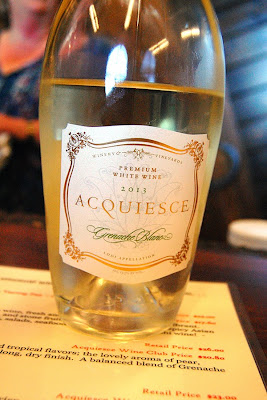
2013 Acquiesce Grenache Blanc
$22

A little firmer body with hints of musk and honeysuckle accompanied by a tart acidity. Excellent with the goat cheese and Meyer lemon zest, and a great roast chicken wine.

2013 Acquiesce Belle Blanc
$26

A combination of Grenache Blanc, Roussanne, and Viognier. Outstanding in the balance of the various elements. The nose is floral and herbal while the acidity is just perfect. It is bright and delightful and manages to capture summer in a glass. Highly recommended.

2013 Acquiesce Viognier
$23

I love a good Viognier, and this one did not disappoint. Aromas of grass and lemon, with a tart and refreshing flavor. I've always thought that this grape is a nice introduction to the earthier elements in white grapes before getting down into the funky, barnyard characteristics. Would be delicious with a cold pasta salad.

2013 Acquiesce Grenache Rosé
$20

The one non-white offering at Acquiesce is still true to the style of Southern France, and we had some amazing dry rosés while we were out there. This Grenache version shows bright notes of strawberry and watermelon with a nicely tart finish. Throw this in a bucket of ice and enjoy it beside the pool with a good book.

Note: This trip was sponsored by Lodi Wine and Snooth.

06 May 2014

Lodi Farewell Dinner

On my last night in town, we had a dinner at Jeremy Wine Co., with a few winemakers, and they broke us up so that the wine writers didn't cluster together in our instinctive fashion. I was seated with a husband and wife team from Peltier Station, and when I introduced myself, the husband mentioned that they had flown into Mississippi to promote their wines. It sounded a little odd, so I said, "Did you fly into Jackson?"

"No..."

The casino business has made Tunica a little busy, so I asked if they'd flown in there. "No, we're not into gambling, it was somewhere else..."

I said, "Did you fly into Olive Branch?" "YES! That's it!" So of course that led into a conversation about general aviation, their Cessna, and how I had not only flown out of that strip on more than one occasion but was privileged to take the yoke while Dad was logging flight hours. Turns out that he and his wife barnstorm all over the country on promotional trips. The jaunt to Memphis went Lodi, CA - Denver, CO - Fayetteville, AR - Olive Branch, MS. He thought it was a great trip, the wife seemed to indicate that it was a little long in some of the stretches.

I thought about my great-grandfather E.J. a lot while I was out there, particularly because two of my fellow writers were from San Diego and because so many of the winemakers that I met were fifth or sixth generation farmers in the same patch of land. I got to place my hands on old vines that were planted during the Civil War, and also to walk through some patches that were considered "new" seeing as how they were planted before WWI. Due to the Volstead Act during Prohibition, people were able to make batches of wine at home for personal use, and since Lodi had easy access to railroads, tons of grapes made their way east to fuel the home wineries of German and Italian immigrants in the big cities. Lodi is also the home of the first A&W root beer stand in the country, and while we drove past it, we did not get a chance to have a float while in town.

I have many more stories to share, but I'll leave you with this: while staying in the luxury resort Wine & Roses for four days, I'd notice that in the morning I'd smell cookies or toast or something similar wafting over the breeze, and it never corresponded to what we had for breakfast. Less than two miles away was a General Mills factory, so I was smelling Cheerios, Lucky Charms, or Kix depending on the schedule that day.

Note: This trip was sponsored by Lodi Wine and Snooth.

03 May 2014

Wine Dogs of Lodi

It's been a long week, and while I haven't posted a lot of content here at BWR, I've been busy posting notes and pictures on Facebook, Twitter, and Instagram along with my fellow wine writers on the trip. We couldn't have had a better time, and I'm sitting on a mountain of material that I can't wait to share.

Since I'm back home with Bella resting at my feet, I thought I'd kick off the first of many posts with a quick look at some of the wine dogs we encountered in Lodi. These were some of the friendliest and most relaxed dogs I've ever met, and everyone loved having them around.

This little black mutt at d'Art Wines grabbed a piece of dried grapevine and brought it to me in the tasting room. Perfect timing, though he didn't have a lot of interest in the chunky rabbit that kept hopping around the flower beds.


Ranger works the tasting room at Harney Lane Winery and greets customers. His other jobs include taking naps on the cool stone floors and searching for dropped food in the outdoor dining areas. One visitor asked if the winery was hiring, and stated that he wanted Ranger's job.


We encountered this old Weimaraner at the historic Bechthold Vineyard, home to what may be the oldest Cinsault vines in the world, planted in 1886. While one of the growers was talking about the care and tending of the gnarled old vines, this dog roamed around and chewed pieces of wood out of the trunks.


Roscoe joined us for a tour of Mohr-Fry Ranches, a farm that also produces a wide range of heirloom beans. According to Nannette, all dogs are named Roscoe.


This rescue mutt got a head scratch from Greg during a morning rosé tasting at the LangeTwins Family Winery original property. I'll have a lot more to say in the future about tailgate wine tastings and how I think they should spread across the nation.

28 April 2014

Greetings from Lodi!

Posting might be a little erratic this week, as I'm not sure how much time I'll have to finish up the dozen incomplete drafts I have sitting in the queue. But I'm not slacking off--I'm here in scenic Lodi, California with Snooth and the Lodi Wine Commission, and I'm about to start three straight days of winery tours, dinners, and tastings.

Yesterday was a long day, during which I traveled for 14 hours and capped it off with a massive three hour dinner here in the charming resort called Wine & Roses. The property is beautiful, full of redwoods, palm trees, olive trees, and more. The immediate area around us features the obvious vineyards, but also fruit orchards, olive and nut groves, dairy farms, and many other crops that I just glimpsed on our ride into town yesterday afternoon.

I'll probably save most of the stories and winery posts for my return home, when I've had a chance to sort through everything. But I will be posting updates on Twitter, where you'll also see the posts of my colleagues and hosts on this great trip.

Cheers!

26 August 2013

Lodi Tasting of August

It's been nice getting to know the Lodi wine region through some recent online tastings. I admire the fact that they're willing to experiment with different grapes and combinations and are not bound down by any established rules. Through these four white wines I think you'll see some amazing creativity and exploration.

2012 Acquiesce Belle Blanc
Lodi, California
60% Grenache Blanc, 30% Roussane, 10% Viognier
$24, 13.5% abv.

Such an elegant bottle and label combination. Light with honey, citrus, flowers, dry, mild, gentle finish. Excellent summer salad pairing with good mesclun greens and a sherry vinaigrette.

2012 Upstream Chardonnay
Lodi, California
100% Chardonnay
$15, 13.6% abv.

Amazing acidity, good minerality, really crisp and bright. Delicious notes of lemongrass and citrus peel. Hard to believe it's Chardonnay. This one is a killer match for Thai or Vietnamese food.

2011 St. Jorge Verdelho Seco
Lodi, California
100% Verdelho
$18, 14.8% abv.

Dusky and rich, honey flavors, long, lingering finish. One that I'd serve with a selection of aged goat cheeses.

2012 Borra Vineyards Intuition Field Blend White
Lodi, California
60% Kerner, 20% Riesling, 20% Gewürztraminer
$22, 13.3% abv.

I was really surprised to see a Kerner from California, since it's obscure even in Germany. This specimen is full of spice and dried apricot, really deep and with a note of rich white fruit. Bright acidity, full fruit flavor, yet fairly dry. Serve with your best roast chicken and a platter of red and white table grapes.


Note: These wines were provided as samples.

03 July 2013

2010 Noble Vines 337 Cabernet Sauvignon

Noble Wines 337 Cabernet SauvignonNoble Vines is a Lodi winery that names each of their bottles after the particular clone used. (The exception is the 1 Red Blend.) When I've talked about grape clones in the past, people have gotten concerned that these are either knockoffs, or genetically modified plants, or something else strange. But the reality is well-known to anyone that's ever taken a cutting of a plant and raised it in a jar of water on the windowsill.

The 337 clone comes from a specific vine in Bordeaux, selected for disease resistance and performance in a certain soil type. It's a newer clone that drives the big, fruit-forward style of red wine that is currently very popular. Cuttings can be taken from that vine and grafted on to other rootstock in France and around the world, and as those vines grow, new cuttings can be made and entire vineyards can be established. Eventually these vines may drift away from their original plant, and certainly environmental variables have a major impact on the wine that is made. But clones are a great way to remove some of the unknowns and establish reliable plants.

2010 Noble Vines 337 Cabernet Sauvignon
Lodi, California
77% Cabernet Sauvignon, 18% Malbec, 5% Petite Sirah
$15, 14.5% abv.

Red cherry and raspberry aromas, with an underlying scent of plum. Firm tannins and a mouth drying finish. The flavors are dominated by red cherry, with smaller hints of cassis, coffee, and leather. Decanting is recommended, and with some air the tannins are softened and the wine is ready to be enjoyed with a nice grilled burger or rack of ribs. Keep this one in mind for barbecues this summer.

Note: This wine was provided as a sample.