15 February 2010

Benito vs. The Pimento Cheese Burger

Sometime during elementary school, you start to notice people with weird food preferences. I say "weird" because they obviously conflict with the rules set down at your home. "Can I have OJ on my cereal instead of milk?" "No! Are you crazy?" Mom and Dad make the decisions about dinner, and there are certain Things You Just Don't Do. Then one day during lunch a kid breaks out a peanut butter and pickle sandwich and you look on in horror while he chomps away. Of course, he's just following the rules of his household, and your bologna and mustard sandwich looks equally weird.

I bring this up because, after a lifetime of living in the south and a lot of experience with pimento cheese, I only recently found out that some folks put it on hamburgers. Even better: there was a place nearby that sold these things. Childhood revulsion at breaking the food rules eventually gave way to, "Why not, I'll give it a try before I criticize it."

Now, I might have to explain this for the Yankees and other Ausländern. Pimento Cheese is a mix of shredded cheese, mayonnaise, sweet peppers (like inside olives), and various seasonings. Traditionally it's served with crackers, celery, or in the most common form, sandwiches. Just a layer of the spread between two slices of white bread, often with the crusts removed and then cut into triangles. Anyone that's ever had to make a hundred of these for a church gathering knows the joy of snacking on the crusts while you try to make perfect finger sandwiches.

Jim & Nick's is a Birmingham, Alabama based chain of BBQ restaurants, and it takes some guts for a resident of the Yellowhammer State to come to Memphis and try to sell 'Q. But even I must admit that they do a great job, and I'm quite fond of their beef brisket. Don't believe me? Check out the review by my friends the Knipples, who note the restaurant's support of the Southern Foodways Alliance.

What about the burger? I felt strange ordering it, felt strange looking at it when I got home, and bit into it with some trepidation. Lesson #1: pimento cheese went everywhere and Wolfie got some of the bits that hit the floor. It's messy if you're not paying attention. That being said, it was really good. Good as in, two hours later, I wanted another one. Unlike most supermarket pimento cheese, this had some real bite to it, with sharp cheddar and some hotter than normal peppers. The cheese doesn't really melt over the burger; if it did so it would most likely separate in an unpleasant fashion.

I really don't know why this isn't more popular, aside from the mess factor. It's a stupidly obvious food combination and a perfect way to use up leftover pimento cheese after you've finished making three hundred triangle sandwiches for Wednesday night Bible Study. My fellow Southerners: you don't have to try this at Jim & Nick's, but I urge you to try it sometime this spring or summer. I believe you'll be pleasantly surprised.

12 February 2010

Beer Week: Beer Wars

I love documentaries, and the more obscure the topic the more I like it. Professional Scrabble players? The Donkey Kong championship? Tilt: The Battle to Save Pinball? Move over Avatar, I'm going to watch an entire film about the font Helvetica.

Thus I was excited to receive an advance DVD copy of the 2009 documentary Beer Wars, written, produced, and directed by Anat Baron. Baron is the former General Manager for Mike's Hard Lemonade and, despite an allergy to alcohol that prevents her from drinking beer or other spirits, has a deep interest in the way the modern beer industry works and the barriers to entry for smaller competitors and new products. Anat Baron answers questions about the film in a detailed interview on 29-95.com.

A few quick stats:

In 1873 there were 4,131 breweries in the U.S. By 1983, the number had dropped to 80, and those were controlled by only 50 companies. The number has risen above 1,500 thanks to the removal of some regulations in the late 70s and the subsequent craft beer movement. But even today, two companies control 78% of the beer in America: Anheuser-Busch InBev and MillerCoors.

When a smaller company is bought out by one of the big two, it's possible that the original brewery will be shut down and the beer will be replicated at a larger factory in a different state--but with no change to the name, label, or advertising. Rolling Rock was an example used in the film: brewed in Latrobe, PA from 1936-2006 and successful enough to becomes nationally distributed. It was bought by Anheuser-Busch and production was moved to New Jersey. Likewise, tons of Coors was brewed here in Memphis for over a decade, with our flat landscape and artesian wells producing that "Pure Rocky Mountain Spring Water" flavor. (The "terroir" of beer is largely water, which makes up 90-95% of the beverage.) If someone bought Moët & Chandon and moved Champagne production to a plant in Nebraska without changing the name or packaging, there would be rioting in the streets and it would dominate wine discussion for years.

It's one thing to get big through buying up smaller companies and being successful at what you do. It's another thing to do it through writing state and federal laws to maintain oligopolies. There are old laws leftover from the days of Prohibition that determine who controls beer distribution in every state, and which beers you're allowed to consume in your area. The National Beer Wholesalers Association is a lobby that maintains these laws across all party lines and all states. They donate to every single Congressman in the country in order to maintain the status quo, making them one of the most powerful lobbying organizations in the country. (Baron did find one Oregon Representative that hadn't accepted NBWA funds, but only because he hadn't been offered. He got campaign funds from them during his following election cycle.)

The end result of this is that you want to sell a beer in bars or grocery stores, you don't have many options. The companies that distribute Anheuser-Busch InBev products tend to stay within the family, so you have to beg for truck and shelf space from the companies that carry MillerCoors products. You can't just sell directly to the bar, restaurant, or grocery store.

Imagine if national and local laws were twisted in such a way that 78% of all meals consumed in the United States were either at McDonald's or Wendy's. Independent restaurants would have to work under the good graces of those two. And say it only became legal to cook at home in 1979, assuming your individual state allows you to. Where would American cuisine be today? It sounds crazy, but once one drop of alcohol is involved, reason and common sense go out the window.

The worst part of this conglomeration has been the fact that American beer was largely turned into a generic, tasteless product: a light lager without bitterness or discerning flavor. In my favorite scene, bar patrons who only drink either Coors Light, Bud Light, or Miller Lite are invited to a blind tasting. Baron (on the right in the above photo) admits it's not scientific, but none of the people tested can pick their preferred brand out of the three.

The documentary is not all doom and gloom and railing against corporate interests. There are success stories, particularly Dogfish Head. On the left side of this photo is Sam Calagione of Dogfish, who in 1995 at the age of 25 used everything he owned to start a brewery... not knowing that it was illegal to brew beer in Delaware. He got the law changed mere days before opening the facility. Today Dogfish makes some of the most creative beers in the country. There's a few of the old holdouts who, like Shiner, survived Prohibition and the conglomeration of the 50s and 60s. It was great to see the Yuengling brewery, which has operated in Pennsylvania since 1829. The Boston Beer Co., maker of Samuel Adams, is the biggest and most successful independent brewery in the United States. It currently accounts for one-half of 1% of the U.S. beer market.

I'm not angry at distributors, some of whom are personal friends of mine. I get irritated when the system prevents me from trying something I'd like, or how beers have to be downgraded to 3.2% alcohol for Utah, or how Sam Adams' Utopias is illegal in 13 states. Nor am I telling you to go to hell if you prefer macrobrews. Drink what you like. But if you're interested in flavor, creativity, and dynamic innovation, check out the independents. Try your local brewpub, or homebrewers' association, or just give a chance to one of those crazy-looking beers you see in the store. OK, in the last case there's a good probability that it's owned by the big two anyway.

Unlike wine, truly world-class beer can be made practically anywhere and the only limit is the imagination of the brewer. You may have to look a little harder, but great beer is worth the search.

As of February 1, 2010, this movie is available everywhere, including iTunes and Netflix. You can also watch it on Amazon using your web browser for $3.99.

And with that, Benito's Beer Week comes to a close... Fear not, I've got some more interesting brews sitting around and there's always something new to try, and I'll sprinkle them around throughout the year, just like all the other crazy non-wine topics I cover. In the meantime, pick the right glass, don't chill it, and enjoy the golden barley goodness. Prosit!

Cover and screen images ©Copyright 2009 Ducks in A Row Entertainment Corporation. NBWA logo is a registered trademark, used here via Wikipedia with more details on fair use rules.

I received this DVD as a sample.

11 February 2010

Beer Week: Three Beers From Three Floyds

More beer treasures thanks to the benevolence of Dave and Thomas Rickert and the occasional deliveries by the former. Cheers to you both, gents. Sláinte!

Three Floyds is an irreverent brewery based out of Munster, Indiana near Chicago. They've got a brewpub and a faithful following in the Midwest. I previously reviewed their Apocalypse Cow alongside some Sloppy Buffaloes, but was happy to try some other offerings.

Alpha King is the current flagship of the Three Floyds line, coming in at 6% abv and 66 IBUs in a standard 12 oz. bottle. It's a classic IPA, strong and bitter with a touch of orange peel. Tastes surprisingly like a fresh draft brew from a pub. The great part is that this is so light, smooth, and refreshing that it disappears quickly. I rarely quote directly from company tasting notes, but the information is important: "This ale is brewed with Centennial, Cascade, and Warrior hops giving it an intense citrus aroma and a crisp hoppy finish." Hell yes. My beer contains Warrior hops. Much like Conan, it knows what is best in life: "To crush your enemies, see them driven before you, and to hear the lamentation of their women."

The Broo Doo was one that I kept laughing at, and The Roommate found terrifying. She's not cool with Troll Dolls, and I had to knock this one out early so it didn't sit too long in the fridge staring at her every time she reached for a Diet Coke. 7% abv, 80 IBUs, 22 oz. bottle.

Spicy, low on the bitter scale despite the high IBU rating, with an earth/wheat profile. Translucent with lots of suspended particles. Beautiful amber color, smooth drinking, with just a little bite of bitterness on the finish. This is a good example of how a heavily hopped beer doesn't necessarily have to be that bitter. Other elements came into play here, leading to a well-balanced beer. Though I have to admit that the label, a mix of 80s kitsch and Grateful Dead typography with just a dash of Barbie's Malibu Dream House, is not going to appeal to the average beer drinker or even the committed beer geek.

Lastly, I finally got the opportunity to try the Dark Lord, the most acclaimed of the Three Floyds beers and the one most likely to disappoint my childhood Sunday School teachers. The white wax indicates that this was the 2009 release. This 22 oz. bottle has a whopping 13% abv, putting it in the wine category for many states. If you are fortunate enough to get a bottle of this, hang onto it until you can enjoy it properly. While it needs to be served and consumed like a Port, it's not going to hold up as long once the bottle is opened. Grab two or three friends if necessary so you can enjoy it before the magic dissipates.

This is an Imperial Stout. I've reviewed a few of these, but if you are a newbie to the world of beer tasting, I will give you one bit of advice. When you are served your first Imperial Stout, SIT DOWN SHUT YOUR MOUTH ZIP YOUR LIPS AND LISTEN HARD. After the host has explained it to you, take a sniff and then sip it slowly.

Tasting notes: very Port-like in aroma, body, and flavor, but dark as molasses. There's an espresso and bitter chocolate flavor, with notes of raisins and spice. Sweet and thick, but balanced against the strong bitter elements in the hops. Definitely an after-dinner drink, and one that will require sharing and long contemplation. I can't imagine drinking a whole bottle by myself. Note that this is only sold from the physical brewery once a year, so it's a special, rare beer. I said similar things about the Ten Fidy on Monday, but this one is far sweeter, making the Port comparison even more apt.

Fun thing to do with this beer: when you're done and there's those last two or three drops clinging to the bottom of the glass, fill it full of water. You will now have a glass of liquid the same shade as Budweiser. That's how dark and concentrated this beer is. In its undiluted state it practically absorbs all light that comes near it.

After tasting through several beers in one day, I was staring at the Dark Lord label and wondered why the Russian word for beer was apparently Иуук. And I knew that the Russian word for "Russian" sounded nothing like "Kgyynft". It should be Русский, pronounced "Rooskie". SHENANIGANS! Somebody just used a Cyrillic font for the fake Russian here on the label. Though I will admit that this is somewhat less annoying than the standard N=И, R=Я laziness.

That's not a slam on Three Floyds or their graphic designers, hell, it's possibly just an intentional joke meant to irritate Russians in the Chicago area. Regardless of the quirky designs, these are seriously incredible beers that deserve critical attention and stand among the most impressive beers I've ever quaffed. Certainly check them out if you're in the area or if you've got a friend willing to do some cross-border smuggling for you.

10 February 2010

Beer Week: Shine On: 100 Years of Shiner Beer

Shiner Beer is a true American success story. Founded by a group of German and Czech immigrants in a small Texas town a hundred years ago and driven by the fascinating Kosmos Spoetzl, the brewery survived Prohibition through the usual creative methods*, made it through the great blanding and conglomerating of the 50s-70s, and has emerged as a distinct and respected beer producer with a devoted regional and national following.

I was introduced to the modern flagship beer Shiner Bock back when it first hit Memphis. Dad had enjoyed it in Texas, and it hit a few local bars in bottles and draft around the time I turned 21. I liked Shiner Bock because, unlike the cheap Southpaw and Red Dog I'd drink with my friends, it had actual flavor and wasn't just something cold to drink with pizza. And it was around $5 per 6-pack, not an expensive beer by any stretch. Later on I tried a few more of their beers, and enjoyed the specialty brews that appeared in the leadup to the 100th Anniversary in 2009. (I considered attending the centenary celebration, but got tied up with other commitments.)

Speaking of that... The book in the picture is Shine On: 100 Years of Shiner Beer by Mike Renfro. It's a big coffee table book about the history of Shiner, ending with a school yearbook-style gallery of the current 55 employees. Frankly that's one of the most amazing things about this book: fifty-five smiling workers, all wearing their work shirts with their nickname on a patch. Many of them have been their for decades. "The brewmaster, Jimmy Mauric, he's been there 30 years, starting from the bottom, unloading sacks of corn and hops at age 17, and working his way up." You don't see that much these days.

The book contains a wealth of old photos and oral history, and is written in a casual Texan vernacular that I found refreshing. It's not hokey or forced, but rather a very honest way of telling the story. Renfro lives in Dallas and provides an authentic, local perspective.

I had to take a picture of the book next to one of the beers. Shiner Bohemian Black is a re-release of the 97th anniversary beer with a new label. 4.9% abv, 18 IBUs. It's got a dark roasted coffee aroma and flavor, medium bitterness, with a light finish. Similar to Guinness in that it looks far stronger than it tastes. In fact, despite the color this is a relatively light and refreshing beer that goes well with pizza, BBQ, burgers, and all sorts of other good grub that folks eat down here.

Are you a fan of Shiner? You might also be interested in my reviews of Shiner Helles and Shiner Kölsch.

*There are hundreds of amusing stories of how various wineries and breweries survived the brutal repression of the Prohibition years. Shiner sold a lot of ice. If you knew someone at the brewery you could show up on the right day and get two or three cases of "ice" if you wanted. A team of snitches was employed in surrounding towns to alert the brewery to the revenoors. In case of inspection, the tanks were dumped into the nearby stream.

09 February 2010

Beer Week: Sierra Nevada Porter

Ah, beer and bratwurst. A match made in heaven.

Among the many beers and treasures Dave brought back from far off Deutschland was a tube of Develey Mittelscharfer Senf, a medium spicy mustard. It feels a bit odd to squeeze it from a toothpaste tube, but it's cleaner and has a better "aim" than plastic squeeze bottles. I also like my mustard on the hotter side, yet this is far superior to anything that comes in a bright yellow bottle. Add in some Swiss on a steamed bun, a little sauerkraut, baked herbed fries, and you're in business. As for the beer...

Sierra Nevada of Chico, California was one of the pioneers of the craft brewing trend back in 1980 and has maintained independence and high quality since then, even as its popularity has soared. While they're best known for their Pale Ale, I popped open a Sierra Nevada Porter to go with this meal. 5.6% abv, 12 oz. bottle. It's toasty and nutty with medium bitterness and a short finish. While this is definitely dark it's not overpowering, and has a nice toffee element from the malts. It's a good introductory porter if you're looking to get into more full-flavored beers.

They also make one of my absolute favorite beers, Bigfoot. It's a traditional Barleywine, a more powerful, higher alcohol style that was more popular a hundred years ago, but has found a new audience today.

08 February 2010

Beer Week: Oskar Blues Ten Fidy

A week of beer reviews deserves a design that looks it was ripped off an Ohio Brauhaus that had been marred by decades of cigarette smoke. Thus, the Benito's Beer Week logo.

* * *

Recently I've had the opportunity to try a lot of independent beers, so this whole week is devoted to beer reviews. And there's enough good beer and beer media (just wait!) to fill up five days this week, so check back Tuesday and Thursday if you're interested but normally only read MWF.

As always, this does not signal a change of theme here--I've done dozens of beer reviews, and other winebloggers like Fredric are getting in on the action. There's a lot to appreciate in good quality beer, and it's a fun change of pace after reviewing a lot of wine.

Let's kick off this Bierwoche with a curious brew I received as a sample: Oskar Blues Ten Fidy, 12 oz. 10.5% abv, 98 IBUs. Made in Lyons, Colorado, this is notable for being a serious "big beer" that's packaged in a can instead of a bottle. Oskar Blues does this both to protect the beer from light damage and for the environmental benefits (easier recycling, lower shipping weight, less space required, etc.).

This is a powerful Imperial Stout that has a very bitter profile with very few of the sweet elements you see in some implementations. Coffee and chocolate dominate the nose and palate. It's thick and dark with a rich brown head, and a hint of burnt orange peel that's very enchanting. Drink this at room temperature after dinner. Treat it like Port; I think it's far too strong to consume with a meal, and you won't be able to appreciate it as much.

I tried it both in the brandy snifter pictured above and straight from the can--definitely go with the snifter, or a wine glass. I mean, yeah, you can drink it from the can, but you're not going to get any of the experience of swirling and sniffing between sips. Just because it's in a can doesn't mean you have to drink it like that. We rarely drink straight from wine bottles. At least, not in public.

The website features a detailed location directory which will let you know specific stores and bars serving their products. I'm looking forward to trying some of the other interesting cans like the amusingly named "Mama's Little Yella Pils".


This beer was received as a sample from Oskar Blues. In full disclosure of other gifts, I received some awesome stickers.

05 February 2010

Three Wines from Dave

My friend Dave Rickert was in town again, and came bearing gifts of the liquid variety. I've mentioned him in the past, and how his hobby of collecting wines during his U.S. Army service in Germany has ended up exposing me to a lot of fascinating bottles. We gathered over at Paul's house with some delicious ribeyes and set in on three great wines.

First we tried the 2007 Castaño Monastrell from Yecla in Southeast Spain. $10, 13.5% abv, 100% Monastrell (Mourvèdre). Delicious aroma of bacon fat, rich currants, touch of cedar, smooth. Minimum tartness, follow through on flavor of currants with a short finish. I really enjoyed this wine, and it showed how Mourvèdre can have an aromatic, mellowing influence on Rhone wines. (Also, if you're interested in this grape, check out Vine Geek's Mourvèdre Mondays, a year-long project he just started.)

Next we opened the 2005 Tintara Cabernet Sauvignon from the McLaren Vale, Australia. $18, 14% abv.
Black cherry, green bell pepper, herbs, firm tannins. Flavors of licorice, with tart cherry skin aftertaste. It's one of the only Australian red wines that had a strong Bourdeaux/Claret profile to it, and it's certainly an amazing wine for the price. I'd love to see how this one develops over time.

Finally we got to the Bordeaux that had been decanted an hour earlier... the 2000 Château La Louvière, €24 in Germany a few years ago, 13% abv, from the Pessac-Léognan subregion of Graves. 64% Cabernet Sauvignon, 30% Merlot, 3% Cabernet Franc, 3% Petit Verdot. Truly a spectacular wine and one that required a lot of thought and examination over the course of a long evening. Lots of tobacco, green tomato leaves, touch of cherry and black pepper. Tremendous balance and structure, just so well put together... This bottle had been properly aged thus far, but could probably go for another 5-10 years.

Afterward we were treated to another delicacy. Dave's mother, Ann Rickert, made her famous Caribbean Fudge Pie, a 1960s-era recipe involving walnuts and a rich chocolate filling. I could only manage a small slice, but it was incredible. Thick and decadent, it was a great way to finish the meal. And chocolate does go well with great red wine, but at this point we'd moved on to an assortment of Ports, Sherries, and whiskies. Unfortunately, I don't have the recipe, but I might see what I can do.

03 February 2010

Benito vs. the Cocktail: Tomatillo Bloody Mary

I'll come right out and say it: I don't like the Bloody Mary cocktail.

I've had plenty at different restaurants in different states, but frankly I'd rather just drink tomato juice and have a shot of vodka and a salad on the side. But if this blog demonstrates nothing else, it's that I'm open minded. If someone ever fixed me an elaborate Bloody Mary with Absolut Peppar and heirloom tomatoes and a foot-high garnish that's a shish kabob of shrimp, boiled eggs, and five different vegetables, I'd drink it and give it a fair chance.

In a recent issue of Saveur, there were a dozen different Bloody Mary recipes. Most were just variations on the same theme, but the Tomatillo Bloody Mary caught my eye. I like tomatillos and the rest of the fresh ingredients listed, and the recipe was just too damned weird to pass up. In the grand tradition of desperation recipes like Buffalo Wings, it seemed like the late night creation of a guy stuck with only a bottle of vodka and a jar of salsa verde.

And that's precisely what it is. In fact, just ditch the vodka and you've got a really delicious salsa verde. It's too thick to drink easily, and while I like the flavor well enough, it isn't really refreshing or relaxing like a cocktail should be. After just a few sips I felt like I'd been doing shots of pulpy wheatgrass juice down at the smoothie bar, trying to humor a pretty vegetarian chick. (Ah, to be 22 again...)

Maybe it would work better as a weird amuse bouche before dinner--call it a cold vodka green tomato soup, for instance. Frankly I'm thinking that this recipe was either a cruel joke in the style of Penn & Teller's Swedish Lemon Angels or an unfortunate Nihilartikel.

Final verdict: I still don't like the Bloody Mary. If anyone has the perfect recipe that will convert me, feel free to post it in the comments and I might tackle this topic again in a few months. It's going to take a while to get the taste of green salsa and grass clippings out of my mouth.

01 February 2010

Alvear Solera 1927 Pedero Ximénez

I hated sherry in my early 20s. Maybe it was the cheap stuff I was buying, but I tried Amontillado, Cream Sherry, and several other styles, and didn't like any of them. I was nearly 30 before I found one I liked, and I think it might just have to be a flavor you grow into. Lately I've been craving it, and at the recent dinner party I used sherry and sherry vinegar throughout the meal.

One I would highly recommend is the Alvear Solera 1927 Pedro Ximénez. $20, 16% abv, 375 mL bottle. As the name implies, it's made from the Pedro Ximénez grape in Spain's Jerez region. In fact, the word "sherry" is an English corruption of "Jerez". The Brits are also responsible for turning "spaghetti bolognese" into the delicious sounding "spag bol".

What about the 1927 part? How can you buy such an old wine for $20? Well, that has to do with the other word, Solera. The Solera method involves blending older and newer barrels to achieve an ideal and affordable mix. When you purchase a fortified wine made in this method, it's some combination of (in this case) 80 years worth of vintages, but not equal parts of each. The percentage of the oldest wine is going to be very tiny, but it's there. Different countries have different laws regarding such blends and how they can be labeled, and similar methods and labeling are used with products like whisky and vinegar.

The wine is very sweet but balanced, with rich aromas and flavors of stewed fruits, raisins, and an element of beef broth. Truly perfect for a cold winter night. I've had this at a wine tasting, but most recently revisited it at Grace Restaurant where several of us at the table enjoyed it after dinner. I decided it was time to grab a bottle of my own.

29 January 2010

Hope Family Wines

Hope Family Wines has been in operation in Paso Robles, California since 1978 and produces wines under four labels: Treana, Austin Hope, Liberty School, and Candor. Here I'm taking a look at the last two.

First up are the wines in the Liberty School product line, representing the affordable, introductory wines of the company. These are pretty widely available around the country and have a good quality-price ratio.

2007 Liberty School Syrah
Central Coast, $14, 13.5% abv
Strong and aromatic, with a bold nose of blackberry jam. Deep, dark berry flavors with medium tannins and a short finish. It has a lingering aftertaste of black cherry with a bit of black pepper, where you can fully appreciate the Syrah grape.

2007 Liberty School Cabernet Sauvignon
Paso Robles, $15, 13.5% abv
Full-bodied like the Syrah, but with a stronger focus on cherry aromas and flavors. Stylistically the two wines are very similar, and both will work well with grilled meats or savory Italian dishes.

2007 Liberty School Chardonnay
Central Coast, $14, 13.5% abv
Big and fruity, with aromas of peach and apple. Low acidity, dry but full-fruit with an apricot finish. Think roast chicken, pasta salad, a few sliced tomatoes: a good wine to keep in the fridge for that light dinner of leftovers after work.

The Candor Wines are in the next tier up both in price and style. More complex and a little more interesting. Curiously, both Candor wines are a blend of the 2007 and 2008 vintages, and are sourced from various regions within California. Normally a blend would just be issued as Non-Vintage, but these two are up front about their vintage mix (hence "candor"). I was really impressed with the performance of both of these bottles, and it's certainly an interesting approach.

Candor Merlot Lot 2
Paso Robles/Lodi, $20, 14.5% abv
The Merlot is smooth and creamy. Aromas of black cherry and black pepper, with a nice flavor of currants. It's very soft, and reminds you how Merlot can be used to mediate the strength of bolder red grapes.

Candor Zinfandel Lot 2
Paso Robles/Santa Barbara, $20, 14.5% abv
Really fascinating nose on this one: tar, cedar, blackberry. It's more spicy and full-bodied than the Merlot, without being jammy or harsh. Balanced tannins and an overall profile that would match to loads of different dishes.


These wines were received as a sample from Hope Family Wines.

27 January 2010

NV New Age White

Welcome Fermentation readers! For regular readers that haven't seen it yet, Tom Wark interviewed me recently for his immensely popular wine blog.

* * *

I constantly get asked about wine marketing, and I think I'm not the best person to answer. Whenever I hit a new wine shop I'll head for the "weird" section and then work backwards. I'm going to dig through the selection of Hungarian and Israeli wines before I even look at their French lineup. The second problem is that I rarely buy the same wine twice, since I'm always interested in trying something new. Often I'll just grab something at random, which is how I ended up with the NV New Age White from Argentina. $10, 9.5% abv. 50% Sauvignon Blanc, 50% Malvasia. The label had zero information on it (all details come from the website), and I ended up with a very unusual wine.

Honey and pineapple aroma, with a muskiness that reminds you of Muscat. Lightly sparkling, very sweet. Mango, papaya, general fruit salad impression. It's the only wine I've ever seen with the serving suggestion of adding a slice of lemon or lime. Definitely not my preferred style, but I know a lot of people that would like this. I don't have a problem with sweet, fun wines like this, but I think more information on the label would help attract the desired customers and perhaps push others to drier selections from the winery or importer.

And if you're expecting just a normal, dry white table wine and don't pay close attention while pouring it, getting a fizzy sweet surprise in your mouth can cause an embarrassing spit-take.

Many thanks to the darling Zoe for posing with this wine. She got a dog biscuit in appreciation. Thinking about getting a dog? Look for a rescue mutt like Zoe, Wendy, or my own beloved Wolfgang. Those dogs need a good home.

25 January 2010

Benito vs. the Pizza Kit

I think I need to kick off BWR Year 6 with some haute cuisine.

A link from the Serious Eats blog led me to a collection of vintage pizza kit ads. While those beauties hail from the 50s and 60s (during which cheese was apparently a dangerous and scary topping), I remember the boxes fondly from the early 80s. The pizza kit occupied an interesting niche: better than the frozen pizzas of the time, but not as good as delivery/restaurant pies. They were also fun to make, since you got to play with the dough, spread the sauce, and lay on the toppings.

There was another type that I haven't seen since then, sold by some schools for fund raising. A few weeks after placing your order you got a set of blank crusts, packets of sauce, and various toppings, all of which were supposed to go in the freezer. Not only did the basic 8-pack fill up your freezer, but you inevitably ran out of cheese and sauce by pizza #6, and a bag of grey sausage pellets would linger behind the frozen corn for years.

Around high school when I was going crazy with bread baking, I made real homemade pizzas and experimented with lots of different ingredients. I still do it occasionally, though the local master in this regard is Fredric with his Saturday night pizza & movie tradition that's been going on for over 10 years.

I've had wood- and coal-fired pizza in trendy bistros, deep dish pizza in Chicago, crazy variations around the country, and I've even had it in Italy. The strangest was probably a funky Gouda/Edam pizza made at an Italian restaurant run by Ecuadorians in Amsterdam. But those goofy ads ignited a craving that had been lying dormant for nearly twenty-five years.

On my next visit to the grocery store, I grabbed a box of the Chef Boyardee Cheese Pizza Kit. I played it straight by the directions, and only added some shredded American-style mozzarella cheese since that's what we did when I was a kid and it's a permitted variation by Chef B. No artisan goat cheese, no Moroccan lamb sausage, no dash of truffle oil on the finished product. I even used the same glass bowl and banged-up stainless steel pan, part of a set of random cookware I inherited when I moved out of the house. With luck, I could recreate the exact flavor I'll always associate with trying to time the pizza to be ready just as soon as ABC would begin showing a James Bond flick on Saturday night.

The finished product faithfully replicated those memories, so much so that I managed to burn the roof of my mouth like I did every single time as a child. The crust is biscuit-like and soft, the sauce is distinctively tangy and sweet... just as I remember it. With the wisdom of experience, I do recognize that this is salted all to hell, the tragic flaw of all processed foods (which I rarely eat these days). I like salt, but I also like to control it.

What wine to serve with this meal? I needed something that would have been easy to get in Memphis in the 1980s and would be a natural match for a 50s-style pizza. Only five seconds of cogitation were required to arrive at the perfect match: Chianti in a straw basket (or fiasco bottle).

The Tuscan 2007 Bell'agio Chianti from Banfi retails for around $10, 12.5% abv. and is made from 90% Sangiovese with the remaining 10% comprised of Canaiolo Nero, Trebbiano, and Malvasia. Interesting woody nose, with cedar and pencil shavings. Medium body with a dominant black cherry flavor, firm tannins, and a long finish. Just a touch of bitterness from the tannins, but the sweetness of the tomato sauce balances that out.

It's not the greatest Italian wine I've ever had, but it's solid, drinkable, and affordable, the kind of wine that would show up in a Billy Joel song.

22 January 2010

5th Anniversary

It's hard to believe that as of today, I've been at this little project for five full years with nearly 750 posts. I stopped counting the number of bottles and grapes a while ago, but it's been a fun ride thus far. 2009 was the first year I felt more like a wine writer than just a random guy with a website. I got loads of samples from wineries, got to travel, spent a lot of time talking to winemakers and other industry professionals, and discovered that many people are interested in my scribblings here.

Tempus fugit, as the poet says. Actually he says Sed fugit interea fugit irreparabile tempus, singula dum capti circumvectamur amore... but let's leave the Latin for another day. It's time to celebrate.

What were some of my highlights of 2009? The series of posts on my trip to Sonoma in search of green winemaking, the joke cocktails on April 1, my first Mexican wine, the Ridge vertical with Fredric, redesigning the blog, an unforgettable meal at Grace Restaurant with Grace, the demon chicken, haggis tamales, Benito vs. the MRE, and of course, the controversial fried bull testicles,

Like I did last anniversary, I'm taking this opportunity to highlight some wine blogs I've discovered in the past year, and bloggers that I've gotten to know somewhat through e-mail. For a twist, these are all from the South. I love the fact that "flyover country" is developing a healthy wine culture. It's interesting to read the perspective of someone not in NYC or in California, where said culture has been more mainstream for a longer period of time and there's a more established tradition of wine writing.

In no particular order...

Suburban Wino, Atlanta, Georgia
Joe writes with a sense of humor and frequent pop culture references as well as a genuine love of wine. You're not going to get a shout-out to the B-movie Tremors from Robert Parker, but I think The Wine Advocate might benefit from the films of Fred Ward.

Wine Tonite, Atlanta, Georgia
This is a group blog that in addition to reviews provides interviews and commentary on trends within the industry as well as a wide range of wine-related topics. Ed and the other talented writers also make regular use of video clips to spice up a post.

Decatur Wine & Food Dude, Decatur, Georgia
Decatur is just outside of Atlanta. I'm going to blame Hardy Wallace for this Peach State explosion. The Dude covers some spectacular wines, as well as great recipes and restaurant reviews.

Wine and Walnuts, Wilmington, North Carolina
Kimberly blurs the line between food and wine blogging, a style that I love to read because I've always maintained that wine is food and doesn't need to be cordoned off.

Louisville Juice, Louisville, Kentucky
To be a wine lover in Bourbon country is a noble pursuit. Tom's one of the few winebloggers I know of that's made the transition from a prior blog in an unrelated subject, in this case a political blog.

Vine Geek, Austin, Texas
I've been chastised here a few times for sci-fi references and other trappings of the nerd life. Jim takes it a step further by invoking video games and even Dungeons & Dragons. Needless to say, this blog caught my attention like Paul-Muad'Dib grabbing Shai-Hulud with a maker hook.

Finally, a trio of food blogs from my hometown of Memphis, Tennessee:

The Chubby Vegetarian
I've mentioned this site here several times, but I don't think I've highlighted it. Over the past year, I've gotten lots of e-mails from readers who say, "I love your site--I bookmarked it and The Chubby Vegetarian!" They never say that about any other blog, testament to Justin's beautiful photography and recipes that can even make a carnivore salivate.

Hungry Memphis
This is a group blog run by The Memphis Flyer, our city's alt-weekly. Susan Ellis and others provide news, reviews, recipes, and commentary about the food scene here. I'm pretty sure it's also the only place online where you can passionately argue for or against the Midtown Schnuck's location and its idiosyncrasies.

Vegan Crunk
I was surprised to find such a vibrant group of vegetarian/vegan foodbloggers in Memphis, a town known for putting pork in everything. Bianca Phillips also writes for The Memphis Flyer, but this is an independent project with a lot of creative cooking. What other foodblogger has a photo of herself with the Dalai Lama in which he's giggling about her lip piercing?

Check out these great blogs, and on each of them you'll discover a dozen or more links to other sites I haven't explored or mentioned yet. Like what you read? Drop a comment or an e-mail and let 'em know.

Cheers, and thanks for reading!


P.S. Interested in WITS? E-mail me and let me know. Nothing solid yet, it's an idea that I've been bouncing around for a while.

20 January 2010

Dinner Party with Jacob's Creek Wines

I received a set of five bottles from Jacob's Creek, produced by the large Orlando Wines based out of the Barossa Valley in South Australia. While grapes have been grown along the banks of Jacob's Creek for 150 years, the first wine under that name was a Shiraz/Cabernet/Malbec released in 1976. All of these wines are from the Reserve series, and represent almost the entire product line (only the Merlot was missing). I had five wines representing popular varietal grapes, and I could have just tasted them on my own in front of the computer. Or... I could have taken it as an opportunity for a dinner party. Paul graciously offered the use of his house, I invited various lovely young women, and began cooking late on a Saturday afternoon.

After the appetizers and a little non-related sparkling wine, it was time to pop open the 2008 Jacob's Creek Reserve Riesling ($14, 12% abv). I was surprised to discover a dry, very mineral white wine with a touch of petrol and wet rock aroma. I hadn't read the information sheets ahead of time (I always do that after tasting), and was pleasantly surprised. Very light and refreshing with a mild fruit profile of pineapple and melon.

Since it's still chilly out, I started out with a warm soup course. Tomato soup doesn't get a lot of respect. It's either the early bird special for old folks or is transformed into a "bisque" even though it contains no seafood. It's the easiest thing in the world to make as long as you use good whole canned tomatoes, sweet onions, chicken stock, and butter. I finished mine off with satuéed diced yellow squash (adds texture and flavor) and a splash of sherry.

Next up was the 2007 Jacob's Creek Reserve Pinot Noir ($14, 13% abv). Delicious aroma of overripe strawberries, light berry flavors and tannins with a medium body and a short finish. For a hotter region I was expecting a much rougher wine, but this was quite nice for the price. And good Pinot Noir always goes well with salmon, hence the accompanying dish.
This is a repeat from my Burns Night dinner, but I felt like making it for a new crowd. Toasted dark rye bread, a thin smear of Dijon mustard, smoked salmon, sour cream, and a chiffonade of basil (though fresh dill would be great here when it's available). It's an open-faced sandwich or Smørrebrød in the Danish style. It was well-received around the table and one diner in particular considered it her favorite course of the evening. Many wanted to make it for breakfast in the future, I want to explore more open-faced sandwiches in 2010.

During the bridge section of the evening, I elected for a salad with the 2007 Jacob's Creek Reserve Chardonnay ($14, 13.5% abv). Fascinating aroma, with bits of mint, apricot, pear, and floral elements. The flavor was light and dry with medium fruit and a lingering finish.

Just a simple mesclun salad with segments of tangerine, shaved aged Parmigiano-Reggiano, and a vinaigrette made with sherry vinegar. The cheese had reached that nice point where it was crumbly and had little crunchy specks of calcium crystals. Oh so delicious. I went for a fairly tart dressing, but the sweetness of the citrus fruit and low acidity of the wine balanced everything out.

Lots of my first time guests are surprised at the appearance of a salad in the middle of everything, but in the Italian style I think it helps clear the palate, aids digestion, and avoids a tendency for dishes to just get increasingly heavier over the progression of the evening.

Finally time for the stronger reds, which provided interesting contrast against each other. The 2006 Jacob's Creek Reserve Shiraz ($14, 14% abv) is a classic example of an Australian Shiraz without going overboard. Plum, black pepper, spicy aromas and flavors with a short finish. Mild cherry flavors appeared on the aftertaste, and about half the table preferred this wine.

The other half voted for the 2005 Jacob's Creek Reserve Cabernet Sauvignon ($14, 14.5% abv). Strong in the Bordeaux style, this wine is. Enchanting vegetal aroma of green bell pepper, tomato leaves, tobacco, and leather. Flavors tended towards the herbal with notes of black cherries. It was definitely my favorite of the evening, and is a tremendous bargain. Like the Shiraz, this was matured in French and American oak and the past five years have been extremely kind to it.

For the main course accompanying the big reds I took a four pound boneless pork loin and carefully sliced it to create a sheet of pork about half an inch thick. I laid down a stuffing of chopped dried apricots, walnuts, fresh sage, and roasted garlic. I rolled it up, tied it, and roasted it for about an hour. In the future I'll soften the dried fruit with white wine and add some salt pork or bacon, and reduce the cooking time a bit. The final product was a great balance of sweet and savory but a little on the dry side. The roulade or braciole technique is something I need to work on. I want to get that perfect spiral with an even filling. I also made a risotto with arborio rice, wild rice, cremini mushrooms, and chicken stock.

For dessert, Laura M. prepared a delicious homemade pound cake with a strawberry-Cointreau sauce. I was in heaven, and forgot to snap a picture.

It was yet another successful dinner party, catching up with friends I hadn't seen in a while, getting an opportunity to share bottles of wine with a group that had a wide range of wine experience, and mostly just the chance to have fun on a rainy weekend night.


The Jacob's Creek wines were provided as samples.

18 January 2010

2004 Can Feixes Penedès Blanc Selecció

After the holidays, I think it's a good idea to dig through the cellar, closet, or pantry and clear out any young, inexpensive wines that might have been forgotten. At some point things are liable to get lost in the shuffle, and not every wine benefits from years of aging. Case in point:

The 2004 Can Feixes Penedès Blanc Selecció from northeast Spain near Barcelona on an estate founded in 1768. $14, 11.5% abv. Made from 40% Parellada, 30% Macabeo, 20% Chardonnay and 10% Malvasía de Sitges.

There's an asparagus-like nose combined with an earthy, grassy quality. I'm not going to say that this aroma will be appealing to everyone, but it's decidedly Old World in its approach. After an initial crisp, acidic flavor, other fruit like honeydew melon and white peach begin to appear.

This one was a little unbalanced, and I think might have been better a couple of years ago. The current release is the 2008, and comes much more highly recommended from friends that have had it.

Served with something Jason's Deli calls a Chicago Club: smoked turkey breast, bacon, smoked red pepper-cilantro aioli spread, organic spinach, roma tomatoes and provolone on herb foccacia, all things that scream "Chi-Town" to me. Teasing aside, it's actually a tasty little sandwich and goes well with a white wine.

15 January 2010

Ask Benito!

One of the more interesting parts of this whole blogging thing is getting questions from readers. Let's open up the old mailbag and answer a few of them today.

Q: I think I live in your part of town. Can you text me every time you try wine so I can come over and try it with you, and have dinner? I'll be bringing a couple of friends and will need you to watch my kids while I'm tasting the wine.
Dee Ridlett, Memphis, TN

A: Well Dee, while I love to hear from fans and enjoy meeting them from time to time, I prefer a certain level of privacy and handle these things on my own terms. My house is also small, contains two large dogs, a female roommate who is armed and trained in the martial arts, and in general it's not the ideal setting for entertaining guests who aren't already dear friends. There's lots of great public wine tastings around town, though! Check the paper on Wednesday for listings.

Q: Back in April 2005, you wrote about the 2002 Fusée Cabernet Sauvignon, which sold for $4. Here in Nevada the price went up to $5 per bottle and then they stopped carrying it. I need you to send me a case every three months at the original price. I don't know why you insist on jacking up the prices, I'm retired and can't afford the expensive wines you make.
David Morgenhorst, Reno, NV

A: Great to hear from you David, and I'm sorry you can't find the wine you like. But for the record, I do not produce or sell wine, nor am I affiliated with any company that does so. I just taste and write. I don't have control over distribution, pricing, or any other factor that might prevent you from drinking the wine of your choice. Even here in town, sometimes I don't know if something is widely available or just a one-time fluke, so your best bet is always to check with your local retailer. And if they don't have any way to get the wine to you, it's possible that production has stopped or it's just not distributed to your state. But don't get angry at your local retailer: explain what you liked about the wine and ask for a good substitute. Chances are they've got something you'll enjoy just as much, if not more.

Q: I need a wine recommendation. I'm making roast duck for dinner tonight, but it's an old family recipe that's boiled, not roasted, and it doesn't have duck in it. I also need a pairing for sushi but I don't eat raw fish, rice, or seaweed.
Claire Devereaux, Fresno, California

A: This is a bit confusing. If it were real roast duck I'd suggest an Oregon Pinot Noir, but you'd have to give me more details as to what manner of critter is getting boiled, or what kind of... sushi you're consuming. I'm happy to pass along suggestions as long as I have a general idea as to the food, but I don't know what your father would like for his birthday, or what would impress your boss, because I don't know them. If I do suggest something I'm only going to go as far as grape and region. If I mention the perfect wine by name, you're going to run around 20 different stores only to find that nobody has it. Again, ask for help from your local wine shop, and be polite. Those folks work hard, and if you show them an ounce of kindness they'll respond with a pound of assistance, and over time will remember what you like and don't like. Eventually they'll start keeping stuff for you behind the counter or inviting you to special tastings.

I know a lot of this sounds like, "Why read reviews at all if I can't find the wine?" Practically everybody who loves wine has to read a hundred reviews with the hope of trying just one of them. And then there's those lovely small production wines--100 cases means 1200 bottles, so maybe 3600 people will get to try the wine while tens of thousands may have read about it. But it's always good to keep reading, and that information will accumulate and interrconnect in your brain. If you read a lot of favorable reviews of specific Washington white wines, it can encourage you to check out that category, or even visit the region. At some point you'll recognize a label or name and will instantly remember a review that you just glanced at six months ago. More knowledge is a good thing!


Got a question for me? Drop it at benjamin.a.carter@gmail.com with "Ask Benito" in the subject line. If I don't answer it on the blog I'll get back to you personally.

13 January 2010

St. Kilda Wines of Australia

For the new year, here's a new pair of wines with a new name from St. Kilda, made by the De Bortoli family who came to Australia from Alpine Italy back in the 1920s.

The name of the wine comes first from St. Kilda, a beachside suburb of Melbourne in Victoria, though both wines are sourced from vineyards in the Riverina region of New South Wales. St. Kilda the town takes its name from a lonely, remote archipelago in the Outer Hebrides of Scotland and doesn't refer to an actual saint. In fact, the name might just be the result of some poor translations. Ah, the joys of etymology.

2008 St. Kilda Shiraz
$14, 14% abv
Spice and black cherry, light body, smooth, short finish. Touch of green pepper, espresso. Serve with grilled lamb or pork and a savory sauce. While smoother than your stereotypical Aussie Shiraz, you're still going to want a flavorful main course to go along wiht this wine.

2008 St. Kilda Chardonnay
$14, 12% abv
Peach, apricot, minerals, full-bodied with lots of fruit, big brassy acidity. For a pairing, bring on the poultry that's been roasted with citrus of some sort: a chicken stuffed with oranges or duck stuffed with lemons, something like that. Even a game bird like quail roasted with slices of lemon would be incredible.

I like the Victorian/Baroque scrollwork on the label. An elegant, old style design element within modern borders, and topped by a convenient screwcap. I think it works a bit better with the red than the orange (more contrast makes it stand out better), but I'm quite happy with both from a graphics standpoint.

This wine was received as a sample from The Country Vintner.

11 January 2010

2008 Mulderbosch Chenin Blanc

One of my first wines tasted in 2010 comes from South Africa, a wine producing country that is getting more prominent and interesting with every passing year. I'm still amazed that these wines are so easily available now; in the 80s, South African products including wine were embargoed in the United States and many other western countries, so sampling one would have required a visit to the country or smuggling, as is the case with Cuban cigars. Now, I can even go to the grocery store and buy oranges with stickers that say "South Africa".

The 2008 Mulderbosch Chenin Blanc is from the Stellenbosch region. $15, 13.5% abv. 100% Chenin Blanc, called Steen down in the RSA. In fact the text below "Chenin Blanc" in Afrikaans says Steen op Hout (Chenin Blanc on wood), though only 30% of the wine spent six months on a combination of French, Hungarian, and American oak. It's enclosed with a DIAM composite cork. I figure if you're going to use natural cork, you might as well do everything you can to avoid cork taint, and DIAM corks seem like a nice compromise.

Nose of jasmine, lemongrass, and just a touch of minerals. Big round mouthfeel of lemon curd, full fruit, crisp and clean, with a short, tart finish. I've had a few vintages of this wine over the years, and while it's been consistent in quality the price has actually come down a bit--checking around online some states carry it as low as $10, but my notes have it as $20 back in 2005. I'm happy with the middle ground.

While it was too cold for a lekker braai, I opted for stewed pork and a potato bake. Damn tasty, bru. Scalloped potatoes were a mainstay of my childhood table but layers of caramelized onions really make it pop.

Note on the label: few wineries do the vertical label, fewer do it well. Mulderbosch pulls off several interesting techniques with their design. The label is thin and vertical, but extends up the neck and under the foil cap. The stock is textured with a pattern I can't easily show here. The printing itself is etched and reminiscent of currency or stock certificates, and if the bottom seal were actually red wax it would be perfect. But it's close enough, and Mulderbosch achieves that rare feat of being recognizable from across a room full of wine bottles.

08 January 2010

2005 Red Diamond Chardonnay

One of my recent "grab a bottle at random" picks was the 2005 Red Diamond Chardonnay from Washington state, $10, 13.5% abv.

Nose of toasted marshmallows, buttered popcorn, just a hint of apricot in the background. Big, buttery mouthfeel with very low acidity, dry and fruity but with an ashy balancing element. Served with an omelet and hash browns after Christmas, sort of a comfort meal around the holiday, where the wine ended up carrying the buttered toast and fruit of a "breakfast for dinner" meal.

I briefly mentioned this wine on Facebook after trying it, and it was funny to read the responses. Some thought it sounded terrible, some thought it sounded delicious. Others just found it interesting. I'll admit that this style surprised me from Washington, and while it's not my favorite Chardonnay profile I do smile when I encounter such a wine. It stands out from the crowd of "Another Boring Chardonnay".

I bring this up not to criticize any of the responses, but rather to illustrate my method of reviewing wines. It should be obvious by now that I don't use scores, stars, or anything like that. Occasionally I'll praise a wine's quality-price ratio, or I'll say something is highly recommended, but mostly I just say, "here's what it smells and tastes like, and here's how it worked with food". In this case I described the wine honestly; if you like toasty/buttery/caramel Chardonnays, then this was a positive review. If you prefer a lighter, more restrained style, then this was a negative review. Take from that what you will.

06 January 2010

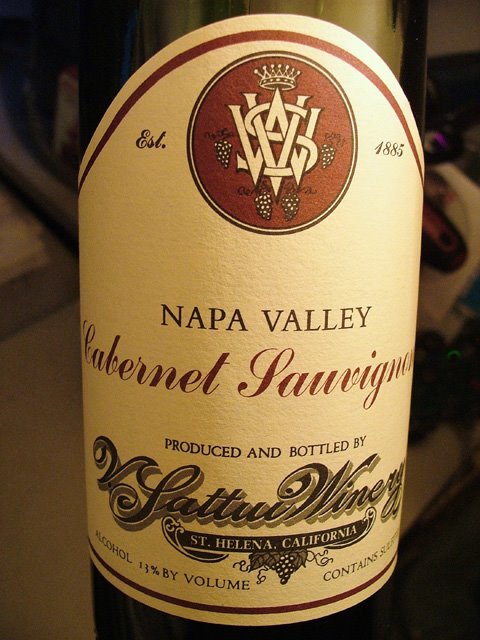
V. Sattui Wines

There are firsts you remember and firsts that you don't. No need to get too personal here, but when it comes to the various beverages I write about, I honestly don't remember specific details about the first beer/wine/spirit I tried. Part of that has to do with the fact that those events are closing in on 20 years ago, and part of it is that I never envisioned a future in which I'd be I'd be writing about these topics for an international audience.

I definitely remember becoming aware of V. Sattui in the early 90s, when I was in high school and eagerly cooking as often as possible. Luckily at the same time, Dad started getting mixed cases of Sattui wines as gifts each year. The household wine consumption at the time was low, but I was permitted to use the odd bottle for cooking purposes. I'd take a sip from the measuring cup occasionally--never enough to feel any effects, just enough to get the flavor and try to gauge what it would do with the food. At the age of thirteen I learned important lessons like "red wine turns risotto a really unappealing shade of purple-gray" and "White Zinfandel makes a weird coq au vin".

When I say sample cases, I'm talking about a really diverse assortment of wines. Chardonnay, Cabernet Sauvignon and Merlot, of course, but also Riesling, Zinfandel, Gewürztraminer, a rosé, and various blends. Of course at the time I was more interested in the sweeter wines, but it was an interesting early exposure to the concept that not all wines smell or taste the same. I know that sounds odd, but in speaking to a lot of people who are new to wine, this is a major hurdle to overcome in wine appreciation. Initially it all just tastes like "wine", maybe "red" or "white" but not much beyond that. In trying to help folks open up to the idea, I'll often try to connect with some hobby or passion of theirs. "All country music sounds the same, right? Every car has four wheels and some doors, what's the difference?"

Two decades later, Dad gave me a pair of Sattui bottles for my birthday.

2007 Sattui Family Red. Zinfandel, Cabernet Sauvignon, and Syrah. $16, 14% abv. I don't know what the specific percentages of the grapes are, but the aroma is primarily Zinfandel. Blackberry jam nose, loads of blackberry and raspberry flavors. Firm tannins, brambly finish. I ended up enjoying this one on New Year's eve with a ribeye, sweet potatoes, and green peas. Wonderful way to cap off 2009.

2007 Gamay Rouge. $18, 12% abv. This is an interesting wine, made from Gamay Rouge (Napa Gamay), which now appears to be Valdiguié. I remembered it as a dry rosé since it was much less sweet than the White Zinfandel, but now I recognize it as a medium sweet wine with 1.5% residual sugar. Loads of strawberry and cherry aromas, with a full-fruit flavor boosted by the sugar and a tart, cranberry acidity. Imagine a very young and brash Pinot Noir but sweeter.

Why the confusion on the grape name? From what I can piece together, Valdiguié was imported from its native Languedoc-Roussillon and labeled as the true Gamay of Beaujolais. California producers started calling it Napa Gamay or Gamay Rouge, and after DNA testing in the 90s, the true heritage was sorted out. Traditions die hard, though, and while you can no longer use the name "Napa Gamay" other variants slip through. It's a story that plays out again and again in the wine world.

I had this with a club sandwich and potato salad, and it seems perfect for a picnic. I think it would be great for gatherings like Thanksgiving, because it's sweet enough to appeal to the novices but serious enough to be enjoyed by the more experienced wine drinkers. I think the last time I had this was the summer I was 19. Brings back quite a few memories.

04 January 2010

Book Review: The Beats: A Graphic History

As a teenager and young adult, I really didn't care about the Beat poets. It's not that I didn't know about them or hadn't read them--on the contrary, an English teacher introduced me to some pretty rough Ginsberg works early on, and I plowed my way through Kerouac without much feeling. I spent summers studying poetry and short stories in workshops all through high school, reading modern works, creating original pieces, and critiquing the output of fellow students. I got exposed to some writers like Galway Kinnell that had a profound impact on me. It was an amazing experience, but I look back and think that letting teenagers write poetry is like letting a two-year-old play with a chainsaw: whatever happens is going to be ugly.

In my early adulthood I tacked backwards and compulsively read through The Oxford Book of English Verse (1919 Quiller-Couch edition, of course), certain that being able to pull up the odd snippet of Dryden, Herrick, or Wordsworth would impress the ladies. This was a losing strategy, while I mostly hid my knowledge of food and wine, later discovered to be far more successful. Ah, the folly of youth.

I never really appreciated the Beats until my mid-20s. It had to do with hearing Burroughs' excerpts read with ambient music on late night radio. There was a certain crazy charm to it, and somehow it made a lot more sense than it ever could to a teenage mind. I went back and read through some of those Beat works, and to this day I think the opening lines of Howl are some of the most powerful in the English language:

"I saw the best minds of my generation destroyed by
madness, starving hysterical naked,
dragging themselves through the negro streets at dawn
looking for an angry fix,
angelheaded hipsters burning for the ancient heavenly
connection to the starry dynamo in the machinery of night,"

You can't fully grok that until you've had a few cups of coffee after midnight and have read the whole thing, aloud. Maybe shouting at a blank wall, a confused dog, or simply walking outside and declaiming to a sky "the color of television, tuned to a dead channel" (with apologies to Gibson, who was influenced by the Beats). It reinforced what that early, wonderfully corrupting English teacher taught me: poetry, like a play or song lyrics, has to be heard to be fully understood. Merely reading through the lines will only take you halfway.

Years later, my appreciation of the graphic novels of Harvey Pekar collided with this topic in The Beats: A Graphic History, edited by Paul Buhle with contributions by Pekar and his wife Joyce Brabner, along with a dozen other writers and artists. I give the book credit for covering lesser-known poets, as well as the impact of female Beats amidst a hostile environment even within their own subculture. The first half is devoted to the major players mentioned already: Ginsberg, Kerouac, Burroughs. But you'll learn a lot of new names along the way, accompanied by the work of multiple cartoonists, each with his own style and feel for the subject matter.

There's very little of the actual Beat poetry or prose present here, just the occasional quote. But it serves as a good reading list if you're interested in studying the subject further. More importantly, the writers and artists involved care deeply about the topic, and that passion comes through in this short but important book.

01 January 2010

It's the End of the Year as We Know It, and I Feel Fine

Happy New Year, y'all.

The holidays provide a certain conundrum in wineblogging. Going by stats, comments, and e-mails, I've noticed a few trends.

Readership jumps up during the months of November and December as novices and folks who are not regular readers hit the internet looking for advice on what to purchase for Thanksgiving, Christmas, New Year's Eve, and the various parties in between, as well as for gift-giving.

Looking for a really last minute sparkling wine review? Try one of the 28 posts I've written on the subject over the past few years.

I think more of the wine fans read less during this same time period. Maybe they work in retail wine sales and at the end of the day all they want is to crack open a beer and not think about the Wine Spectator Top 100 List for a while. Maybe they've spent the two months fielding questions from friends, family, and co-workers and also need a break. Or maybe it's just the best time of year to simply sit back and enjoy a wine, setting aside the notebook and pen to make eye contact with a loved one across the table.

Likewise, this post is going up on New Year's Eve, but will mostly be read--if at all--on January 1, as a traditional day of sober rest and recuperation. Not the best time to write about a gin and Champagne cocktail or a crazy recipe incorporating pig ears and mushrooms.

Does this sound like burnout, or that I simply have nothing to post? Hardly! There's a dozen posts in the draft stage waiting for the light of day, some unknown quantity of bottles rattling around downstairs begging for review, and a few other surprises waiting for the proper moment. I'm also getting ready for my fifth anniversary here at BWR in a few weeks, and it's a great opportunity to look back and reflect. But anything meaningful is going to get lost in the shuffle, and I want the wines, recipes, and books to get the attention they deserve when everyone has recovered and feels like reading again.

I wish you all a safe and happy holiday, a good rest this weekend, and an exciting and productive 2010.

Cheers!