12 March 2008

Breakfast for Dinner

The Girlfriend requested breakfast for dinner, and I was all too happy to oblige. Specifically, she was looking for a sort of Greek omelet: spinach, lamb, and goat cheese, but she wanted something other than spinach. I love these kind of challenges, so here's the menu I created.

First off, let's look at spinach alternatives. While here in the South there are plenty of greens available, I generally substitute rapini (broccoli raab) or Swiss chard. I settled on the latter this time. Now, if you've never purchased this relative of the beet, it can look a little odd at the store. The stalks and veins are white, yellow, pink, and red, and the leaves are often wilted and droopy. I've never had problems in the past, but this time I decided to cut a half inch off the bottom of the stalks and allow capillary action to soak up some water while the leaves sat in a glass. The next morning the chard leaves were all standing at attention, but since the standard method of cooking involves getting rid of as much water as possible, I realized that I hadn't really accomplished anything.

When prepared as a side dish, I chop the stems, sautée them until soft, and then add the chopped leaves and cook those until wilted. Here I just used the leaves, wilted in a small bit of oil. A huge bunch of leaves condenses down to a very small final product--keep that in mind.

For a wine, I decided on an Italian Prosecco. The NV Cantine Maschio Prosecco Brut is a crisp, dry sparkling wine that has a nice touch of acidity but isn't overwhelming. The Girlfriend mixed hers with some orange juice for a little mimosa action. I demurred from the cocktail, but at $12 this wine would be great for brunch or bellinis or even fried chicken/BBQ: two of my favorite foods with sparkling wine. I find that generally if you can't figure out a good match for something, a sparkler or a rosé often works well.

Since I didn't have any leftover roast leg of lamb on hand, I instead chose to trim the bones off a rack of lamb and roast it. The bones and attached meat were roasted in the oven and then simmered with organic chicken stock for a few hours to create a little easy lamb stock, which after cooling went into the freezer for future use. The resulting log of meat looked much like a pork tenderloin. I dusted it with some sea salt and fresh ground pepper and then seared the little ribeye roast in a stainless steel skillet. After it was nicely browned, I threw it into a 350° oven until it reached a medium-rare internal temp of 135°. Then a rest period, followed by slicing the roast into little half-inch steaks. The end result combines the delicious flavor of lamb with the look and texture of prime rib.

Lamb ribeyes aren't an original idea; aside from having it at the Brooks recently, there's a good recipe on the Stags Leap website. On the side I made some sweet potato hash browns, and freshly sliced cantaloupe was also provided. As for the overall meal, it was a nice variation on the old steak and egg special at Waffle House. The lamb ribeyes were delicious and so easy that I can see using them for appetizers and other purposes. The omelet was one of the best I've ever had, and the sweet potatoes provided a nice touch of sweetness and less starch than your standard white potatoes.

10 March 2008

2006 Ortman Cuvée Eddy

I've somehow managed to go two weeks without a wine review. Don't know how that happened, but this week should be all wine-related.

I picked this up based on a recommendation from a friend. The 2006 Ortman Cuvée Eddy is from San Luis Obispo in California (the beloved Paso Robles area). $21, 14.7% abv. 44% Syrah, 30% Grenache, 9% Mourvedre, 15% Petite Sirah, 2% Viognier. Which means that this is something like a GSM/CDR/CDP/Cote Rotie hybrid. Let's just say it combines the best of Southern France with the experimental enthusiasm of Southern California. On the nose it's a blackberry explosion, jammy and full-bodied. On the mouth there are firm tannins, a bit of a chocolate flavor, and great deep berries. Overall this is an excellent wine, and went down well with a ribeye and some green beans.

The name comes from the eddies or swirls that form in a river, and are reflected in the spiral O in the name of the winery. Which leads me to...

Typography time at Benito's Wine Reviews! The winery logo is set in the font family Shelley, which uses the same lowercase letters among its three variants. Shelley is a notoriously popular wine label font and can be found on wines from all over the planet. The O in Ortman is set in Shelley Andante, while the F & V are set in Shelley Allegro. Tricky, but an acceptable design choice given the caps involved. Kudos to the bit of integration with the V and i in Vineyards. It's always nice to see that someone didn't just slap something together in Microsoft Word and send it off to the printer.

07 March 2008

Scottish Tea Towel

Someone e-mailed to ask about the beige rectangle on the wall behind some of my photos. It's a Scottish tea towel that a friend gave me over a decade ago. I've hung it up in the various kitchens I've used over the years. Here's the text and translations from the Scots dialect:

A SCOTS TOAST

May the best you've ever seen
Be the worst you'll ever see;


Think about the best time of your life, and I hope that things in the future never get worse than that.

May the mouse ne'er leave your girnal
Wi' a tear drap in its e'e;


Literally "I don't want mice to leave your pantry sad because there's no food". Basically I hope your pantry is always full.

May your lum keep blithely reekin'
Till ye're old enough to dee;


I hope that your chimney keeps smoking for the rest of your life, or that you're always successful enough to heat your own home.

May you aye be just as happy
As I wish you now to be!


I hope you're always as happy as I want you to be right now.

05 March 2008

Link-O-Rama

A bit of news: you'll notice the ads to the left. I was invited to become part of the Forbes Business and Financial Blog Network. It hasn't quite launched yet, but I went ahead and set it up on the site. I was never in this thing for the money, but whatever I do make will be funneled back into new and exciting wine and food to write about.

My friends and family have been quite supportive in reading this blog, and so it's time to share some of the love. So with a tumbler of Bourbon and Coke at hand, let me direct you to a few of their websites.

First I've got to send a quick merci across the pond. I'm quite honored to be #34 in the wine blog listing of Mlle. Estelle Platini. This lovely young woman is not only a sommelier in Marseille but has also come up with a mathematically delightful ranking method for wine blogs. Check out her blog, there's a lot of good stuff there, and she definitely breaks the stereotype of the old, grouchy French sommelier.

Moving away from the world of wine, let's look at family. My Dad's cousin Nancy designs children's clothes and writes musings about life in California. Due to the fact that she spent a large portion of her life in Germany and married a German man, you'll see posts in two languages. Fear not, the German parts mostly repeat the English sections. You're on your own with the comments, Außländer.

My cousin Kyle Jones works in the digital design realm, creating fonts, websites, and animation. I was particularly fond of his entry in the New Yorker cover contest, which solicited unique interpretations of mascot Eustace Tilley. Kyle's was created using only the Edwardian Script font, and I've been fortunate to see it in person. When I checked in with him, he suggested that you all might enjoy his parody ad for Raw: The Meat Flavored Energy Drink.

On to the friends... Sally and Terry are friends of mine who work in video production. Based out of Nashville, their video work takes them all over the country. In her spare time, Sally crochets and engages in other textile-based pursuits. They're the ones who hooked me up with tickets to the Tennessee Wine Festival a few years ago, and I'm always glad when they come to town.

And of course, my good friend and "brother from another mother" Paul Jones, who between his work as an internationally-renowned PHP programmer, taking care of four dogs, and getting engaged, still lets me use his house for dinner parties.

03 March 2008

Coffee Time

Saturday I popped in at Wild Oats on Poplar to attend the Slow Food Memphis presentation about coffee given by the guys from Ugly Mug Coffee Co. Lots of great info about organic and fair trade coffee, and the slower, better tasting processes that produce great coffee.

I don't drink coffee every day, but I do enjoy it especially when it's decent stuff. Ugly Mug produces many delicious brews and I'm anxious to try all of them.

I found out about the event from the Squirrels and was glad to see them there. Additionally I got to meet the writer behind the More Deliberate Every Day blog. I've been reading that for months and never got around to putting it in my blogroll. That has been rectified! I got to meet a few other readers of this blog, and was surprised to see it mentioned in the latest issue of Edible Memphis.

I'm glad that I finally got some business cards printed, as I got the opportunity to meet new and interesting people with a love of good food at this event. In my previous life as a graphic designer, I probably did layouts for two thousand different cards. Don't know why I waited so long to make some for myself: "The cobbler's children have no shoes", I suppose.


I pulled out my French press and tried Ugly Mug's Ethiopian coffee at home. The benefit of using a French Press or a gold filter instead of paper is that you get a colloidal suspension of the oils within the coffee and thus a richer flavor. This one is light and mild, while still having a great flavor to it. Nice little touch of acidity. The best part, and what distinguishes great coffee from a mere caffeine delivery system, is that an hour later you can still slightly taste the coffee but don't want to brush your teeth because it still tastes great. There's a creamier mouthfeel and more pleasant drinking experience when those oils are kept in the beverage.

27 February 2008

Benito vs. the Cheese Board: Round Two

Here's another round of cheese reviews, based on picking up little wedges of cheeses I've never tried before. Will this be a recurring feature? Perhaps. There's a whole world of cheese out there with all sorts of individual flavors and backgrounds, much like wine. Maybe in ten years after I run out of wine, cheese, and food to write about, I'll start grousing about spatula design three times a week. Stay tuned!

As always, click on the photo for a larger version.

Mimolette was commissioned by Louis XIV and was a favorite of Charles de Gaulle. That thick tan rind is made by the actions of the cheese mites, who leave their dander and excrement behind while digging holes in the cheese. Sounds revolting but I've had worse. The cheese is delicious: rich and savory, slightly tangy, firm, dry, and much like aged Edam. The rind tastes like a handful of dirt and made me wonder if dried earthworms taste the same. Note: it is not recommended that you eat the rind on Mimolette. Even the rind-loving French find it tough and unpleasant.

Maître Moutardier is a relatively new Swiss-made cow's milk cheese that's blended with mustard seeds and meant for snacking. I'm a mustard fanatic, and always have at least three different styles in my fridge, and that's not counting the neon-yellow French's that The Roommate eats. This has a flavor of mild Swiss but the mustard flavor is extremely restrained. Only with strong chewing does the flavor start to emerge.

Cashel Blue is the first farmhouse bleu cheese from the Emerald Isle, and is made by hand in County Tipperary.

It's a long way to Tipperary,
It's a long way to go.
It's a long way to Tipperary
To the sweetest girl I know!


Our Scout Troop had a version of of this WWI song about going to camp. And then there were the unofficial lyrics about invading the girl's camp across the lake, which will not be printed here.

I picked it out because I didn't have any strong moldy cheese in the house. It performed admirably when smeared over a steak and allowed to melt slightly. While it definitely has a strong, pungent quality, it's also creamier and softer than many bleu cheeses out there. It would not crumble well, but sliced beautifully.

Idiazábal is a sheep's milk cheese from Spain. Hard and dry, initially mild in flavor but with a pronounced ovine aftertaste. Has a sort of piney tinge to it, which the article informs me comes from the smoking process. Glad to know I'm not crazy or that the cheese didn't get hit with Pine-Sol during an overzealous cleaning session at the grocery store. A good addition for a tapas bar, and I'd love to try it with a good Albariño.

Oka is made by monks at the Abbaye Cistercienne d'Oka in Québec. Now, what I don't know about Canadian cheese could fill a small government-subsidized bibliothèque des fromages in Montréal. The history of this cheese indicates that it's based on Port Salut but produced by a group that came to North America in the late 1800s after getting kicked out of France. It's a nutty, earthy semi-soft cow's milk cheese that that tastes somewhere between Jarlsberg and Brie. Quite nice with some fresh grapes and a bit of ham. Warning: in a hot Memphis summer I think this would last about ten minutes outside before melting and oozing off the plate.

25 February 2008

2003 Georges Dubœuf Chénas

Found on the clearance rack at Great Wines: a bottle of 2003 Georges Dubœuf Chénas. 2003 was the year of the massive heat wave in Europe that killed nearly 15,000 people in France. The heat also had a powerful impact on grapes in the area, and the few grapes that were harvested were generally of great quality. This wine presents a nose of stewed fruit, though it's more subtle than when you normally come across that aroma. Flavor-wise it's mellow, with just a trace of tannins and raisin/prune notes. Not as strong as something like a Banyuls, but it combines these interesting elements with smooth and light mouth feel. Once again this is a reminder why the Cru Beaujolais should never be underestimated.

I've got just two of the Crus left to try: Chiroubles and Côte-de-Brouilly. Any hints on where to find these in Memphis? Wine shop or restaurant, either is fine.

22 February 2008

2006 Villa Pozzi Nero d'Avola

Random selection from the wine shop: the 2006 Villa Pozzi Nero d'Avola from Marsala, Sicily. Made from the Nero d'Avola grape. $11, 13.5% abv. Touch of cherries, hint of prunes, little bit of mint. Despite the dark and strong tendencies of this grape, it's not overpowering. Firm tannins, voluptuous body, lovely cherry aftertaste that lingers for a while.

The name of the grape does not come from the Roman emperor but rather the simple Italian word for "black", as in a black grape from the town of Avola on the southern tip of Sicily, near the historic town of Syracuse (Siracusa).

I served it with a bunch of odds and ends from Lucchesi's: sausage lasagne, spinach and gorgonzola ravioli, creamed spinach, etc. Awesome comfort food, and it was convenient to take home and heat up later. While the pairing with the wine was great, I think it would be even better with lamb or a hearty roast duck.

For some reason this bottle reminded me of another saucy Sicilian*, CNBC's Maria Bartiromo. Not only is my grandfather a fan of her financial analysis, but the great Joey Ramone wrote a song about her shortly before his death in 2001. The Guardian has more background on the story.

*All right, so she's half Neapolitan. Non mi rompere le palle.

20 February 2008

Wine & Port

Here's another $30 offering as I work my way through the Marietta catalog: the 2004 Marietta "Emilia's Cuvée", made in Mendocino County, California from the Montepulciano grape. An earthy, ashy aroma with elements of blackberries, giving way to a well-balanced, low tannin black cherry flavor. It proved a good match for the ribeyes, pasta salad, and standard Southern Waldorf salad. (As this was for guys' night, I was looking for full flavor and low preparation. Quick sear and bake on the meat, and the rest came from the deli. Delicious, and it hit the spot.) While a great wine on its own, I still prefer the Angeli Cuvée.

After dinner, it was time for something a little stronger. For a month I'd held on to the 2005 Bogle Petite Sirah Port from Clarksburg, California. I've long been a fan of Bogle and was delighted to see this entry into the market. $20 for a an elegant, wax-capped 500mL bottle. Only 23 barrels made! There are lots of wineries making domestic Ports from various non-traditional grapes, and this is the first I'd seen using Petite Sirah. (For more information on the controversy around using the name Port, check out Fredric's article.) It's a ruby style Port, and was actually quite mild for a fortified wine. In fact, it was much like a very strong red wine. There were nice cherry elements, but overall it was bold and youthful. We had it with some Stilton (couldn't hold up to that cheese), but with organic dark chocolate it was a winner.

Following that, we had to have a bit of the 20 Year Old Sandeman Tawny Port, which showed proper maturity and complexity and was a perfect match for the Stilton. Between the two there is no comparison, yet the Bogle remains a good choice for desserts like cheesecake or simple chocolate and fruit.

18 February 2008

2006 Maddalena Sauvignon Blanc

Over a fun dinner at home The Girlfriend and I opened the 2006 Maddalena Sauvignon Blanc from Paso Robles. $12, 14% abv, pure Sauvignon Blanc. The wine was tasted well away from the hyacinths, so as not to influence the nose.

Nice aroma of green apples, though the end result is smoother and rounder than many of the highly citric Sauvignon Blancs that are hitting the market. It's not flabby--there is a good acidic structure. Flavors of green apple and pear are present, with hints of cake. I chose to pair it with a salad, though seafood would be an ideal match.

Dinner was the result of an amusing misunderstanding. I've had a craving for Waldorf salad recently, and have picked it up at the deli a few times. Found out that The Girlfriend loves Waldorf salad, so I picked up a pint a couple of weeks ago. After getting excited about the prospect of this dish, she finally asked where it was. "Right there in the plastic tub! Help yourself!" And thus the confusion.

Invented by Oscar Tschirky in 1893 at the Waldorf-Astoria Hotel in New York, the original contained only apples, celery, and mayonnaise. Over the years other ingredients have been added, and the regular Southern version I served included pineapple and coconut. The Girlfriend, on the other hand, comes from California, where the Waldorf salad is an actual lettuce-based salad with chunks of apple, walnut, raisins, etc. and no mayo, and is often served with cubed chicken or salmon or some other cold protein.

For my take on this west coast recipe, I used spring mix, golden raisins and dried cherries (soaked in water before), Granny Smith apples, grilled chicken, celery, honey-roasted walnuts, seedless black grapes, crumbled gorgonzola, and a balsamic vinaigrette. For the benefit of the various diners at the table with different tastes (no celery! no nuts! extra grapes!), I just arranged everything on a platter in separate piles and allowed everyone to build their own salad. The result was quite satisfying, and hearty enough to serve as a proper entrée.

15 February 2008

2005 Pouilly-Fuissé

Here's another $20 white Burgundy: 2005 Pouilly-Fuissé from Domaine Béranger. It's a remarkably fresh and fruity wine, with aromas of fresh cut apples, pears, and ginger. Nice fruit flavors, but overall well balanced.

By contrast, a few weeks ago I tried the 2005 Pouilly-Fuissé from Louis Jadot. It had such a rich oak aroma that my friend Paul said it smelled exactly like an old church. It was an interesting combination: old leather, wooden pews, and the faint scent of Lemon Pledge. After breathing this dissipated, but it was still charming.

In the foreground of the photo you can see the wood-bound wine journal that Paul's fiancée Grace got me for Christmas. It's in Italian and English (definitely a plus for me) and provides a two page spread for each wine in which you evaluate all elements and draw a sketch of the label. I do not intend to use it for every wine, but at times it's nice to sit down and put pen to paper. Most of my wine notes are scribbled on the backs of envelopes and receipts and are shoved into a pocket for transcribing to the web later.

13 February 2008

2003 Marietta Angeli Cuvée

The 2003 Marietta Angeli Cuvée from Geyserville, California is a proprietary blend of Zinfandel, Petit Sirah, and Carignane. A whopping 15.7% alcohol, retails for around $30. After the hot alcohol blows off, you get dark plum and blackberry aromas. Blackberry flavors with strong tannins and firm acidity. Good match for a steak, some mushrooms, and steamed carrots.

I'm warming up to these Zinfandel blends. Not as refined yet as the Meritage/Claret blends, but I think there's some real potential and I enjoy the various experiments that are being performed.

There's no label here, rather the Marietta signature and Angeli logo are printed directly on the bottle with gold foil and the remaining text is in opaque white ink which looks nice against the dark glass. I'd quibble with the choice of Snell Roundhand Bold for the front text (personal pet peeve there, damn you Snell!), but otherwise it's a beautiful design.

The quality of a wine should never be judged by the label, marketing, or hype involved, but there's nothing wrong with appreciating good graphic design whether on a bottle or on a business card.

11 February 2008

2004 South River Vineyard "Karma"

I spent a recent week in Cleveland, Ohio. Cleveland gets a bad rap from many people, not the least of which is its own population. I entered the city with a fresh perspective and eager hopes: I was greeted with a mass of grey upon grey upon grey. I suspected this was a temporary confluence of weather and season until the fog rolled in from Lake Erie and I discovered whole new levels of grey, combined with such low visibility that the tops of street lamps were fuzzy.

At right: the steamship William G. Mather, built in 1925 and six hundred feet long. It used to haul ore and coal throughout the Great Lakes during much of the 20th century. Currently it's parked on the shore of Lake Erie down by the Rock and Roll Hall of Fame and the Browns Stadium.

Despite the economic depression and the fact that the population has fallen by half since the 1950s, I discovered ways to find happiness in this town. A martini after work, dinner at one of the dozens of mom & pop Italian joints, followed by driving back to the hotel listening to a great local jazz station.

As part of my commitment to try indigenous wines when traveling, I chose the 2004 South River Vineyard "Karma" from Geneva, Ohio. $15, 12%abv, 42% Cabernet Franc, 39% Merlot, 19% Cabernet Sauvignon. Aggressive nose of herbs, grass, underlying cherry. Flavor is a bit odd but you really get to taste some of the unique elements of Cabernet Franc.

Perhaps my favorite meal of the trip was at McCormick & Schmick's. Actually a chain but it's definitely a great, upscale seafood restaurant. Dinner was a glass of Sauvignon Blanc with a pasta/shellfish entree, but the best part was the first half.

I started off with a cocktail. Their bar menu helpfully arranges the cocktails in chronological order, going back to the 1800s. I picked one from the Depression-era, the Negroni. It's equal parts gin, sweet red vermouth, and Campari, an Italian liquor made from 60 different secret ingredients but tasting strongly of orange peels. This cocktail is deep red and bitter as all hell, which means that I loved it.

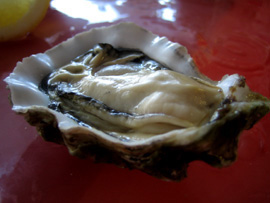
And then a sampler of oysters (afterwards, the server was kind enough to discuss my notes with me--the man knew his bivalves):

Hog's Island Oysters from Norfolk, VA: big, full-flavored, salty
James River Oysters from the James River, VA: small and mild
Hood Canal Oysters from the Hood Canal, WA: sweet and earthy and delicious (these also have shells so pretty if you found one on the beach you'd take it home with you)
Steamboat Oysters from Bay Center, WA: long, rich, and herbal
Delaware Bay Oysters from Delaware Bay, NJ: big and meaty
Cameron Shoal Oysters from Totten Inlet, WA: long and satisfiyingly chewy

Cleveland has a lot to offer, and if you know where to go and are willing to roam around a bit, there's a lot of nice spots in town. Next time I hope to hit Michael Symon's Lola.

08 February 2008

2003 Argiolas S'elegas

Here's my third wine review from Sardinian producer Argiolas, part of my commitment to the unsung grapes from less publicized corners of the wine world. The 2003 Argiolas S'elegas is from the Nuragus di Cagliari DOC of Sardinia and is made from the Nuragus grape, supposedly brought to the island by the Phoenicians 3,000 years ago and named after the local ancient stone towers. $16. Because of the reliability of this grape it's also known by the name pagadeppidus, which means "to pay debts". Such a nicknaming convention continues today in the form of the popular Mortgage Lifter tomato.

The wine has a deep golden yellow color to it, with an aroma of peaches and jasmine. The flavor profile is crisp on the beginning, with full fruit flavors, trailing off towards a soft and mild finish.

For the meal I was thinking Mexican and used a big 2 lb. fillet of Red Snapper to make pescado a la veracruzana, with a topping made of red bell pepper, red onion, manzanillo olives, capers, and white wine. On the side I've got butter-sautéed cremini mushroom tops, steamed artichoke hearts, and a little salad made of julienned jicama and chopped Campari tomatoes. This was my first time eating or preparing jicama (the big turnip-looking thing above), and I was quite happy with it. The flavor is somewhere between a water chestnut and a Granny Smith Apple.

Moving backwards in the meal, we started out with a wedge salad. I know that iceberg lettuce has fallen out of favor in culinary circles, but a lot of time has passed since this was a staple menu item, making it either refreshingly retro or charmingly nostalgic depending on your point of view. I used a sixth of a head of iceberg for each person, accompanied by sliced Campari tomatoes, a diced boiled egg, a crumbled strip of bacon, and some bleu cheese dressing topped with a bit of cracked black pepper. I was inspired by the great wedge salad at River Oaks I had Thursday afternoon, and felt like having one at home. It was a big hit all around, and goes to show that you don't necessarily have to have a mesclun blend with a pomegranate vinaigrette to feed a group of friends.

06 February 2008

2005 Marques de Casa Concha Cabernet Sauvignon

Here's the 2005 Marques de Casa Concha Cabernet Sauvignon, from the Maipo Valley of Chile. Probably the definition of a closed wine: it was sampled fresh out of the bottle, decanted for an hour, and tried again several hours later. It's only after the max of aeration that the hot alcohol aroma blows off and you can grab a little bell pepper and cherry aroma. As for the flavor, the tannins are still quite strong and the cherry flavors are distant. It's a decent wine with no obvious flaws, and one I'd love to try in a few years, but I don't think it's ready for drinking now.

I tried it on its own, but also with a homemade chili. Hand-dicing the chuck roast makes for a much better dish than ground beef, though it did take a while and at one point I was wondering whether or not this "cow" had at some point worn a saddle and metal shoes. That didn't matter, as the long simmering time resulted in a rich, savory, and tender chili enhanced with black beans. Many decry the use of beans or any starch in chili; I tend to prefer a base of good beans or rice or pasta to offset the hearty meat sauce. Would you eat a whole bowl of bolognese sauce for dinner?

03 February 2008

Wine Gear Review: Wine Travel Tote

The good folks at Simply Bags sent me their monogrammed Wine Travel Tote ($34.99) for evaluation. I was pretty excited when this arrived, because I've really been needing one of these but haven't seen anything like it locally. I'm ashamed to admit that when I take wine to friends' houses it's usually in a plastic grocery bag, with newspaper wrapped around the bottles to keep them from clacking together.

The canvas and leather bag holds two standard 750mL bottles of wine and comes with an attractive waiter's-style corkscrew with a wood-plated handle. Inside there's a padded divider to provide protection between the bottles, but it is attached with velcro and can be removed if needed. It closes up with a zipper, and there's a pocket on the front for storing notepads and pens or whatever else you need.

I've tried it out with unopened bottles and knocked them around a bit, even casually tossing the bag into the car. No breakage, and while I know that kind of abuse isn't good for wine, I wanted to test the product under real life conditions. It performed admirably and gets the "Benito Seal of Approval".

It also solves another problem for me, which is traveling with wine. You can't take bottles in carry-on luggage, but they're fine in checked baggage. My strategy of stuffing the bottle in a big tube sock and surrounding it with t-shirts was doomed to failure eventually. This bag is compact enough that it can rest inside a larger suitcase and provide some protection for the bottles.

In addition to the many other bags produced by this company for various purposes, they offer two additional wine bags that are waterproof inside and can be filled with ice for chilling wine. The four bottle version ($29.99) is cool, but the three bottle bag with cheese board and knife ($37.95) looks perfect for classy picnicking.

Disclaimer: I'm not receiving financial compensation for this review or for sales of this product. It's a genuinely good product that fits my wine needs, and I enjoy supporting companies that produce such wine/food accessories.

01 February 2008

Paprikás Csirke

Paprikás Csirke is oddly similar to the popular Indian dish chicken tikka masala, which isn't authentically Indian but was adapted for British palates. For this dish, you can check out an authentic Hungarian recipe, or you can try something a little easier to read. It's a rich chicken dish that uses a lot of paprika (my preparation called for a quarter cup of Hungarian sweet paprika). I also like to use chicken thighs, as they taste great and hold up well to the stew-like cooking process.

The first time I made this was a few years ago. My buddy Paul and I were hanging out and I made the paprikás along with the traditional homemade Spätzle noodles. Between the onions and the sauce and the heavy noodles, this dish was delicious but seriously damaging. We each had one bowl of it and spent the next three hours on our respective couches groaning and trying not to move. Not wanting to repeat that experience, I lightened it up. I used leeks instead of onions, light sour cream, skimmed most of the fat off the dish, and used some whole-wheat egg noodles as a base. As I type a few hours later, I'm suffering no ill effects and consider the meal a success.

30 January 2008

Marietta California Port

Over the past few months, I've seen bottles of the Marietta California Port (Lot Number Two). For $15 a half bottle (375mL), why not give it a shot? It's just the right size to bring to a party, and it's also a good quantity for those that don't drink a ton of Port. Or those that try to limit the amount of Port in their homes in order to resist temptation. (It's Wednesday evening at nine? Sounds like Port time to me! Norwegian Independence Day? Break out the Port!)

It's a ruby-style domestic Port made from 30% Zinfandel and the rest a blend of Touriga, Souzao, and Tinta Cao. Spice and raisins on the nose, and it's got a light mouthfeel and isn't overly sweet. At 19.5% alcohol it would be an over-the-top Zin but it's a fairly restrained Port. I had it with a little Huntsman cheese as a late night snack.

As a side note, while looking around the Marietta website, I found a little recipe for minestrone that looked good (scroll down to #8). While it's not the kind of thing you'd serve with Port, it was delicious on its own and easy to make. The last time I made minestrone was back in high school, and I made the mistake of adding pasta early on and letting it simmer for two hours. The result? A gluey, unappetizing mass. The Marietta recipe, on the other hand, is fresher tasting and chock full of good vegetables. The Swiss chard really makes the dish. You might think that the cornbread muffins aren't authentic, but don't be so sure--the February 2008 issue of La Cucina Italiana features a recipe for muffin di farina gialla on page 42.

28 January 2008

Benito vs. the Cheese Board

I decided to lump a lot of cheese reviews into one post. While putting the finishing touches on this, I was watching Trekkies 2, the 2004 documentary that follows up on 1997's Trekkies. The films feature things like a Star Trek-themed dentist office, the Little Rock woman who demanded to wear her Lt. Commander uniform as a juror in the Whitewater trial, a guy who modified his home to resemble a Star Trek set, people who write erotic Trek fiction, and various folks who dress up their pets in uniform.

I'll admit it, I've read and watched a lot of science fiction in my day, and could probably answer an embarrassing number of Star Trek trivia questions, but I have a bit of pride in never having attended a convention wearing Spock ears. Then a British Star Trek fan was explaining the term anorak (a nerd who obsesses over one topic), and gave as an example someone who collects cheese labels. Like the Greek heroes of old, hubris brings my downfall.

White Stilton with Apricot from England. Made from white Stilton cheese that hasn't had the characteristic penicillin mold added to it. It's a fairly dry, crumbly cheese with a yogurt flavor. Good for the holidays but a bit of a mess as it turns into crumbs. White Stilton gets a lot of flak for being a watered-down version of its true blue ancestry, but there's times when these fruit-infused mild cheeses are fun. And they're not going to scare off folks who aren't fond of strong, aromatic cheeses.

Sage Derby is a sort of British white cheddar in which a sage-based herb mixture has been introduced between the curds. To the uninformed observer, this looks like a cheese that has gone well past the edible stage and deep into the High School Science Project realm. But it's not a strong, stinky, or moldy cheese, just a colorful one. I shared this with a pair of dames that don't touch the scary cheeses, yet they loved it. The cheese itself is quite mild, and the sage is restrained yet provides a refreshing counterpoint to the dairy flavor.

Fontinella is a nutty white Italian cheese derived from Fontina. It's fairly close to Swiss cheese in flavor and firmness, though there are no holes or air bubbles. It does have a clear white wax rind, which might not be noticed until you've chewed on a chunk of it. This cheese cries out for some ham or prosciutto.

Grana Padano, a hard Italian cheese. Not as popular as Parmigiano Reggiano or Romano, but it's a great cheese. Hard and suitable for grating, it has little calcium crystals in it that provide a pleasing crunch. While I enjoy it on its own before or after a meal, it can be used in many of the same applications as Parmigiano Reggiano.

Huntsman hails from England and is a carefully layered mix of Stilton and Double Gloucester. As a child, I remember being repulsed by a block of Kraft mild cheddar that had blue mold on one corner. Now I'm paying $10/lb for cheddar with a big chunk of moldy cheese in the middle. It's a nice contrast of flavors, the buttery Gloucester with the tangy Stilton.

24 January 2008

2002 Argiolas Costera

Based on my prior experience with the Perdera, I decided to try the 2002 Argiolas Costera from Sardinia. 92% Cannonau (more on that later), with the remainder comprised of Carignano and Bovale Sardo. Served up with a little ribeye, some roast sweet potatoes, and assorted vegetables.

Even though they're from the same year, I felt the Perdera ($15) aged a little better than the Costera ($20). This one is leaning towards oxidation, with a mild sherry aroma. Still some hints of prune and cherry on the nose, and the flavor is a little tart, medium tannins, with elements of blackberry and leather. It's not spoiled, but it's probably near the end of its aging potential.

Back to the Cannonau. Some say it's the exact same thing as Grenache, some say it's a derivative or clone, others say that it's the father of Grenache. The Italians believe that Cannonau is Grenache, originated in Sardinia and that it was exported to Spain during a period of Spanish rule of the island (1400s). The Spanish say they brought it over during the same time period. Others say that Cannonau was brought there by Jesuits and is a derivative of Alicante. And let's complicate matters by pointing out that the island has also been ruled over the past millennia by the Phoenicians, Carthaginians, Romans, Vandals, Byzantines, plus a bunch of little Spanish and Italian city-states, kingdoms, and principalities. I have no solid data on the origin of the grape, and am not going to say a word lest this blog get hit with EU sanctions and some Sardo winemaker swears a blood oath against me and my descendants. Let me state again, though, that one of the things I love about wine is that it's truly history in a glass.

22 January 2008

3rd Anniversary

I've made it to year 3...

Some milestones:

January 22, 2005: First post, the first review came the same day. I started this whole thing just as a place to keep notes. I'm astonished at what it's become.

August 5, 2005: First linkage via another blogger, Professor Bainbridge, law prof at UCLA and wine lover extraordinaire. Barbara from New Zealand soon followed, kicking off my international audience. For a long time, I had a lot more readers in England, California, and the Southern Hemisphere than I did here in Memphis.

September 1, 2005: Comments are enabled.

December 1, 2005: One of my most personal posts, in which I eulogized my high school English teacher. I still get lots of mail from this one.

April 15, 2006: First correction requested by a French winemaker.

September 10, 2006: The first "Benito vs. the..." post, in this case Beets and Pluots. I chose the topic as sort of an Iron Chef challenge, not any sort of animus towards the ingredients used.

October 1, 2006: My parents discovered the blog. I didn't mean to keep it secret, but I'd slowly moved from being semi-anonymous to somewhat public, and once the cat was out of the bag, I made my name known to everyone. Traffic increased substantially, and old friends have gotten in touch with me through the blog.

May 13, 2007: First visit to a winery as a blogger.

August 22, 2007: First "Benito vs. the Hotel Room" post, featuring osso buco.

As of today, I'm the #1 search on Google for Benjamin A. Carter, and in the top 10 searches for Ben Carter and Benito. The first two are cool, but the last is fairly surprising considering the number of famous historical Benitos, as well as the continued popularity of the name in the Italian- and Spanish-speaking regions of the world. One of these days I'll beat Mussolini!

My stats (only tracked since June 8, 2006 via Google Analytics):
79,117 visits from 128 countries

Most popular by country:
1 - United States
2 - Canada
3 - United Kingdom
4 - Australia
5 - Germany
6 - France
7 - Brazil
8 - Netherlands
9 - New Zealand
10 - Singapore

As for the US, I've still got more readers in California and New York than I do in Tennessee.

Thanks go out to all of you who have read this blog, left comments, or shared a table with me at some point. If this thing is still going at the five year mark, I think a big party is in order.

20 January 2008

2006 Handley Pinot Noir Rosé

Here's the 2006 Handley Pinot Noir Rosé from Mendocino County, California. $16. Packaged in an attractive clear Alsatian Hoch bottle, which really helps to show off the color of the wine from pale pink at the neck to a deeper coral by the shoulders.

It's got a light strawberry aroma. The flavor is crisp berry, but not tart. A good lunch wine. While I'm sipping this it's below freezing outside, but it would be a great wine for a picnic this spring.

18 January 2008

Benito vs. the Ocean: Slipper Tails

While shopping for dinner, I picked up a half dozen frozen slipper tails. If you've dug around in the frozen seafood section of your supermarket, you may have seen these. And they're always packaged with just the tail. Why? Well, unlike its more photogenic cousin, the slipper lobster is ugly. As in, "your mama gonna have to tie a pork chop around your neck so the dogs will play with you" ugly. For reference, check out the photo on the article under the Aussie name, Moreton Bay Bug. Authentic Oz recipes can be found by searching for "bug tails". This abomination of the deep looks like the unholy offspring of a lobster and a crab. Fortunately, this man isn't afraid of ugly food. Taste is all that matters, and these were tasty decapod tails. I had a little ramekin of melted butter, and while the tails weren't quite as good as regular Maine lobster, they were delicious. Also not a bad deal at 6 for $15 (roughly a pound of tails), and they would be excellent appetizers or first courses for a dinner party. Just spear them on a skewer if you don't want them curly, and it would be polite to pre-split them for guests.

The Girlfriend is challenging me to cook for her in more healthy directions, including no carbs. I enjoy said challenges, and chose some steamed veggies as well as a bunch of spring onions simply baked with a bit of olive oil, salt and pepper. (I cooked them in a little Le Creuset dish that was a Christmas present to myself.)

For the wine, I poured the 2006 Clos du Bois Chardonnay from the North Coast appellation in Geyserville, California. I've had this wine several times in restaurants but felt I ought to try it on its own. Since I've typically ordered a glass with seafood and was happy with the results, I felt it would be a good match. It did not disappoint. Green apple on the nose, with hints of burnt sugar. Nice bright fruit flavors, light oak, and decent acidity.

16 January 2008

Barolo Tasting

Every once in a while I am fortunate enough to taste wines outside of my usual sub-$30 beat. Mike Whitfield, local food/wine guru and longtime family friend, gave me a call this past weekend and asked if I wanted to taste some Barolos, including those up to 40 years old. He didn't have to beg me.

Sunday we met up at the Brooks Museum of Art to join around a dozen others for a tasting of 16 Barolos ranging in vintage from 1967 to 1985, with one 1996 thrown in for good measure. The tasting was hosted and guided by Mary Lynn and Tom Cassidy, who provided a wealth of background information on the various producers and vintages. I would copy all that here, but it would become a book and not a blog post.

I'm not going to provide details on all of these, but will point out a few notes in general. The 20-year old Barolos were dark red, and still fairly bold. As they moved back to the 30- and 40-year old flights, the color got lighter and more orange, providing sort of a brick color. Most still had firm acidity. Some had passed their prime, most others were delightful. All were decanted and allowed to breathe for about an hour and a half before serving.

For those wanting more information on the Barolo region (northwest Italy/Nebbiolo grape), here's a decent summary. And here's Lettie Teague on the Barolo Wars between the traditionlists and the modernists.

The food was out of this world, and it was fun to try the different wines on their own and with the various courses. By the last course you had seventeen glasses in front of you spanning 30 years.

Flight 1:
1967 Giuseppe Marbarini
1967 Bersano
1967 Monforte Massolino Mascarello e Figlio
1967 Terre del Barolo Falletto Reserva

Course 1: grilled baby octopus with fingerling potatoes. Baby octopus is one of my favorite ingredients in the world, and I was overjoyed to see it on my plate.

Note: Drinking several wines from this year was a real treat. When those grapes were picked, my parents were in high school and the moon landing was still two years away. I like to think of the rain that fell in Italy, traveled up the roots, plumped up the grapes, and eventually found its way into that bottle. Forty years later, the voyage of those raindrops continued into my glass.

Flight 2:
1968 Ferruccio Nicolello
1970 Ferruccio Nicolello
1970 Pio Cesare

Course 2: dates stuffed with sweet sausage and wrapped with bacon, risotto, surrounded by chestnut soup. Heavenly. The sweet/salty/savory combination was amazing, and the chestnut soup was a unique addition to the dish.

Flight 3:
1978 Terre del Barolo Falletto Reserva
1978 Pio Cesare
1978 Giovanni Scanavino (my favorite, thanks mostly to the beautiful cedar chest nose)
1978 Massolino Vigna Rionda

Course 3: lamb ribeyes, ravioli stuffed with sweetbreads, spinach, and pomegranate au jus. The ribeyes were tiny but full-flavored, and the ravioli were delicate and mild.

Flight 4:
1982 Marchesi di Barolo Sarmassa
1982 Pio Cesare (a clear favorite of the group)
1985 Pio Cesare
1985 Terre del Barolo Falletto Reserva
1985 Massolino Vigna Rionda
1996 Cannubi (provided an excellent younger benchmark to better understand the older wines)

Course 4: Barolo-braised short ribs with olives and gnocchi drizzled with a basil purée. By far the lightest and most delicate gnocchi I've ever eaten, and the meat was fork-tender.

Note: While I've got a few fragmentary memories of 1979 forward, the period of 1982-1985 is pretty vivid for me. Six to nine was a fun age, full of Legos and building forts and church baseball and riding bikes all day long.

I've used this phrase in the past, but sitting down with great wines over a couple of hours is an excellent way to spend a Sunday afternoon. The Brooks is hosting a number of wine-related events in the next several months as part of The Art of Good Taste 2008. These tastings and auctions are a great way to experience some fantastic wine as well as support the oldest and largest art museum in the Volunteer State.

14 January 2008

Truite aux amandes

Truite aux amandes is a dish better known around here as Trout Almondine. Seems as though it was popular decades ago but has faded from the culinary landscape. I decided to give it a shot, going back to the basic French recipe. Some trout dredged in flour, cooked in butter or oil, and a little sauce prepared from sliced almonds, butter, and lemon. Simple enough, but filling and tasty. I think there's room for improvement, though, and I might revisit it in the months to come. I'm trying to see how much seafood I can process through my kitchen this year. By Christmas I ought to have more mercury in my bloodstream than a case of thermometers.

The wine for the evening was the 2006 Morgan Metallico Chardonnay from Monterey, California. $20. Nice citrus aromas, with flavors of lemon, ginger, and lychee. Good acidity but not crisp; overall excellent balance.

Curious about the orange side dish? That's orange cauliflower, a hybrid developed from a random mutation in a plant 30 years ago. (The math geek in me likes the fractal patterns in the florets.) It tastes better than white cauliflower and has loads of beta carotene/vitamin A. I steamed the florets until tender and then put them in a casserole dish with some olive oil, sea salt, pepper, and a topping of grated grana padano cheese. Excellent result, and I'm looking forward to trying the green variety of cauliflower soon.

11 January 2008

2005 Μπουτάρη Μοσχοφίλερο

Greek wines are growing in popularity, and I'm looking forward to an all-Greek tasting sometime in the next couple of years, much in the way that Spanish wines are plentiful and affordable today. For $15, I got a fairly well-known Greek wine, the 2005 Boutari Moschofilero. It's made from the Moschofilero grape in the Mantinea area of the Peloponnesian peninsula. The bottle comes from a town between the historical cities of Sparta and Corinth. Probably not the same style of wine swilled by Spartan soldiers on the way to the Battle of Thermopylae, but a feller can dream.

Big lime aroma with an underlying muskiness that's entrancing. After a glass or two has been poured, a beautiful floral component emerges. Dry, with citrus flavors but relatively mellow. I drank the wine with some take-out sushi, but something about the flavors made me crave Thai dishes (with lots of basil) more than seafood or even Greek cuisine.

09 January 2008

2004 St. Francis Red


Quick note: the frog post was pretty popular, so for anyone interested in running your own frog farm, I found this article via BoingBoing. It's from the 1934 issue of Modern Mechanix magazine: Big Profits in Back Yard FROG Raising. I'm sure your neighbors will love you for it.

Feel free to print the above label and put it on a jar or can of chicken stock as a gag gift.

And now for a legitimately delicious wine that has nothing to do with frogs.

Here's a decent little $12 wine for a basic steak and potatoes dinner: 2004 St. Francis Red, Sonoma County, California. A blend of Merlot, Cabernet Sauvignon, Cabernet Franc and Zinfandel (no percentages available). Nice nose of currants and raspberries. Mild tannins, and the Zinfandel plays a good contributing role without overpowering the other grapes.

The label comes in several versions, all variations on splattered red paint.

07 January 2008

2004 Hogue Genesis Merlot

Curious about the odd red fruits on the plate? Those are hachiya persimmons, picked up at Wild Oats this weekend. I was a bit apprehensive in trying them, as I'd heard that the unripe versions were almost painfully tart. The local native persimmons tend to have smaller fruit, and my one experience with that on a childhood camping trip was rough. It taught me why folks refer to someone with a puckered face as looking like "a possum eating a persimmon".

But these were amazing. Soft and lightly sweet, texturally like an overripe peach or plum but with a milder flavor. It's soft and creamy and amazingly delicious. Tiny edible seeds, no real pith, and the skin is easily removed. I'm surprised it's taken thirty years to see these in the grocery store.

Out of concern for my palate, I tried the wine first and the fruit later. This is the 2004 Hogue Genesis Merlot from the Columbia Valley of Washington State. 85% Merlot, 12% Syrah, and 3% Cabernet Sauvignon. Hogue remains a beloved producer that I got to know back before I could legally purchase wine. In fact, I don't remember the first bottle of wine I purchased as a legal adult (in the U.S., that is), but money may have changed hands to pick up a 1994 Hogue Johannisberg Riesling when I was 19 and cooking dinner for my fellow resident advisors at the dorm. Hypothetically speaking, of course.

It's got a big currant aroma with hints of leather, tobacco, and green bell pepper--much like a good right bank Bordeaux. It's nowhere near that refined, but with some age it could possibly be amazing. It's got a rich, concentrated flavor, with strong tannins that soften with breathing. I sipped it along with a winter dinner of ham steak and cellentani con formaggio, or some fancy mac & cheese made with tubular corkscrew pasta and a rich Mornay sauce. The persimmons were dessert, and nothing makes me happier than some simple ripe fruit to top off a meal.

03 January 2008

Benito vs. the Amphibian: Frog Legs

For the record, I'm not particularly fond of frog legs. I don't dislike them, I don't turn up my nose at them, but the damned things don't bring any hint of a smile to my face. It's been nearly a decade since I ate them last (Dad deep-fried some for a 4th of July cookout on the request of an older relative), but when I was at the store and saw them in the seafood case, I had to buy a pair. Since folks are increasingly asking where I find these odd ingredients, I got these at the Kroger at Germantown Parkway and Trinity. It's going through a renovation which includes--quel surprise!--a huge international cheese selection with free samples and great prices.

The first thing you need to know is that you're going to have to defend your purchase against the checkout employee as well as the customers in front and behind you in line. I had to explain that they weren't being used for bait. That I was really going to eat them. That I would be happy to scan the item so the poor girl would stop shrieking. I tried to justify my purchase by using the French term cuisses de grenouilles, but that didn't help.

The second thing you need to know is that raw frog legs can look a little scary, like a human in miniature. Unlike chicken, turkey, or lamb legs, you see perfectly formed thigh and calf muscles. Plus they come in pairs, so during prep you're staring at a pale white frog butt. Not quite as appetizing as a well-marbled steak.

I was going to use the legs as a fun appetizer, but didn't feel like fighting with the women and instead just cooked them in the afternoon for my own enjoyment. I dredged the legs through a mix of flour, Old Bay, and pepper and then fried them in butter. For serving I applied a liberal amount of lime juice and poured a dollop of Dijon mustard. Some say that the neutral flavor makes them "a good way to get mustard in your mouth".

How does frog taste? Many people say chicken, but I think it's closer to catfish. It's whiter than poultry, more delicate, and slightly fishy, and you can't eat the skin and the bones provide no real flavor. (If anyone out there makes frog stock, I don't want to know about it.) I've had them fried, both with flour and cornmeal based batters, and I've had them grilled. These were made in a slightly Cajun way. I've heard that Kung Pao preparations are interesting, but frankly, there's not a lot of meat on those hindquarters, and the flavor's not something that flings a craving on me once in a while. These were juicy, edible, and somewhat satisfying, but I don't see them as part of my regular dinner repertoire.

I had to fix this in honor of the holiday because 2008 is, after all, a leap year.

01 January 2008

Happy New Year!

For my New Year's Eve Champagne, I picked the NV Veuve Clicquot Ponsardin and chose to serve it during a viewing of Casablanca, where the Yellow Label makes a cameo appearance. It's also been featured in other films, such as Hitchcock's Rope and To Catch a Thief, as well as the oft-maligned Godfather III and the acclaimed Babette's Feast. The screenshot above is from the 22 minute mark in the film, after Claude Rains has said "May I recommend Veuve Clicquot '26, a good French wine." This is when the waiter has returned to serve it, though it's a quick cut amongst gunplay and confusion while Peter Lorre is escaping.

This Champagne is made from 50-55% Pinot Noir, 15-20% Pinot Meunier, and 28-33% Chardonnay. Crisp, a little tart, with aromas of green apple and some lingering flavors of apricot. My New Year's plans were fairly low key, so we enjoyed it with various cheeses during the film.

It looks like with the new year, winter has finally arrived here in Memphis. It's right at freezing as I type this, and perhaps I'll even get a chance or two to wear wool scarves before spring arrives. Stay warm out there, kick back and enjoy a cup of hot tea while the north winds blow.