21 May 2014

2011 Kris Heart Rosso

Kris Wine is an Italian winery based in Alto Adige, the northern region that borders Austria and Switzerland. As I've written before, the area is heavily influenced by Germanic culture and language, and thus is often associated with the kind of lighter white wines you'll find in those countries, as well as similar border regions like Alsace.

While this wine was made in Alto Adige, the grapes were sourced from throughout the entire length of the country, and the varieties involved are not what you normally think of when you're thinking about when you're looking at the Dolomite Mountains.

The distinctive labels were created by the polymath Riccardo Schweizer (1925–2004, painter, sculptor, designer, architect, etc.), who studied under Pablo Picasso and Joan Miró. Sometimes a wine label is just a one off design that came out of a cubicle somewhere (like when I worked in graphic design), and other times there is a deeper story there. It's amazing how much great art we pass by every day without stopping to take a look and appreciate it.

2011 Kris Heart Rosso
Italy
60% Merlot, 20% Cabernet Sauvignon, 20% Montepulciano
$14, 13.5% abv.

I would suggest letting this one breathe a little bit to soften before serving. It starts out with tart raspberry and cherry aromas, firm tannins, and a long cherry skin finish. However, with a little air and time, it balances out and serves as a great casual, mid-week, pizza and burger kind of wine. I had it with a plate of St. Louis-style toasted ravioli and marinara sauce, a childhood favorite that I still revisit once in a while.

Note: This wine was provided as a sample for review.

19 May 2014

Votre Santé Wines from Coppola

A lot of the wines from Coppola have some connection to family, whether the bottle is named after a relative or there's a story going back generations. The Votre Santé marque is named in honor of his French grandmother who would toast in her native tongue at every meal.

In the spirit of family, I brought these wines (along with many others) to the baby shower for The Former Roommate. She was there with her husband and her mother, but my parents hosted, my brother and sister-in-law were there, Julia, Sally and Terry, Grace, and my cousin and her husband. This was the Memphis baby shower, occurring after her own family shower in her small West Tennessee town, but having lived with her for fifteen years, she's family as far as we're all concerned, and I'm looking forward to being an honorary uncle soon.

Here I take a look at the Pinot Noir and Chardonnay, and you can also read about the red blend in a previous post.

2011 Votre Santé Chardonnay
California
100% Chardonnay
$14, 13.5% abv.

Creamy and oaky with some of that classic California buttered popcorn aroma. Good acidity with a full mouthfeel. I haven't had a wine in this style in a while, and it was fun to enjoy with appetizers while catching up with friends and family.

2011 Votre Santé Pinot Noir
California
100% Pinot Noir
$14, 13.5% abv.

Bright and tart with a dominant aroma of strawberries. Just a little touch of brambles underneath it all, though certainly a bold New World Pinot Noir. Excellent with the smoked chicken wings that Dad was pulling off of his Big Green Egg smoker.

Note: These wines were provided as samples for review.

16 May 2014

Lodi Rules

Out in California, you'll see a lot of wine certifications outside of the USDA Organic or Demeter Biodynamic system. While in Lodi, many of the wines we tried (but not all) carried the symbol of The Lodi Rules for Sustainable Winegrowing. We had a bit of fun with the term in the spirit of "San Dimas High School Football Rules!" as can be seen in the above photo that I put together while walking past the Kirschenmann Vineyard operated by Turley. The term was also used in an affectionate way as referring to the casual, fun spirit of Lodi. But there is a great concept behind the certification.

The Rules are fairly simple but are followed faithfully with auditing by a third party organization. Why not go with the official organic or biodynamic certification? Well, that's not always what is best for the land, and the growers in Lodi are attempting to conserve the land in the smartest way possible for the next generation and beyond. Bear in mind most of these folks are working the same patch of land that their families have been farming for five or six generations, and there is a strong desire to keep it going.

An example that was commonly offered was how to deal with leaf mites. You can use traditional pesticides and kill off everything except for the vines. Or you can go for the organic alternative, but that also kills off everything--the good and the bad bugs in your little farm ecosystem, and after the spray washes off, you're headed back out there several times before harvest. However, there's a modern chemical alternative that just kills the leaf mites and doesn't bother the ladybugs who kill the aphids, the birds that eat the gophers, or anything else that lets nature take its course while still having productive agriculture. Even better, you only have to spray once, so not only does it save time, but you end up having a more natural life cycle for the vines.

We got to see this kind of agriculture in operation out in the fields of Mohr-Fry Ranches, where grapes are grown for St. Amant Winery among others. In the foreground you can see an owl box, a small birdhouse that Lodi Rules growers build to encourage the habitat for small owls. But in the background is a gigantic palm tree that has been home to generations of gigantic hawks who take care of the rabbits and other small prey that come out in the daytime. By encouraging an environment that is welcoming to natural predators while at the same time making judicious use of modern technology, they are able to supply many well-known wineries as well as producing a line of heirloom beans that is gaining in popularity.

I was a little disappointed that we didn't get to spend more time talking about heirloom beans (seriously, I rarely meet someone who appreciates a good Christmas Lima much less grows them), but Mohr-Fry also grows cherries and other fruits on their beautiful family property that goes back over 150 years.

I'll also note that Lodi Rules is not an entirely either-or proposition. We saw many vineyards where one patch was conventional, another patch was certified Lodi Rules, and a third patch was certified organic, depending on what the various customers wanted from the growers. All got equal attention, but presented their own challenges and rewards. Still, I think that such local sustainable certifications are a great option for farmers who want to work their land in the way that works best for their particular patch of the earth as well as what will ensure fertile ground for decades to come.

Note: This trip was sponsored by Lodi Wine and Snooth.

14 May 2014

2013 Elena Walch 20/26 Rosé

After a recent review of the Elena Walch Gewürztraminer made in Italy, I was contacted by a publicist and offered the chance to try anything from the product lineup. Whenever I'm presented with this opportunity, I don't head for the most expensive or prestigious option, but rather the one that I find the most interesting.

People often ask me what I like in a wine, and I generally say that I'd love to try something I've never had before. I'm always far more excited to try a grape or region that is new to me versus going back to the same bottle over and over again. There is nothing wrong with finding your sweet spot and sticking to it, but I've got a curious palate that is constantly wanting to experience new things.

I'm a long time fan of dry-rosé, and I couldn't pass up the chance to try something made from Lagrein, Pinot Nero, and Merlot. Except for the Pinot, you don't see these grapes often in the pink format, and it's also unusual to see these grapes combined anywhere in the world.

2013 Elena Walch 20/26 Rosé
IGT Vigneti delle Dolomiti
33% Lagrein, 33% Pinot Nero, 33% Merlot
$18, 13% abv.

Bright red berry flavors but with a round mouthfeel. Gentle raspberry aromas with a light and refreshing finish. Perfect spring rosé. Serve this one cold and preferably with a nice picnic lunch of cold fried chicken, fresh slices of watermelon, and cubes of feta cheese. If it weren't raining outside right now I'd be tempted to put a blanket out in the backyard and have this meal myself.

Note: This wine was provided as a sample for review.

12 May 2014

Acquiesce Winery & Vineyards

In honor of Mother's Day, how about a look at a winemaker who is also a mom? During my recent trip to Lodi, we had a stop almost in the exact middle of the week at Acquiesce Winery & Vineyards.

I got some messages from friends and colleagues while I was out there along the lines of, "Hope you can make it through all that old vine Zinfandel." Lodi is certainly famous for those old vines, deep reds, and of course the powerhouse standard grapes that go into California table wines bottled elsewhere. But there is a lot more to the story of this region, and Acquiesce is a great example. Susan Tipton had a transformative experience with a white Châteauneuf-du-Pape over a decade ago and was determined to make great Rhône-style white wines in Lodi. On top of that, she's continuing to swap out patches of Zinfandel and other grapes that are currently making money in order to graft on more white vines that won't show a profit for years to come. It's a story that I heard over and over again in the region, and one that speaks to the passion that these folks have about making quality wine.
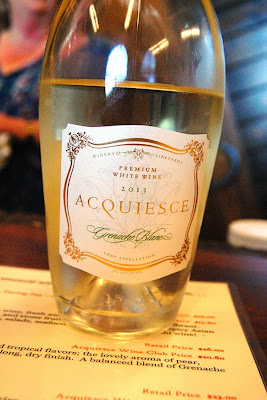
We tried five wines with Tipton, and she presented little appetizers to go along with each one. My favorite was the Dubliner cheese topped with jasmine confit, perhaps the fanciest jelly you'll ever consume. All were served on their own individual amuse-bouche bowls or spoons, and the craftiness and attention to style can be seen throughout the tasting room with wind chimes made from wine bottles and homemade candle holders. (Speaking of the bottles, the unique shape is imported from France. That style is perhaps best known for the Sofia Coppola wines, but that glass comes from China these days.)

These wines can be purchased through the winery website.

2013 Acquiesce Picpoul Blanc
$22

There are only about 10 acres of Picpoul Blanc planted in the United States, and Tipton farms 100 vines of them. It's a fascinating grape with hints of lime curd and floral notes. A light, delicate body with a crisp and quick finish. The current vintage is, unfortunately, sold out, but keep an eye out for this one in the future.

2013 Acquiesce Grenache Blanc
$22

A little firmer body with hints of musk and honeysuckle accompanied by a tart acidity. Excellent with the goat cheese and Meyer lemon zest, and a great roast chicken wine.

2013 Acquiesce Belle Blanc
$26

A combination of Grenache Blanc, Roussanne, and Viognier. Outstanding in the balance of the various elements. The nose is floral and herbal while the acidity is just perfect. It is bright and delightful and manages to capture summer in a glass. Highly recommended.

2013 Acquiesce Viognier
$23

I love a good Viognier, and this one did not disappoint. Aromas of grass and lemon, with a tart and refreshing flavor. I've always thought that this grape is a nice introduction to the earthier elements in white grapes before getting down into the funky, barnyard characteristics. Would be delicious with a cold pasta salad.

2013 Acquiesce Grenache Rosé
$20

The one non-white offering at Acquiesce is still true to the style of Southern France, and we had some amazing dry rosés while we were out there. This Grenache version shows bright notes of strawberry and watermelon with a nicely tart finish. Throw this in a bucket of ice and enjoy it beside the pool with a good book.

Note: This trip was sponsored by Lodi Wine and Snooth.

09 May 2014

Jamieson Ranch Vineyards

Jamieson Ranch is the southernmost winery in Napa, and was formerly known as Reata (Spanish for "lariat"). I've covered their wines in the past, and even with the new name, several of the bottles will continue to carry the Reata marque. These three wines provide you with a great tour of classic Napa wines at reasonable prices.

2012 Reata Carneros Chardonnay
Carneros, California
100% Chardonnay
$20, 14.3% abv.
11,000 cases made

Bright apricot with a touch of vanilla, little touches of cream on the mild, round, and low acid body. Gentle mouthfeel, and one that would be great with a nice lobster roll.

2012 Reata Three County Pinot Noir
Monterey, Sonoma, San Benito, California
100% Pinot Noir
$30, 14.3% abv.
13,000 cases made

Chocolate covered strawberry aroma, with with deep berry flavors on the palate, firm tannins and a rich, deep finish. I recently had a duck molé dish and think that this would be the perfect match for it.

2011 Jamieson Ranch "Double Lariat" Cabernet Sauvignon
Napa Valley, California
100% Cabernet Sauvignon
$45, 14.7% abv.
3,000 cases made

This wine opened up early with rich cassis and blackberry aromas, accompanied by full fruit flavors and medium tannins. While excellent with a steak right now, this one is sure to improve and develop over the next few years.

Note: These wines were provided as samples for review.

06 May 2014

Lodi Farewell Dinner

On my last night in town, we had a dinner at Jeremy Wine Co., with a few winemakers, and they broke us up so that the wine writers didn't cluster together in our instinctive fashion. I was seated with a husband and wife team from Peltier Station, and when I introduced myself, the husband mentioned that they had flown into Mississippi to promote their wines. It sounded a little odd, so I said, "Did you fly into Jackson?"

"No..."

The casino business has made Tunica a little busy, so I asked if they'd flown in there. "No, we're not into gambling, it was somewhere else..."

I said, "Did you fly into Olive Branch?" "YES! That's it!" So of course that led into a conversation about general aviation, their Cessna, and how I had not only flown out of that strip on more than one occasion but was privileged to take the yoke while Dad was logging flight hours. Turns out that he and his wife barnstorm all over the country on promotional trips. The jaunt to Memphis went Lodi, CA - Denver, CO - Fayetteville, AR - Olive Branch, MS. He thought it was a great trip, the wife seemed to indicate that it was a little long in some of the stretches.

I thought about my great-grandfather E.J. a lot while I was out there, particularly because two of my fellow writers were from San Diego and because so many of the winemakers that I met were fifth or sixth generation farmers in the same patch of land. I got to place my hands on old vines that were planted during the Civil War, and also to walk through some patches that were considered "new" seeing as how they were planted before WWI. Due to the Volstead Act during Prohibition, people were able to make batches of wine at home for personal use, and since Lodi had easy access to railroads, tons of grapes made their way east to fuel the home wineries of German and Italian immigrants in the big cities. Lodi is also the home of the first A&W root beer stand in the country, and while we drove past it, we did not get a chance to have a float while in town.

I have many more stories to share, but I'll leave you with this: while staying in the luxury resort Wine & Roses for four days, I'd notice that in the morning I'd smell cookies or toast or something similar wafting over the breeze, and it never corresponded to what we had for breakfast. Less than two miles away was a General Mills factory, so I was smelling Cheerios, Lucky Charms, or Kix depending on the schedule that day.

Note: This trip was sponsored by Lodi Wine and Snooth.

03 May 2014

Wine Dogs of Lodi

It's been a long week, and while I haven't posted a lot of content here at BWR, I've been busy posting notes and pictures on Facebook, Twitter, and Instagram along with my fellow wine writers on the trip. We couldn't have had a better time, and I'm sitting on a mountain of material that I can't wait to share.

Since I'm back home with Bella resting at my feet, I thought I'd kick off the first of many posts with a quick look at some of the wine dogs we encountered in Lodi. These were some of the friendliest and most relaxed dogs I've ever met, and everyone loved having them around.

This little black mutt at d'Art Wines grabbed a piece of dried grapevine and brought it to me in the tasting room. Perfect timing, though he didn't have a lot of interest in the chunky rabbit that kept hopping around the flower beds.


Ranger works the tasting room at Harney Lane Winery and greets customers. His other jobs include taking naps on the cool stone floors and searching for dropped food in the outdoor dining areas. One visitor asked if the winery was hiring, and stated that he wanted Ranger's job.


We encountered this old Weimaraner at the historic Bechthold Vineyard, home to what may be the oldest Cinsault vines in the world, planted in 1886. While one of the growers was talking about the care and tending of the gnarled old vines, this dog roamed around and chewed pieces of wood out of the trunks.


Roscoe joined us for a tour of Mohr-Fry Ranches, a farm that also produces a wide range of heirloom beans. According to Nannette, all dogs are named Roscoe.


This rescue mutt got a head scratch from Greg during a morning rosé tasting at the LangeTwins Family Winery original property. I'll have a lot more to say in the future about tailgate wine tastings and how I think they should spread across the nation.

30 April 2014

Live from Lodi - Snooth Virtual Tasting Tonight!

I've participated in a lot of online tastings over the years, but tonight I'll be on camera along with my fellow wine writers and some of our hosts here in Lodi. The Snooth Virtual Tasting starts at 5:30 Pacific/8:30 Eastern. Tune in if you'd like to watch us discuss a quartet of wines and hear about the exciting things going on in the Lodi wine region.

28 April 2014

Greetings from Lodi!

Posting might be a little erratic this week, as I'm not sure how much time I'll have to finish up the dozen incomplete drafts I have sitting in the queue. But I'm not slacking off--I'm here in scenic Lodi, California with Snooth and the Lodi Wine Commission, and I'm about to start three straight days of winery tours, dinners, and tastings.

Yesterday was a long day, during which I traveled for 14 hours and capped it off with a massive three hour dinner here in the charming resort called Wine & Roses. The property is beautiful, full of redwoods, palm trees, olive trees, and more. The immediate area around us features the obvious vineyards, but also fruit orchards, olive and nut groves, dairy farms, and many other crops that I just glimpsed on our ride into town yesterday afternoon.

I'll probably save most of the stories and winery posts for my return home, when I've had a chance to sort through everything. But I will be posting updates on Twitter, where you'll also see the posts of my colleagues and hosts on this great trip.

Cheers!

25 April 2014

Headed to California

I'm posting during a big thunderstorm here in Memphis, so there's a chance that this post is going to evaporate as soon as the power goes out. But I did want to announce that I'm headed to California on Sunday for almost a week of wine tasting in the Lodi AVA. I've had a lot of wines from this area in the past, and I like their combination of tradition and experimentation. They do a lot of old school Zin, but are also willing to plant Albariño and see how it works out.

I'm going to be traveling with some of my Snooth pals. These are all good people, most of whom I've met before, and I'm going to provide some links below:

Gregory Dal Piaz - Editor at Snooth

Nannette Eaton - Wine Harlots

Amy Gross - Wine4Me

Dezel Quillen - My Vine Spot

...and looking forward to meeting Bill Eyer of Cuvée Corner.

I've got the schedule of all of the wineries and restaurants, even the menus of each meal we are going to consume. Frankly I'm headed into a 48 hour fast and cleanse to prepare for the trip. I'm looking forward to yet another great wine adventure with fellow writers I admire as well as winemakers whose products deserve serious attention. Next week I'll continue posting reviews of wines I've tasted in the past few months, but expect some great Lodi content in the first week of May.

Cheers!

23 April 2014

2011 Avignonesi Rosso di Montepulciano

I've written several times about my trip to Italy with my college girlfriend, back in the halcyon days of 1996. I've recently unearthed a lot of photos (back when we used to take those on film and get them printed at the pharmacy) as well as my handwritten journal from the trip (prior to Blogger, Twitter, Facebook, etc.). I've got enough content to fill a book, but at the end of the day I know that what was a life-changing event for me has been repeated many times over the centuries. Young folks go to Italy, drink some wine, look at some art, and try to avoid getting robbed while figuring out a crazy street system in each unique city.

It doesn't mean that I'll never write about that trip in detail, but it has been on my mind recently. I miss the adventure of trucking out on foreign streets and conversing in a foreign language. I would be more than happy to trade my half hour car ride through horrible traffic clutching a V8 or Diet Coke with a quiet, contemplative train ride that I could enjoy with a newspaper, caffe latte, and chunk of bread. Let me fill out the crossword in the International Herald Tribune in peace before I have to spend hours creating performance metric dashboards.

Back to the wine, which brought back fond memories of tasty Tuscan reds that I sipped with wild abandon back in 1996, never asking for alcohol percentages, grape composition, or how long the family had been making wine.

2011 Avignonesi Rosso di Montepulciano
Montepulciano
94% Sangiovese, 6% other local red grapes
$19, 14% abv.

The wine shows classic Tuscan aromas of black cherry and plum with firm tannins and a long, lingering finish. It's chewy, a little tannic, and quite tasty when served with a rustic roast beef meal accompanied by grilled asparagus. Delicious and true to the region, and one that I hope you will enjoy here in the States as well as back in the home country.

Note: This wine was provided as a sample for review.

21 April 2014

2012 Maculan Dindarello Moscato

This weekend I had the pleasure of hosting a baby shower at my parents' house for The Woman Formerly Known As The Roommate. Just around the time for her first wedding anniversary, she is due to give birth to her first child. I have been granted honorary Uncle status, and wish everyone the best.

The baby shower was a lot of fun, as it was co-ed and I brought along a dozen bottles of wine. Dad smoked chicken drummies on the Big Green Egg, Mom helped coordinate everything, and Bella ran around begging for appetizers. It was a pleasure to catch up with so many friends and to celebrate the Easter weekend together.

I brought along this particular wine specifically for my mother and my sister-in-law, who are connoisseurs of the sweet wines. This Italian sample performed admirably...

2012 Maculan Dindarello Moscato
Veneto IGT
100% Moscato
$22/375mL, 11.5% abv.

Intensely floral nose. Great honeysuckle and jasmine with hints of citrus flower. On the palate it shows a deep, sweet, and musky flavor sparked by a great tang of lemony acidity. Not terribly cloying, and it doesn't hang on the glass that long. This is a great dessert wine that is not explicitly a dessert wine; more a tasty after dinner wine that needs to be served with good cheese. Highly recommended.

Note: This wine was provided as a sample for review.

18 April 2014

A German Grape Takes a Tour of Europe

I've always been interested in studying transitional geographical regions--places that have changed hands over the centuries and today contain elements of the various cultures that have occupied the physical area. Granted, a lot of that involved war, religious persecution, or other horrible things, but they remind us that national borders are not firm laws set down from time immemorial, but often redrawn when one side has more power, and endure when the other side doesn't feel like fighting back for the dozenth time.

I've written a lot about Alsace and how I feel it is its own unique European region nestled between Germany and France, hence the reason for using the flag of Alsace rather than the tricolore. In today's post, I'll extend the same courtesy to the Alto Adige region of Italy, an autonomous state that borders Austria and Switzerland. I make these decisions not for political reasons but more for cultural ones--Trentino-Alto Adige (or Südtirol) was part of the Austro-Hungarian Empire until after WWI, and German is still spoken there. In both cases, you've got German-speaking folks living on the borders of other countries, growing their grapes for a long, long time.

Although this particular quartet of Gewürztraminer presents a fun orthographical dichotomy: Italy uses the umlaut, France doesn't. I'll respect the choices for the names of the wines, but since the grape is more commonly spelled with the umlaut, I'll use that for the varietal name... So ist das Leben.

2011 Hugel Gewurztraminer
Alsace, France
100% Gewürztraminer
$23, 14% abv.

This bottle showed up sweet and spicy, round with low acidity. Really a classic Gewürztraminer and one that would fall in well with both German and New World versions.

2008 Domaines Schlumberger Les Princes Abbes Gewurztraminer
Alsace, France
100% Gewürztraminer
$28, 13% abv.

I found the Schlumberger similar to the above, but more earthy and with a honey element. Obviously it has aged quite well without becoming cloying. There's a lot of depth here as well as structured acidity, which almost pushes this into dessert wine territory. A great bargain for a well-aged wine.

2013 Elena Walch Selezione Gewürztraminer
Alto Adige, Italy
100% Gewürztraminer
$20, 14.5% abv.

It showed great apricot and floral notes, almost perfume-like, but in contrast to the Alsatian wines this was quite dry with low acidity and a round mouthfeel. Good minerality. Excellent wine made in the Austrian style.

2012 Elena Walch Kastelaz Gewürztraminer
Alto Adige, Italy
100% Gewürztraminer
$32, 14.5% abv.

Coming to the end of the quartet, I've got to say that Alto Adige won me over, and this particular bottle was my favorite of the four. It has many of the attributes of the former Elena Walch wine but with a luscious honeysuckle aroma that captures my heart every time. However, this bottle had better acidity, firmer body, making it a more serious wine all around. Serve this with roast quail and a winter vegetable purée and you've got a magical combination during this lingering cold weather.

* * *

Thanks for reading, and remember that you can still follow GrapeCollective.com and register to win two Riedel wine glasses:

a Rafflecopter giveaway


Note: These wines were provided as samples for review.

16 April 2014

Riedel Wine Glass Giveaway with Grape Collective

I was recently interviewed on GrapeCollective.com, as was my dear friend Fredric Koeppel. Both were conducted by my SnoothPVA pal Jameson Fink, but the site also features the work of Managing Editor Meg Maker, another SnoothPVA friend. Wine brings folks together, and thanks to this website, you now have an opportunity to get some fancy Riedel glasses if you follow Grape Collective on Twitter and Facebook. Here are the details:

a Rafflecopter giveaway


They're putting out some great writing and great interviews, and I urge you to check out the site. If you like it, follow the links in the above section and you'll be registered to win some Riedel glasses. The contest period is open from 2014-04-16 at 12:00 a.m. to 2014-04-21 at 12:00 a.m.

14 April 2014

2011 Faust Cabernet Sauvignon

There's nothing quite like a good Bordeaux blend, even if it's made in California (and sometimes especially if it's made in California). I tried the 2005 Faust in 2008 and was delighted to try a current release here in 2014.

This blend uses all five of the Bordeaux red grapes to achieve outstanding balance and a bottle that will certainly improve over the next five to ten years. While I love experimentation in wine and don't mind some of the crazy blends coming out of Paso Robles and Lodi, there are reasons why certain classic combinations have endured for so long.

I am also a big fan of the label, which has changed slightly over the years while retaining certain critical elements. The 2011 label displays a heart of vines full of leaves. It's an odd situation in which the exact same design looks perfectly elegant on a wine bottle but would have a somewhat different impression if tattooed on the upper right breast of a biker chick at Sturgis.

2011 Faust Cabernet Sauvignon
Napa Valley, California
78% Cabernet Sauvignon, 17% Merlot, 3% Petit Verdot, 1% Malbec, 1% Cabernet Franc
$55, 14.2% abv.

The wine has a rich nose with deep cassis and chocolate, touches of cedar and pyrazine (tomato leaf, tobacco). On the palate it is full of dark fruit flavors, medium tannins and a long, lingering finish. I would recommend decanting at this stage in its development, though in the coming years it will most likely soften and be ready to serve right away.

Memphis is in a weird weather spot right now, as it was in the 80s yesterday but a few days from now it will be in the 30s at night. Since today was cloudy and quiet, I took the opportunity to celebrate the end of winter with one last glorious casserole dish. I made a simple veal and spinach lasagna served with a little red leaf lettuce and Roma tomatoes. Splash of vinaigrette and we're done. It hit the spot, and I celebrated a glorious combination of great wine and hearty food with a healthy nap, accompanied by Bella who snored away at my feet.

In the words of my grandfather Chuck, "Fellers, it just don't get any better than this."

Note: This wine was provided as a sample for review.

09 April 2014

Stinson Vineyards of Virginia

Years ago, I was surprised to taste a wine with an Italian name that was from the Galilee region. At the time I thought it was somewhere in California, settled by particularly religious settlers from Sicily. Nope, it was an Israeli wine from the original Galilee.

Someone could have a similar reaction to pulling out a bottle that says Monticello. Italian? No. From somewhere in the New World settled heavily by Italians, like California or Argentina? No. This one bears its name from the home of Thomas Jefferson in Charlottesville, Virginia. I've visited a lot of presidential homes and libraries, particularly during the year I worked in Ohio. I even passed up an off-hours dinner with co-workers to zip west to check out the Rutherford B. Hayes Presidential Center in Fremont.

Stinson Vineyards is located near Jefferson's estate and continues on the tradition of growing Vitis vinifera grapes in the Old Dominion since the 18th century.

If you're interested in Virginia wines, bloggers from that state tend to be highly engaged in their local wines, and a list of them can be found at my Winebloggers In The South sister site.

2012 Stinson Rosé
Shenandoah Valley, Virginia
100% Mourvèdre
$17, 13% abv.

The wine pours with bright acidity, mostly expressed in overripe strawberry elements and a slightly ashy finish. I actually tried this last year but got an off bottle. This one was enjoyable and presented in the French profile, and made for a delicious pairing with a croque madame.

2012 Stinson Cabernet Franc
Shenandoah Valley, Virginia
80% Cabernet Franc, 10% Merlot, 10% Petit Verdot
$23, 12.8% abv.

Light plum aromas with a touch of spice, followed by firm dark fruit flavors from the tiny grapes. The tannins are fairly mild and there's a long dark fruit finish. Cab Franc and Petit Verdot are two of my favorites, and while this doesn't taste Bordelais, it doesn't taste Californian either. Excellent example if you want to explore the influence of Virginia terroir on French grapes.

Note: These wines were provided as samples for review.

07 April 2014

2013 M. Chapoutier Belleruche Rosé

M. Chapoutier is a négociant based in the Rhône region of France. That means that the grapes are purchased from nearby vineyards and made into the various bottles that bear the Chapoutier name. This is not a practice that is isolated in France, but I don't think that any other countries have a specific name for it.

I love rosé year-round, and was absolutely delighted to get to try this tasty pink wine in the spring...

2013 M. Chapoutier Belleruche Rosé
Côtes du Rhône, France
Grenache & Syrah
$8, 13% abv.

Light aromas of tart raspberry with flavors that follow, including a burst of lemony acidity. Round mouthfeel with a beautiful salmon color and a long, tart finish. Incredible bargain and highly recommended. I had some very specific ideas about what sort of meal I would pair with this wine.

Spring has not entirely arrived here in my dear River City, something that brings me much joy. We had a few warm days last week but thankfully it's dipping down near freezing at night. However, I acknowledge the longer days and greening of the foliage with a proper Provençal lunch: stuffed clams, asparagus tips, and grilled lamb chops. Such a delicious pairing with this rosé and one that I hope you will enjoy at your own table.

Note: This wine was provided as a sample for review.

04 April 2014

2012 Gnarly Head Malbec

A little site news first... Be sure to check out my latest post on PalatePress.com, in which I discuss awkward wine moments I've experienced. I've told a few of these stories here before, but I go into more depth in this new article. Also, I was recently interviewed by Jameson Fink for Grape Collective. There are some neat stories coming up in the next month, but I don't want to spoil anything quite this early.

On to the wine!

Even though the weather is getting warmer, it's still nice enough to enjoy some great reds before the searing Memphis heat turns our attention toward clean, crisp whites and fruity rosés. While Gnarly Head is most known for their Old Vine Zin, they've launched an Argentine Malbec as well. I would recommend both for your steak and burger nights, perhaps like the old 3Bs guys' nights that Paul and I enjoyed for years while he was still living in Memphis (3Bs = beef, booze, bad movies).

2012 Gnarly Head Malbec
Mendoza, Argentina
100% Malbec
$12, 13.5% abv.

Mild and fruity with great black plum aromas and flavors. Gentle tannins and soft acidity contribute to the round mouthfeel, and the good dark fruit shows well at a range of temperatures. Good bargain and it should be easy to find anywhere in the country.

Look at that! A sighting of a Nomacorc! It's pretty cool knowing that I've seen the actual machine that produced and cut that cork, as well as all of the equipment used in the testing and research. While I'll have some more details on the cork factory in the future, I'd highly recommend checking out this video of the factory shot by my friends at Wine Folly. It will give you the brief tour of how the synthetic corks are extruded and sliced.

Note: This wine was provided as a sample for review.

01 April 2014

Red Wattle Hog

In nine years of swine blogging, there are always old favorites that you return to year after year. I most recently wrote about the Red Wattle pig last year for the Cochon Heritage Pork event here in Memphis, where that breed (and a few Berkshire hybrids) were used in the cooking of over forty distinct dishes using every part of the pig except for the oink.

The Red Wattle is easy to identify even at a young age, due to the presence of the distinctive "wattles", or pair of fleshy tags that hang down from the neck. These serve no evolutionary or culinary purpose, but remain as iconic as the beautiful chestnut roan color of the hair. The breed is known for being friendly and easy to handle, and the sows reliably deliver litters of up to 15 piglets. They're great if you've got a lot of oak trees, since they love to forage for acorns and that will definitely help deliver the classic heritage breed flavor. They are on the lean side, though the meat is not bland like most of the current lean hogs used for mass production. You can correct for that by wrapping chops in bacon or through the use of a larding needle for roasts. Whatever you do, don't overcook it.

There are varying theories about the origin of the Red Wattle breed. Some point to Texas, but I've always preferred the more legendary origin of French colonists bringing the pig to the US in the 1700s from the island of New Caledonia, a collectivité sui generis française located in Melanesia east of Australia.

Pigs were first introduced to the South Pacific some 3500 years ago, and pig roasts remain popular for special feasts throughout the islands. It is not improbable that some random mutation from an East Asian pig resulted in the familiar Red Wattle profile, though breeding records from those areas are highly unreliable. Still, the breed is making a renaissance in the United States, and I hope to see more of them in organic farms and in discerning butcher shops throughout the country.