06 October 2006

Benito vs. the Farmer's Market: Apples & Chestnuts

Black Arkansas Apple
The Black Arkansas is an unusual apple variety. It's much smaller than those you see in the grocery store, and it's hard as a rock. If you threw this at someone, you could cause some serious injury. (I say this as someone who grew up with a peach tree in the backyard and a little brother. Unripe peaches hurt, ripe peaches make a mess, and rotten peaches mean that mom's going to make you strip in the back yard and hose off before coming in the house.)

It's a little hard to bite into, but from there, it eats like a normal apple. It's sort of woody and not very sweet. I've heard that this variety is ideal for cider making, and I'm a big fan of cider, both the natural unfiltered variety and the harder type.

The apples taste much better cooked. I baked the remaining apples (sliced and cored, kept the peels on) with some honey, butter, and cinnamon) for a side dish alongside the recent Combinations #6 dinner. The dark peels provided some lovely color. And there's something I like about the size and shape... Not the huge glossy yet flavorless apples you see in the stores (Red Delicious I'm looking at you), but this is a scrawny, scrappy little fruit that when properly prepared can reveal some delicious secrets.

Chestnuts
I haven't eaten chestnuts since my trip to Italy ten years ago. I was there in December, and in most of the decent sized cities I could buy a bag of roasted chestnuts from a street vendor to snack on while walking around the town in the evening. (Nothing like a warm snack to hold on to while bundled against the winter wind!) Typically the vendor would have a little fire going from wood or charcoal, and would roast the chestnuts on a perforated metal plate. You could smell them from a block away.

Here in the Memphis area, the pecan tree is our major nut tree. I actually like to buy them from my barber, whose family owns a substantial pecan grove in Mississippi. But we've got chestnuts as well--some farmed on purpose, others leftovers from plantings over a hundred years ago. Looking at a raw chestnut you'd never guess that they're edible, but when properly cooked the meat inside is delicious.

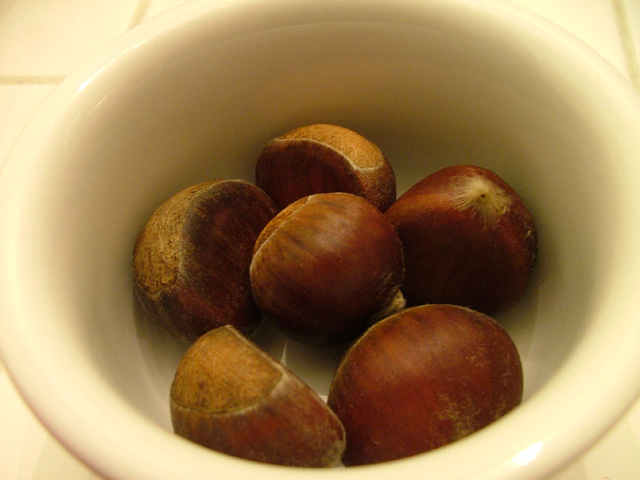
Pictured above are the raw chestnuts. My first attempt involved roasting them in a pan on the stove. They tasted OK, but a little bland. Obviously much better when I cooked them for my birthday dinner--roasted in the oven for a half hour, shelled and sliced and then pan-fried in butter and honey and brown sugar. Quite tasty.

01 October 2006

30th Birthday Party

I actually turned thirty back on September 13, but that week wasn't conducive to celebrations as some of my closest friends were out of town. And while minor parties occurred throughout the month, I was saving up for a big dinner party at the end when everyone could be there. I did all the cooking, friends and family provided the wine and dessert, and we all had a grand time. I know that it's in bad taste to throw a birthday party for yourself, but honestly, I didn't want any presents, I didn't want to go out and eat... I just wanted to spend some time with those closest to me and cook a bunch of dishes that I'd been dying to try out.

Before I go any further, I have to give full credit to Paul for hosting, as well as joining my father and my brother John, all three of whom spent half the evening washing dishes. Couldn't have done it without y'all.
Once everyone arrived, we started out with a toast, basically thanking Paul for hosting and thanking my parents for giving birth to me 30 years ago. We toasted with the Schramsberg Blanc de Noirs, a non-vintage sparkler from California. I'd been holding on to this bottle for a few months and wasn't disappointed. It had a heady, vegetal aroma, but a cool and crisp mouth feel to it. I found myself sipping it throughout the evening as a palate cleanser. Some of my guests elected to toast with the Fetzer Riesling, a light and sweet wine. My roommate, a devout non-drinker, toasted with the 2006 Diet Coke.

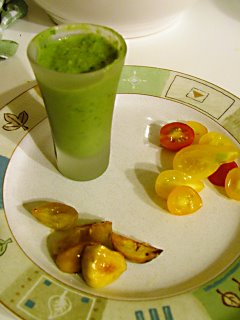
Oh, the photo... Instead of a bank of appetizers, I elected to provide an amuse bouche, French for an entertainment of the mouth. The idea is to provide the diner with a free sample of the chef's intent, but not necessarily anything related to the dinner to follow. In this case, I prepared a trio of richly flavored items. First off, a purée of peas courtesy of Jacques Pépin. Slightly cooked peas blended with some mint and jalapeños from my garden, plus some Italian parsley and the other items in the recipe linked above. Served in a shot glass for the purposes of just tasting the sauce. Then there's a few of my late harvest yellow cherry tomatoes, topped with the diner's choice of Kosher salt or French grey sea salt. Finally, there's some honey roasted chestnuts. I roasted the chestnuts whole for a half hour, then shelled and sliced them before sautéeing in a pan with butter, honey, and brown sugar. My dining companions found all of this a little odd but ultimately delicious.
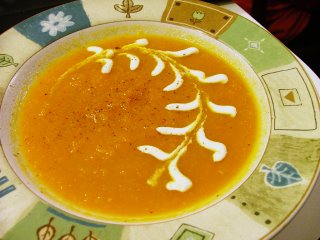
For the soup course, I made a "14 Carrot Soup". Pardon the pun... There were only about ten carrots in there, three parsnips, a good chunk of diced ginger, several cloves of garlic, and two leeks. I really didn't have to season the soup, which was fortified by a half gallon of chicken stock and half a bottle of wine. Root vegetables can have some incredible flavors on their own, if you cook them properly. For serving, I made a little vine design using some sour cream piped through a bag. Then I dragged a knife through the lines to produce the vine. (I picked this up as a decorating tip from a pumpkin soup recipe about 15 years ago.) A little dusting of freshly ground nutmeg and we're ready to go.

For wine, we drank the 2005 Alois Lageder Pinot Grigio from the Alto Adige region of Italy, though I was still finishing off some of the sparkling wine. The pinot grigio was tart, lemony, and quite refreshing. Brought by my sister-in-law. (I put an odd rule in the invitation: all men had to bring red wines, all the ladies had to bring white wines, though no one would be turned away for breaking the rule. Though perhaps chauvanist, it's really not a bad way of achieving a balance of wines, is it?)
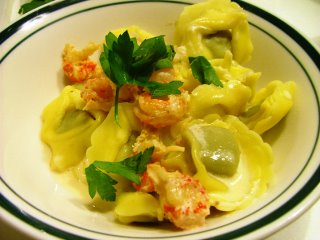
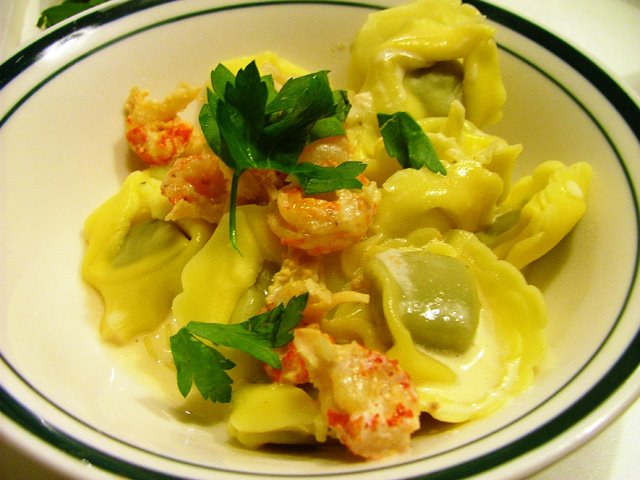
Throughout the evening, we sipped on my brother's red wine, the 2001 Chateau Potelle Zinfandel from Paso Robles in California. A dark and jammy Zin with hints of plum and black cherry. Typically I follow the Soup-Fish-Meat-Dessert paradigm, but I mixed it up a little this time and did a more Italian primo piatti dish with a Southern flair. What you see before you is spinach and cheese tortelli, topped with crawfish tails and a light cream sauce. A little grated Romano cheese and Italian parsley to top it off. This was a big hit of the evening, and while I was concerned that it might fill everyone up too fast, there was enough time before the secondo piatti for everyones stomachs to settle.

The wine I recommended for this course was provided by my mother.
2004 Lockwood Chardonnay
from Monterey, California. A delightful little wine, whose French oak aging really matched well with the rich crawfish and cream sauce.
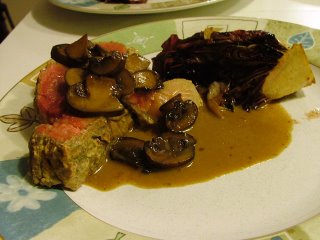
Between the pasta and meat courses, I poured the 2002 Shelton Vineyards Cabernet Franc, a bottle I picked up after a recent tasting. This is an incredible wine, and everyone was shocked when I told them that it came from North Carolina and was very affordable. For the main course, I cooked a whole beef tenderloin (coated in a horseradish-mustard sauce with fresh rosemary and black pepper), served with a savory mushroom sauce and some grilled radicchio. The radicchio were made more or less in the style of chef Michael Chiarello, including the use of anchovies to spice up the vinaigrette. I didn't tell anybody beforehand about the anchovies, and nobody complained after the disclosure. The beef was really good. Several diners gorged themselves to excess. The primary wine for this course was provided by Dad, the 2004 Pilgrim Vineyard Zinfandel from V. Sattui's Lodi Vineyard.

Dessert was a key lime pie provided by my parents, accompanied by some vino brulé that I made according to an old Italian recipe. It was deep and hearty, but didn't discourage us from enjoying snifters of Paul's favorite Port, the Penfolds Grandfather. A perfect way to end a delightful evening.

I'd like to thank all of my friends and family that were able to attend, as well as thanking them for putting up with my various culinary experiments over the years. Several of those in attendance said, "But we should be taking you out for your birthday." Honestly, there's no other way that I would have wanted to celebrate this particular milestone.

24 September 2006

Tasting Notes for September 23, 2006

I was pretty excited about this tasting... All of the wines below come from Shelton Vineyards in the Yadkin Valley of North Carolina. I've never had North Carolina wine before. Based off my experience with Tennessee wines, I was a little apprehensive, but everything was great. All of the wines use traditional European grapes as opposed to the American natives and hybrids you get elsewhere in the South. There was a representative from the vineyard on hand to answer questions. Currently, about 70% of their sales are in North Carolina, and the wines are available in limited quantities in ten other states.

Wine 1: NV Shelton Madison Lee White. 72% Chardonnay, 14% Viognier, 10% Riesling, 3% Pinot Blanc, 1% Sauvignon Blanc. Bright and tart, lemony but not sweet. Very refreshing. Nice way to open up the palate. $10.

Wine 2: NV Shelton Vineyards Riesling. 95% Riesling and 5% Viognier. Lightly sweet, but with a very full mouth feel. Honey like. Lots of fun, low acidity. A really surprising Riesling. Reminded me of some similar bottles from Oregon. $12.

Wine 3: 2005 Shelton Vineyards Bin 17 Chardonnay. Pure Chardonnay. This one didn't do much for me, I thought it had an unusual taste that I couldn't quite pin down and a bitter finish. Probably should have tasted it before the Riesling, though. $10.

Wine 4: NV Salem Fork Blush. The website claims this is made with Sangiovese and Viognier, but the rep said it was a rosé of Sangiovese and Zinfandel. The latter is the reason why it doesn't bear the Shelton name on the label--they don't grow Zinfandel grapes in that area and have to import them. Despite the appearance, it's not a sweet wine. Rather, it's bold and fruity. I really enjoyed it. $8.

Wine 5: NV Shelton Madison Lee Red. 33% Merlot, 28.6% Cabernet Sauvignon, 22.1% Sangiovese, 10.4% Cabernet Franc, 3.3% Syrah, 2.6% Petite Verdot. Sort of a Bordeaux with Sangiovese thrown in for fun. A surprisingly good table red, well balanced and applicable to a wide range of foods. She said that it was their pizza and burger wine, and I think it would work well with even higher class fare. $10.

Wine 6: 2002 Shelton Cabernet Franc. 92% Cabernet Franc, 5% Cabernet Sauvignon, 3% Merlot. Wow. Black cherry flavors and aromas, with some of that nice herbal character you get from the Cab Franc. I was really happy with this wine, and ended up purchasing a bottle after the tasting. It's difficult to find a basically pure Cab Franc for $15.

Wine 7: 2002 Shelton Merlot. 93% Merlot, 7% Cabernet Sauvignon. Medium tannins, mild and light. I found it a little thin, but that could have been the influence of the Cabernet Franc from the previous wine. $15.

Wine 8: 2002 Shelton Cabernet Sauvignon. 85% Cabernet Sauvignon, 15% Merlot. Smooth, cherry flavors abound. Light tannins, light acidity and mild oak. $15.

23 September 2006

Combinations #6: Roast Partridge with Grapes and Walnuts

Andrew's hosting yet another round of Combinations... For Combinations #6, we're tasked with preparing Roast Partridge with Grapes and Walnuts and matching an appropriate wine. First off, in gathering the ingredients for this recipe, I found myself purchasing raw grapes for the first time in... I can't remember. I've eaten grapes occasionally in the past decade, but it seems I only buy them in their fermented and bottled form these days. I'm reminded of the Scotsman who, fond of the deep-fried pizza of his home, goes to Naples, is served a perfect pizza margherita, and exclaims, "D'ya expect me to eat it raw?"

Speaking of the raw grapes, I used Sable Seedless, which are black as night and taste great. I couldn't help but be curious about what kind of wine they'd make. (And yes, I know that wine grapes often don't taste all that great and that table grapes make crap wine. Still curious.)

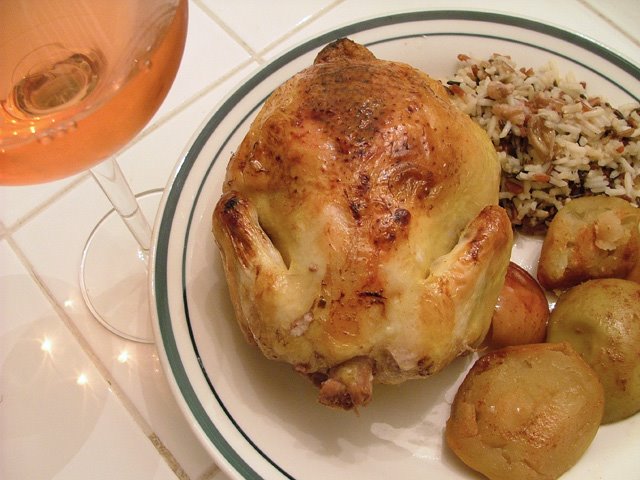
We have partridges here in the States, but they're actually a species of quail. (Couldn't get my hands on any farm-raised quail--my local supplier for farm-raised game went out of business.) Right now we're at the end of dove season, and while I wouldn't have been averse to going out and shooting a brace of doves with the trusty 16 gauge, I haven't had the opportunity to get out in the fields. Grabbing a pigeon from the street didn't seem too appetizing, and I wasn't going to try to snare one of the mourning doves out of my backyard. Doves don't really have much meat on them, though, and looking at pictures of European partridge dishes, I figured my best bet was going to be Cornish game hen, basically a very small breed of chicken.

I don't know how popular these are overseas... Here they're available everywhere, and very inexpensive (yet ridiculously expensive at restaurants/catered events). Most people get them frozen, but I was lucky to pick up some fresh ones. Some people like to cook them for small Thanksgiving dinners, because they cook rather quickly and there's not a ton of leftovers.

Brief anecdote: I first cooked Cornish game hens back in high school when I was going through my first cooking experimenting phase. I prepared them in an Italian manner with a sausage-based stuffing. They turned out delicious--I made one for each member of our family. Mom looked down at hers and almost got upset. "But it looks like a little baby chicken... I don't know if I can eat this." Surprisingly, over our lifetime, my mother has rarely had to force me to eat anything, but there's been several dishes I put in front of her that she didn't want to touch. Love you anyway, mom.

I followed the recipe closely, except I used some of the chosen wine instead of the Madeira and substituted a multicolor rice blend for the side dish. I also included some honey and cinnamon baked apples as an additional side. More on the apples in a future post, as they were an unusual variety.

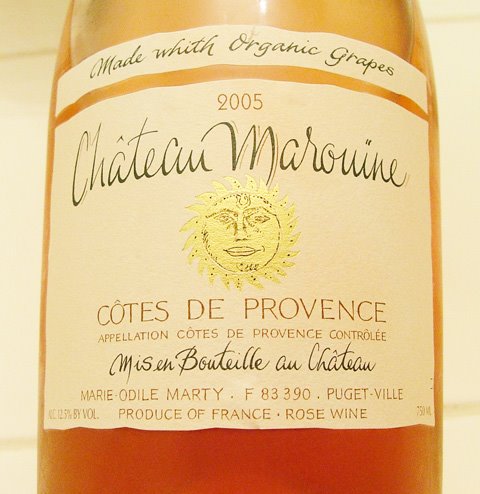
For the wine, I picked the 2005 Château Marouïne Côtes de Provence Rosé, obviously from Provence in France. Alder gave it a good score at a big rosé tasting. It's also fully organic, which is sort of amusing as none of the other ingredients for dinner were organic. 28% Grenache, 26% Cinsault, 26% Mourvèdre, 20% Carignan. Kudos to the winemaker for putting this information on the back of the label! What a lovely Southern French blend.

The first thing I thought of when purchasing the bottle was James Ivey's Extremely Pale Rose: A Very French Adventure. I haven't read this book, but saw mention of it on some wine blog and can't wait to get my hands on a copy. This is indeed a very pale rosé with just a slight orange tinge. Think of a white wine to which you've just whispered something naughty. Flavorwise, it's crisp and tart. Not sweet at all, but well balanced. Tasted blind, this could easily pass for a white wine. Very light flavors of pear. Easily drinkable, perhaps too light and refreshing for this autumnal dish. As it hit 91°F (33°C) here today, I feel entirely justified in this selection.

22 September 2006

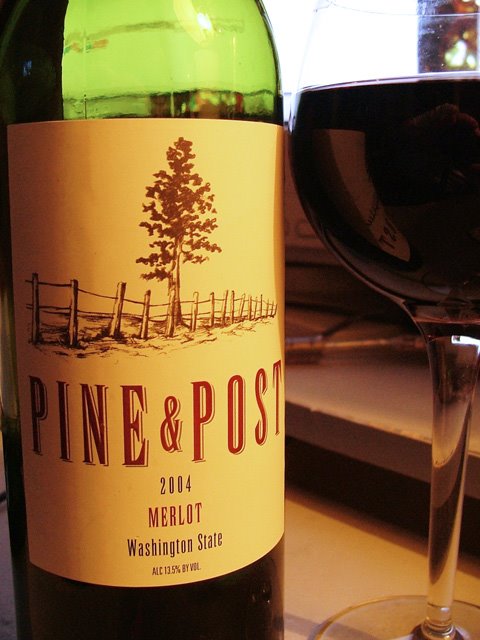
2004 Pine & Post Merlot

Here's the first super-bargain Washington wine I've had, the $5 2004 Pine & Post Merlot from the Columbia Valley. Frankly, I'm not getting a lot out of it. I picked it up for possible use in mulled wine later in the season, but my roommate had some Greek pizza and I figured "why not?"

(For a fun bit of recursion, the photo shown was taken here at the computer desk right before typing this paragraph--you may be able to make out the Blogger entry screen in the back.)

There's some black cherry flavors, and sort of a cinnamon kick on the finish (rather strong for a Merlot), but overall it simply tastes like... red wine. Rather reminds me of some parties I attended in my early 20s where the wine selection consisted of a gallon jug of Red and a gallon jug of White. The adventurous could make an ersatz rosé by mixing them half and half, though much of the time you'd have to add a little Sprite or 7-Up for that frosty wine cooler flavor.

But hey, the music was pumping, and you were desperately trying to appear interested while some hot yet crazy art student was describing her latest work that involved Legos and ketchup. Meanwhile, the first "wine virgin" of the evening goes one red plastic cup over the line, and retreats to the back porch to vomit in the yard. Several new couples form over the course of the evening, one or two break up and never speak again. Many break off into groups to engage in the newfound conversational pleasure of Being An Expert In Everything Because We're In College. An assortment of wallflowers decorate the edges of the party, quietly sipping on their drinks and never quite working up the courage to bust in on any conversations. One chick walks through the living room wearing a ballerina outfit complete with fairy wings, and you wonder if it's just a dance student or a hallucination brought on by too much jug wine.

18 September 2006

Wine Blogging Wednesday #25

Sam over at Becks & Posh has posted the roundup on Wine Blogging Wednesday #25. I submitted a slightly not-quite-Champagne entry a month ago, and mostly forgot about it. However, I got included at the bottom of the list for those that didn't precisely follow the rules. I was pretty damned close, and I'd hope that the story helped out somewhat.

Cheers to Sam for being understanding, and for having one of the most attractive food and wine blogs I've had the pleasure of reading!

17 September 2006

Benito vs. the Produce Section: Swiss Chard

Memphis isn't London or New York or Tokyo, but even in this town of a million I've got access to a wide range of raw ingredients for cooking. In my attempt to cook things I've never cooked or eaten before, I'm starting out with my local but well-stocked grocery store. Once I blitz through all of those selections, assuming I don't get bored, then I can start checking out my local Indian, Chinese, Russian, Mexican, and Vietnamese markets. And if I get bored with all of those and haven't died yet, I'll figure out something new.

There's a lot of talk about improving your health and palate by shopping at the edges of the supermarket--fresh fruits and vegetables, raw meats, and dairy--and avoiding all of the processed foods in the middle. I don't promise that I eat foods that are healthy, gourmet, or even interesting all the time, but I find that foods built from simple raw materials are often the most flavorful and personally rewarding.

Swiss Chard
Swiss chard has to be one of the most beautiful vegetables in the produce section. What you see here is commonly marketed as "rainbow chard", meaning that white, red, pink, and yellow varieties are grown separately and then bunched together for sale. Chard is closely related to the beet plant, though here the focus is on the stalks and leaves rather than the root.

The stalks are edible, though they have to cook longer than the leaves. Without any former experience with Swiss chard, I decided to take the common advice to "treat it like spinach". I cooked some pancetta, chopped the stalks, sautéed them in the pancetta grease, and then added the torn leaves to allow them to wilt and cook.

The end result? Interesting. Not delicious, but good enough on its own. A little bitter, but I like bitter flavors in my food and beer. It really needed some hard Italian cheese mixed in it, and I think it could definitely benefit from a cream-based sauce. With this round of produce experiments, I'm trying to discern the inherent flavors of these weird ingredients, and thus I can find a good use for them in the future.

For instance, I use spinach heavily whenever I make a vegetarian lasagna, so I think I'll substitute Swiss chard next time. I'll also be on the lookout for some traditional recipes that really show off the color and flavor. Still, it's a damned shame that you can't just serve the stuff raw in a salad. Perhaps used as garnish? Think about a half dozen pork ribs laid out along a broad leaf of red chard...

12 September 2006

NV Candoni Prosecco Brut

So I was cooking dinner for the girlfriend tonight, and she had only one request: boiled artichokes with homemade mayonnaise on the side. Simple enough, but as much as I enjoy a good 'choke, I generally prefer a bit more substance on a dinner plate. So I decided to do lightly beer battered shrimp (some decent 16 count specimens I shelled myself), a schmattering of French fries for the hell of it, and some sourdough and clementines to balance everything out.

What wine would go best with such an odd meal? I felt a strong pull towards Prosecco. A combinations of fried foods and fresh mayonnaise really begs for something crisp and acidic to cut through the grease (though my shrimp were not greasy, thank you very much). I settled on the NV Candoni Prosecco Brut. That site doesn't give much information, but at least you can see the unique label. It's actually painted directly on the glass of the bottle, and depicts an Etruscan fresco from Tarquinia, Italy, in the fifth century BC. The girlfriend teaches ancient history, so I scored a few bonus points there.

It is indeed crisp, with medium acidity and is very refreshing (as I often do, I save at least a glass' worth to sample while writing here on the blog). Around $15, so a good bargain to boot. It was a perfect fit for the meal, and I appreciated the fact that it had a wire cage and traditional champagne cork. There are some proseccos that come with these terrible little corks--they're rock solid composite corks like a champagne cork, but there's only about an eighth of an inch above the top of the bottle, not enough to grasp. You can use a corkscrew, but I destroyed a rabbit-style corkscrew that way.

One more amusing note... While I was still doing the prep work before the arrival of the girlfriend, I started making the homemade mayonnaise. I've done this a dozen times before, though I always alter the recipe a bit to try new things. This time I used safflower oil (and used the remaining oil for frying the shrimp--gets nice and hot without smoking). So I'm building the mayo with white wine vinegar and fresh lemon juice and Dijon mustard, and drizzling in the safflower oil, and wondering why in the hell the damned sauce isn't thickening up.

And then I realize that I forgot the egg yolk. What an idiot.

Fortunately, I read this great French cookbook back when I was in high school. I can't remember the name or the author, but the whole point was to make French cuisine fun and non-threatening. From that cookbook, I made my first cream of X soup (in that case, asparagus), as well as my first fresh pasta. There was a whole chapter on "Kitchen First Aid", and there were lots of tricks on how to fix screwed up sauces. In particular, it mentioned what to do with a curdled Bearnaise sauce: start another emulsion in a separate pot, and then slowly introduce the curdled sauce until it comes together. So in a separate bowl, I mixed an egg yolk with a little more vinegar and mustard, got my emulsion going, and then added in what was effectively a terribly oily vinaigrette. The end result: a perfectly delicious fresh mayonnaise, one that paired wonderfully with the boiled artichokes. And it went well with the fries; a few trips to the Netherlands convinced me of that delectable combination.

11 September 2006

Two Grand Ales

A Friday night, good friends, and two amazing ales... Both of these came from the "big beers" category, which in our part of the country are only sold at liquor stores. The first was 7.2% alcohol, the second 9.0%.

Arrogant Bastard Ale, from Stone Brewing Company in California. Very bitter, though it smooths out a bit after some mellowing in the glass. If you're not afraid of bitter beer, this is a good one and a great bargain--around $4 for a 650mL (1 pint 6 oz.) bottle. We enjoyed this alongside smoked chicken, grilled corn, and chicken-apple sausage. A big hand for the bottle design. As long as you're drinking beer, you might as well further disappoint your mother by having a demon on the bottle.

Brother Thelonious Belgian Style Abbey Ale, from the good people at the North Coast Brewing Company in California, comes in a 750mL bottle with a cork. How could I pass this up? A hilarious pun, great jazz reference, cool label, and $2 from every case goes to the Thelonious Monk Institute of Jazz. Pure delight. Rich and deep, chocolate flavors and aromas. Very low bitterness, golden crema-style head on top.

A perfect after-dinner beer, and the cage and champagne cork provide a little elegance. Bonus points for listening to the 1957 recording of the Thelonious Monk Quartet with John Coltrane at Carnegie Hall. At the very least, break out your old LP of Round Midnight and slow dance with your woman. The lights turned low, and the stereo turned up just enough to allow the sweet tickling of the ivories to vibrate through the night air.

You know, I've thus far managed to keep my love of jazz off the blog. I love playing classic jazz during dinner parties--Dave Brubeck, Miles Davis, Duke Ellington, Artie Shaw, Benny Goodman, all those guys, and many more. Even people who claim to hate jazz are often captivated by the rhythms. And I attempt to avoid the jazz fan stereotype by never talking about the subject: I just play the music and let it speak for itself. Generally at a level low enough to allow conversation to take place, but loud enough for it to be the focus of attention during quiet lulls.

10 September 2006

Benito vs. the Produce Section: Beets & Pluots

When it comes to wine, I'm certainly willing to try anything, and generally, the weirder the better. And I'm pretty adventurous when it comes to food. But lately I've noticed that at the grocery store and the farmer's market, I tend to buy the same set of ordinary fruits and vegetables. Time to shake things up! I won't promise that this will be a recurring feature, but when possible I'm going to purchase a raw ingredient I've never cooked and/or eaten before, and post the results. Here's tonight's entries:

Beets
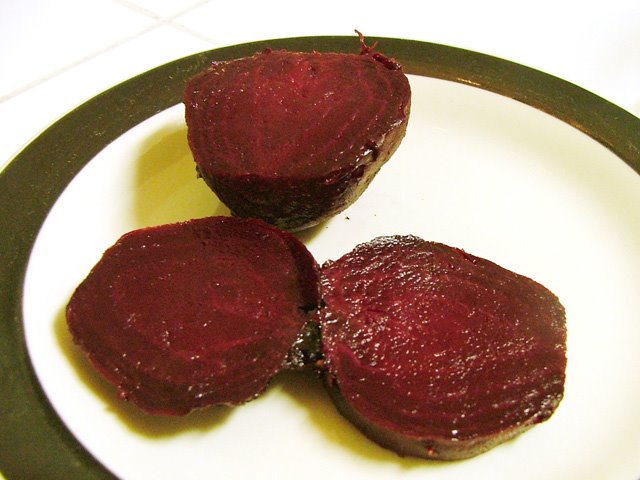
There's nothing unusual or odd about beets, but I've never fixed them before. Frankly, I've never voluntarily ingested them in my entire lifetime. I've had pickled beets once or twice at some point way back when, but I can never recall waking up one day and saying, "Man, I could murder a bunch of beets!" I was smoking some andouille sausage tonight, so I rinsed and scrubbed the beets, drizzled them with olive oil, black pepper, and thyme, and wrapped them in foil. They sat near the hot part of the grill for about an hour. (They were wrapped tight enough that smoke didn't reach the vegetable.)

After roasting, I peeled the skin off and tried the beets. Not that great. I splashed a little balsamic vinegar on a slice and it was much better, but still not something I'd go out of my way to eat. Still, I'm willing to try these as part of a salad or some other preparation before I write them off for good. Perhaps I'll check with my Ukranian friends and learn a good borscht recipe.

Oh, and the andouille sausage was delicious, particularly with a little horseradish mustard on the side.

Pluots
A pluot is a hybrid fruit that is ¾ plum and ¼ apricot. I've seen these over the past few years but never felt like buying one. I grew up with easy access to peach and plum trees, so when it comes to stone fruit my loyalties are clear. But I gave the pluot a shot. As you can see, it's quite attractive when sliced open. And this is one juicy damned fruit. If you try and eat it out of hand you're going to get juice all over you. It's insanely sweet, though the actual flavor is very mild, much like an apricot. The skin contains a tart burst of plum flavor, but frankly, I'd be happier eating nice ripe plums picked from a neighbor's tree (with permission, of course).

Tasting Notes for September 9, 2006

Odd mixed tasting of Spanish, Italian, and Chilean wines.

Wine 1: 2005 Tiefenbrunner Pinot Grigio. Alto Adige, Italy. Probably the best Pinot Grigio I've ever had. A little sweet, but with surprisingly decent body. A little lemon, firm tartness. $16.

Wine 2: 2004 Las Brisas. Rueda, Spain. I tasted this back in June of 2005, and enjoyed it enough to pick up a bottle. It remains a decent bargain white wine--full bodied and fruity, with some grapefruit flavors. Slight bitter edge, but not tart. Perfect for shellfish. $10.

Wine 3: 2005 Cavalchina Bianco di Custoza. Verona, Italy. Mostly Trebbiano, some Cortese and Tocai. Slight sweetness, but sort of flabby. Ultimately dull on the tongue. $15.

Wine 4: 2003 Morandé Terrarum Chardonnay. Maipo Valley, Chile. Clean and thin, some apple aromas. Really a rather neutral wine. Apparently Morandé is ceasing US distribution. $12.

Wine 5: 2004 Piccini Chianit. Tuscany, Italy. I had this a week ago, and it still remains a great bargain Chianti. $9.

Wine 6: 2004 Las Rocas Garnacha. Calatayud, Spain. Lovely little Spanish Grenache. Aromas and flavors run towards ripe strawberries with some plum. Light and refreshing, should be good for a wide range of foods. Just turn the bottle around so you don't have to see the big Comic Sans text on the label. $10.

Wine 7: Bodegas Tikalo 2004 "Rubens" Tierra de Castilla Tempranillo. Ciudad Real, Spain. Some toasted bread aromas on top. Well balanced, light and fruity--odd for a young, inexpensive Tempranillo. Medium tannins. Another great bargain. $10.

Wine 8: 2003 Venta Mazzaron Tempranillo. Castilla de León, Spain. Little heavy and tannic. Dark plum flavors, but very dry. I'd like to try this again after some decanting or breathing. $14.

Wine 9: 2005 Bodega Finca Luzón. Jumilla, Spain. Syrah and Monastrell blend. Black cherry aromas. Good fruit, but exceptionally well balanced. Medium tannins, short finish. $10.

Wine 10: 2003 Mas Donis Barrica. Montsant, Spain. A Grenache and Syrah blend. Light flavor, heavy tannins. A smooth finish, but a little watery. Needs some more punch to it. $14.

07 September 2006

2004 Bogle Cabernet Sauvignon

Dinner with a friend: grilled boneless ribeyes, some grilled endive, and a little dry baguette and roasted garlic, and a bottle of the 2004 Bogle Cabernet Sauvignon. At $13, this is a great little cab. I'm always wary of Cabernet Sauvignon under $20, having been burned many times in the past, but this is a winner. At two years of age, the tannins are remarkably mellow. The aromas are heavy with cherry, and the flavor builds on that with a hint of spice. Once again, Bogle doesn't let me down.

Back to the grilled endive, I've recently become a big fan of grilled radicchio and endive, both from the chicory family. It may have something to do with the savory and bitter flavors you get from this preparation--a big departure from the crisp and tart, occasionally sweet flavors that you get from regular salad preparations. Endive is a little lighter in flavor and radicchio is darker and deeper in flavor. I'd say match them with your wines: endives for whites and radicchio for reds.

03 September 2006

Cheese Plate

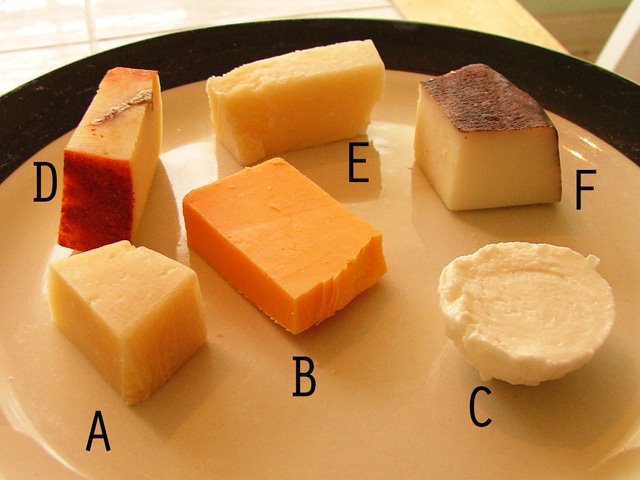
Dinner tonight didn't involve any wine, but I was just using up odds and ends from the kitchen. Some grilled chicken sausage and corn on the cob, a baguette, fresh tomatoes, and hey, some cheese would be nice... While digging through the fridge I realized that I had six decent cheeses on hand. A, B, and C were enjoyed before dinner; D, E, and F afterwards.

A. Parmigiano Reggiano (Italy)
Nothing too special here, you all know it and love it. This particular wedge wasn't too appetizing in chunk form, though it grates beaufifully.

B. Extra Sharp Cheddar (Wisconsin)
This isn't just your standard orange "rat cheese", this is 18-month old extra sharp cheddar. It makes you crave things like roasted potatoes, apple pie... It's unfortunate that most of the cheddar consumed in this country is bland and mild and eaten in massive quantities.

C. Fresh Mozzarella (California)
This is cow's milk rather than water buffalo, but it's still tasty. If you've got fresh tomatoes and basil growing at home, it's a crime not to keep some fresh mozzarella on hand.

D. Applewood Smoked Cheddar (Wisconsin)
Pleasantly sharp, with a subdued smoke flavor and a deliciously spicy rind. Rather like the dry rub that we use on ribs down here in Memphis. I'm not historically a fan of smoked cheeses; Dad loved the stuff when I was young and while I would always try a slice (typically smoked cheddar or Gouda), I never liked it. The smoke flavor was too harsh, and the cheese often had the texture of plastic. This cheese, however, is delicious, and has been a big pleaser amongst my friends. (For those fearful of veins of mold, it's only on the edges. For the rest of us: extra flavor!)

E. Grana Padano (Italy)
Can be used in a manner similar to Parmigiano Reggiano, but tastes incredible on its own. Nice and crumbly, very dry. With the more expensive, older, stravecchio versions of this cheese, you can feel the crunch of little salt crystals as you chew. Wonderful grated over good pasta or used as a stuffing enhancer in something like ravioli.

F. Drunken Goat (Spain)
Wow. Much firmer than what you normally think of as goat cheese, but still a little soft. It's soaked in Doble Pasta wine for up to three days. All of the sharpness is gone, and instead it mellows out into a ricotta-like flavor, though not a soft and spongy texture. The elements of the wine really show through... It's a rare delight; it feels like eating cheese and drinking wine at the same time, with just a hint of an aftertaste like you've just taken a sip of sherry.

Tasting Notes for August 26, 2006

Here's some week old notes, and a few of these may be repeats from previous weeks... The last of the blind tastings for the summer:

Wine 1: 2005 Hendry Unoaked Napa Chardonnay. Napa, California. Floral and tart. Bright fruit flavor and a slightly bitter finish. $18.

Wine 2: 2005 Casa Silva Sauvignon Blanc. Slight creamy quality, very fruity. Apple and pear dominate. Lovely little wine. Colchagua Valley, Chile. $15.

Wine 3: 2005 Craneford Viognier. Very sweet for a Viognier. Lots of honey and lemon flavors, and the finish tends more to the dry side. Adelaide Hills, Australia. $18.

Wine 4: 2004 Hermanos Lurton Rueda Bianco. Mild and dry with some herbal notes. No prominent flavors, but a pleasant and balanced wine. Rueda, Spain. $13.

Wine 5: 2004 Concha y Toro Casa Concha Chardonnay. Thin aroma. Mild tartness, a little cream. Would be incredible with mild seafood dishes. Maipo Valley, Chile. $18.

Wine 6: 2004 Torres Viña Sol. Very crsip with mild acidity, very short finish. Penedes, Spain. $10.

Wine 7: 2004 Hayman & Hill Pinot Noir. Light strawberry aroma, very mild. Low tannins with a smooth finish. Excellent bargain Pinot Noir. Much improvement since the last time I tried this wine (different patch of grapes, different year, but same producer and varietal). Santa Lucia Highlands, California. $15.

Wine 8: 2003 Cellier des Dauphins Côtes du Rhône. Light, mild tannins, cherry flavors abound. Very enjoyable. Côtes du Rhône, France. $10.

Wine 9: 2003 Domaine La Milliere Merlot. Somewhat hard aroma. Strong unripe strawberry flavors, mild tannins, a short finish. France. $13.

Wine 10: Yauquen Cabernet-Merlot. Harsh tannins, off flavor, bitter flavor. Not impressed. Argentina. $10.

Wine 11: 2001 Osborne Shiraz-Tempranillo. Slightly sweet with full fruit flavors. Plum and black cherry. Mellow tannins. Spain. $11.

Wine 12: 2002 Sebastiani Sonoma County Merlot. Some light pepper aromas and flavor. Strong tannins with a deep structure. Never would have guessed this was a Merlot. Sonoma, California. $17.

Wine 13: 2003 Jacob's Creek Reserve Shiraz. Very deep and dark. Bold fruit, dark plum flavors. Mild tannins. Australia. $16.

Wine 14: 2001 Zenato Ripassa Valpolicella. Strong hot alcohol aroma, but with good raspberry flavors. Full round mouth feel. Complex wine that requires a little extra time to enjoy. Veneto, Italy. $27.

31 August 2006

The Wine Century Club Followup

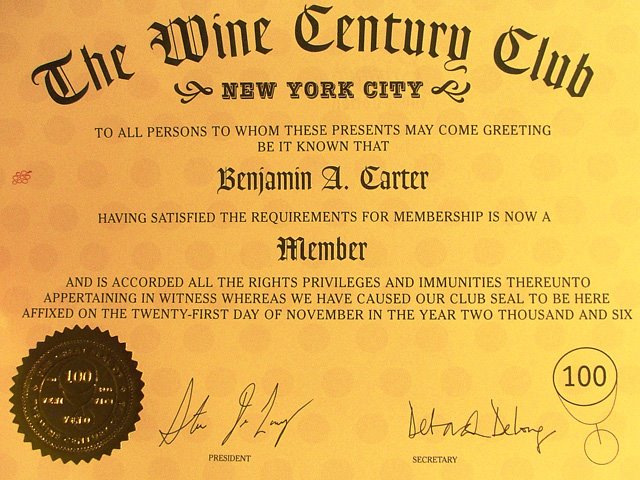
Back in May, I applied for the Wine Century Club, an organization honoring those who have tried at least 100 different grapes. I filled out the application, provided dates and the offer to provide producer, region, and vintage notes on each grape tasted as well.

Once again, in my defense, several of the odder grapes were tasted as parts of European blends. However, I also tried a few single-varietal wines that were not included on the application form, but I added them and I received credit for those. (I've also tried several more grapes in the interim, and as always welcome any challenge to my tasting of any of these grapes. A friend of mine has a case full of wines from Bulgaria waiting for a tasting, and I can assure you those grapes won't show up on any mainstream list of wines.) And honestly, you could probably spend a month in Italy and taste more than 200 grapes easily.

Since then, I'd completely forgotten about the club. Until today.

Let me set the stage, since so many wine anecdotes involve beautiful women, luscious sunsets, and idyllic landscapes. I prefer to bring a little realism into the wineblogging world.

It was five in the afternoon. I was home from work early, and was dressed in my typical après work garb of khaki shorts and a t-shirt, no shoes. I was in the backyard tending the tomato vines, and my t-shirt was speckled with yellow pollen and the bright green blood of tomato hornworms. To make things more wonderful, it had started raining. I struggled to pick any of the nearly-ripe fruit to avoid any cracking (a big influx of water can cause tomatoes to split). Then I heard the bad brakes and slipping transmission of my local postal carrier, and trod out front to receive the mail. Along with the usual junk mail, bills, and other detritus, there was a large envelope, handlettered, all the way from London!

Once inside, I opened the letter to reveal my certificate admitting me into the Wine Century Club. Even though I'm a member of the New York chapter, the application was processed in London, printed there, and mailed from there. So now I've got to find an A4 frame here in the middle of the United States...

30 August 2006

2004 Piccini Chianti

Based on a warm review from the local wine merchant, I purchased a bottle of the 2004 Piccini Chianti, a steal at $9. It's full DOCG and is made from Sangiovese and Canaiolo. I drank it with some spinach tortellini covered in a freshly prepared alfredo sauce. I added a handful of diced fresh tomatoes and a healthy dose of basil to punch up the flavor. Top it all of with some grated grana padano, and man that was tasty.

The wine has classic Chianti aromas and flavors, but fortunately it escapes the pitfalls of other bargain Italian reds. I'd highly recommend this for any casual Italian dining.

A note on tortellini... I ate handmade tortellini in Italy frequently. The sign of a good trattoria in Tuscany was often an elderly woman in the back corner tenderly tucking little rounds of pasta and filling into delicate shapes. I was spoiled, and didn't eat it much upon my return, finding disappointment at every turn. I've never attempted to make it by hand over here, but I've tried various frozen and fresh varieties without much luck, but finally found an imported Italian version from Gia Russa. (You won't see it on the site, but here's the product.) It's dried but not bone dry; the pasta is slightly flexible. Yet it doesn't have to be refrigerated. Boil for eight minutes, drain, and serve with the sauce of your choice. I'm keeping the leftover pasta and sauce separate, in case I decide to make a nice Bolognese sauce tomorrow.

29 August 2006

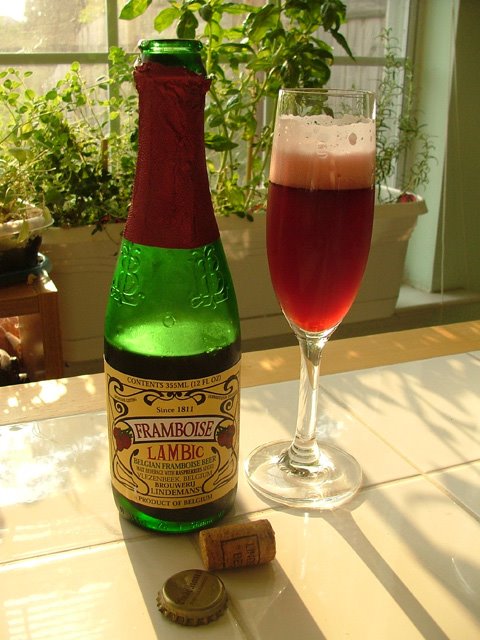
Lindemans Framboise Lambic

Confession time: this is the first time I've ever had a fruit lambic. I had been a little leery of these over the years, assuming that they would be overly sweet. But a trusted friend demanded I try one, so I picked up a bottle on the way home tonight.

For my first lambic, I chose the Lindemans Framboise Lambic. Obviously this would be a great dessert beer, going well with things like cheesecake or chocolate, but I just had it alone after dinner. Tremendous flavor. The purest, most delicious concentration of raspberry flavors you can imagine, but not any sweeter than real raspberries. Instead you get firm tartness and some earthiness from the hops underneath.

As you can see, it pours beautifully. And in fact, if you didn't know it was a beer, you could probably sneak it in behind something like an Italian brachetto d'acqui or spumante rosso without arousing too much suspicion. Though it's a little pricy for a beer ($6 for this 355mL bottle), it's still cheap compared to a bottle of wine. The store I went to also featured a peach version; I can't wait to try that out.

One last note: this came with a cork and a bottle cap, as you can see in the photo. I've seen some beers that use a champagne-style enclosure with a mushroom cork and a wire cage, as well as some that use a clasp and a rubber or plastic stopper. The cork shown above was smaller than a regular wine cork, and was composed of lots of small bits of cork like a champagne cork, but without the natural disk at the bottom.

27 August 2006

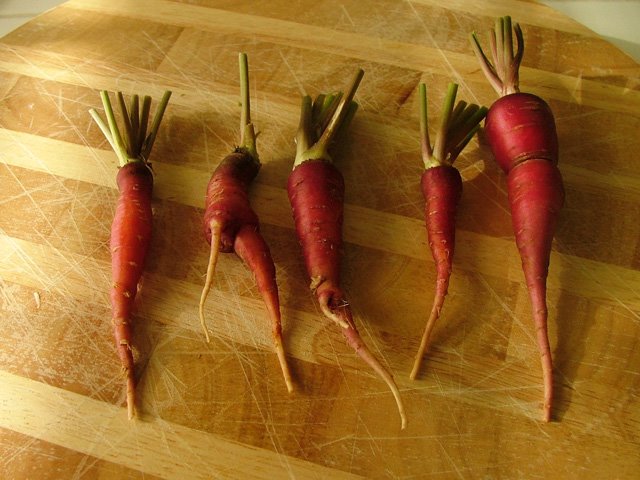
Benito's Carrot Harvest

Follow the link below and you can read the story of my attempt to grow odd colored carrots (yes, they're supposed to be purple). Fortunately I didn't put too much effort into this project, so the pitiful results don't bother me too much. I've still got tons of delicious tomatoes coming in!

Benito's Carrot Harvest

25 August 2006

Combinations #5: Roundup

Here's the roundup for my first hosting of the Combinations challenge. It's always fun coming up with a recipe for a dinner party, but it's a whole different ballgame coming up with something for a lot of people you've never met to cook. I hope that all of you who participated were able to find ingredients or substitutes easily, and that you enjoyed preparing and eating the meal. I'm delighted to see the range of wines selected for this recipe.

Without further ado, here's the combinations chosen for Grilled Mint Julep Lamb Chops and Slow Cooked Green Beans:

A little lower on this page you can see my entry, using the 2003 Rock Rabbit Syrah. I made this dinner the same day I posted the challenge--just wanted to make sure everything was as good as it sounded in my head.

The first outside entry came in from Mickey at Kitchen Inferno, who opened a bottle of Domaine Drouhin Pinot Noir from Oregon. I recently had a bottle from the Burgundy side of that family, and will have to give this a try.

Next up came a truly southern post via Australian blogger Edward at Wino Sapien. Edward selected the 1994 Black Label Coonawarra Cabernet. The lamb I used in my dish came from Australia, so it all comes full circle.

The final contribution came by way of the Contributions founder, Andrew of Spittoon. He and I were thinking alike, and he used a Syrah/Shiraz, in this case the 2005 Ravenswood Lane Off The Leash Red Max from Australia. Sorry it didn't work out as well for you! On a side note, I've been in several bars (and a few homes) where a spittoon was in use, though not for wine... In the South and West, a spittoon or cuspidor is used for spitting while chewing tobacco, one vice of which I've never partaken. Woe unto he who accidentally knocks over the spittoon on his way out of the bar.

Thanks to all of the participants, and I hope we meet again in a future Combinations challenge.

23 August 2006

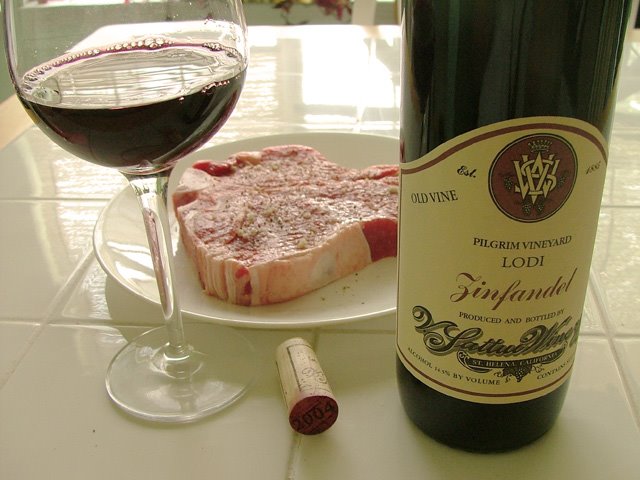
2004 V. Sattui Pilgrim Vineyard Lodi Zinfandel

Here's my second report on a Sattui wine, another gift from Dad. Today, for reasons that I won't get into, was a bad day. Had to call in sick to work, lots of automotive repair in the driveway, mowed the yard, repaired the weedeater, and attended to other gloriously fun duties. After all was said and done, I felt like rewarding myself. There was a steak in the fridge, plenty of ripe tomatoes, and a bottle of 2004 V. Sattui Pilgrim Vineyard Lodi Zinfandel. It's also an Old Vine wine. I don't have any real opinions on young versus old vines, though I'm providing the information anyway. Pictured at right you can see the wine and the steak, in this case a decent-sized T-bone. Not my favorite cut of beef, but nothing to sneer at. And yes, I did cook the steak. I enjoy beef rare, but not that rare.

I usually salt and pepper my steaks before grilling, but I decided to upgrade the procedure a bit. I replaced my old black peppercorns with a much more aromatic blend of white and black peppercorns, and for salt, I used coarse French grey salt. The latter is mostly due to the influence of Michael Chiarello. I didn't use his branded grey salt, but got some from a local spice shop. God, that stuff is delicious. I can eat it straight, and it's wonderful with my tomatoes.

The wine is wonderful. It's definitely a Zin, but even at 14.5% alcohol, it doesn't have a hot aroma or flavor. On the nose I get some leather and a hint of coffee, as well as the rich dark cherry you'd expect. Particularly when paired with hearty fare, this is a remarkably light Zinfandel for its age. Flavors are bold and fruit-forward, but not jammy or succumbing to the California Zin stereotypes. On its own there is a bit of tannic bite on the finish. It's time like this when I wonder why I don't drink more well-made Zinfandel.