22 January 2010

5th Anniversary

It's hard to believe that as of today, I've been at this little project for five full years with nearly 750 posts. I stopped counting the number of bottles and grapes a while ago, but it's been a fun ride thus far. 2009 was the first year I felt more like a wine writer than just a random guy with a website. I got loads of samples from wineries, got to travel, spent a lot of time talking to winemakers and other industry professionals, and discovered that many people are interested in my scribblings here.

Tempus fugit, as the poet says. Actually he says Sed fugit interea fugit irreparabile tempus, singula dum capti circumvectamur amore... but let's leave the Latin for another day. It's time to celebrate.

What were some of my highlights of 2009? The series of posts on my trip to Sonoma in search of green winemaking, the joke cocktails on April 1, my first Mexican wine, the Ridge vertical with Fredric, redesigning the blog, an unforgettable meal at Grace Restaurant with Grace, the demon chicken, haggis tamales, Benito vs. the MRE, and of course, the controversial fried bull testicles,

Like I did last anniversary, I'm taking this opportunity to highlight some wine blogs I've discovered in the past year, and bloggers that I've gotten to know somewhat through e-mail. For a twist, these are all from the South. I love the fact that "flyover country" is developing a healthy wine culture. It's interesting to read the perspective of someone not in NYC or in California, where said culture has been more mainstream for a longer period of time and there's a more established tradition of wine writing.

In no particular order...

Suburban Wino, Atlanta, Georgia
Joe writes with a sense of humor and frequent pop culture references as well as a genuine love of wine. You're not going to get a shout-out to the B-movie Tremors from Robert Parker, but I think The Wine Advocate might benefit from the films of Fred Ward.

Wine Tonite, Atlanta, Georgia
This is a group blog that in addition to reviews provides interviews and commentary on trends within the industry as well as a wide range of wine-related topics. Ed and the other talented writers also make regular use of video clips to spice up a post.

Decatur Wine & Food Dude, Decatur, Georgia
Decatur is just outside of Atlanta. I'm going to blame Hardy Wallace for this Peach State explosion. The Dude covers some spectacular wines, as well as great recipes and restaurant reviews.

Wine and Walnuts, Wilmington, North Carolina
Kimberly blurs the line between food and wine blogging, a style that I love to read because I've always maintained that wine is food and doesn't need to be cordoned off.

Louisville Juice, Louisville, Kentucky
To be a wine lover in Bourbon country is a noble pursuit. Tom's one of the few winebloggers I know of that's made the transition from a prior blog in an unrelated subject, in this case a political blog.

Vine Geek, Austin, Texas
I've been chastised here a few times for sci-fi references and other trappings of the nerd life. Jim takes it a step further by invoking video games and even Dungeons & Dragons. Needless to say, this blog caught my attention like Paul-Muad'Dib grabbing Shai-Hulud with a maker hook.

Finally, a trio of food blogs from my hometown of Memphis, Tennessee:

The Chubby Vegetarian
I've mentioned this site here several times, but I don't think I've highlighted it. Over the past year, I've gotten lots of e-mails from readers who say, "I love your site--I bookmarked it and The Chubby Vegetarian!" They never say that about any other blog, testament to Justin's beautiful photography and recipes that can even make a carnivore salivate.

Hungry Memphis
This is a group blog run by The Memphis Flyer, our city's alt-weekly. Susan Ellis and others provide news, reviews, recipes, and commentary about the food scene here. I'm pretty sure it's also the only place online where you can passionately argue for or against the Midtown Schnuck's location and its idiosyncrasies.

Vegan Crunk
I was surprised to find such a vibrant group of vegetarian/vegan foodbloggers in Memphis, a town known for putting pork in everything. Bianca Phillips also writes for The Memphis Flyer, but this is an independent project with a lot of creative cooking. What other foodblogger has a photo of herself with the Dalai Lama in which he's giggling about her lip piercing?

Check out these great blogs, and on each of them you'll discover a dozen or more links to other sites I haven't explored or mentioned yet. Like what you read? Drop a comment or an e-mail and let 'em know.

Cheers, and thanks for reading!


P.S. Interested in WITS? E-mail me and let me know. Nothing solid yet, it's an idea that I've been bouncing around for a while.

20 January 2010

Dinner Party with Jacob's Creek Wines

I received a set of five bottles from Jacob's Creek, produced by the large Orlando Wines based out of the Barossa Valley in South Australia. While grapes have been grown along the banks of Jacob's Creek for 150 years, the first wine under that name was a Shiraz/Cabernet/Malbec released in 1976. All of these wines are from the Reserve series, and represent almost the entire product line (only the Merlot was missing). I had five wines representing popular varietal grapes, and I could have just tasted them on my own in front of the computer. Or... I could have taken it as an opportunity for a dinner party. Paul graciously offered the use of his house, I invited various lovely young women, and began cooking late on a Saturday afternoon.

After the appetizers and a little non-related sparkling wine, it was time to pop open the 2008 Jacob's Creek Reserve Riesling ($14, 12% abv). I was surprised to discover a dry, very mineral white wine with a touch of petrol and wet rock aroma. I hadn't read the information sheets ahead of time (I always do that after tasting), and was pleasantly surprised. Very light and refreshing with a mild fruit profile of pineapple and melon.

Since it's still chilly out, I started out with a warm soup course. Tomato soup doesn't get a lot of respect. It's either the early bird special for old folks or is transformed into a "bisque" even though it contains no seafood. It's the easiest thing in the world to make as long as you use good whole canned tomatoes, sweet onions, chicken stock, and butter. I finished mine off with satuéed diced yellow squash (adds texture and flavor) and a splash of sherry.

Next up was the 2007 Jacob's Creek Reserve Pinot Noir ($14, 13% abv). Delicious aroma of overripe strawberries, light berry flavors and tannins with a medium body and a short finish. For a hotter region I was expecting a much rougher wine, but this was quite nice for the price. And good Pinot Noir always goes well with salmon, hence the accompanying dish.

This is a repeat from my Burns Night dinner, but I felt like making it for a new crowd. Toasted dark rye bread, a thin smear of Dijon mustard, smoked salmon, sour cream, and a chiffonade of basil (though fresh dill would be great here when it's available). It's an open-faced sandwich or Smørrebrød in the Danish style. It was well-received around the table and one diner in particular considered it her favorite course of the evening. Many wanted to make it for breakfast in the future, I want to explore more open-faced sandwiches in 2010.

During the bridge section of the evening, I elected for a salad with the 2007 Jacob's Creek Reserve Chardonnay ($14, 13.5% abv). Fascinating aroma, with bits of mint, apricot, pear, and floral elements. The flavor was light and dry with medium fruit and a lingering finish.

Just a simple mesclun salad with segments of tangerine, shaved aged Parmigiano-Reggiano, and a vinaigrette made with sherry vinegar. The cheese had reached that nice point where it was crumbly and had little crunchy specks of calcium crystals. Oh so delicious. I went for a fairly tart dressing, but the sweetness of the citrus fruit and low acidity of the wine balanced everything out.

Lots of my first time guests are surprised at the appearance of a salad in the middle of everything, but in the Italian style I think it helps clear the palate, aids digestion, and avoids a tendency for dishes to just get increasingly heavier over the progression of the evening.

Finally time for the stronger reds, which provided interesting contrast against each other. The 2006 Jacob's Creek Reserve Shiraz ($14, 14% abv) is a classic example of an Australian Shiraz without going overboard. Plum, black pepper, spicy aromas and flavors with a short finish. Mild cherry flavors appeared on the aftertaste, and about half the table preferred this wine.

The other half voted for the 2005 Jacob's Creek Reserve Cabernet Sauvignon ($14, 14.5% abv). Strong in the Bordeaux style, this wine is. Enchanting vegetal aroma of green bell pepper, tomato leaves, tobacco, and leather. Flavors tended towards the herbal with notes of black cherries. It was definitely my favorite of the evening, and is a tremendous bargain. Like the Shiraz, this was matured in French and American oak and the past five years have been extremely kind to it.

For the main course accompanying the big reds I took a four pound boneless pork loin and carefully sliced it to create a sheet of pork about half an inch thick. I laid down a stuffing of chopped dried apricots, walnuts, fresh sage, and roasted garlic. I rolled it up, tied it, and roasted it for about an hour. In the future I'll soften the dried fruit with white wine and add some salt pork or bacon, and reduce the cooking time a bit. The final product was a great balance of sweet and savory but a little on the dry side. The roulade or braciole technique is something I need to work on. I want to get that perfect spiral with an even filling. I also made a risotto with arborio rice, wild rice, cremini mushrooms, and chicken stock.

For dessert, Laura M. prepared a delicious homemade pound cake with a strawberry-Cointreau sauce. I was in heaven, and forgot to snap a picture.

It was yet another successful dinner party, catching up with friends I hadn't seen in a while, getting an opportunity to share bottles of wine with a group that had a wide range of wine experience, and mostly just the chance to have fun on a rainy weekend night.


The Jacob's Creek wines were provided as samples.

18 January 2010

2004 Can Feixes Penedès Blanc Selecció

After the holidays, I think it's a good idea to dig through the cellar, closet, or pantry and clear out any young, inexpensive wines that might have been forgotten. At some point things are liable to get lost in the shuffle, and not every wine benefits from years of aging. Case in point:

The 2004 Can Feixes Penedès Blanc Selecció from northeast Spain near Barcelona on an estate founded in 1768. $14, 11.5% abv. Made from 40% Parellada, 30% Macabeo, 20% Chardonnay and 10% Malvasía de Sitges.

There's an asparagus-like nose combined with an earthy, grassy quality. I'm not going to say that this aroma will be appealing to everyone, but it's decidedly Old World in its approach. After an initial crisp, acidic flavor, other fruit like honeydew melon and white peach begin to appear.

This one was a little unbalanced, and I think might have been better a couple of years ago. The current release is the 2008, and comes much more highly recommended from friends that have had it.

Served with something Jason's Deli calls a Chicago Club: smoked turkey breast, bacon, smoked red pepper-cilantro aioli spread, organic spinach, roma tomatoes and provolone on herb foccacia, all things that scream "Chi-Town" to me. Teasing aside, it's actually a tasty little sandwich and goes well with a white wine.

15 January 2010

Ask Benito!

One of the more interesting parts of this whole blogging thing is getting questions from readers. Let's open up the old mailbag and answer a few of them today.

Q: I think I live in your part of town. Can you text me every time you try wine so I can come over and try it with you, and have dinner? I'll be bringing a couple of friends and will need you to watch my kids while I'm tasting the wine.
Dee Ridlett, Memphis, TN

A: Well Dee, while I love to hear from fans and enjoy meeting them from time to time, I prefer a certain level of privacy and handle these things on my own terms. My house is also small, contains two large dogs, a female roommate who is armed and trained in the martial arts, and in general it's not the ideal setting for entertaining guests who aren't already dear friends. There's lots of great public wine tastings around town, though! Check the paper on Wednesday for listings.

Q: Back in April 2005, you wrote about the 2002 Fusée Cabernet Sauvignon, which sold for $4. Here in Nevada the price went up to $5 per bottle and then they stopped carrying it. I need you to send me a case every three months at the original price. I don't know why you insist on jacking up the prices, I'm retired and can't afford the expensive wines you make.
David Morgenhorst, Reno, NV

A: Great to hear from you David, and I'm sorry you can't find the wine you like. But for the record, I do not produce or sell wine, nor am I affiliated with any company that does so. I just taste and write. I don't have control over distribution, pricing, or any other factor that might prevent you from drinking the wine of your choice. Even here in town, sometimes I don't know if something is widely available or just a one-time fluke, so your best bet is always to check with your local retailer. And if they don't have any way to get the wine to you, it's possible that production has stopped or it's just not distributed to your state. But don't get angry at your local retailer: explain what you liked about the wine and ask for a good substitute. Chances are they've got something you'll enjoy just as much, if not more.

Q: I need a wine recommendation. I'm making roast duck for dinner tonight, but it's an old family recipe that's boiled, not roasted, and it doesn't have duck in it. I also need a pairing for sushi but I don't eat raw fish, rice, or seaweed.
Claire Devereaux, Fresno, California

A: This is a bit confusing. If it were real roast duck I'd suggest an Oregon Pinot Noir, but you'd have to give me more details as to what manner of critter is getting boiled, or what kind of... sushi you're consuming. I'm happy to pass along suggestions as long as I have a general idea as to the food, but I don't know what your father would like for his birthday, or what would impress your boss, because I don't know them. If I do suggest something I'm only going to go as far as grape and region. If I mention the perfect wine by name, you're going to run around 20 different stores only to find that nobody has it. Again, ask for help from your local wine shop, and be polite. Those folks work hard, and if you show them an ounce of kindness they'll respond with a pound of assistance, and over time will remember what you like and don't like. Eventually they'll start keeping stuff for you behind the counter or inviting you to special tastings.

I know a lot of this sounds like, "Why read reviews at all if I can't find the wine?" Practically everybody who loves wine has to read a hundred reviews with the hope of trying just one of them. And then there's those lovely small production wines--100 cases means 1200 bottles, so maybe 3600 people will get to try the wine while tens of thousands may have read about it. But it's always good to keep reading, and that information will accumulate and interrconnect in your brain. If you read a lot of favorable reviews of specific Washington white wines, it can encourage you to check out that category, or even visit the region. At some point you'll recognize a label or name and will instantly remember a review that you just glanced at six months ago. More knowledge is a good thing!


Got a question for me? Drop it at benjamin.a.carter@gmail.com with "Ask Benito" in the subject line. If I don't answer it on the blog I'll get back to you personally.

13 January 2010

St. Kilda Wines of Australia

For the new year, here's a new pair of wines with a new name from St. Kilda, made by the De Bortoli family who came to Australia from Alpine Italy back in the 1920s.

The name of the wine comes first from St. Kilda, a beachside suburb of Melbourne in Victoria, though both wines are sourced from vineyards in the Riverina region of New South Wales. St. Kilda the town takes its name from a lonely, remote archipelago in the Outer Hebrides of Scotland and doesn't refer to an actual saint. In fact, the name might just be the result of some poor translations. Ah, the joys of etymology.

2008 St. Kilda Shiraz
$14, 14% abv
Spice and black cherry, light body, smooth, short finish. Touch of green pepper, espresso. Serve with grilled lamb or pork and a savory sauce. While smoother than your stereotypical Aussie Shiraz, you're still going to want a flavorful main course to go along wiht this wine.

2008 St. Kilda Chardonnay
$14, 12% abv
Peach, apricot, minerals, full-bodied with lots of fruit, big brassy acidity. For a pairing, bring on the poultry that's been roasted with citrus of some sort: a chicken stuffed with oranges or duck stuffed with lemons, something like that. Even a game bird like quail roasted with slices of lemon would be incredible.

I like the Victorian/Baroque scrollwork on the label. An elegant, old style design element within modern borders, and topped by a convenient screwcap. I think it works a bit better with the red than the orange (more contrast makes it stand out better), but I'm quite happy with both from a graphics standpoint.

This wine was received as a sample from The Country Vintner.

11 January 2010

2008 Mulderbosch Chenin Blanc

One of my first wines tasted in 2010 comes from South Africa, a wine producing country that is getting more prominent and interesting with every passing year. I'm still amazed that these wines are so easily available now; in the 80s, South African products including wine were embargoed in the United States and many other western countries, so sampling one would have required a visit to the country or smuggling, as is the case with Cuban cigars. Now, I can even go to the grocery store and buy oranges with stickers that say "South Africa".

The 2008 Mulderbosch Chenin Blanc is from the Stellenbosch region. $15, 13.5% abv. 100% Chenin Blanc, called Steen down in the RSA. In fact the text below "Chenin Blanc" in Afrikaans says Steen op Hout (Chenin Blanc on wood), though only 30% of the wine spent six months on a combination of French, Hungarian, and American oak. It's enclosed with a DIAM composite cork. I figure if you're going to use natural cork, you might as well do everything you can to avoid cork taint, and DIAM corks seem like a nice compromise.

Nose of jasmine, lemongrass, and just a touch of minerals. Big round mouthfeel of lemon curd, full fruit, crisp and clean, with a short, tart finish. I've had a few vintages of this wine over the years, and while it's been consistent in quality the price has actually come down a bit--checking around online some states carry it as low as $10, but my notes have it as $20 back in 2005. I'm happy with the middle ground.

While it was too cold for a lekker braai, I opted for stewed pork and a potato bake. Damn tasty, bru. Scalloped potatoes were a mainstay of my childhood table but layers of caramelized onions really make it pop.

Note on the label: few wineries do the vertical label, fewer do it well. Mulderbosch pulls off several interesting techniques with their design. The label is thin and vertical, but extends up the neck and under the foil cap. The stock is textured with a pattern I can't easily show here. The printing itself is etched and reminiscent of currency or stock certificates, and if the bottom seal were actually red wax it would be perfect. But it's close enough, and Mulderbosch achieves that rare feat of being recognizable from across a room full of wine bottles.

08 January 2010

2005 Red Diamond Chardonnay

One of my recent "grab a bottle at random" picks was the 2005 Red Diamond Chardonnay from Washington state, $10, 13.5% abv.

Nose of toasted marshmallows, buttered popcorn, just a hint of apricot in the background. Big, buttery mouthfeel with very low acidity, dry and fruity but with an ashy balancing element. Served with an omelet and hash browns after Christmas, sort of a comfort meal around the holiday, where the wine ended up carrying the buttered toast and fruit of a "breakfast for dinner" meal.

I briefly mentioned this wine on Facebook after trying it, and it was funny to read the responses. Some thought it sounded terrible, some thought it sounded delicious. Others just found it interesting. I'll admit that this style surprised me from Washington, and while it's not my favorite Chardonnay profile I do smile when I encounter such a wine. It stands out from the crowd of "Another Boring Chardonnay".

I bring this up not to criticize any of the responses, but rather to illustrate my method of reviewing wines. It should be obvious by now that I don't use scores, stars, or anything like that. Occasionally I'll praise a wine's quality-price ratio, or I'll say something is highly recommended, but mostly I just say, "here's what it smells and tastes like, and here's how it worked with food". In this case I described the wine honestly; if you like toasty/buttery/caramel Chardonnays, then this was a positive review. If you prefer a lighter, more restrained style, then this was a negative review. Take from that what you will.

06 January 2010

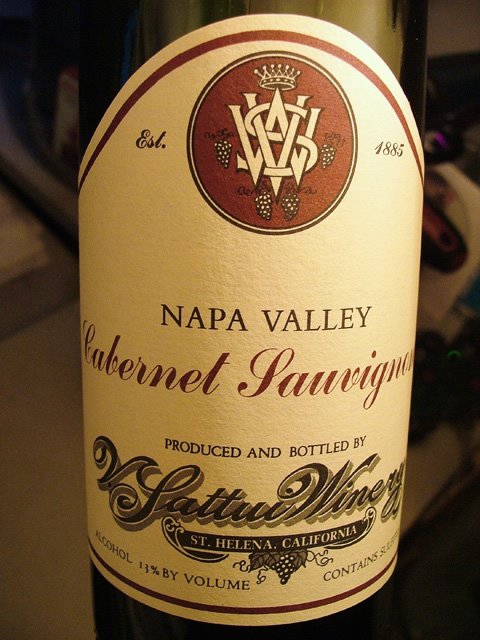
V. Sattui Wines

There are firsts you remember and firsts that you don't. No need to get too personal here, but when it comes to the various beverages I write about, I honestly don't remember specific details about the first beer/wine/spirit I tried. Part of that has to do with the fact that those events are closing in on 20 years ago, and part of it is that I never envisioned a future in which I'd be I'd be writing about these topics for an international audience.

I definitely remember becoming aware of V. Sattui in the early 90s, when I was in high school and eagerly cooking as often as possible. Luckily at the same time, Dad started getting mixed cases of Sattui wines as gifts each year. The household wine consumption at the time was low, but I was permitted to use the odd bottle for cooking purposes. I'd take a sip from the measuring cup occasionally--never enough to feel any effects, just enough to get the flavor and try to gauge what it would do with the food. At the age of thirteen I learned important lessons like "red wine turns risotto a really unappealing shade of purple-gray" and "White Zinfandel makes a weird coq au vin".

When I say sample cases, I'm talking about a really diverse assortment of wines. Chardonnay, Cabernet Sauvignon and Merlot, of course, but also Riesling, Zinfandel, Gewürztraminer, a rosé, and various blends. Of course at the time I was more interested in the sweeter wines, but it was an interesting early exposure to the concept that not all wines smell or taste the same. I know that sounds odd, but in speaking to a lot of people who are new to wine, this is a major hurdle to overcome in wine appreciation. Initially it all just tastes like "wine", maybe "red" or "white" but not much beyond that. In trying to help folks open up to the idea, I'll often try to connect with some hobby or passion of theirs. "All country music sounds the same, right? Every car has four wheels and some doors, what's the difference?"

Two decades later, Dad gave me a pair of Sattui bottles for my birthday.

2007 Sattui Family Red. Zinfandel, Cabernet Sauvignon, and Syrah. $16, 14% abv. I don't know what the specific percentages of the grapes are, but the aroma is primarily Zinfandel. Blackberry jam nose, loads of blackberry and raspberry flavors. Firm tannins, brambly finish. I ended up enjoying this one on New Year's eve with a ribeye, sweet potatoes, and green peas. Wonderful way to cap off 2009.

2007 Gamay Rouge. $18, 12% abv. This is an interesting wine, made from Gamay Rouge (Napa Gamay), which now appears to be Valdiguié. I remembered it as a dry rosé since it was much less sweet than the White Zinfandel, but now I recognize it as a medium sweet wine with 1.5% residual sugar. Loads of strawberry and cherry aromas, with a full-fruit flavor boosted by the sugar and a tart, cranberry acidity. Imagine a very young and brash Pinot Noir but sweeter.

Why the confusion on the grape name? From what I can piece together, Valdiguié was imported from its native Languedoc-Roussillon and labeled as the true Gamay of Beaujolais. California producers started calling it Napa Gamay or Gamay Rouge, and after DNA testing in the 90s, the true heritage was sorted out. Traditions die hard, though, and while you can no longer use the name "Napa Gamay" other variants slip through. It's a story that plays out again and again in the wine world.

I had this with a club sandwich and potato salad, and it seems perfect for a picnic. I think it would be great for gatherings like Thanksgiving, because it's sweet enough to appeal to the novices but serious enough to be enjoyed by the more experienced wine drinkers. I think the last time I had this was the summer I was 19. Brings back quite a few memories.

04 January 2010

Book Review: The Beats: A Graphic History

As a teenager and young adult, I really didn't care about the Beat poets. It's not that I didn't know about them or hadn't read them--on the contrary, an English teacher introduced me to some pretty rough Ginsberg works early on, and I plowed my way through Kerouac without much feeling. I spent summers studying poetry and short stories in workshops all through high school, reading modern works, creating original pieces, and critiquing the output of fellow students. I got exposed to some writers like Galway Kinnell that had a profound impact on me. It was an amazing experience, but I look back and think that letting teenagers write poetry is like letting a two-year-old play with a chainsaw: whatever happens is going to be ugly.

In my early adulthood I tacked backwards and compulsively read through The Oxford Book of English Verse (1919 Quiller-Couch edition, of course), certain that being able to pull up the odd snippet of Dryden, Herrick, or Wordsworth would impress the ladies. This was a losing strategy, while I mostly hid my knowledge of food and wine, later discovered to be far more successful. Ah, the folly of youth.

I never really appreciated the Beats until my mid-20s. It had to do with hearing Burroughs' excerpts read with ambient music on late night radio. There was a certain crazy charm to it, and somehow it made a lot more sense than it ever could to a teenage mind. I went back and read through some of those Beat works, and to this day I think the opening lines of Howl are some of the most powerful in the English language:

"I saw the best minds of my generation destroyed by
madness, starving hysterical naked,
dragging themselves through the negro streets at dawn
looking for an angry fix,
angelheaded hipsters burning for the ancient heavenly
connection to the starry dynamo in the machinery of night,"

You can't fully grok that until you've had a few cups of coffee after midnight and have read the whole thing, aloud. Maybe shouting at a blank wall, a confused dog, or simply walking outside and declaiming to a sky "the color of television, tuned to a dead channel" (with apologies to Gibson, who was influenced by the Beats). It reinforced what that early, wonderfully corrupting English teacher taught me: poetry, like a play or song lyrics, has to be heard to be fully understood. Merely reading through the lines will only take you halfway.

Years later, my appreciation of the graphic novels of Harvey Pekar collided with this topic in The Beats: A Graphic History, edited by Paul Buhle with contributions by Pekar and his wife Joyce Brabner, along with a dozen other writers and artists. I give the book credit for covering lesser-known poets, as well as the impact of female Beats amidst a hostile environment even within their own subculture. The first half is devoted to the major players mentioned already: Ginsberg, Kerouac, Burroughs. But you'll learn a lot of new names along the way, accompanied by the work of multiple cartoonists, each with his own style and feel for the subject matter.

There's very little of the actual Beat poetry or prose present here, just the occasional quote. But it serves as a good reading list if you're interested in studying the subject further. More importantly, the writers and artists involved care deeply about the topic, and that passion comes through in this short but important book.

01 January 2010

It's the End of the Year as We Know It, and I Feel Fine

Happy New Year, y'all.

The holidays provide a certain conundrum in wineblogging. Going by stats, comments, and e-mails, I've noticed a few trends.

Readership jumps up during the months of November and December as novices and folks who are not regular readers hit the internet looking for advice on what to purchase for Thanksgiving, Christmas, New Year's Eve, and the various parties in between, as well as for gift-giving.

Looking for a really last minute sparkling wine review? Try one of the 28 posts I've written on the subject over the past few years.

I think more of the wine fans read less during this same time period. Maybe they work in retail wine sales and at the end of the day all they want is to crack open a beer and not think about the Wine Spectator Top 100 List for a while. Maybe they've spent the two months fielding questions from friends, family, and co-workers and also need a break. Or maybe it's just the best time of year to simply sit back and enjoy a wine, setting aside the notebook and pen to make eye contact with a loved one across the table.

Likewise, this post is going up on New Year's Eve, but will mostly be read--if at all--on January 1, as a traditional day of sober rest and recuperation. Not the best time to write about a gin and Champagne cocktail or a crazy recipe incorporating pig ears and mushrooms.

Does this sound like burnout, or that I simply have nothing to post? Hardly! There's a dozen posts in the draft stage waiting for the light of day, some unknown quantity of bottles rattling around downstairs begging for review, and a few other surprises waiting for the proper moment. I'm also getting ready for my fifth anniversary here at BWR in a few weeks, and it's a great opportunity to look back and reflect. But anything meaningful is going to get lost in the shuffle, and I want the wines, recipes, and books to get the attention they deserve when everyone has recovered and feels like reading again.

I wish you all a safe and happy holiday, a good rest this weekend, and an exciting and productive 2010.

Cheers!

30 December 2009

Medianoche

If you're lucky this holiday season, you'll have lots of delicious leftovers. If you're creative, you can throw together a medianoche or Cuban Sandwich. And it's appropriate for New Year's Eve, because medianoche means "midnight", and a salty savory sandwich like this would go very well with a young bubbly wine full of crisp acidity.

Take a soft, long loaf of bread and slice it open lengthwise. If it's really tall, you might want to slice an inch out of the center. On the bottom slice of the loaf, lay down some mustard. The traditional option is just yellow mustard, but I prefer Dijon, and I also add a bit of mayo, which I know is anathema to some purists. Whatever your spread, layer on sliced Kosher dill pickles. Again, opinions vary: delis and restaurants tend to skimp here, but I say double up on the pickles. So much of the flavor comes from pork that you need something tart and acidic to balance it out. Then layer the sliced pork loin (or shredded pork shoulder, or whatever roasted pig you have on hand), the ham, the Swiss cheese, and finally the top half of the loaf.

Many guides will tell you to butter the inside of the bread, and I will admit that this is tasty. But I prefer to spread the butter on the outside, as it aids in crisping. With a manageable 12" loaf, I'll do it in a skillet and press it down with a casserole dish, but with anything longer you'll want to do this in the oven, on a cookie sheet, with another sheet on top of the sandwich and a set of weights on top of that to press it all together (clean bricks are ideal). Flip it occasionally to make sure both the top and bottom get equal heating.

Personally I prefer the shorter sandwich in the skillet or on the griddle; like I said, take anything solid and sanitary and press down as hard as you can on top of the sandwich while it's grilling. Not only will it smash the flavors together but the bread will become this buttery, crusty, compressed wonder. (If you're using a fancy panini press, just heat up the meats beforehand, otherwise you'll have a hot exterior and a cold interior.)

Traditionally this would be served with French fries or perhaps rice and black beans. Both are delicious, but in the interest of balance and digestion, I'd heavily recommend a salad with a light vinaigrette or some fresh fruit. As wholly delicious as this sandwich is, keep in mind that it's a concentrated mass of meat, salt, fat, and starch. The pickles and mustard are key to balancing it out, but they're not quite enough. Make a salad, grab some celery sticks, or even go with cole slaw. It's all about harmony, folks.

28 December 2009

Assorted Leftover Bottles

Here's a few bottles that got tasted and reviewed, but not posted in 2009. They sat around in the bullpen for a while, and I decided I might as well let them out for the 9th inning.

* * *

This wine comes from the time when Bonny Doon's Ca' del Solo line was still whimsical and lighthearted. With a move to biodynamics and a trimming of the wild mix of grapes and products, Ca' del Solo wines now bear very unusual labels. This older label reminds me of the children's book Madeline, though this little girl is obviously not an orphan.

There's not a lot of information out there about this wine--a few reviews of various vintages going back to the 90s, but Bonny Doon is a company that has grown, shrunk, exploded with products, focused on a handful of wines, reinvented itself, and has built up certain mythologies about its products. Like how people mistake the Ca' del Solo line for Italian wines, or think the Big House wines (no longer part of Bonny Doon) were actually made by prisoners. Press releases and company info on old products seem to disappear completely, like the Fraise strawberry liqueur I tried in 1997, leaving us with second- and third-hand accounts and reviews.

Our mystery white is the 2005 Ca' del Solo Malvasia Bianca from the Central Coast of California. $12, 13% abv. Lots of lime on the nose, like lemon curd but with more of a lime tang--think Key Lime Pie. Plenty of fruit flavor here, and a quick finish. Tropical fruits like papaya and pineapple. I had it with a little cold pasta salad, and it definitely needs something salty like olives to balance out the touch of sweetness. I would have liked to have tried this in its youth; I have nothing to directly compare it with, but I think there might have been some more sparkle a few years ago.

* * *

Different European countries have different rules and regulations when it comes to what kind of grapes can be grown in various regions. France is pretty strict; I often think that Italy and Spain are more accommodating because they have thousands of indigenous grapes that might only be a few hundred distinct vines with ten names each. (It's possible for a wine grape to have over 150 different names.) In Italy the IGT system has permitted well-crafted wines to be produced using plots planted with both indigenous Italian vines and imported French vines. Cabernet Sauvignon and Merlot are popular blending grapes, even as far south as Sicily.

One relatively mainstream example is the 2005 Bonizio Cecchi from Maremma, Italy (the western corner of Tuscany). $10, 12.5% abv, 90% Sangiovese, 10% "other" red grapes. This little Tuscan IGT has a little blackberry and clove on the nose, with mild tannins and cherry flavors. It performs well for the price and was a decent accompaniment to a pepperoni pizza.

* * *

This is a very inexpensive Pinot Noir, decent enough for the price. After Sideways a lot of people rushed out and bought the cheapest Pinot on the shelf. Many of those folks were sorely disappointed, but it doesn't mean that bargain Pinot doesn't exist. It's just hard to find. I've often considered taping a note to my wallet that says, "Don't buy a Pinot Noir under $20. They've never made you happy."

But for the same reason that I've always dated [REDACTED], I decided to try another bargain California Pinot that showed up at the local shop. This is the 2006 Jargon Pinot Noir that retails for a paltry $7, 13.5% abv. Surprisingly, it is pretty soft and smooth, with decent black cherry notes, but lacking real complexity. Just a touch of acidity, tannins are pretty much nonexistent. It's the kind of wine I'd suggest for a diner if my local diners actually served wine.

* * *

A lot of folks like to beat up on Red Truck, and while it pales in comparison to fine Burgundy or Bordeaux I've always thought it was a fun table wine. Better in previous years, I think, but it's a great "gateway wine" for men. If a guy has never tasted wine before, flowery labels and French language aren't going to convince him. But if there's half a hog on the smoker, and you pull out a slightly chilled wine that has an old pickup truck on the label... You might have just made a convert. In five years he'll be criticizing your Barolo vintages and explaining why he prefers Spiegelau glasses over Riedel.

The 2006 Red Truck is $12, 13.5% abv, and shows notes of plum, brambles, with notes that are vegetal. Just a touch of herbs. Big tannins and acidity but they subside with an hour of breathing. The grapes are a proprietary blend of Syrah, Petite Syrah, Cabernet Franc, Grenache, and Mourvèdre. While this may sound like a confused mess, it's probably close to the spirit of pre-Prohibition California "red wine" that used to flow out across the country years and years ago. Fortunately, you'll get a chance to enjoy it in bottle or cask form instead of having it shipped in tankers via train.

* * *

I'm an unabashed fan of the metric system and curse the archaic, illogical standard system we use here. However, for historical and literary purposes I do find obscure forms of measurement fascinating. Fathoms, leagues, hogsheads... Italian miles versus German miles versus Arabic miles... Gold gets measured in troy ounces, and horses get measured in "hands" from the ground to the withers, units now standardized at 4 inches. 14-16 hands is pretty average for a horse. (Similar human body-derived units are feet, paces, cubits, and the Selleck, used to measure mustache thickness.)

Another random wine selection based on the name is the 2007 14 Hands Merlot, $12, 13.5% abv. It's comprised of 85% Merlot, 14% Syrah, and 1% "other", sourced from a variety of locations in Washington state. Pacific Northwest wines are growing in popularity and availability, and it's always interesting to talk to people that just got back from a trip to Washington or Oregon wine country. They talk about it in this dreamy way like they've been to France.

Jammy, with an initial cherry and blueberry nose that can be overwhelming. After some breathing, it mellows out and you're able to get notes of chocolate, tobacco, and tomato vines. Definitely fruity, with medium tannins and a long chocolate-covered-cherry finish.

25 December 2009

Merry Christmas

Here's hoping you all have a safe and happy Christmas, whether with friends, family, or in a strange land far from home.


Taken at Zoo Lights at the Memphis Zoo in 2005.

23 December 2009

NV Segura Viudas Brut Rosé

Continuing with the bubbly theme, but this time on the bargain side...

I selected this wine for a recent Commercial Appeal online tasting. I'm repeating some of my background notes here, because this is an interesting little wine that deserves some attention. And since you can find it for under $10, it's the kind of thing you can keep in the fridge and open whenever you're in the mood. It's also extremely food-friendly, so have fun trying it with practically anything.

The NV Segura Viudas Brut Rosé. $9, 12% abv. This wine comes from Penedès, part of Catalonia in the northeast corner of Spain, near the French border. 80% Trepat, 10% Monastrell, and 10% Garnacha. Monastrell and Garnacha are just different names for Mourvèdre and Grenache. Trepat is a grape that's only grown in this region and is mostly used for rosés.

About 2800 years ago the Phoenicians were buying wine in Catalonia and selling it to the Egyptians. Cava (meaning "cave") is a more recent invention, from the 1870s. Cavas are really popular in Spain, and have gained a lot of ground here in the US as well. Segura Viudas also makes a Reserva Heredad that's bottled with a metal badge and base. You've probably seen it in the store--it looks like a prop from "Lord of the Rings".

Segura Viudas has been making wine commercially since the 1950s, but the estate goes back to the 11th century. We get excited when a building is 100 years old; some of the buildings on that property are a thousand years old.

So how does it taste? Yeasty nose, with a hint of strawberry leaves and seeds. Dry but fruity. Very crisp, firm acidity, tart berry flavors of unripe raspberries or cranberries. Big bubbles, big flavors, just what you'd expect from a casual everyday sparkler. Serve it with appetizers, salty and fatty things like olives and ham.

I took a picture of this wine using a 1/8th second exposure--just long enough to get some fun trails of the rising bubbles. I lucked out and got a fun "flame" effect there at the top of the glass. Since bubbles only form at the site of microscopic imperfections inside the glass, better Champagne flute manufacturers will laser-etch the interior to provide symmetrical "scratches" that will cause a constant and aesthetically pleasing bubble experience.

You don't really get that from a can of soda, which is one of the many reasons why we love sparkling wines.

21 December 2009

NV Gaston Chiquet Tradition

Typically I don't even mention a wine here unless the blessed grape juice has passed my lips, but I'm making an exception in the run-up to New Year's Eve. While I've written about a lot of different wines here, covering many obscure grapes and lesser-known regions, one glaring omission has been proper Champagne. Oh, I pop Prosecco and Cava and Washington sparklers like cans of soda, but I almost never drink real Champagne. Why? Part of it is a cost issue, part of it is that most of my personal friends prefer the more everyday sparkling wines I serve, and the other part comes from the fact that all the wine samples I receive are still, not bubbly.

This shouldn't be taken to imply that I don't like Champagne--on the contrary, I'm quite fond of it. I've had Dom Perignon, Moët & Chandon, Veuve Clicquot, Mumm, Taittinger, all of the big producers. But this year I wanted to ring in 2010 with something different, and so I turned to a pair of friends who happen to be both wine bloggers and wine retailers: Michael Hughes of Joe's Wines & Liquor in Midtown Memphis, and Samantha Dugan of The Wine Country in Signal Hill/Long Beach, California. Both of them have tasted much more Champagne than I have, so I issued them a challenge: collaborate, pick out an interesting selection for me around $50, and I'd buy a bottle here in town while plugging both stores*.

It didn't work out quite like I expected, but Sam and Michael performed admirably. Turns out that the selections and prices were much different between the two sides of the US, and without an individual bottle to recommend, it was time to switch to a certain category of Champagne.

There's an interesting trend of récoltants-manipulants or harvester-producers: farmers who have historically supplied grapes to the big houses, but have begun making their own small-batch Champagne. In the US, these wines are known as grower Champagnes, or sometimes the more casual "farmer fizz". While I've read quite a bit about this movement and admire it in the broader trend towards small production food and wine, I haven't ever had one myself.

Consensus was reached on the NV Gaston Chiquet Tradition, which I purchased at Joe's on Saturday. $53, 12.5% abv, made from 35% Chardonnay, 45% Pinot Meunier, 20% Pinot Noir. (A plurality of Pinot Meunier? Be still my beating heart!) According to the importer website, it's a blend of the 2004, 2002, 2001, 1998 vintages. I'm really excited about trying this wine, but I have to just stare at it for the next ten days.

Is this my official recommendation for your New Year's celebration? Well, it's what I'll be drinking, but I think I bought Michael's last bottle and Sam doesn't carry it. But if you're looking for my formal advice, I'd say try a grower Champagne. It's going to be something different, something individual, something with personality. I like Veuve Clicquot, but you can find that yellow label anywhere in the world at any time of year. When you buy a grower Champagne, you're one of a select few people who will be enjoying that specific wine as the clock ticks down to midnight. You can brag to your friends, impress that girl you've been dating, and most importantly, you'll be drinking a solidly produced wine rather than just an excuse for breaking out the sparkling wine flutes.

Many thanks to Michael and Sam for their assistance, and I'm sure this will be a New Year's Eve to remember!


*This isn't advertising, and I didn't receive any financial compensation for this project. Basically two good writers happen to be passionate about Champagne and are in the retail business. A knowledgeable wine salesperson who has the bottles on hand in your city is worth more than all of the Top 100 lists ever written. If you stop by Joe's or The Wine Country in search of a great Champagne for New Year's, tell 'em I sent you.

18 December 2009

2008 Colores del Sol Malbec Reserva

What do you do when you've got holiday leftover side dishes but no turkey or ham? A narrow strip steak fits in nicely on a crowded plate, but this demands a somewhat bolder wine than the usual holiday middle-weight compromises.

Faced with this delicious dilemma, I poured the 2008 Colores del Sol Malbec Reserva from the Luján de Cuyo region of northern Mendoza in Argentina. $13, 13.5% abv. Blackberry and plum nose, with a touch of pencil shavings. Starts off pretty brash and tart, but with a couple of hours of breathing it is smooth and fruit-filled, and a slightly ashy plum flavor pulls through. Strong tannins on the finish.

With this ample bounty on my plate, full of all sorts of wonderful flavors and textures, it's still the humble deviled egg that brings me the most joy. They're easy to make, I almost always have all the necessary ingredients on hand, and they're a good platform for some recipe modification and experimentation. But I almost never eat them except around the holidays. Hmmm... might have to make another batch and incorporate some of that pickled okra.

16 December 2009

Hendrick's Gin

One of the overlooked Christmas classics is The Thin Man. OK, it's not really a Christmas movie, but is set during the season and has a lot of partying and humor, so we'll let it slide.

In this scene, William Powell (as Nick Charles) lectures the bartenders on martini theory before sampling his fifth of the evening, just a warmup to #6. A fan of the shake method, Nick says, "The important thing is the rhythm! Always have rhythm in your shaking. Now a Manhattan you shake to fox-trot time, a Bronx to two-step time, a dry martini you always shake to waltz time."

I considered counting up how many cocktails and other drinks he consumed during the course of the 90 minute film, but he was never empty-handed and frequently referred to prior and subsequent beverages. What does he do if Nora wakes him up in the middle of the night? Fortunately there's a little bar right in the bedroom! I'm pretty sure that Asta the dog was the only sober character.

While I don't advocate Nick's dawn-to-dusk drinking, I did find myself craving a martini during the movie. And since I was housesitting at Paul's, I helped myself to a bit of the Hendrick's Gin, made in Ayrshire, Scotland (in the southwest near Glasgow). Gins are made with a wide variety of spices and obscure ingredients left over from the old days of Dutch expeditions to the tropics, but Hendrick's is unique. Its flavor and aroma come from rose petals and cucumbers in addition to the more traditional coriander and juniper. It's smoother and has a rounder mouthfeel than most gins, and the scent is so alluring you can sip it over an hour and never get bored.

I made a 4:1 martini with Hendrick's and the European-style Noilly Prat (stirred slowly... adagio). And if I garnish Hendrick's with anything, it's going to be a thin slice of cucumber. I think olives would clash, and lemon peel would obscure some of the more delicate aromas. The cucumber is mild enough to just enhance the flavors already there, and it floats gently on the surface of the cocktail.

If you haven't tried Hendrick's, or if you've been turned off by gin in the past, I'd urge you to give it a try. Many of your better restaurant bars carry it (in fact, that old-fashioned medicine bottle is a great sign that you're at a quality bar), so order a martini or a shot. I think you'll be pleasantly surprised.

Still image ©1934 MGM.

14 December 2009

2007 Cuvée A Midnight Saignée

The croque-monsieur is, in its basic form, just a grilled ham and cheese sandwich. Some might roll their eyes at the thought of giving something so simple a fancy name*, but it basically means "Mister Crunchy" back in France. There are dozens of variations on this theme, but I found myself with the ingredients and appetite for a croque-madame, which is topped with a fried egg and a béchamel sauce. I tweaked it a bit, trying out blindfolded eggs and a sauce mornay (béchamel plus cheese and spices).

The blindfolded eggs are fun (act like you're frying an egg, but throw in some water and cover so it steams the yolk), just don't overcook them. As for the sandwich? Savory and delicious. I wish open-faced sandwiches were more popular; there's so much that you can do with them.

For wine I cracked open the 2007 Cuvée A Midnight Saignée from Anne Amie Vineyards in the Willammette Valley of Oregon. $14, 13% abv, pure Pinot Noir. Some of the greatest dry rosés are made with Pinot Noir, and this specimen is wonderful with its striking salmon color. Delicate wild strawberry aroma, tart ripe berry flavors with a touch of brambly earthiness. There's a slight green tea finish--just a hint of tannins to remind you that you're drinking red grapes.

While this was a fun and delicious pairing with the croque-madame, I think it would be a great match for grilled seafood. That dash of bright acidity would really help bring out the flavors of trout or redfish.


*My favorite example of a goofy French food is the name for little scraps of pastry dough that are deep fried: pets de nonne. Follow the link to find out what it means!

11 December 2009

Beaujolais Showdown

I was going to skip the Beaujolais Nouveau this year. I got turned off in 2008 by the high price and low quality. But the price was better this year, and I'm hearing that 2009 is a great year for Beaujolais (i.e., the real Cru Beaujolais we'll be drinking in a year or two). Why not give it a shot? I took the opportunity to perform a wholly unscientific experiment testing two ideas:

1) Supposedly Beaujolais Nouveau is better a couple of weeks after the official release, allowing it to settle down and recover from bottle shock. I have no proof of this, nor did I try it before and after, but I thought it'd be worth it to try the wine after a few weeks rather than guzzling it down 45 minutes after bringing it home.

2) Find a real Beaujolais at the same price and alcohol content and evaluate it against the Nouveau, adding additional credence to the widespread fact that any Beaujolais is better than Nouveau.

Starting off... the 2009 Georges Dubœuf Beaujolais Nouveau. $13, 12.5% abv. Bananas and strawberries, as usual, though the 2009 is far smoother than the 2008 and has a more pleasant tartness. It tastes better chilled than at room temperature, and after being open and in the fridge for two days, it was even more relaxed. Did the waiting and resting make a difference? I can't say for sure, but with the haste and jostling of the bottles in the runup to Bojo Novo day ever year, it wouldn't hurt to wait a few days at least.

At one point I began thinking that unused Beaujolais Nouveau could make a really delicious red wine vinegar, one of those odd intersections Terry Pratchett described as "where the falling angel meets the rising ape".

A lot of people have said this year's label design looks Chinese, but to my eye it seems more inspired by the Хохлома folk art of Nizhny Novgorod. I'm by no means an art expert or a specialist in Khokhloma, but having looked at a lot of Russian vases, plates, and lacquer boxes from the region I always wondered why they designed everything in red, gold, and black. Just look at examples of the style, particularly the swan at the bottom of this page.

I lucked out and found a Beaujolais at the same price and alcohol content. 2007 Louis Jadot Beaujolais-Villages. $13, 12.5% abv. Much more balanced, with a dominant raspberry profile and an alluring hint of cardamom. The tartness and acidity of the Nouveau is completely gone, with a light red wine that goes down as easily as water. In fact, it's a joy to try a restrained red after so many fruit bombs. This wine tastes better at room temperature; chilled it loses complexity. All in all a much better wine, and I can't stress this enough, AT THE SAME PRICE AS THE NOUVEAU.

The Nouveau is enclosed with a short plastic cork, and the Jadot has a composite Diam cork, which is engineered using granulated natural cork and treated to avoid TCA contamination. I haven't encountered a lot of Diam-branded corks yet, but they provide the look and feel of "real" corks with fewer of the drawbacks.

First I invited my brother over for dinner (steaks and baked potatoes) and tried the pair of wines. They performed well, and I took my initial notes, but it really wasn't an ideal pairing. That would have to wait until two days later, when I served the leftover Beaujolais with some delicate lamb chops, coated in Dijon mustard and breadcrumbs and baked/broiled until cooked to medium doneness. Together these three little chops barely topped a half pound, but were perfect in flavor, tenderness, and juiciness. I'll eat any cut of lamb at any time of the day or night, yet I'm pretty sure this is the first time I've had a Gamay-based wine with lamb. It's a good pairing, and while the Nouveau worked well, again, the Beaujolais-Villages came shining through as the superior choice.

I know it's become popular in some circles to bash Beaujolais Nouveau for a variety of reasons from anti-French sentiment to snobbishness to carbon footprint, but I don't think it should be completely avoided. As a fun holiday novelty wine at $10? No problem. But I'd urge any fans stocking up this Christmas season to consider picking up a Nouveau and a Cru or Beaujolais-Villages rather than two bottles of the Nouveau. Try them side by side, see what you think, and I've got a hunch you'll be buying a lot more "real" Beaujolais in 2010.

Correction: Alert reader Fredric noted that Beaujolais-Villages is not a Cru, but rather an intermediate level below the ten official Crus. The post has been changed to reflect this, but note that Beaujolais-Villages is made like a traditional wine, not the quick method used for Nouveau. Thanks!

09 December 2009

2007 Montevina Merlot

Even though I rarely follow recipes precisely and have a cavalier attitude towards measuring ingredients, I think it's always a good idea to read recipes for new flavor combinations. Thus I discovered anchovy butter as a topping for steak. It's a great savory mix of butter, fish, and garlic, but I didn't like the recipe as written. I tripled the garlic, doubled the anchovies, and didn't rinse the little fishes. Why waste any of that great flavor?

Making the butter was easy, I just used a firm spoon and a bowl. Partway through the process it smells like the dumpster behind a cheap seafood joint, but keep mixing and it settles down. I broiled a couple of Delmonico steaks* and served a healthy knob of the anchovy butter on each one.

It tastes great, but of the various compound butters I've made and tried over the years, I think sage butter and red wine butter are better candidates. Yes, this had a salty/savory/umami quality to it, but it's harder to make than the other compound butters and I can't see it being a successful menu item anywhere. Plus you end up with a good bit of leftover anchovy butter, and it's difficult to find other uses before it goes south.

With the steak I served the 2007 Montevina Merlot from California, $12, 13.7% abv. Touches of coffee and spice on the nose, with flavors of black cherry, jam, medium tannins. A pretty basic and drinkable California red wine.

I've included a closeup here, because this is a gorgeous label that evokes old stock certificates, currency, and California fruit crate labeling. But it has a fatal flaw: the date (click the picture to enlarge). Many wineries use "shells": loads of label sheets printed and then later overstamped with the vintage as needed. You see this a lot in French wines, with the year in red. I'm not against the practice, but two things made it difficult here. For one, you're printing on top of other ink, which is always problematic, and two, the designer made an ornate but painfully small target for the printer to hit. Even under the best conditions this would be hard to pull off properly, and you can see the result here. The ink has bled, the registration is off, and the end result looks like the sloppy application of a hand stamp.

I'm not assessing blame to one specific group here, though having worked as both a designer and a press operator I'm going to say that the pressmen probably did the best they could under the circumstances. The design would have been unified if the year could have been printed in brown along with the rest of the label, perhaps with a few separate runs to cover the next few years. Or it would have been easy enough to fill up that corner with the script text or simply leave it blank, and save the vintage to go along with the grape name on the separate lower label. "2007 Merlot" would have been elegant and informative in reversed white text.

At some point a compromise was reached and the result is a flawed label.

It wouldn't have bothered me if this were just another mediocre label, but I really love this design. Someone obviously worked very hard to create this look and feel, with the kind of engraving that was more common a century ago. It is otherwise perfect... It pains me that the only people who will really appreciate the layout are likewise going to notice the scarred vintage.


*There are many definitions of the Delmonico steak, but this one was a ribeye from the portion near the chuck roast. My local Schnuck's carries them occasionally, and always at a dollar less per pound than the ribeyes. It's difficult to tell the difference just from looking. The shape on this one is a bit odd as I'd trimmed off a third for The Roommate, who just wanted a small steak without anchovy butter.

07 December 2009

2008 Whitehaven Sauvignon Blanc

Costco sells these gigantic chicken pot pies: 2.5 kg/5.5 lbs, enough to feed a good ten people. I've always walked past them with a mix of curiosity and regret. It's a common blend of emotions at Costco, as you pass by five gallon jugs of mustard and 50 lb. bags of rice. But I thought, what the hell, it's only $15, I can grab a few friends and gnaw on the leftovers for a couple of days. In case you're curious, the crust is delicious but the rest is pretty basic. The sauce in particular needs more oomph, with reduced chicken broth and white wine, but hey, it works for simple comfort food.

I decided to serve the 2008 Whitehaven Sauvignon Blanc, $20, 13.9% abv. Marlborough, New Zealand. Golden delicious apple aromas, with a touch of flowers and Meyer lemon. Balanced acidity with full citrus fruit flavors. There's a touch of cedar and minerals on the finish. (Had I served a South Australia wine, I would have put the pie upside down in 16 litres of pea soup for the ultimate pie floater.)

I was very impressed with this wine, and it delivers additional complexity as it reaches room temperature. A great white wine tastes good but subtly different whether it's cool or at room temperature; a bad one only tastes good when it's near freezing. Oddly, this rule holds for beer as well. But I purchased the wine not based on its merits or land of origin. No, I noticed it years ago in an ad because the winery shares its name with my home neighborhood in Memphis.

Whitehaven is a little suburb on the south side of Memphis. It would be otherwise unremarkable, but this patch of earth where I was born and raised is also home to the world's busiest cargo airport (MEM, thanks to FedEx), as well as Elvis Presley's Graceland, which gets more than a half million visitors a year from all over the world. On the modern food front, Whitehaven is also the birthplace of Bryant Terry, pioneer of vegan soul food.

Still, despite the fond memories of my childhood it's not a part of town that I generally associate with wine. Poll a hundred random people in Memphis to come up with the name for a classy Sauvignon Blanc and nobody is going to answer "Whitehaven". But this is a damned good wine, and I'd encourage any current or former residents to try this out. And yes, a slightly crisp, full-fruit white wine like this will be an incredible pairing with many of the southern/soul food options available in the Whitehaven area.

* * *

As a followup to the Thanksgiving post last Monday, this wine was felt by many to be the best wine at the gathering. The above post was a test run about a week before the holiday to check it out. The other more serious wine served was the Höpler Grüner Veltliner, though I don't have pictures or detailed notes to go along with it. Suffice it to say that the Höpler is a great way to get into Austrian wine, and I've found that it is a delicious pairing with shellfish like seared scallops. I'll revisit it in a couple of weeks.

04 December 2009

Dirty Sue Martini Mix and the End of Prohibition

As far as I can recall, the Dirty Martini (a regular Martini with a dash of brine from the olive jar) is the first cocktail I ever had. I seem to remember someone pushing one in my hand when I was a bit short of my 21st birthday. It was on the rocks, a bit cloudy and salty. But hey, free Martini! My first legal Martini came later that year, with the release of a James Bond film and a bar within walking distance of the movie theater. That cocktail considerably improved the experience of Tomorrow Never Dies.

Some say that Franklin Delano Roosevelt toasted the end of Prohibition on December 5, 1933 with a Dirty Martini, his first legal drink in years. Some say it was just a Martini. It's hard to say for sure, but if you're interested in the topic you can read this article about FDR in Modern Drunkard Magazine, which contains quotes from the president's family and associates regarding his martini preferences.

Arguing about the specifics of cocktail history is usually a pointless endeavor, since so much of it has devolved into legend and myth. We have more hard data about the Roman Empire than we do about such topics as where and when the Martini was invented. While most of this hazy history has to do with the fact that few people at the time felt such topics were worth recording and publishing, let's be honest and point out that all of these crucial events occurred in bars with people who were drinking and decided to mix a few ingredients. A police officer often can't get a coherent story out of five guys about what happened at the bar 30 minutes ago; now try to pin down events of 100 years ago. (Wine history is much more solid due to property/tax/church/inheritance records.)

Back to the cocktail at hand... The essential problem of the Dirty Martini is that you'll run out of olive brine before you run out of olives. Recently I received a sample of Dirty Sue Martini Mix, a bottle of olive brine that makes it easier to make Dirty Martinis without leaving your poor olives high and dry. $6 for a 375mL bottle, and with the below recipe, you can get 17 drinks from one bottle, more if you lighten up on the olive juice.

Dale DeGroff's
Dirty Martini


2½ oz. Gin or Vodka
Dash of White Vermouth
¾ oz. Dirty Sue
Pitted olive, no pimento

Stir with ice and strain into a martini glass, garnish with the olive.

I tried it both with gin and vodka, and this is a rare time when I'll come out in favor of the vodka version. With gin there's just way too much fighting for your palate's attention.

Dirty Martinis are, by their very nature, more salty than a regular Martini. Thus, they're better suited to drinking on their own, perhaps slowly over an afternoon. (If you find it too salty, add an ice cube or two until the dilution softens the drink.) Cocktails often go well with the sort of salty appetizers and hand food of a party, but if your drink is already salty you're going to lose your desire for prosciutto and Kalamata olives and even certain cheeses.

Still, there are those times when I have a huge craving for olives, but don't have any in the house. Having a bottle of this on hand will be a great temporary substitute, and I know enough people that are crazy about Dirty Martinis that it will be great to take along to the next party. I also applaud the makers of Dirty Sue for using real olives in this product--so many bottled drink mixtures are nothing but corn syrup and citric acid with artificial coloring. This product is by no means a cheat, just a convenience. If you want a different twist on your Martini routine, grab a bottle of Dirty Sue in the store or via Amazon.com.

Saturday, raise a glass to the 76th Anniversary of the Repeal of Prohibition. It doesn't even have to be anything with alcohol in it. Celebrate the freedom to choose.

Photo of FDR ©1937 Life Magazine. He's drinking wine, not a cocktail, but do you think you'll ever see a future photo of a sitting president (no pun intended) drinking and smoking?


Note: I received this bottle of olive juice as a sample. All other ingredients in the cocktail were my own.

02 December 2009

Egg Nog

Egg Nog wasn't a big part of my family Christmas tradition. Mom was more fond of Boiled Custard, Dad enjoyed the odd cup at a company Christmas party, and for some reason Egg Nog always tasted funny to me. When I purchased my first bottle of Bourbon in my early 20s, I tried spiking a bit of store-bought nog and was disappointed with the results.

But times and tastes change, and eventually I grew to love the nutmeg-scented holiday beverage even in its virgin, mass-produced, pasteurized form. Maybe a small dash of rum for fun, but part of me always felt like I was missing out on the real thing.

This winter, destiny came calling.

I received a pair of acrylic moose mugs, inspired by the glasses used in the holiday classic National Lampoon's Christmas Vacation. These mugs hold 260mL of liquid, or a bit over one cup. They're packaged in individual boxes, so in theory you could repack them each year with the Christmas ornaments and other decorations. Frankly I'm going to be looking for excuses to use them year-round, such as any time I have Canadian beer in the house.

I've got lots of different glasses for various wines, beers, and cocktails, but now I've got the world's finest Egg Nog mugs. This demands a classic, made-from-scratch recipe. How about...

David Wondrich's Virginia Eggnog
from Esquire, adjusted to a third of the original quantity
serves 4

4 Eggs
4 TB Sugar
⅔ cup Cognac
⅓ cup Dark Rum
⅔ cup Milk
⅓ cup Cream
Nutmeg

Follow the link for detailed preparation instructions, though it's more like making dessert than a regular cocktail. Absolutely nothing about this recipe is healthy, and if you're queasy about raw eggs, keep in mind that most aficionados recommend keeping the jar of nog sitting unrefrigerated in the pantry for weeks, or even years for the flavor to really develop. The substantial amount of alcohol (about ¼ cup per serving) works as a strong preservative.

I used Brandy and Bourbon in place of Cognac and Dark Rum, respectively. It's definitely the best Egg Nog I've ever had. It's got a lighter texture and more intense flavor than the store-bought variety, which some have compared to melted ice cream. If your guests aren't afraid of raw eggs, I'd highly recommend this recipe.

The mug performed admirably, and it's difficult not to grin like an idiot while drinking from it. Since the antlers are on both sides, it works for right- or left-handed people, though there's a natural inclination to grab both like a toddler.

P.S. The authentic glass moose mugs identical to those in the film can be purchased online from the original artist, but bear in mind they're $90 per glass with a two glass minimum order. The acrylic ones mentioned above and shown in the photo are $25 per mug.

Screenshot ©1989 Warner Bros. Pictures