Here's a handful of books I've read in the past few months... These are all primarily books about food--chefs, restaurants, criticism--but wine comes up from time to time. I've recently had an interest in books written by chefs that aren't cookbooks. Nothing against cookbooks, but the background stories and behind-the-scenes anecdotes are often quite rewarding. Yes, I do read other things, but these books are probably of specific interest to the readers of this blog. And for the most part, I got all of them at my local network of libraries. Check 'em out! When I was a teenager and first getting interested in cooking, I loved checking out, say, an Italian cookbook for three weeks and cooking everything that looked interesting. Amazon links are provided if you feel like buying any of them.
These are presented in no particular order; aside from the first, all are autobiographical or first-person accounts.
The Soul of a Chef by Michael Ruhlman. The first part of this book covers the arduous Certified Master Chef exam conducted by the Culinary Institute of America. I was surprised to see a local chef in the story, Lynn Kennedy-Tilyou who worked at La Tourelle here in Memphis in the 90s. The remainder of the book focuses on a few up and coming chefs of the 90s, including the great Thomas Keller of the French Laundry. The best feature of this book is that you get a third person look at how several different chefs operate in the kitchen.
The Apprentice: My Life in the Kitchen by Jacques Pépin. Dude had a hard childhood. I've had to shovel manure for stables and as part of gardening, but I never had to follow behind cart horses with a shovel just to help feed the family during a major world war and German occupation. I'm also amazed at the almost medieval apprenticeship system that Pépin had to go through as he became a great chef. For instance, he dropped out of school at the age of 13 and started on the lowest rung at a fancy hotel. He slept in a bunk on the premises and was charged with preparing food for the owner's dogs.
Kitchen Confidential: Adventures in the Culinary Underbelly and Bone in the Throat by Anthony Bourdain. Bourdain comes across as arrogant, but he seems proud of the reputation. The first book is a bizarre tale of sex, drugs, and rock and roll as he moved from a child of privilege to a poor starving chef to an international star. The second book is a work of fiction focusing on the intersection of restaurants and organized crime in New York City. In an effort to continue my formal culinary education, I've ordered his Les Halles Cookbook and look forward to working my way through the recipes.
The Tummy Trilogy by Calvin Trillin. This is a compilation of three books, all of which are made up of Trillin's articles for The New Yorker during the 70s and 80s. When every Chamber of Commerce in the Country was trying to get him to eat at the local bad yet expensive French restaurant, Trillin was eating at down home rib joints and taco stands and burger huts. Lots of smart humor here, making me miss even more the great 80s newspaper humorists like Mike Royko and Lewis Grizzard. While Royko had the fictitious yet endearing Slats Grobnik, Trillin had a real life pizza baron named Fats Goldberg to converse with in his columns. Add to that a wife who restricted him to only three meals a day and a pair of daughters who lived on fish sticks and bagels, and you've got a lot of great stories. I'm looking forward to finding more of his work.
Tender at the Bone: Growing Up at the Table, Comfort Me with Apples: More Adventures at the Table, and Garlic and Sapphires: The Secret Life of a Critic in Disguise, all by Ruth Reichl. These form a trilogy--though I hope it hasn't ended yet! Reichl recounts her life in food, from being the daughter of a bipolar mother who served rotten food all the time, to cooking for loads of friends at a communal residence in Berkeley, to becoming the food editor of The New York Times, often reviewing restaurants twice: once as the famous critic and once in disguise as a nobody. You also get a lot of back story about the California cuisine revolution of the 80s.
Speaking of which, why not segue into California Dish: What I Saw (and Cooked) at the American Culinary Revolution by Jeremiah Tower. Here you get lots of stories about Alice Waters. I love the Chez Panisse recipes and ideals, but there's also a soap opera element about the formative years. Like Bourdain, Tower grew up wealthy and then struck out on his own as a chef. It's exciting to read about this period in American cooking history, when fresh and local ingredients combined with fun and creativity started beating out the staid, traditional Continental fare. It's also sort of the "Forrest Gump" of the food writing world, as you see guest appearances from the likes of Wolfgang Puck and Paul Prudhomme and many others.
Delights and Prejudices by James Beard. A classic. I purchased a copy of this book at a sale ten years ago and ignored it for a decade. I recently read it and thoroughly enjoyed the tale. Again, Beard was a child of privilege, and because of his amazing taste memory, he can recount in vivid detail virtually everything he ate from birth to adulthood. He was from the Pacific Northwest, and having spent some time there, I can appreciate the rich stories of seafood and wild mushrooms and other local delicacies.
Food in History by Reay Tannahill. The least folksy and most serious of the bunch, this is a study of eating from the Paleolithic era to the present, with stops at major cultural and historical points. If you were the kid who could never get enough in history class, this book is for you. Particularly if you were the kid who helped prepare an authentic Elizabethan meal for Ms. Hankins' AP English class for extra credit. Ahem.

19 October 2006


15 October 2006
2004 Clay Station Petite Sirah
I've spent a good bit of the day working on a classic French beef stock, with the goal of eventually making demi-glace. Aside from that, I managed to come across a great sale on some Delmonico cuts of boneless ribeye, so I got one thick one for me and a thin one for the roommate who prefers her steaks well done. With mine, I had a glass or two of the 2004 Clay Station Petite Sirah, purchased for a song at $8. Apparently this winery is putting out a series of "emerging varietals", including things like Viognier and Malbec. The Petite Sirah is good, but not as strong as I generally like it. Smooth on the beginning and fully tannic on the end, with notes of cherry and blueberry. I'm anxious to try their other offerings, and appreciate this attempt to bring lesser known grapes into the mainstream. Though with my eclectic palate, these hardly count as unusual. Where's the Negroamaro and Kadarka?
Back to the stock: there's a tradition in restaurants or in households 200 years ago of keeping a kettle slightly boiling all the time. In the modern era, we normally see this with activities like making stock or soup. I roasted a bunch of beef soup bones, carrots, celery, and onion earlier, and added them to the enameled cast iron Dutch oven with a lot of cold, filtered water. I added some peppercorns, sprigs of rosemary and oregano (I don't have any fresh thyme on hand), and have been skimming the broth every hour or so. And when my roommate and I both had leftovers from our steaks, I tossed them in the pot. A couple of green beans got in there? No problem! I picked a couple of ripe tomatoes earlier, rinsed them and crushed them by hand into the sauce. Seriously, I've read incredible stories about what goes into the stock at commercial kitchens. Carrot peels, the inedible portions of the cow, leftovers from the sausage mill... All I can say is, the stock smells awesome and I haven't even strained it yet. Reduced down into proper demi-glace... I can hardly wait.
Back to the stock: there's a tradition in restaurants or in households 200 years ago of keeping a kettle slightly boiling all the time. In the modern era, we normally see this with activities like making stock or soup. I roasted a bunch of beef soup bones, carrots, celery, and onion earlier, and added them to the enameled cast iron Dutch oven with a lot of cold, filtered water. I added some peppercorns, sprigs of rosemary and oregano (I don't have any fresh thyme on hand), and have been skimming the broth every hour or so. And when my roommate and I both had leftovers from our steaks, I tossed them in the pot. A couple of green beans got in there? No problem! I picked a couple of ripe tomatoes earlier, rinsed them and crushed them by hand into the sauce. Seriously, I've read incredible stories about what goes into the stock at commercial kitchens. Carrot peels, the inedible portions of the cow, leftovers from the sausage mill... All I can say is, the stock smells awesome and I haven't even strained it yet. Reduced down into proper demi-glace... I can hardly wait.
Dining With Monkeys
At some point in the near future, I'm going to do a roundup of Memphis wine and food bloggers. I'm not sure how many locals read this blog, but there's an increasing number of us writing around here. Once I get a list together, I'll give it a special section over in the left column blogroll. (If you want to be included, drop me a line.) I do have to give a mention to one tonight, though. Dining With Monkeys, a blog focused on local restaurant reviews by people with small children. Some funny stories (probably less so if you were there), but it's interesting to see what the perspective of a restaurant is like when you've got small kids.
Admittedly, I don't like being around screaming children in a restaurant. If a baby's crying, I know that can't be helped, but if elementary-school age children are running around and throwing things, it bugs me. I had an incident at a local Mexican restaurant a few months ago, in which I was led to my table for one only to have a nearby kid fling a ramekin of cheese dip onto my table. I elected to sit at the bar instead. Good tip, by the way--if you want to avoid kids altogether and don't mind the smoke, grabbing a seat at the bar or in the smoking section isn't a bad strategy.
When I was a kid, my parents were pretty strict about proper restaurant manners and dinner etiquette. (And since my parents are now reading this blog, thank you, thank you, thank you.) Basically the procedure was to nail down the training at home, and then test it out at a casual restaurant, and then at a nice restaurant. Whether at a backard BBQ or at a wedding reception dinner, proper form was required at all times. It's odd how some of that sticks with you... I can't remember precisely when I was taught to eat with chopsticks, just that it was the polite way to eat Chinese and Japanese foods. I still eat pizza with a fork--something that my friends find crazy. Honestly, if I'm alone in my room, in front of the computer with a slice of pizza and a beer after a long day at work, I've got a fork there. And a napkin in my lap.
That's not to say that I can't have fun. There's really no dignified way to eat barbequed ribs or Buffalo wings. I mean, you can keep from making your fellow diners sick, but you're still going to have grease and sauce on your face and up to your wrists. And I'll admit, the last time I roasted a duck my friend and I pretty much just tore the thing apart and ate it by hand.
The following is not a critique of existing parents, but rather something I've been thinking about. I know a lot of kids these days that just won't eat many foods, and find the concept of "adult food" completely alien. If it's not heavily processed or sweetened or fried, they won't eat it. But there's nothing biological about small children that prevents them from enjoying the same good food as their parents. That's how kids eat in most of the rest of the world. I'm particularly impressed with the French in this regard; while not every Frenchman is a gourmand, they do get exposed to rich and varied flavors from early on. If your first exposure to asparagus was in mashed form before you had teeth, then you're probably not going to be averse to it later on in life.
Seriously, do you think that cuisines like Thai and Jamaican and Indian and Vietnamese would have survived this long if the kids were all raised on bland, flavorless food? There's a world of food out there beyond the chicken nugget!
Admittedly, I don't like being around screaming children in a restaurant. If a baby's crying, I know that can't be helped, but if elementary-school age children are running around and throwing things, it bugs me. I had an incident at a local Mexican restaurant a few months ago, in which I was led to my table for one only to have a nearby kid fling a ramekin of cheese dip onto my table. I elected to sit at the bar instead. Good tip, by the way--if you want to avoid kids altogether and don't mind the smoke, grabbing a seat at the bar or in the smoking section isn't a bad strategy.
When I was a kid, my parents were pretty strict about proper restaurant manners and dinner etiquette. (And since my parents are now reading this blog, thank you, thank you, thank you.) Basically the procedure was to nail down the training at home, and then test it out at a casual restaurant, and then at a nice restaurant. Whether at a backard BBQ or at a wedding reception dinner, proper form was required at all times. It's odd how some of that sticks with you... I can't remember precisely when I was taught to eat with chopsticks, just that it was the polite way to eat Chinese and Japanese foods. I still eat pizza with a fork--something that my friends find crazy. Honestly, if I'm alone in my room, in front of the computer with a slice of pizza and a beer after a long day at work, I've got a fork there. And a napkin in my lap.
That's not to say that I can't have fun. There's really no dignified way to eat barbequed ribs or Buffalo wings. I mean, you can keep from making your fellow diners sick, but you're still going to have grease and sauce on your face and up to your wrists. And I'll admit, the last time I roasted a duck my friend and I pretty much just tore the thing apart and ate it by hand.
The following is not a critique of existing parents, but rather something I've been thinking about. I know a lot of kids these days that just won't eat many foods, and find the concept of "adult food" completely alien. If it's not heavily processed or sweetened or fried, they won't eat it. But there's nothing biological about small children that prevents them from enjoying the same good food as their parents. That's how kids eat in most of the rest of the world. I'm particularly impressed with the French in this regard; while not every Frenchman is a gourmand, they do get exposed to rich and varied flavors from early on. If your first exposure to asparagus was in mashed form before you had teeth, then you're probably not going to be averse to it later on in life.
Seriously, do you think that cuisines like Thai and Jamaican and Indian and Vietnamese would have survived this long if the kids were all raised on bland, flavorless food? There's a world of food out there beyond the chicken nugget!
13 October 2006
Tasting Notes for October 7, 2006
Theme for the day: Rhone Varietals.
Wine 1: 2004 Guigal Côtes du Rhône Blanc. Rhone, France. Mix of Grenache Blanc, Marsanne, and Roussanne. Light and fruity, with a little sweetness. Lots of pear, some peach flavors. $11.
Wine 2: 2004 Rosenblum Chateau La Paws Cote du Bone Blanc. California. Rhone whites with some Viognier in there. Bright, green apple nose. Very mild and light with a slightly bitter aftertaste. $15.
Wine 3: 2004 Tablas Creek Grenache Blanc. Paso Robles, California. This is the first pure Grenache Blanc that I've had. No discernable nose to it; I found it kind of neutral. Perhaps it should have been a little closer to room temperature? $28.
Wine 4: 2003 Rosenblum Roussane Fess Parker Vineyard. Santa Barbara, California. Prominent taste and aroma of bananas with a little citrus. Full, round mouth feel. An unusual yet delicious wine. $21.
Wine 5: 2005 Rosenblum Viognier Kathy's Cuvee. California. Lightly sweet, acidic and crisp. Missing the herbal notes that you get in some Viogniers, but a good solid wine. $19.
Wine 6: 2004 La Vielle Ferme Rouge Cotes du Ventoux. Rhone, France. 50% Grenache, 20% Syrah, 15% Carignan, 15% Cinsault. Ripe strawberry and cherry aromas, light and refreshing with mild tannins. Good bargain. $9.
Wine 7: 2004 Las Rocas Garnacha. Calatayud, Spain. This is the second or third time I've had this wine, and I still love it. $10.
Wine 8: 2001 Caves des Papes "Oratorio" Gigondas. Rhone, France. 80% Grenache, 10% Syrah, 10% Mourvedre. Very light and mild, mineral notes on the finish. Very delicate. $34.
Wine 9: La Crau de Ma Mere Châteauneuf-du-Pape. Rhone, France. Not much of a nose, but some barnyard flavors with good fruit. Drying tannins. $36.
Wine 10: 2003 Tablas Creek Esprit de Beaucastel Rouge. Paso Robles, California. 50% Mourvèdre, 27% Syrah, 16% Grenache, 7% Counoise. Hey, another new grape! Counoise is a Rhone grape used in blending Châteauneuf-du-Pape. Black cherry nose, with matching flavors including plum. Full, firm tannins. $40.
Wine 11: 2004 Altos de Luzon. Jumilla, Spain. Blend of Mourvedre, Cabernet Sauvignon, and Tempranillo. Very dark. Rich, deep dark plum and blackberry flavors. Complex and delicious. $16.
Wine 1: 2004 Guigal Côtes du Rhône Blanc. Rhone, France. Mix of Grenache Blanc, Marsanne, and Roussanne. Light and fruity, with a little sweetness. Lots of pear, some peach flavors. $11.
Wine 2: 2004 Rosenblum Chateau La Paws Cote du Bone Blanc. California. Rhone whites with some Viognier in there. Bright, green apple nose. Very mild and light with a slightly bitter aftertaste. $15.
Wine 3: 2004 Tablas Creek Grenache Blanc. Paso Robles, California. This is the first pure Grenache Blanc that I've had. No discernable nose to it; I found it kind of neutral. Perhaps it should have been a little closer to room temperature? $28.
Wine 4: 2003 Rosenblum Roussane Fess Parker Vineyard. Santa Barbara, California. Prominent taste and aroma of bananas with a little citrus. Full, round mouth feel. An unusual yet delicious wine. $21.
Wine 5: 2005 Rosenblum Viognier Kathy's Cuvee. California. Lightly sweet, acidic and crisp. Missing the herbal notes that you get in some Viogniers, but a good solid wine. $19.
Wine 6: 2004 La Vielle Ferme Rouge Cotes du Ventoux. Rhone, France. 50% Grenache, 20% Syrah, 15% Carignan, 15% Cinsault. Ripe strawberry and cherry aromas, light and refreshing with mild tannins. Good bargain. $9.
Wine 7: 2004 Las Rocas Garnacha. Calatayud, Spain. This is the second or third time I've had this wine, and I still love it. $10.
Wine 8: 2001 Caves des Papes "Oratorio" Gigondas. Rhone, France. 80% Grenache, 10% Syrah, 10% Mourvedre. Very light and mild, mineral notes on the finish. Very delicate. $34.
Wine 9: La Crau de Ma Mere Châteauneuf-du-Pape. Rhone, France. Not much of a nose, but some barnyard flavors with good fruit. Drying tannins. $36.
Wine 10: 2003 Tablas Creek Esprit de Beaucastel Rouge. Paso Robles, California. 50% Mourvèdre, 27% Syrah, 16% Grenache, 7% Counoise. Hey, another new grape! Counoise is a Rhone grape used in blending Châteauneuf-du-Pape. Black cherry nose, with matching flavors including plum. Full, firm tannins. $40.
Wine 11: 2004 Altos de Luzon. Jumilla, Spain. Blend of Mourvedre, Cabernet Sauvignon, and Tempranillo. Very dark. Rich, deep dark plum and blackberry flavors. Complex and delicious. $16.
10 October 2006
Benito vs. the Produce Section: Edamame & Rapini
 Edamame
I'm perhaps the last person in my circle of friends to try Edamame, which has exploded in popularity over the past decade. That's got a lot to do with the fact that we're talking about soybeans, and I was raised to view them as a commodity crop and source of fake meat products.
I'm descended from farmers on both sides of my family, though these days none of my relatives actually farm. We own the land and manage the affairs, but don't actually till the soil. On Dad's side, it's all cotton. On Mom's side, they grow cotton, corn, and soybeans. The beans pictured above aren't from the family farm, but they're the first whole soybeans I've ever eaten. I picked up a bag of frozen pods at the grocery store, and gave them a quick boil. I was pleasantly surprised at the flavor. Rich and savory, and not that filling. Sort of like the world's best lima bean. I served some recently with a little butter, salt and pepper for additional flavor.
This is probably the first of my "weird vegetable experiments" that I'm going to eat on a regular basis.
 Rapini
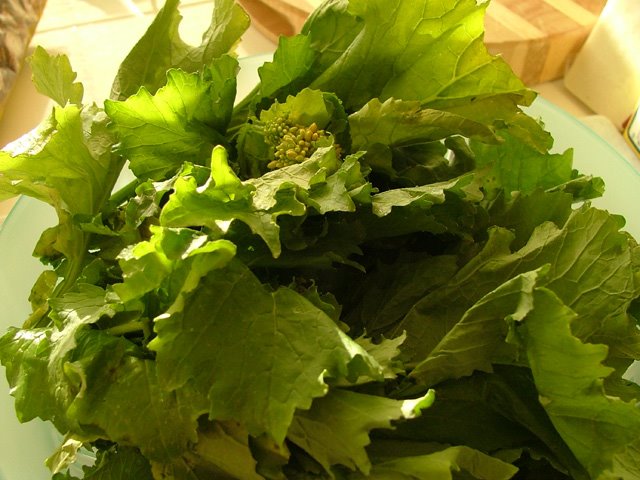
This vegetable goes by a lot of names, but for the sake of clarity I'll go with rapini or broccoli raab, even though it's not related to broccoli. Given that fresh spinach is still a danger here in the states, many people are looking for alternatives. What a perfect time for my voyage through the underappreciated greens! I made a variation on the pasta dish I cooked for my 30th birthday party. I used campanelle or bell-shaped pasta, combined with sautéed mushrooms, garlic, a cream sauce, Romano cheese, and crawfish tails. For color and added nutrients, I wilted down the large bunch of rapini pictured at right on the stovetop griddle with some olive oil and added it after the cream sauce. My dining companions remarked about how delicious the spinach was--I was quick and eager to give credit to the lesser-known rapini. It's a little more bitter than spinach, but that balanced nicely against the sweetness of the crawfish tails.
08 October 2006
Cognac Tasting Notes for October 5, 2006
Last Thursday, I took my father to a guided Cognac tasting hosted by Frédéric Goossens, the Southern USA Regional Director for Pierre Ferrand. Frédéric is from France originally, and in addition to providing information on the various Cognacs we tasted, he also lectured on the history of Cognac as well as details of the production process. Dad and I arrived early, and got to hang out with Frédéric. I got to show off my poor mastery of the French language, and when Frédéric asked us how we heard about the tasting, I mentioned that I was a regular at this particular host's tastings, and that I'd brought my father because of his love of Cognac. We then proceded to tell him about the time 15 years ago when I, a mere teenager, was awakened by my father on Christmas Eve. He had been at work (at the airport) late that night, receiving gifts from abroad: expensive French cognac from some Japanese friends and fresh smoked salmon from his Norwegian contacts. It was two in the morning, and we stayed up watching old black and white movies, eating huge slabs of smoked salmon, and sipping cognac.
Interesting bits of trivia:
We tasted six in all--five Cognacs and one Armagnac. The Cognacs can all be found at the above link, and the Armagnac is on a nearby page. We tasted the Armagnac last, but I'm going to write about it first because it was the least impressive of the group, and frankly, after the really old Cognacs, it never had a chance. I found it strong and bold, rougher on the palate than any of the other selections. Much of this was due to single distillation rather than the double distillation required for Cognac. $42.
All of these come from Grand Champagne, the premiere subregion within Cognac. All were served in separate glasses and allowed to breathe for at least 30 minutes before tasting.
Cognac 1: 10 Year Old Ambre. I found it a little thin, but it had a wonderful aroma. It was definitely the most pale of all the offerings. $43.
Cognac 2: 20 Year Old Reserve. Probably my favorite of the tasting, if by favorite you mean something I could potentially afford and really enjoyed. Very smooth, with a light sweetness. Touches of almonds and licorice on the nose and tongue. $64.
Cognac 3: 25 Year Old Cigare. Designed with an attractive cigar band style label above the main label and intended for pairing with cigars. I found more orange and spice on this one, though it was in many ways similar to the 20 year old. $90.
Cognac 4: 30 Year Old Selection des Anges. Named after the "angel's share", that portion of a distilled spirit that is lost due to evaporation. A mild aroma, and smooth as cream on the palate. Smells and tastes included candied fruits, mint, vanilla. Quite complex. $116.
Cognac 5: 45 Year Old Abel. Named after the grandfather of Pierre Ferrand, and poured into a lovely handblown bottle. Smooth and creamy like the 30 year old, but even more so. Some aromas of cherry and almonds. It was hard to keep myself from licking the inside of the glass to get every last drop. $240.
Interesting bits of trivia:
- Cognac became really popular after the marriage of Eleanor of Aquitaine to Henry Plantagenet in 1152, where it was a featured beverage.
- Armagnac never really became popular worldwide, as it is landlocked and distribution was difficult over land. Cognac, on the other hand, is situated right next to the Charente River, providing easy access to the Atlantic Ocean.
- To properly sniff Cognac, you must do it three times: hold it against your chest, then at neck level, and finally stick your nose in the glass.
- Contrary to popular opinion, snifters are not the ideal drinking glasses. Regular wine glasses are much more appropriate.
We tasted six in all--five Cognacs and one Armagnac. The Cognacs can all be found at the above link, and the Armagnac is on a nearby page. We tasted the Armagnac last, but I'm going to write about it first because it was the least impressive of the group, and frankly, after the really old Cognacs, it never had a chance. I found it strong and bold, rougher on the palate than any of the other selections. Much of this was due to single distillation rather than the double distillation required for Cognac. $42.
All of these come from Grand Champagne, the premiere subregion within Cognac. All were served in separate glasses and allowed to breathe for at least 30 minutes before tasting.
Cognac 1: 10 Year Old Ambre. I found it a little thin, but it had a wonderful aroma. It was definitely the most pale of all the offerings. $43.
Cognac 2: 20 Year Old Reserve. Probably my favorite of the tasting, if by favorite you mean something I could potentially afford and really enjoyed. Very smooth, with a light sweetness. Touches of almonds and licorice on the nose and tongue. $64.
Cognac 3: 25 Year Old Cigare. Designed with an attractive cigar band style label above the main label and intended for pairing with cigars. I found more orange and spice on this one, though it was in many ways similar to the 20 year old. $90.
Cognac 4: 30 Year Old Selection des Anges. Named after the "angel's share", that portion of a distilled spirit that is lost due to evaporation. A mild aroma, and smooth as cream on the palate. Smells and tastes included candied fruits, mint, vanilla. Quite complex. $116.
Cognac 5: 45 Year Old Abel. Named after the grandfather of Pierre Ferrand, and poured into a lovely handblown bottle. Smooth and creamy like the 30 year old, but even more so. Some aromas of cherry and almonds. It was hard to keep myself from licking the inside of the glass to get every last drop. $240.
06 October 2006
Benito vs. the Farmer's Market: Apples & Chestnuts
 Black Arkansas Apple
The Black Arkansas is an unusual apple variety. It's much smaller than those you see in the grocery store, and it's hard as a rock. If you threw this at someone, you could cause some serious injury. (I say this as someone who grew up with a peach tree in the backyard and a little brother. Unripe peaches hurt, ripe peaches make a mess, and rotten peaches mean that mom's going to make you strip in the back yard and hose off before coming in the house.)
It's a little hard to bite into, but from there, it eats like a normal apple. It's sort of woody and not very sweet. I've heard that this variety is ideal for cider making, and I'm a big fan of cider, both the natural unfiltered variety and the harder type.
The apples taste much better cooked. I baked the remaining apples (sliced and cored, kept the peels on) with some honey, butter, and cinnamon) for a side dish alongside the recent Combinations #6 dinner. The dark peels provided some lovely color. And there's something I like about the size and shape... Not the huge glossy yet flavorless apples you see in the stores (Red Delicious I'm looking at you), but this is a scrawny, scrappy little fruit that when properly prepared can reveal some delicious secrets.
 Chestnuts
I haven't eaten chestnuts since my trip to Italy ten years ago. I was there in December, and in most of the decent sized cities I could buy a bag of roasted chestnuts from a street vendor to snack on while walking around the town in the evening. (Nothing like a warm snack to hold on to while bundled against the winter wind!) Typically the vendor would have a little fire going from wood or charcoal, and would roast the chestnuts on a perforated metal plate. You could smell them from a block away.
Here in the Memphis area, the pecan tree is our major nut tree. I actually like to buy them from my barber, whose family owns a substantial pecan grove in Mississippi. But we've got chestnuts as well--some farmed on purpose, others leftovers from plantings over a hundred years ago. Looking at a raw chestnut you'd never guess that they're edible, but when properly cooked the meat inside is delicious.
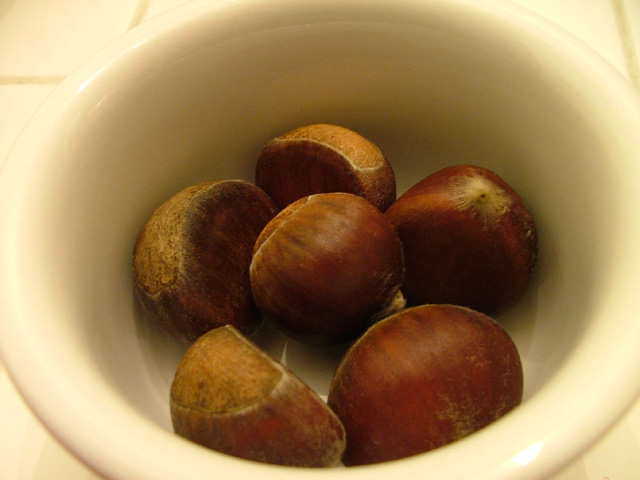
Pictured above are the raw chestnuts. My first attempt involved roasting them in a pan on the stove. They tasted OK, but a little bland. Obviously much better when I cooked them for my birthday dinner--roasted in the oven for a half hour, shelled and sliced and then pan-fried in butter and honey and brown sugar. Quite tasty.
01 October 2006
30th Birthday Party
I actually turned thirty back on September 13, but that week wasn't conducive to celebrations as some of my closest friends were out of town. And while minor parties occurred throughout the month, I was saving up for a big dinner party at the end when everyone could be there. I did all the cooking, friends and family provided the wine and dessert, and we all had a grand time. I know that it's in bad taste to throw a birthday party for yourself, but honestly, I didn't want any presents, I didn't want to go out and eat... I just wanted to spend some time with those closest to me and cook a bunch of dishes that I'd been dying to try out.
Before I go any further, I have to give full credit to Paul for hosting, as well as joining my father and my brother John, all three of whom spent half the evening washing dishes. Couldn't have done it without y'all.
 Once everyone arrived, we started out with a toast, basically thanking Paul for hosting and thanking my parents for giving birth to me 30 years ago. We toasted with the Schramsberg Blanc de Noirs, a non-vintage sparkler from California. I'd been holding on to this bottle for a few months and wasn't disappointed. It had a heady, vegetal aroma, but a cool and crisp mouth feel to it. I found myself sipping it throughout the evening as a palate cleanser. Some of my guests elected to toast with the Fetzer Riesling, a light and sweet wine. My roommate, a devout non-drinker, toasted with the 2006 Diet Coke.
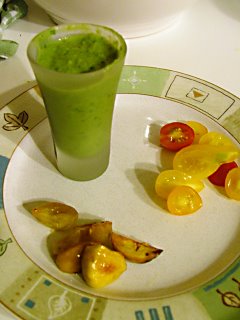
Oh, the photo... Instead of a bank of appetizers, I elected to provide an amuse bouche, French for an entertainment of the mouth. The idea is to provide the diner with a free sample of the chef's intent, but not necessarily anything related to the dinner to follow. In this case, I prepared a trio of richly flavored items. First off, a purée of peas courtesy of Jacques Pépin. Slightly cooked peas blended with some mint and jalapeños from my garden, plus some Italian parsley and the other items in the recipe linked above. Served in a shot glass for the purposes of just tasting the sauce. Then there's a few of my late harvest yellow cherry tomatoes, topped with the diner's choice of Kosher salt or French grey sea salt. Finally, there's some honey roasted chestnuts. I roasted the chestnuts whole for a half hour, then shelled and sliced them before sautéeing in a pan with butter, honey, and brown sugar. My dining companions found all of this a little odd but ultimately delicious.
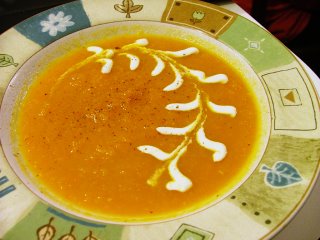 For the soup course, I made a "14 Carrot Soup". Pardon the pun... There were only about ten carrots in there, three parsnips, a good chunk of diced ginger, several cloves of garlic, and two leeks. I really didn't have to season the soup, which was fortified by a half gallon of chicken stock and half a bottle of wine. Root vegetables can have some incredible flavors on their own, if you cook them properly. For serving, I made a little vine design using some sour cream piped through a bag. Then I dragged a knife through the lines to produce the vine. (I picked this up as a decorating tip from a pumpkin soup recipe about 15 years ago.) A little dusting of freshly ground nutmeg and we're ready to go.
For wine, we drank the 2005 Alois Lageder Pinot Grigio from the Alto Adige region of Italy, though I was still finishing off some of the sparkling wine. The pinot grigio was tart, lemony, and quite refreshing. Brought by my sister-in-law. (I put an odd rule in the invitation: all men had to bring red wines, all the ladies had to bring white wines, though no one would be turned away for breaking the rule. Though perhaps chauvanist, it's really not a bad way of achieving a balance of wines, is it?)
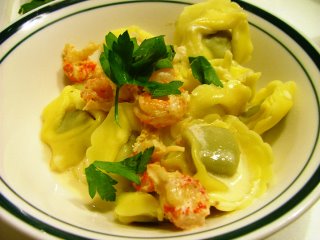 Throughout the evening, we sipped on my brother's red wine, the 2001 Chateau Potelle Zinfandel from Paso Robles in California. A dark and jammy Zin with hints of plum and black cherry. Typically I follow the Soup-Fish-Meat-Dessert paradigm, but I mixed it up a little this time and did a more Italian primo piatti dish with a Southern flair. What you see before you is spinach and cheese tortelli, topped with crawfish tails and a light cream sauce. A little grated Romano cheese and Italian parsley to top it off. This was a big hit of the evening, and while I was concerned that it might fill everyone up too fast, there was enough time before the secondo piatti for everyones stomachs to settle.
The wine I recommended for this course was provided by my mother.
2004 Lockwood Chardonnay from Monterey, California. A delightful little wine, whose French oak aging really matched well with the rich crawfish and cream sauce.
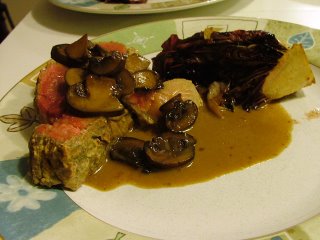 Between the pasta and meat courses, I poured the 2002 Shelton Vineyards Cabernet Franc, a bottle I picked up after a recent tasting. This is an incredible wine, and everyone was shocked when I told them that it came from North Carolina and was very affordable. For the main course, I cooked a whole beef tenderloin (coated in a horseradish-mustard sauce with fresh rosemary and black pepper), served with a savory mushroom sauce and some grilled radicchio. The radicchio were made more or less in the style of chef Michael Chiarello, including the use of anchovies to spice up the vinaigrette. I didn't tell anybody beforehand about the anchovies, and nobody complained after the disclosure. The beef was really good. Several diners gorged themselves to excess. The primary wine for this course was provided by Dad, the 2004 Pilgrim Vineyard Zinfandel from V. Sattui's Lodi Vineyard.
Dessert was a key lime pie provided by my parents, accompanied by some vino brulé that I made according to an old Italian recipe. It was deep and hearty, but didn't discourage us from enjoying snifters of Paul's favorite Port, the Penfolds Grandfather. A perfect way to end a delightful evening.
I'd like to thank all of my friends and family that were able to attend, as well as thanking them for putting up with my various culinary experiments over the years. Several of those in attendance said, "But we should be taking you out for your birthday." Honestly, there's no other way that I would have wanted to celebrate this particular milestone.
Before I go any further, I have to give full credit to Paul for hosting, as well as joining my father and my brother John, all three of whom spent half the evening washing dishes. Couldn't have done it without y'all.
 Once everyone arrived, we started out with a toast, basically thanking Paul for hosting and thanking my parents for giving birth to me 30 years ago. We toasted with the Schramsberg Blanc de Noirs, a non-vintage sparkler from California. I'd been holding on to this bottle for a few months and wasn't disappointed. It had a heady, vegetal aroma, but a cool and crisp mouth feel to it. I found myself sipping it throughout the evening as a palate cleanser. Some of my guests elected to toast with the Fetzer Riesling, a light and sweet wine. My roommate, a devout non-drinker, toasted with the 2006 Diet Coke.
Oh, the photo... Instead of a bank of appetizers, I elected to provide an amuse bouche, French for an entertainment of the mouth. The idea is to provide the diner with a free sample of the chef's intent, but not necessarily anything related to the dinner to follow. In this case, I prepared a trio of richly flavored items. First off, a purée of peas courtesy of Jacques Pépin. Slightly cooked peas blended with some mint and jalapeños from my garden, plus some Italian parsley and the other items in the recipe linked above. Served in a shot glass for the purposes of just tasting the sauce. Then there's a few of my late harvest yellow cherry tomatoes, topped with the diner's choice of Kosher salt or French grey sea salt. Finally, there's some honey roasted chestnuts. I roasted the chestnuts whole for a half hour, then shelled and sliced them before sautéeing in a pan with butter, honey, and brown sugar. My dining companions found all of this a little odd but ultimately delicious.
 For the soup course, I made a "14 Carrot Soup". Pardon the pun... There were only about ten carrots in there, three parsnips, a good chunk of diced ginger, several cloves of garlic, and two leeks. I really didn't have to season the soup, which was fortified by a half gallon of chicken stock and half a bottle of wine. Root vegetables can have some incredible flavors on their own, if you cook them properly. For serving, I made a little vine design using some sour cream piped through a bag. Then I dragged a knife through the lines to produce the vine. (I picked this up as a decorating tip from a pumpkin soup recipe about 15 years ago.) A little dusting of freshly ground nutmeg and we're ready to go.
For wine, we drank the 2005 Alois Lageder Pinot Grigio from the Alto Adige region of Italy, though I was still finishing off some of the sparkling wine. The pinot grigio was tart, lemony, and quite refreshing. Brought by my sister-in-law. (I put an odd rule in the invitation: all men had to bring red wines, all the ladies had to bring white wines, though no one would be turned away for breaking the rule. Though perhaps chauvanist, it's really not a bad way of achieving a balance of wines, is it?)
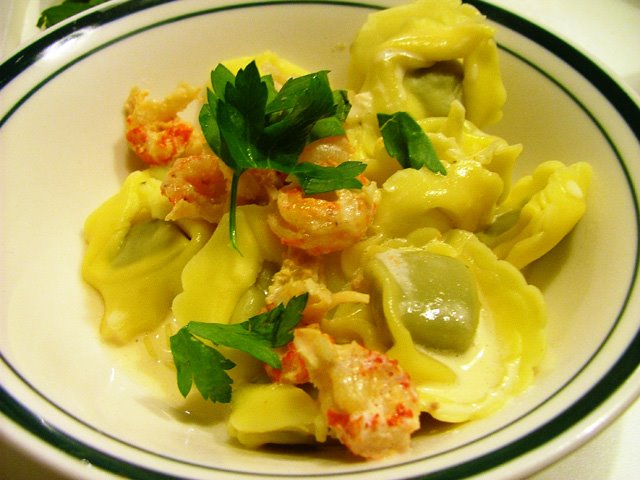 Throughout the evening, we sipped on my brother's red wine, the 2001 Chateau Potelle Zinfandel from Paso Robles in California. A dark and jammy Zin with hints of plum and black cherry. Typically I follow the Soup-Fish-Meat-Dessert paradigm, but I mixed it up a little this time and did a more Italian primo piatti dish with a Southern flair. What you see before you is spinach and cheese tortelli, topped with crawfish tails and a light cream sauce. A little grated Romano cheese and Italian parsley to top it off. This was a big hit of the evening, and while I was concerned that it might fill everyone up too fast, there was enough time before the secondo piatti for everyones stomachs to settle.
The wine I recommended for this course was provided by my mother.
2004 Lockwood Chardonnay from Monterey, California. A delightful little wine, whose French oak aging really matched well with the rich crawfish and cream sauce.
 Between the pasta and meat courses, I poured the 2002 Shelton Vineyards Cabernet Franc, a bottle I picked up after a recent tasting. This is an incredible wine, and everyone was shocked when I told them that it came from North Carolina and was very affordable. For the main course, I cooked a whole beef tenderloin (coated in a horseradish-mustard sauce with fresh rosemary and black pepper), served with a savory mushroom sauce and some grilled radicchio. The radicchio were made more or less in the style of chef Michael Chiarello, including the use of anchovies to spice up the vinaigrette. I didn't tell anybody beforehand about the anchovies, and nobody complained after the disclosure. The beef was really good. Several diners gorged themselves to excess. The primary wine for this course was provided by Dad, the 2004 Pilgrim Vineyard Zinfandel from V. Sattui's Lodi Vineyard.
 Dessert was a key lime pie provided by my parents, accompanied by some vino brulé that I made according to an old Italian recipe. It was deep and hearty, but didn't discourage us from enjoying snifters of Paul's favorite Port, the Penfolds Grandfather. A perfect way to end a delightful evening.
I'd like to thank all of my friends and family that were able to attend, as well as thanking them for putting up with my various culinary experiments over the years. Several of those in attendance said, "But we should be taking you out for your birthday." Honestly, there's no other way that I would have wanted to celebrate this particular milestone.
24 September 2006
Tasting Notes for September 23, 2006
I was pretty excited about this tasting... All of the wines below come from Shelton Vineyards in the Yadkin Valley of North Carolina. I've never had North Carolina wine before. Based off my experience with Tennessee wines, I was a little apprehensive, but everything was great. All of the wines use traditional European grapes as opposed to the American natives and hybrids you get elsewhere in the South. There was a representative from the vineyard on hand to answer questions. Currently, about 70% of their sales are in North Carolina, and the wines are available in limited quantities in ten other states.
Wine 1: NV Shelton Madison Lee White. 72% Chardonnay, 14% Viognier, 10% Riesling, 3% Pinot Blanc, 1% Sauvignon Blanc. Bright and tart, lemony but not sweet. Very refreshing. Nice way to open up the palate. $10.
Wine 2: NV Shelton Vineyards Riesling. 95% Riesling and 5% Viognier. Lightly sweet, but with a very full mouth feel. Honey like. Lots of fun, low acidity. A really surprising Riesling. Reminded me of some similar bottles from Oregon. $12.
Wine 3: 2005 Shelton Vineyards Bin 17 Chardonnay. Pure Chardonnay. This one didn't do much for me, I thought it had an unusual taste that I couldn't quite pin down and a bitter finish. Probably should have tasted it before the Riesling, though. $10.
Wine 4: NV Salem Fork Blush. The website claims this is made with Sangiovese and Viognier, but the rep said it was a rosé of Sangiovese and Zinfandel. The latter is the reason why it doesn't bear the Shelton name on the label--they don't grow Zinfandel grapes in that area and have to import them. Despite the appearance, it's not a sweet wine. Rather, it's bold and fruity. I really enjoyed it. $8.
Wine 5: NV Shelton Madison Lee Red. 33% Merlot, 28.6% Cabernet Sauvignon, 22.1% Sangiovese, 10.4% Cabernet Franc, 3.3% Syrah, 2.6% Petite Verdot. Sort of a Bordeaux with Sangiovese thrown in for fun. A surprisingly good table red, well balanced and applicable to a wide range of foods. She said that it was their pizza and burger wine, and I think it would work well with even higher class fare. $10.
Wine 6: 2002 Shelton Cabernet Franc. 92% Cabernet Franc, 5% Cabernet Sauvignon, 3% Merlot. Wow. Black cherry flavors and aromas, with some of that nice herbal character you get from the Cab Franc. I was really happy with this wine, and ended up purchasing a bottle after the tasting. It's difficult to find a basically pure Cab Franc for $15.
Wine 7: 2002 Shelton Merlot. 93% Merlot, 7% Cabernet Sauvignon. Medium tannins, mild and light. I found it a little thin, but that could have been the influence of the Cabernet Franc from the previous wine. $15.
Wine 8: 2002 Shelton Cabernet Sauvignon. 85% Cabernet Sauvignon, 15% Merlot. Smooth, cherry flavors abound. Light tannins, light acidity and mild oak. $15.
Wine 1: NV Shelton Madison Lee White. 72% Chardonnay, 14% Viognier, 10% Riesling, 3% Pinot Blanc, 1% Sauvignon Blanc. Bright and tart, lemony but not sweet. Very refreshing. Nice way to open up the palate. $10.
Wine 2: NV Shelton Vineyards Riesling. 95% Riesling and 5% Viognier. Lightly sweet, but with a very full mouth feel. Honey like. Lots of fun, low acidity. A really surprising Riesling. Reminded me of some similar bottles from Oregon. $12.
Wine 3: 2005 Shelton Vineyards Bin 17 Chardonnay. Pure Chardonnay. This one didn't do much for me, I thought it had an unusual taste that I couldn't quite pin down and a bitter finish. Probably should have tasted it before the Riesling, though. $10.
Wine 4: NV Salem Fork Blush. The website claims this is made with Sangiovese and Viognier, but the rep said it was a rosé of Sangiovese and Zinfandel. The latter is the reason why it doesn't bear the Shelton name on the label--they don't grow Zinfandel grapes in that area and have to import them. Despite the appearance, it's not a sweet wine. Rather, it's bold and fruity. I really enjoyed it. $8.
Wine 5: NV Shelton Madison Lee Red. 33% Merlot, 28.6% Cabernet Sauvignon, 22.1% Sangiovese, 10.4% Cabernet Franc, 3.3% Syrah, 2.6% Petite Verdot. Sort of a Bordeaux with Sangiovese thrown in for fun. A surprisingly good table red, well balanced and applicable to a wide range of foods. She said that it was their pizza and burger wine, and I think it would work well with even higher class fare. $10.
Wine 6: 2002 Shelton Cabernet Franc. 92% Cabernet Franc, 5% Cabernet Sauvignon, 3% Merlot. Wow. Black cherry flavors and aromas, with some of that nice herbal character you get from the Cab Franc. I was really happy with this wine, and ended up purchasing a bottle after the tasting. It's difficult to find a basically pure Cab Franc for $15.
Wine 7: 2002 Shelton Merlot. 93% Merlot, 7% Cabernet Sauvignon. Medium tannins, mild and light. I found it a little thin, but that could have been the influence of the Cabernet Franc from the previous wine. $15.
Wine 8: 2002 Shelton Cabernet Sauvignon. 85% Cabernet Sauvignon, 15% Merlot. Smooth, cherry flavors abound. Light tannins, light acidity and mild oak. $15.
23 September 2006
Combinations #6: Roast Partridge with Grapes and Walnuts
Andrew's hosting yet another round of Combinations... For Combinations #6, we're tasked with preparing Roast Partridge with Grapes and Walnuts and matching an appropriate wine. First off, in gathering the ingredients for this recipe, I found myself purchasing raw grapes for the first time in... I can't remember. I've eaten grapes occasionally in the past decade, but it seems I only buy them in their fermented and bottled form these days. I'm reminded of the Scotsman who, fond of the deep-fried pizza of his home, goes to Naples, is served a perfect pizza margherita, and exclaims, "D'ya expect me to eat it raw?"
Speaking of the raw grapes, I used Sable Seedless, which are black as night and taste great. I couldn't help but be curious about what kind of wine they'd make. (And yes, I know that wine grapes often don't taste all that great and that table grapes make crap wine. Still curious.)
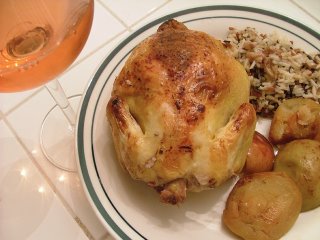 We have partridges here in the States, but they're actually a species of quail. (Couldn't get my hands on any farm-raised quail--my local supplier for farm-raised game went out of business.) Right now we're at the end of dove season, and while I wouldn't have been averse to going out and shooting a brace of doves with the trusty 16 gauge, I haven't had the opportunity to get out in the fields. Grabbing a pigeon from the street didn't seem too appetizing, and I wasn't going to try to snare one of the mourning doves out of my backyard. Doves don't really have much meat on them, though, and looking at pictures of European partridge dishes, I figured my best bet was going to be Cornish game hen, basically a very small breed of chicken.
I don't know how popular these are overseas... Here they're available everywhere, and very inexpensive (yet ridiculously expensive at restaurants/catered events). Most people get them frozen, but I was lucky to pick up some fresh ones. Some people like to cook them for small Thanksgiving dinners, because they cook rather quickly and there's not a ton of leftovers.
Brief anecdote: I first cooked Cornish game hens back in high school when I was going through my first cooking experimenting phase. I prepared them in an Italian manner with a sausage-based stuffing. They turned out delicious--I made one for each member of our family. Mom looked down at hers and almost got upset. "But it looks like a little baby chicken... I don't know if I can eat this." Surprisingly, over our lifetime, my mother has rarely had to force me to eat anything, but there's been several dishes I put in front of her that she didn't want to touch. Love you anyway, mom.
I followed the recipe closely, except I used some of the chosen wine instead of the Madeira and substituted a multicolor rice blend for the side dish. I also included some honey and cinnamon baked apples as an additional side. More on the apples in a future post, as they were an unusual variety.
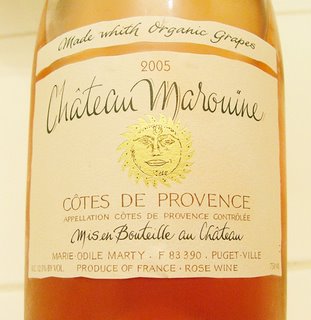 For the wine, I picked the 2005 Château Marouïne Côtes de Provence Rosé, obviously from Provence in France. Alder gave it a good score at a big rosé tasting. It's also fully organic, which is sort of amusing as none of the other ingredients for dinner were organic. 28% Grenache, 26% Cinsault, 26% Mourvèdre, 20% Carignan. Kudos to the winemaker for putting this information on the back of the label! What a lovely Southern French blend.
The first thing I thought of when purchasing the bottle was James Ivey's Extremely Pale Rose: A Very French Adventure. I haven't read this book, but saw mention of it on some wine blog and can't wait to get my hands on a copy. This is indeed a very pale rosé with just a slight orange tinge. Think of a white wine to which you've just whispered something naughty. Flavorwise, it's crisp and tart. Not sweet at all, but well balanced. Tasted blind, this could easily pass for a white wine. Very light flavors of pear. Easily drinkable, perhaps too light and refreshing for this autumnal dish. As it hit 91°F (33°C) here today, I feel entirely justified in this selection.
Speaking of the raw grapes, I used Sable Seedless, which are black as night and taste great. I couldn't help but be curious about what kind of wine they'd make. (And yes, I know that wine grapes often don't taste all that great and that table grapes make crap wine. Still curious.)
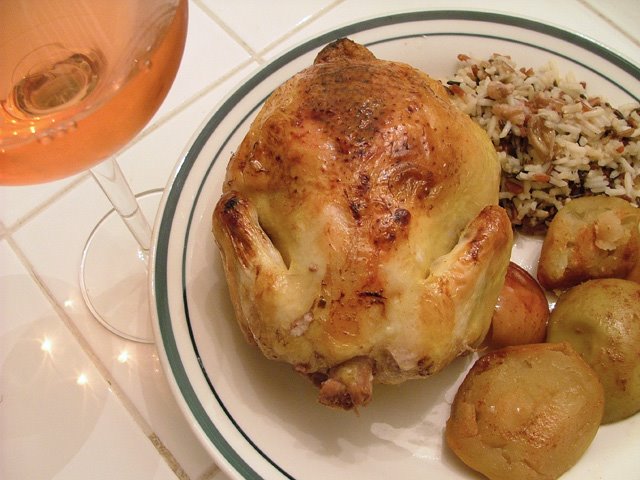 We have partridges here in the States, but they're actually a species of quail. (Couldn't get my hands on any farm-raised quail--my local supplier for farm-raised game went out of business.) Right now we're at the end of dove season, and while I wouldn't have been averse to going out and shooting a brace of doves with the trusty 16 gauge, I haven't had the opportunity to get out in the fields. Grabbing a pigeon from the street didn't seem too appetizing, and I wasn't going to try to snare one of the mourning doves out of my backyard. Doves don't really have much meat on them, though, and looking at pictures of European partridge dishes, I figured my best bet was going to be Cornish game hen, basically a very small breed of chicken.
 I don't know how popular these are overseas... Here they're available everywhere, and very inexpensive (yet ridiculously expensive at restaurants/catered events). Most people get them frozen, but I was lucky to pick up some fresh ones. Some people like to cook them for small Thanksgiving dinners, because they cook rather quickly and there's not a ton of leftovers.
Brief anecdote: I first cooked Cornish game hens back in high school when I was going through my first cooking experimenting phase. I prepared them in an Italian manner with a sausage-based stuffing. They turned out delicious--I made one for each member of our family. Mom looked down at hers and almost got upset. "But it looks like a little baby chicken... I don't know if I can eat this." Surprisingly, over our lifetime, my mother has rarely had to force me to eat anything, but there's been several dishes I put in front of her that she didn't want to touch. Love you anyway, mom.
I followed the recipe closely, except I used some of the chosen wine instead of the Madeira and substituted a multicolor rice blend for the side dish. I also included some honey and cinnamon baked apples as an additional side. More on the apples in a future post, as they were an unusual variety.
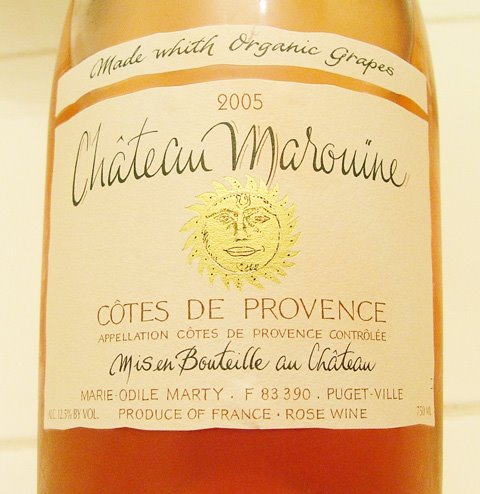 For the wine, I picked the 2005 Château Marouïne Côtes de Provence Rosé, obviously from Provence in France. Alder gave it a good score at a big rosé tasting. It's also fully organic, which is sort of amusing as none of the other ingredients for dinner were organic. 28% Grenache, 26% Cinsault, 26% Mourvèdre, 20% Carignan. Kudos to the winemaker for putting this information on the back of the label! What a lovely Southern French blend.
 The first thing I thought of when purchasing the bottle was James Ivey's Extremely Pale Rose: A Very French Adventure. I haven't read this book, but saw mention of it on some wine blog and can't wait to get my hands on a copy. This is indeed a very pale rosé with just a slight orange tinge. Think of a white wine to which you've just whispered something naughty. Flavorwise, it's crisp and tart. Not sweet at all, but well balanced. Tasted blind, this could easily pass for a white wine. Very light flavors of pear. Easily drinkable, perhaps too light and refreshing for this autumnal dish. As it hit 91°F (33°C) here today, I feel entirely justified in this selection.
22 September 2006
2004 Pine & Post Merlot
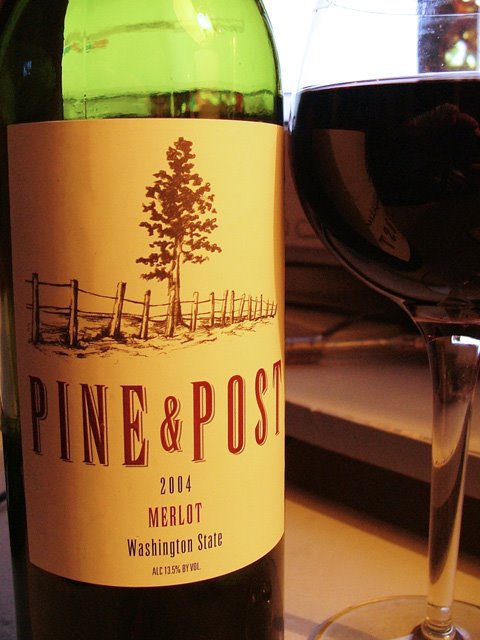 Here's the first super-bargain Washington wine I've had, the $5 2004 Pine & Post Merlot from the Columbia Valley. Frankly, I'm not getting a lot out of it. I picked it up for possible use in mulled wine later in the season, but my roommate had some Greek pizza and I figured "why not?"
(For a fun bit of recursion, the photo shown was taken here at the computer desk right before typing this paragraph--you may be able to make out the Blogger entry screen in the back.)
There's some black cherry flavors, and sort of a cinnamon kick on the finish (rather strong for a Merlot), but overall it simply tastes like... red wine. Rather reminds me of some parties I attended in my early 20s where the wine selection consisted of a gallon jug of Red and a gallon jug of White. The adventurous could make an ersatz rosé by mixing them half and half, though much of the time you'd have to add a little Sprite or 7-Up for that frosty wine cooler flavor.
But hey, the music was pumping, and you were desperately trying to appear interested while some hot yet crazy art student was describing her latest work that involved Legos and ketchup. Meanwhile, the first "wine virgin" of the evening goes one red plastic cup over the line, and retreats to the back porch to vomit in the yard. Several new couples form over the course of the evening, one or two break up and never speak again. Many break off into groups to engage in the newfound conversational pleasure of Being An Expert In Everything Because We're In College. An assortment of wallflowers decorate the edges of the party, quietly sipping on their drinks and never quite working up the courage to bust in on any conversations. One chick walks through the living room wearing a ballerina outfit complete with fairy wings, and you wonder if it's just a dance student or a hallucination brought on by too much jug wine.
18 September 2006
Wine Blogging Wednesday #25
Sam over at Becks & Posh has posted the roundup on Wine Blogging Wednesday #25. I submitted a slightly not-quite-Champagne entry a month ago, and mostly forgot about it. However, I got included at the bottom of the list for those that didn't precisely follow the rules. I was pretty damned close, and I'd hope that the story helped out somewhat.
Cheers to Sam for being understanding, and for having one of the most attractive food and wine blogs I've had the pleasure of reading!
Cheers to Sam for being understanding, and for having one of the most attractive food and wine blogs I've had the pleasure of reading!
17 September 2006
Benito vs. the Produce Section: Swiss Chard
Memphis isn't London or New York or Tokyo, but even in this town of a million I've got access to a wide range of raw ingredients for cooking. In my attempt to cook things I've never cooked or eaten before, I'm starting out with my local but well-stocked grocery store. Once I blitz through all of those selections, assuming I don't get bored, then I can start checking out my local Indian, Chinese, Russian, Mexican, and Vietnamese markets. And if I get bored with all of those and haven't died yet, I'll figure out something new.
There's a lot of talk about improving your health and palate by shopping at the edges of the supermarket--fresh fruits and vegetables, raw meats, and dairy--and avoiding all of the processed foods in the middle. I don't promise that I eat foods that are healthy, gourmet, or even interesting all the time, but I find that foods built from simple raw materials are often the most flavorful and personally rewarding.
 Swiss Chard
Swiss chard has to be one of the most beautiful vegetables in the produce section. What you see here is commonly marketed as "rainbow chard", meaning that white, red, pink, and yellow varieties are grown separately and then bunched together for sale. Chard is closely related to the beet plant, though here the focus is on the stalks and leaves rather than the root.
The stalks are edible, though they have to cook longer than the leaves. Without any former experience with Swiss chard, I decided to take the common advice to "treat it like spinach". I cooked some pancetta, chopped the stalks, sautéed them in the pancetta grease, and then added the torn leaves to allow them to wilt and cook.
The end result? Interesting. Not delicious, but good enough on its own. A little bitter, but I like bitter flavors in my food and beer. It really needed some hard Italian cheese mixed in it, and I think it could definitely benefit from a cream-based sauce. With this round of produce experiments, I'm trying to discern the inherent flavors of these weird ingredients, and thus I can find a good use for them in the future.
For instance, I use spinach heavily whenever I make a vegetarian lasagna, so I think I'll substitute Swiss chard next time. I'll also be on the lookout for some traditional recipes that really show off the color and flavor. Still, it's a damned shame that you can't just serve the stuff raw in a salad. Perhaps used as garnish? Think about a half dozen pork ribs laid out along a broad leaf of red chard...
There's a lot of talk about improving your health and palate by shopping at the edges of the supermarket--fresh fruits and vegetables, raw meats, and dairy--and avoiding all of the processed foods in the middle. I don't promise that I eat foods that are healthy, gourmet, or even interesting all the time, but I find that foods built from simple raw materials are often the most flavorful and personally rewarding.
 Swiss Chard
Swiss chard has to be one of the most beautiful vegetables in the produce section. What you see here is commonly marketed as "rainbow chard", meaning that white, red, pink, and yellow varieties are grown separately and then bunched together for sale. Chard is closely related to the beet plant, though here the focus is on the stalks and leaves rather than the root.
The stalks are edible, though they have to cook longer than the leaves. Without any former experience with Swiss chard, I decided to take the common advice to "treat it like spinach". I cooked some pancetta, chopped the stalks, sautéed them in the pancetta grease, and then added the torn leaves to allow them to wilt and cook.
The end result? Interesting. Not delicious, but good enough on its own. A little bitter, but I like bitter flavors in my food and beer. It really needed some hard Italian cheese mixed in it, and I think it could definitely benefit from a cream-based sauce. With this round of produce experiments, I'm trying to discern the inherent flavors of these weird ingredients, and thus I can find a good use for them in the future.
For instance, I use spinach heavily whenever I make a vegetarian lasagna, so I think I'll substitute Swiss chard next time. I'll also be on the lookout for some traditional recipes that really show off the color and flavor. Still, it's a damned shame that you can't just serve the stuff raw in a salad. Perhaps used as garnish? Think about a half dozen pork ribs laid out along a broad leaf of red chard...
12 September 2006
NV Candoni Prosecco Brut
So I was cooking dinner for the girlfriend tonight, and she had only one request: boiled artichokes with homemade mayonnaise on the side. Simple enough, but as much as I enjoy a good 'choke, I generally prefer a bit more substance on a dinner plate. So I decided to do lightly beer battered shrimp (some decent 16 count specimens I shelled myself), a schmattering of French fries for the hell of it, and some sourdough and clementines to balance everything out.
What wine would go best with such an odd meal? I felt a strong pull towards Prosecco. A combinations of fried foods and fresh mayonnaise really begs for something crisp and acidic to cut through the grease (though my shrimp were not greasy, thank you very much). I settled on the NV Candoni Prosecco Brut. That site doesn't give much information, but at least you can see the unique label. It's actually painted directly on the glass of the bottle, and depicts an Etruscan fresco from Tarquinia, Italy, in the fifth century BC. The girlfriend teaches ancient history, so I scored a few bonus points there.
It is indeed crisp, with medium acidity and is very refreshing (as I often do, I save at least a glass' worth to sample while writing here on the blog). Around $15, so a good bargain to boot. It was a perfect fit for the meal, and I appreciated the fact that it had a wire cage and traditional champagne cork. There are some proseccos that come with these terrible little corks--they're rock solid composite corks like a champagne cork, but there's only about an eighth of an inch above the top of the bottle, not enough to grasp. You can use a corkscrew, but I destroyed a rabbit-style corkscrew that way.
One more amusing note... While I was still doing the prep work before the arrival of the girlfriend, I started making the homemade mayonnaise. I've done this a dozen times before, though I always alter the recipe a bit to try new things. This time I used safflower oil (and used the remaining oil for frying the shrimp--gets nice and hot without smoking). So I'm building the mayo with white wine vinegar and fresh lemon juice and Dijon mustard, and drizzling in the safflower oil, and wondering why in the hell the damned sauce isn't thickening up.
And then I realize that I forgot the egg yolk. What an idiot.
Fortunately, I read this great French cookbook back when I was in high school. I can't remember the name or the author, but the whole point was to make French cuisine fun and non-threatening. From that cookbook, I made my first cream of X soup (in that case, asparagus), as well as my first fresh pasta. There was a whole chapter on "Kitchen First Aid", and there were lots of tricks on how to fix screwed up sauces. In particular, it mentioned what to do with a curdled Bearnaise sauce: start another emulsion in a separate pot, and then slowly introduce the curdled sauce until it comes together. So in a separate bowl, I mixed an egg yolk with a little more vinegar and mustard, got my emulsion going, and then added in what was effectively a terribly oily vinaigrette. The end result: a perfectly delicious fresh mayonnaise, one that paired wonderfully with the boiled artichokes. And it went well with the fries; a few trips to the Netherlands convinced me of that delectable combination.
What wine would go best with such an odd meal? I felt a strong pull towards Prosecco. A combinations of fried foods and fresh mayonnaise really begs for something crisp and acidic to cut through the grease (though my shrimp were not greasy, thank you very much). I settled on the NV Candoni Prosecco Brut. That site doesn't give much information, but at least you can see the unique label. It's actually painted directly on the glass of the bottle, and depicts an Etruscan fresco from Tarquinia, Italy, in the fifth century BC. The girlfriend teaches ancient history, so I scored a few bonus points there.
It is indeed crisp, with medium acidity and is very refreshing (as I often do, I save at least a glass' worth to sample while writing here on the blog). Around $15, so a good bargain to boot. It was a perfect fit for the meal, and I appreciated the fact that it had a wire cage and traditional champagne cork. There are some proseccos that come with these terrible little corks--they're rock solid composite corks like a champagne cork, but there's only about an eighth of an inch above the top of the bottle, not enough to grasp. You can use a corkscrew, but I destroyed a rabbit-style corkscrew that way.
One more amusing note... While I was still doing the prep work before the arrival of the girlfriend, I started making the homemade mayonnaise. I've done this a dozen times before, though I always alter the recipe a bit to try new things. This time I used safflower oil (and used the remaining oil for frying the shrimp--gets nice and hot without smoking). So I'm building the mayo with white wine vinegar and fresh lemon juice and Dijon mustard, and drizzling in the safflower oil, and wondering why in the hell the damned sauce isn't thickening up.
And then I realize that I forgot the egg yolk. What an idiot.
Fortunately, I read this great French cookbook back when I was in high school. I can't remember the name or the author, but the whole point was to make French cuisine fun and non-threatening. From that cookbook, I made my first cream of X soup (in that case, asparagus), as well as my first fresh pasta. There was a whole chapter on "Kitchen First Aid", and there were lots of tricks on how to fix screwed up sauces. In particular, it mentioned what to do with a curdled Bearnaise sauce: start another emulsion in a separate pot, and then slowly introduce the curdled sauce until it comes together. So in a separate bowl, I mixed an egg yolk with a little more vinegar and mustard, got my emulsion going, and then added in what was effectively a terribly oily vinaigrette. The end result: a perfectly delicious fresh mayonnaise, one that paired wonderfully with the boiled artichokes. And it went well with the fries; a few trips to the Netherlands convinced me of that delectable combination.
11 September 2006
Two Grand Ales
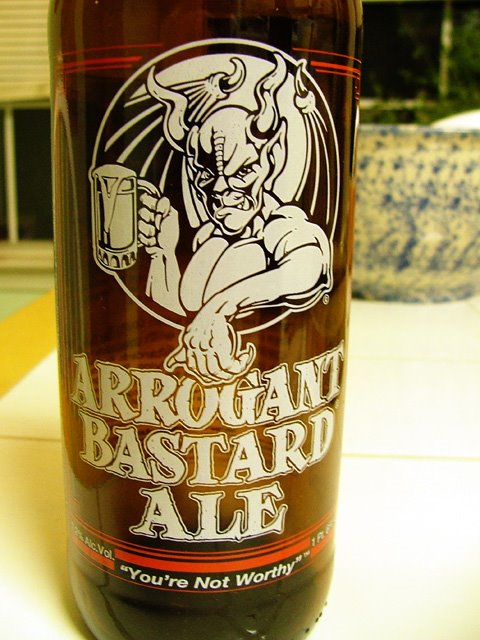 A Friday night, good friends, and two amazing ales... Both of these came from the "big beers" category, which in our part of the country are only sold at liquor stores. The first was 7.2% alcohol, the second 9.0%.
 Arrogant Bastard Ale, from Stone Brewing Company in California. Very bitter, though it smooths out a bit after some mellowing in the glass. If you're not afraid of bitter beer, this is a good one and a great bargain--around $4 for a 650mL (1 pint 6 oz.) bottle. We enjoyed this alongside smoked chicken, grilled corn, and chicken-apple sausage. A big hand for the bottle design. As long as you're drinking beer, you might as well further disappoint your mother by having a demon on the bottle.
Brother Thelonious Belgian Style Abbey Ale, from the good people at the North Coast Brewing Company in California, comes in a 750mL bottle with a cork. How could I pass this up? A hilarious pun, great jazz reference, cool label, and $2 from every case goes to the Thelonious Monk Institute of Jazz. Pure delight. Rich and deep, chocolate flavors and aromas. Very low bitterness, golden crema-style head on top.
 A perfect after-dinner beer, and the cage and champagne cork provide a little elegance. Bonus points for listening to the 1957 recording of the Thelonious Monk Quartet with John Coltrane at Carnegie Hall. At the very least, break out your old LP of Round Midnight and slow dance with your woman. The lights turned low, and the stereo turned up just enough to allow the sweet tickling of the ivories to vibrate through the night air.
 You know, I've thus far managed to keep my love of jazz off the blog. I love playing classic jazz during dinner parties--Dave Brubeck, Miles Davis, Duke Ellington, Artie Shaw, Benny Goodman, all those guys, and many more. Even people who claim to hate jazz are often captivated by the rhythms. And I attempt to avoid the jazz fan stereotype by never talking about the subject: I just play the music and let it speak for itself. Generally at a level low enough to allow conversation to take place, but loud enough for it to be the focus of attention during quiet lulls.
10 September 2006
Benito vs. the Produce Section: Beets & Pluots
When it comes to wine, I'm certainly willing to try anything, and generally, the weirder the better. And I'm pretty adventurous when it comes to food. But lately I've noticed that at the grocery store and the farmer's market, I tend to buy the same set of ordinary fruits and vegetables. Time to shake things up! I won't promise that this will be a recurring feature, but when possible I'm going to purchase a raw ingredient I've never cooked and/or eaten before, and post the results. Here's tonight's entries:
 Beets
Beets
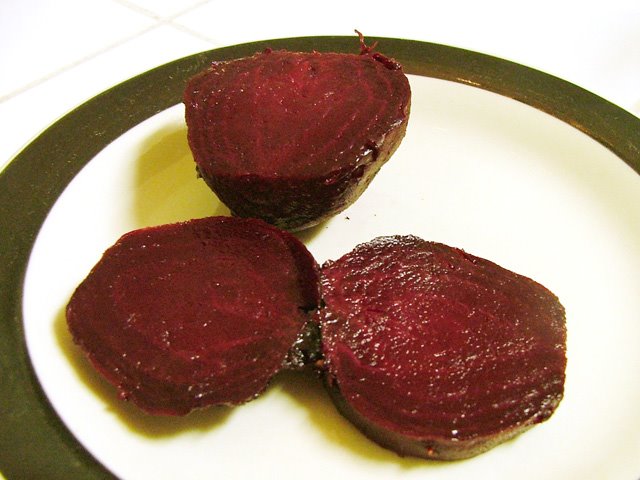
There's nothing unusual or odd about beets, but I've never fixed them before. Frankly, I've never voluntarily ingested them in my entire lifetime. I've had pickled beets once or twice at some point way back when, but I can never recall waking up one day and saying, "Man, I could murder a bunch of beets!" I was smoking some andouille sausage tonight, so I rinsed and scrubbed the beets, drizzled them with olive oil, black pepper, and thyme, and wrapped them in foil. They sat near the hot part of the grill for about an hour. (They were wrapped tight enough that smoke didn't reach the vegetable.)
After roasting, I peeled the skin off and tried the beets. Not that great. I splashed a little balsamic vinegar on a slice and it was much better, but still not something I'd go out of my way to eat. Still, I'm willing to try these as part of a salad or some other preparation before I write them off for good. Perhaps I'll check with my Ukranian friends and learn a good borscht recipe.
Oh, and the andouille sausage was delicious, particularly with a little horseradish mustard on the side.
 Pluots
A pluot is a hybrid fruit that is ¾ plum and ¼ apricot. I've seen these over the past few years but never felt like buying one. I grew up with easy access to peach and plum trees, so when it comes to stone fruit my loyalties are clear. But I gave the pluot a shot. As you can see, it's quite attractive when sliced open. And this is one juicy damned fruit. If you try and eat it out of hand you're going to get juice all over you. It's insanely sweet, though the actual flavor is very mild, much like an apricot. The skin contains a tart burst of plum flavor, but frankly, I'd be happier eating nice ripe plums picked from a neighbor's tree (with permission, of course).
 Beets
BeetsThere's nothing unusual or odd about beets, but I've never fixed them before. Frankly, I've never voluntarily ingested them in my entire lifetime. I've had pickled beets once or twice at some point way back when, but I can never recall waking up one day and saying, "Man, I could murder a bunch of beets!" I was smoking some andouille sausage tonight, so I rinsed and scrubbed the beets, drizzled them with olive oil, black pepper, and thyme, and wrapped them in foil. They sat near the hot part of the grill for about an hour. (They were wrapped tight enough that smoke didn't reach the vegetable.)
After roasting, I peeled the skin off and tried the beets. Not that great. I splashed a little balsamic vinegar on a slice and it was much better, but still not something I'd go out of my way to eat. Still, I'm willing to try these as part of a salad or some other preparation before I write them off for good. Perhaps I'll check with my Ukranian friends and learn a good borscht recipe.
Oh, and the andouille sausage was delicious, particularly with a little horseradish mustard on the side.
 Pluots
A pluot is a hybrid fruit that is ¾ plum and ¼ apricot. I've seen these over the past few years but never felt like buying one. I grew up with easy access to peach and plum trees, so when it comes to stone fruit my loyalties are clear. But I gave the pluot a shot. As you can see, it's quite attractive when sliced open. And this is one juicy damned fruit. If you try and eat it out of hand you're going to get juice all over you. It's insanely sweet, though the actual flavor is very mild, much like an apricot. The skin contains a tart burst of plum flavor, but frankly, I'd be happier eating nice ripe plums picked from a neighbor's tree (with permission, of course).
Tasting Notes for September 9, 2006
Odd mixed tasting of Spanish, Italian, and Chilean wines.
Wine 1: 2005 Tiefenbrunner Pinot Grigio. Alto Adige, Italy. Probably the best Pinot Grigio I've ever had. A little sweet, but with surprisingly decent body. A little lemon, firm tartness. $16.
Wine 2: 2004 Las Brisas. Rueda, Spain. I tasted this back in June of 2005, and enjoyed it enough to pick up a bottle. It remains a decent bargain white wine--full bodied and fruity, with some grapefruit flavors. Slight bitter edge, but not tart. Perfect for shellfish. $10.
Wine 3: 2005 Cavalchina Bianco di Custoza. Verona, Italy. Mostly Trebbiano, some Cortese and Tocai. Slight sweetness, but sort of flabby. Ultimately dull on the tongue. $15.
Wine 4: 2003 Morandé Terrarum Chardonnay. Maipo Valley, Chile. Clean and thin, some apple aromas. Really a rather neutral wine. Apparently Morandé is ceasing US distribution. $12.
Wine 5: 2004 Piccini Chianit. Tuscany, Italy. I had this a week ago, and it still remains a great bargain Chianti. $9.
Wine 6: 2004 Las Rocas Garnacha. Calatayud, Spain. Lovely little Spanish Grenache. Aromas and flavors run towards ripe strawberries with some plum. Light and refreshing, should be good for a wide range of foods. Just turn the bottle around so you don't have to see the big Comic Sans text on the label. $10.
Wine 7: Bodegas Tikalo 2004 "Rubens" Tierra de Castilla Tempranillo. Ciudad Real, Spain. Some toasted bread aromas on top. Well balanced, light and fruity--odd for a young, inexpensive Tempranillo. Medium tannins. Another great bargain. $10.
Wine 8: 2003 Venta Mazzaron Tempranillo. Castilla de León, Spain. Little heavy and tannic. Dark plum flavors, but very dry. I'd like to try this again after some decanting or breathing. $14.
Wine 9: 2005 Bodega Finca Luzón. Jumilla, Spain. Syrah and Monastrell blend. Black cherry aromas. Good fruit, but exceptionally well balanced. Medium tannins, short finish. $10.
Wine 10: 2003 Mas Donis Barrica. Montsant, Spain. A Grenache and Syrah blend. Light flavor, heavy tannins. A smooth finish, but a little watery. Needs some more punch to it. $14.
Wine 1: 2005 Tiefenbrunner Pinot Grigio. Alto Adige, Italy. Probably the best Pinot Grigio I've ever had. A little sweet, but with surprisingly decent body. A little lemon, firm tartness. $16.
Wine 2: 2004 Las Brisas. Rueda, Spain. I tasted this back in June of 2005, and enjoyed it enough to pick up a bottle. It remains a decent bargain white wine--full bodied and fruity, with some grapefruit flavors. Slight bitter edge, but not tart. Perfect for shellfish. $10.
Wine 3: 2005 Cavalchina Bianco di Custoza. Verona, Italy. Mostly Trebbiano, some Cortese and Tocai. Slight sweetness, but sort of flabby. Ultimately dull on the tongue. $15.
Wine 4: 2003 Morandé Terrarum Chardonnay. Maipo Valley, Chile. Clean and thin, some apple aromas. Really a rather neutral wine. Apparently Morandé is ceasing US distribution. $12.
Wine 5: 2004 Piccini Chianit. Tuscany, Italy. I had this a week ago, and it still remains a great bargain Chianti. $9.
Wine 6: 2004 Las Rocas Garnacha. Calatayud, Spain. Lovely little Spanish Grenache. Aromas and flavors run towards ripe strawberries with some plum. Light and refreshing, should be good for a wide range of foods. Just turn the bottle around so you don't have to see the big Comic Sans text on the label. $10.
Wine 7: Bodegas Tikalo 2004 "Rubens" Tierra de Castilla Tempranillo. Ciudad Real, Spain. Some toasted bread aromas on top. Well balanced, light and fruity--odd for a young, inexpensive Tempranillo. Medium tannins. Another great bargain. $10.
Wine 8: 2003 Venta Mazzaron Tempranillo. Castilla de León, Spain. Little heavy and tannic. Dark plum flavors, but very dry. I'd like to try this again after some decanting or breathing. $14.
Wine 9: 2005 Bodega Finca Luzón. Jumilla, Spain. Syrah and Monastrell blend. Black cherry aromas. Good fruit, but exceptionally well balanced. Medium tannins, short finish. $10.
Wine 10: 2003 Mas Donis Barrica. Montsant, Spain. A Grenache and Syrah blend. Light flavor, heavy tannins. A smooth finish, but a little watery. Needs some more punch to it. $14.
07 September 2006
2004 Bogle Cabernet Sauvignon
Dinner with a friend: grilled boneless ribeyes, some grilled endive, and a little dry baguette and roasted garlic, and a bottle of the 2004 Bogle Cabernet Sauvignon. At $13, this is a great little cab. I'm always wary of Cabernet Sauvignon under $20, having been burned many times in the past, but this is a winner. At two years of age, the tannins are remarkably mellow. The aromas are heavy with cherry, and the flavor builds on that with a hint of spice. Once again, Bogle doesn't let me down.
Back to the grilled endive, I've recently become a big fan of grilled radicchio and endive, both from the chicory family. It may have something to do with the savory and bitter flavors you get from this preparation--a big departure from the crisp and tart, occasionally sweet flavors that you get from regular salad preparations. Endive is a little lighter in flavor and radicchio is darker and deeper in flavor. I'd say match them with your wines: endives for whites and radicchio for reds.
Back to the grilled endive, I've recently become a big fan of grilled radicchio and endive, both from the chicory family. It may have something to do with the savory and bitter flavors you get from this preparation--a big departure from the crisp and tart, occasionally sweet flavors that you get from regular salad preparations. Endive is a little lighter in flavor and radicchio is darker and deeper in flavor. I'd say match them with your wines: endives for whites and radicchio for reds.
03 September 2006
Cheese Plate
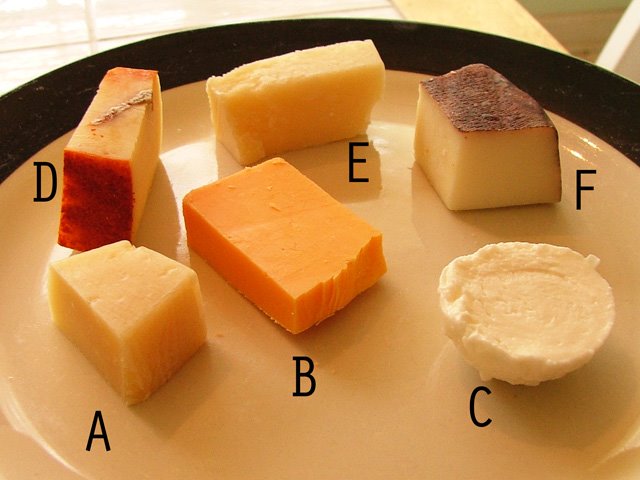 Dinner tonight didn't involve any wine, but I was just using up odds and ends from the kitchen. Some grilled chicken sausage and corn on the cob, a baguette, fresh tomatoes, and hey, some cheese would be nice... While digging through the fridge I realized that I had six decent cheeses on hand. A, B, and C were enjoyed before dinner; D, E, and F afterwards.
 A. Parmigiano Reggiano (Italy)
Nothing too special here, you all know it and love it. This particular wedge wasn't too appetizing in chunk form, though it grates beaufifully.
B. Extra Sharp Cheddar (Wisconsin)
This isn't just your standard orange "rat cheese", this is 18-month old extra sharp cheddar. It makes you crave things like roasted potatoes, apple pie... It's unfortunate that most of the cheddar consumed in this country is bland and mild and eaten in massive quantities.
C. Fresh Mozzarella (California)
This is cow's milk rather than water buffalo, but it's still tasty. If you've got fresh tomatoes and basil growing at home, it's a crime not to keep some fresh mozzarella on hand.
D. Applewood Smoked Cheddar (Wisconsin)
Pleasantly sharp, with a subdued smoke flavor and a deliciously spicy rind. Rather like the dry rub that we use on ribs down here in Memphis. I'm not historically a fan of smoked cheeses; Dad loved the stuff when I was young and while I would always try a slice (typically smoked cheddar or Gouda), I never liked it. The smoke flavor was too harsh, and the cheese often had the texture of plastic. This cheese, however, is delicious, and has been a big pleaser amongst my friends. (For those fearful of veins of mold, it's only on the edges. For the rest of us: extra flavor!)
E. Grana Padano (Italy)
Can be used in a manner similar to Parmigiano Reggiano, but tastes incredible on its own. Nice and crumbly, very dry. With the more expensive, older, stravecchio versions of this cheese, you can feel the crunch of little salt crystals as you chew. Wonderful grated over good pasta or used as a stuffing enhancer in something like ravioli.
F. Drunken Goat (Spain)
Wow. Much firmer than what you normally think of as goat cheese, but still a little soft. It's soaked in Doble Pasta wine for up to three days. All of the sharpness is gone, and instead it mellows out into a ricotta-like flavor, though not a soft and spongy texture. The elements of the wine really show through... It's a rare delight; it feels like eating cheese and drinking wine at the same time, with just a hint of an aftertaste like you've just taken a sip of sherry.
Tasting Notes for August 26, 2006
Here's some week old notes, and a few of these may be repeats from previous weeks... The last of the blind tastings for the summer:
Wine 1: 2005 Hendry Unoaked Napa Chardonnay. Napa, California. Floral and tart. Bright fruit flavor and a slightly bitter finish. $18.
Wine 2: 2005 Casa Silva Sauvignon Blanc. Slight creamy quality, very fruity. Apple and pear dominate. Lovely little wine. Colchagua Valley, Chile. $15.
Wine 3: 2005 Craneford Viognier. Very sweet for a Viognier. Lots of honey and lemon flavors, and the finish tends more to the dry side. Adelaide Hills, Australia. $18.
Wine 4: 2004 Hermanos Lurton Rueda Bianco. Mild and dry with some herbal notes. No prominent flavors, but a pleasant and balanced wine. Rueda, Spain. $13.
Wine 5: 2004 Concha y Toro Casa Concha Chardonnay. Thin aroma. Mild tartness, a little cream. Would be incredible with mild seafood dishes. Maipo Valley, Chile. $18.
Wine 6: 2004 Torres Viña Sol. Very crsip with mild acidity, very short finish. Penedes, Spain. $10.
Wine 7: 2004 Hayman & Hill Pinot Noir. Light strawberry aroma, very mild. Low tannins with a smooth finish. Excellent bargain Pinot Noir. Much improvement since the last time I tried this wine (different patch of grapes, different year, but same producer and varietal). Santa Lucia Highlands, California. $15.
Wine 8: 2003 Cellier des Dauphins Côtes du Rhône. Light, mild tannins, cherry flavors abound. Very enjoyable. Côtes du Rhône, France. $10.
Wine 9: 2003 Domaine La Milliere Merlot. Somewhat hard aroma. Strong unripe strawberry flavors, mild tannins, a short finish. France. $13.
Wine 10: Yauquen Cabernet-Merlot. Harsh tannins, off flavor, bitter flavor. Not impressed. Argentina. $10.
Wine 11: 2001 Osborne Shiraz-Tempranillo. Slightly sweet with full fruit flavors. Plum and black cherry. Mellow tannins. Spain. $11.
Wine 12: 2002 Sebastiani Sonoma County Merlot. Some light pepper aromas and flavor. Strong tannins with a deep structure. Never would have guessed this was a Merlot. Sonoma, California. $17.
Wine 13: 2003 Jacob's Creek Reserve Shiraz. Very deep and dark. Bold fruit, dark plum flavors. Mild tannins. Australia. $16.
Wine 14: 2001 Zenato Ripassa Valpolicella. Strong hot alcohol aroma, but with good raspberry flavors. Full round mouth feel. Complex wine that requires a little extra time to enjoy. Veneto, Italy. $27.
Wine 1: 2005 Hendry Unoaked Napa Chardonnay. Napa, California. Floral and tart. Bright fruit flavor and a slightly bitter finish. $18.
Wine 2: 2005 Casa Silva Sauvignon Blanc. Slight creamy quality, very fruity. Apple and pear dominate. Lovely little wine. Colchagua Valley, Chile. $15.
Wine 3: 2005 Craneford Viognier. Very sweet for a Viognier. Lots of honey and lemon flavors, and the finish tends more to the dry side. Adelaide Hills, Australia. $18.
Wine 4: 2004 Hermanos Lurton Rueda Bianco. Mild and dry with some herbal notes. No prominent flavors, but a pleasant and balanced wine. Rueda, Spain. $13.
Wine 5: 2004 Concha y Toro Casa Concha Chardonnay. Thin aroma. Mild tartness, a little cream. Would be incredible with mild seafood dishes. Maipo Valley, Chile. $18.
Wine 6: 2004 Torres Viña Sol. Very crsip with mild acidity, very short finish. Penedes, Spain. $10.
Wine 7: 2004 Hayman & Hill Pinot Noir. Light strawberry aroma, very mild. Low tannins with a smooth finish. Excellent bargain Pinot Noir. Much improvement since the last time I tried this wine (different patch of grapes, different year, but same producer and varietal). Santa Lucia Highlands, California. $15.
Wine 8: 2003 Cellier des Dauphins Côtes du Rhône. Light, mild tannins, cherry flavors abound. Very enjoyable. Côtes du Rhône, France. $10.
Wine 9: 2003 Domaine La Milliere Merlot. Somewhat hard aroma. Strong unripe strawberry flavors, mild tannins, a short finish. France. $13.
Wine 10: Yauquen Cabernet-Merlot. Harsh tannins, off flavor, bitter flavor. Not impressed. Argentina. $10.
Wine 11: 2001 Osborne Shiraz-Tempranillo. Slightly sweet with full fruit flavors. Plum and black cherry. Mellow tannins. Spain. $11.
Wine 12: 2002 Sebastiani Sonoma County Merlot. Some light pepper aromas and flavor. Strong tannins with a deep structure. Never would have guessed this was a Merlot. Sonoma, California. $17.
Wine 13: 2003 Jacob's Creek Reserve Shiraz. Very deep and dark. Bold fruit, dark plum flavors. Mild tannins. Australia. $16.
Wine 14: 2001 Zenato Ripassa Valpolicella. Strong hot alcohol aroma, but with good raspberry flavors. Full round mouth feel. Complex wine that requires a little extra time to enjoy. Veneto, Italy. $27.
31 August 2006
The Wine Century Club Followup
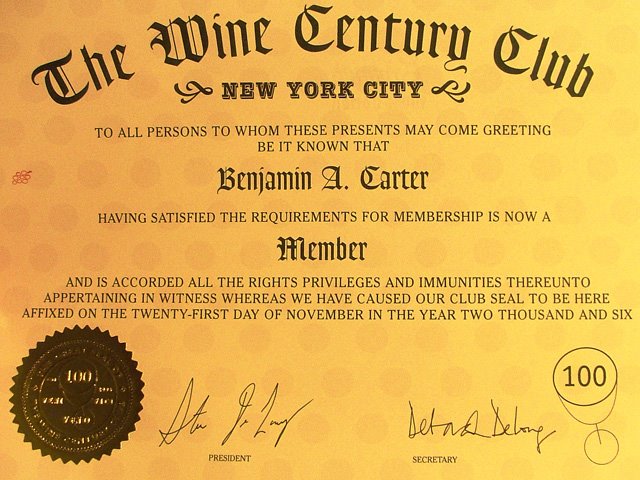 Back in May, I applied for the Wine Century Club, an organization honoring those who have tried at least 100 different grapes. I filled out the application, provided dates and the offer to provide producer, region, and vintage notes on each grape tasted as well.
 Once again, in my defense, several of the odder grapes were tasted as parts of European blends. However, I also tried a few single-varietal wines that were not included on the application form, but I added them and I received credit for those. (I've also tried several more grapes in the interim, and as always welcome any challenge to my tasting of any of these grapes. A friend of mine has a case full of wines from Bulgaria waiting for a tasting, and I can assure you those grapes won't show up on any mainstream list of wines.) And honestly, you could probably spend a month in Italy and taste more than 200 grapes easily.
Since then, I'd completely forgotten about the club. Until today.
Let me set the stage, since so many wine anecdotes involve beautiful women, luscious sunsets, and idyllic landscapes. I prefer to bring a little realism into the wineblogging world.
It was five in the afternoon. I was home from work early, and was dressed in my typical après work garb of khaki shorts and a t-shirt, no shoes. I was in the backyard tending the tomato vines, and my t-shirt was speckled with yellow pollen and the bright green blood of tomato hornworms. To make things more wonderful, it had started raining. I struggled to pick any of the nearly-ripe fruit to avoid any cracking (a big influx of water can cause tomatoes to split). Then I heard the bad brakes and slipping transmission of my local postal carrier, and trod out front to receive the mail. Along with the usual junk mail, bills, and other detritus, there was a large envelope, handlettered, all the way from London!
Once inside, I opened the letter to reveal my certificate admitting me into the Wine Century Club. Even though I'm a member of the New York chapter, the application was processed in London, printed there, and mailed from there. So now I've got to find an A4 frame here in the middle of the United States...
30 August 2006
2004 Piccini Chianti
Based on a warm review from the local wine merchant, I purchased a bottle of the 2004 Piccini Chianti, a steal at $9. It's full DOCG and is made from Sangiovese and Canaiolo. I drank it with some spinach tortellini covered in a freshly prepared alfredo sauce. I added a handful of diced fresh tomatoes and a healthy dose of basil to punch up the flavor. Top it all of with some grated grana padano, and man that was tasty.
The wine has classic Chianti aromas and flavors, but fortunately it escapes the pitfalls of other bargain Italian reds. I'd highly recommend this for any casual Italian dining.
A note on tortellini... I ate handmade tortellini in Italy frequently. The sign of a good trattoria in Tuscany was often an elderly woman in the back corner tenderly tucking little rounds of pasta and filling into delicate shapes. I was spoiled, and didn't eat it much upon my return, finding disappointment at every turn. I've never attempted to make it by hand over here, but I've tried various frozen and fresh varieties without much luck, but finally found an imported Italian version from Gia Russa. (You won't see it on the site, but here's the product.) It's dried but not bone dry; the pasta is slightly flexible. Yet it doesn't have to be refrigerated. Boil for eight minutes, drain, and serve with the sauce of your choice. I'm keeping the leftover pasta and sauce separate, in case I decide to make a nice Bolognese sauce tomorrow.
The wine has classic Chianti aromas and flavors, but fortunately it escapes the pitfalls of other bargain Italian reds. I'd highly recommend this for any casual Italian dining.
A note on tortellini... I ate handmade tortellini in Italy frequently. The sign of a good trattoria in Tuscany was often an elderly woman in the back corner tenderly tucking little rounds of pasta and filling into delicate shapes. I was spoiled, and didn't eat it much upon my return, finding disappointment at every turn. I've never attempted to make it by hand over here, but I've tried various frozen and fresh varieties without much luck, but finally found an imported Italian version from Gia Russa. (You won't see it on the site, but here's the product.) It's dried but not bone dry; the pasta is slightly flexible. Yet it doesn't have to be refrigerated. Boil for eight minutes, drain, and serve with the sauce of your choice. I'm keeping the leftover pasta and sauce separate, in case I decide to make a nice Bolognese sauce tomorrow.
29 August 2006
Lindemans Framboise Lambic
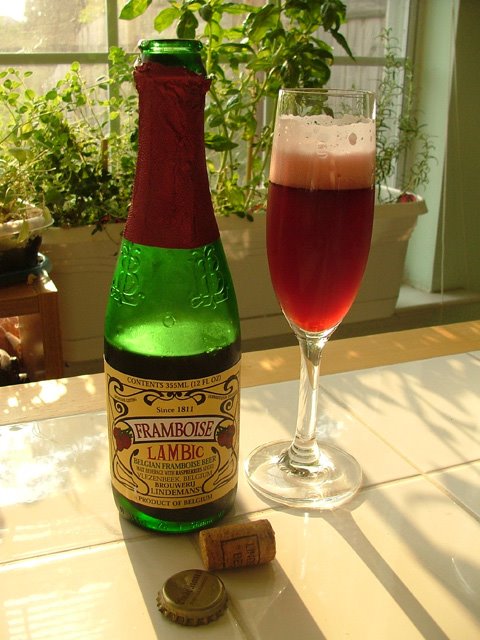 Confession time: this is the first time I've ever had a fruit lambic. I had been a little leery of these over the years, assuming that they would be overly sweet. But a trusted friend demanded I try one, so I picked up a bottle on the way home tonight.
For my first lambic, I chose the Lindemans Framboise Lambic. Obviously this would be a great dessert beer, going well with things like cheesecake or chocolate, but I just had it alone after dinner. Tremendous flavor. The purest, most delicious concentration of raspberry flavors you can imagine, but not any sweeter than real raspberries. Instead you get firm tartness and some earthiness from the hops underneath.
As you can see, it pours beautifully. And in fact, if you didn't know it was a beer, you could probably sneak it in behind something like an Italian brachetto d'acqui or spumante rosso without arousing too much suspicion. Though it's a little pricy for a beer ($6 for this 355mL bottle), it's still cheap compared to a bottle of wine. The store I went to also featured a peach version; I can't wait to try that out.
One last note: this came with a cork and a bottle cap, as you can see in the photo. I've seen some beers that use a champagne-style enclosure with a mushroom cork and a wire cage, as well as some that use a clasp and a rubber or plastic stopper. The cork shown above was smaller than a regular wine cork, and was composed of lots of small bits of cork like a champagne cork, but without the natural disk at the bottom.
27 August 2006
Benito's Carrot Harvest
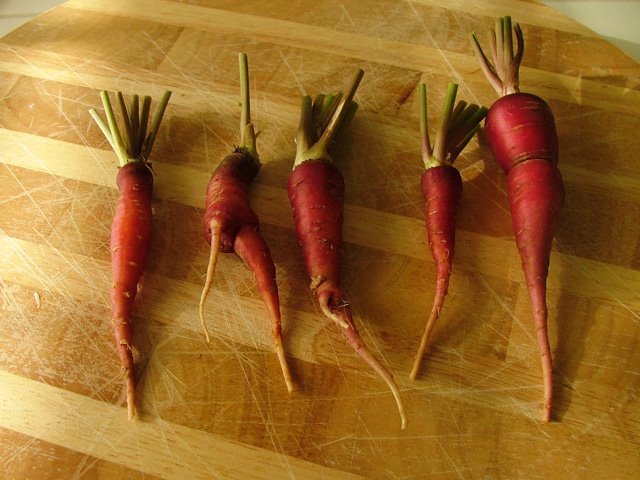 Follow the link below and you can read the story of my attempt to grow odd colored carrots (yes, they're supposed to be purple). Fortunately I didn't put too much effort into this project, so the pitiful results don't bother me too much. I've still got tons of delicious tomatoes coming in!
 Benito's Carrot Harvest
25 August 2006
Combinations #5: Roundup
 Here's the roundup for my first hosting of the Combinations challenge. It's always fun coming up with a recipe for a dinner party, but it's a whole different ballgame coming up with something for a lot of people you've never met to cook. I hope that all of you who participated were able to find ingredients or substitutes easily, and that you enjoyed preparing and eating the meal. I'm delighted to see the range of wines selected for this recipe.
Without further ado, here's the combinations chosen for Grilled Mint Julep Lamb Chops and Slow Cooked Green Beans:
A little lower on this page you can see my entry, using the 2003 Rock Rabbit Syrah. I made this dinner the same day I posted the challenge--just wanted to make sure everything was as good as it sounded in my head.
The first outside entry came in from Mickey at Kitchen Inferno, who opened a bottle of Domaine Drouhin Pinot Noir from Oregon. I recently had a bottle from the Burgundy side of that family, and will have to give this a try.
Next up came a truly southern post via Australian blogger Edward at Wino Sapien. Edward selected the 1994 Black Label Coonawarra Cabernet. The lamb I used in my dish came from Australia, so it all comes full circle.
The final contribution came by way of the Contributions founder, Andrew of Spittoon. He and I were thinking alike, and he used a Syrah/Shiraz, in this case the 2005 Ravenswood Lane Off The Leash Red Max from Australia. Sorry it didn't work out as well for you! On a side note, I've been in several bars (and a few homes) where a spittoon was in use, though not for wine... In the South and West, a spittoon or cuspidor is used for spitting while chewing tobacco, one vice of which I've never partaken. Woe unto he who accidentally knocks over the spittoon on his way out of the bar.
Thanks to all of the participants, and I hope we meet again in a future Combinations challenge.
23 August 2006
2004 V. Sattui Pilgrim Vineyard Lodi Zinfandel
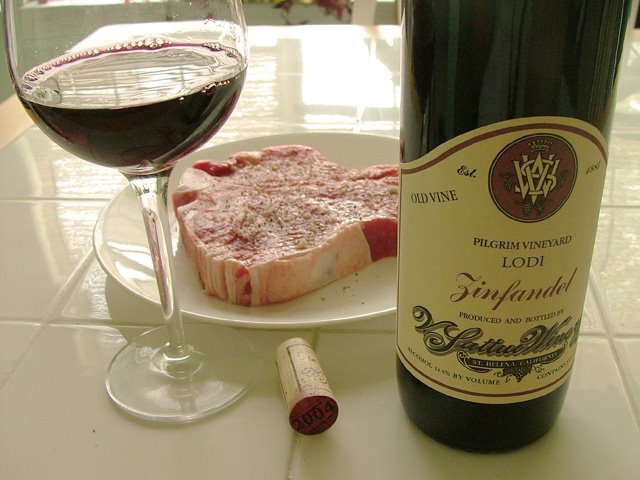 Here's my second report on a Sattui wine, another gift from Dad. Today, for reasons that I won't get into, was a bad day. Had to call in sick to work, lots of automotive repair in the driveway, mowed the yard, repaired the weedeater, and attended to other gloriously fun duties. After all was said and done, I felt like rewarding myself. There was a steak in the fridge, plenty of ripe tomatoes, and a bottle of 2004 V. Sattui Pilgrim Vineyard Lodi Zinfandel. It's also an Old Vine wine. I don't have any real opinions on young versus old vines, though I'm providing the information anyway. Pictured at right you can see the wine and the steak, in this case a decent-sized T-bone. Not my favorite cut of beef, but nothing to sneer at. And yes, I did cook the steak. I enjoy beef rare, but not that rare.
 I usually salt and pepper my steaks before grilling, but I decided to upgrade the procedure a bit. I replaced my old black peppercorns with a much more aromatic blend of white and black peppercorns, and for salt, I used coarse French grey salt. The latter is mostly due to the influence of Michael Chiarello. I didn't use his branded grey salt, but got some from a local spice shop. God, that stuff is delicious. I can eat it straight, and it's wonderful with my tomatoes.
The wine is wonderful. It's definitely a Zin, but even at 14.5% alcohol, it doesn't have a hot aroma or flavor. On the nose I get some leather and a hint of coffee, as well as the rich dark cherry you'd expect. Particularly when paired with hearty fare, this is a remarkably light Zinfandel for its age. Flavors are bold and fruit-forward, but not jammy or succumbing to the California Zin stereotypes. On its own there is a bit of tannic bite on the finish. It's time like this when I wonder why I don't drink more well-made Zinfandel.
21 August 2006
Combinations #5: My Entry + Comments!
First off, I just discovered that I'd hit a setting on the blog that required comments to be verified, but I never received the notifications. So for all of you that have been posting comments over the past couple of months, you should now see them. I'll try to respond to any questions over the next week or so. Honestly, I thought people just stopped commenting!
And let this post serve as a reminder to send in your Combinations entry! Entries are due on the 24th. Due to the international readership, I'm not going to cut off entries at 0000 GMT. However, I'll publish the roundup sometime on the evening of the 25th. Once again, you can e-mail me or you can drop a comment in this or the original thread.
 Here's what I did for my own Combinations challenege... I followed the recipes I laid out in the initial post, though I cooked the chops a little differently. I did use the grill, but banked all the coals on one side. I heavily seared both sides of each chop, and them moved them over to the cool part of the grill to allow indirect heat and smoke to finish them off. In order to provide aromatic smoke, I used an old stave from a red wine barrel. (These are pretty cool, but having them around the house makes it look like I'm awaiting a vampire invasion.)
For some bread, I decided to make johnnycakes. For those of you overseas, johnnycakes are essentially pancakes made with cornmeal. The name is a matter of some debate, but many believe the term to be a corruption of journey cakes, meaning that you'd make a batch before going on a long trip, which in the colonial period meant walking or riding a horse.
Johnnycake tends to be more of a Yankee term. Around here, we call them hoe cakes, as in you could cook them on the back of your hoe (a farming implement, not a woman of ill repute) while taking a break from working in the fields. Don't believe me? You can order the mix online, though they're dead simple to make from scratch.
For the wine, I chose the 2003 Rock Rabbit Syrah from the Central Coast region of California. First off, I felt an American wine was appropriate, though those from the South tend to be lacking. And I love Syrah with lamb--something about those black pepper and dark fruits seem to be a perfect fit for the aromatic flavor of grilled lamb. Rock Rabbit Syrah can generally be found for $10-13, and is one of my favorite bargain wines.
My dining companion and I polished off two lamb chops a piece, and they were delicious. The sauce worked out well, the beans were savory and amazing, and the johnnycakes were pure heaven with some soft butter and honey.
Remember, send me your entries by August 24th for inclusion in my final wrap-up!
And let this post serve as a reminder to send in your Combinations entry! Entries are due on the 24th. Due to the international readership, I'm not going to cut off entries at 0000 GMT. However, I'll publish the roundup sometime on the evening of the 25th. Once again, you can e-mail me or you can drop a comment in this or the original thread.
 Here's what I did for my own Combinations challenege... I followed the recipes I laid out in the initial post, though I cooked the chops a little differently. I did use the grill, but banked all the coals on one side. I heavily seared both sides of each chop, and them moved them over to the cool part of the grill to allow indirect heat and smoke to finish them off. In order to provide aromatic smoke, I used an old stave from a red wine barrel. (These are pretty cool, but having them around the house makes it look like I'm awaiting a vampire invasion.)
 For some bread, I decided to make johnnycakes. For those of you overseas, johnnycakes are essentially pancakes made with cornmeal. The name is a matter of some debate, but many believe the term to be a corruption of journey cakes, meaning that you'd make a batch before going on a long trip, which in the colonial period meant walking or riding a horse.
Johnnycake tends to be more of a Yankee term. Around here, we call them hoe cakes, as in you could cook them on the back of your hoe (a farming implement, not a woman of ill repute) while taking a break from working in the fields. Don't believe me? You can order the mix online, though they're dead simple to make from scratch.
For the wine, I chose the 2003 Rock Rabbit Syrah from the Central Coast region of California. First off, I felt an American wine was appropriate, though those from the South tend to be lacking. And I love Syrah with lamb--something about those black pepper and dark fruits seem to be a perfect fit for the aromatic flavor of grilled lamb. Rock Rabbit Syrah can generally be found for $10-13, and is one of my favorite bargain wines.
My dining companion and I polished off two lamb chops a piece, and they were delicious. The sauce worked out well, the beans were savory and amazing, and the johnnycakes were pure heaven with some soft butter and honey.
Remember, send me your entries by August 24th for inclusion in my final wrap-up!
11 August 2006
2003 V. Sattui Napa Valley Cabernet Sauvignon
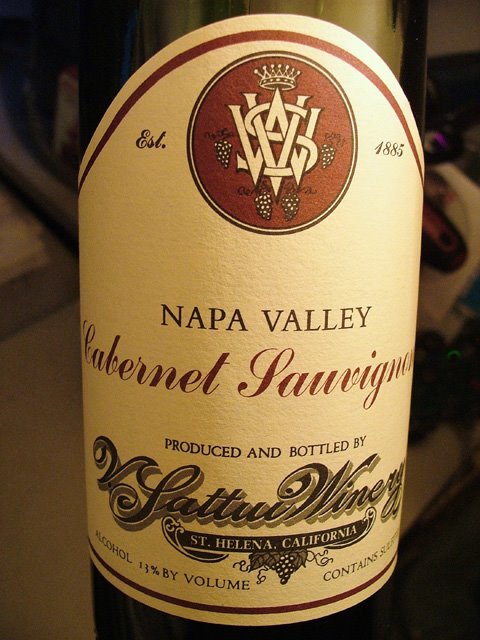 When I think about my wine firsts, I can generally credit Vittorio Sattui Winery from the Napa Valley. Dad started getting sampler cases from this winery every year when I was around twelve, and by the age of fourteen (circa 1990), when I got serious about cooking and curious about wine, I started getting a chance to try some of those wines. As a teenager, my favorites were the Johannesburg Riesling and the Gamay Rouge (the latter perhaps sparking an early love with rosé). I got to cook with some of the Chardonnay, and started to appreciate the subtle flavors in Cabernet Sauvignon beyond the big tannins and bold presence.
 Note: V. Sattui wines are only available at the winery or via mail order, so don't go asking for them at your local wine shop.
Dad hasn't been receiving these wines every year since then, but once in a while he gets a case. And thus it comes to pass that I was given a bottle of the 2003 V. Sattui Napa Valley Cabernet Sauvignon, along with the admonition to eat it with a decent piece of meat. Fear not, Dad.
I fixed a simple yet delicious supper: grilled ribeye with a simple salad. The ribeye was about an inch thick, boneless, dark red, and heavily marbled. Cooked medium rare over hot coals after seasoning with good salt and pepper. For the salad, I used some spring mix, some of my microgreens, a dash of homegrown cherry tomatoes, some shredded Parmesan cheese, and a freshly made balsamic vinaigrette (with just a dash of honey).
Pure heaven.
And as for the wine? Delicious. Deep cassis aroma with just a hint of fig. The flavors amplify those aromas, with a little black cherry added. It's quite smooth with a hearty meal, though on its own the tannins will dry your mouth a bit. Very deep color with good structure and balance. While amazing now, I'd love to see how this tastes in a few years.
06 August 2006
NV Simonnet-Febvre Crémant de Bourgogne
Here's my entry for Wine Blogging Wednesday #25. It's not technically a Champagne, but it's only about 60km from the edge of the region. I politely requested an honorable mention in the writeup, but I don't want to screw anything up and cause the first major blogging scandale of the wine blogosphere.
This was an impulse purchase, as I find it hard to pass up a bargain sparkling wine from a region that knows how to make it... Thus I find myself in possession of a $13 bottle of NV Simonnet-Febvre Crémant de Bourgogne from the region of Chablis, France. The main site is still under development. It's made from 60% Chardonnay and 40% Pinot Noir. It's got a yeasty aroma, with crisp lemony flavors and fairly large bubbles. A short finish, and when served ice cold, quite refreshing.
What was the occasion for opening it tonight? Mom and Dad took out the girlfriend and me for dinner. We ate at Pasta Italia in Collierville, a suburb of Memphis. It's a sort of classic northern Italian trattoria run by a chef from Modena, Michele D'Oto. He came by the table, and I got to break out my college Italian, much to the amusement of the girlfriend, who got kissed on the hand by the chef. Signore D'Oto and I chatted for a while, and over the course of the evening I got to talk to the other Italian employee as well as a few fellow diners from the old country.
(And I've mentioned this before, but I don't have a drop of Italian blood in me. I've been to Italy, I love the food, I speak the language fairly well, and use the nickname Benito. I'm not trying to mislead anyone, but I love hanging out with Italians.)
Dad and I each knocked back a bottle of the 2003 Castello di Brolio Chianti Classico, a great entry-level Chianti that's remarkably mellow and well-rounded for such a young Italian wine. Dad and I also had the osso buco, while the women went for pasta. Great food, and the dinner was ended with Vino Brulé, a hot mulled wine. (Or try your luck with an original Italian recipe.)
Dinner took a good two hours--that may seem rough for American diners, and in fact, Mom was getting a little impatient at first, but I loved it. When I was in Italy I adored the long, leisurely dinners with plenty of wine. You spend more time talking with each other, with the waiters, the owner, fellow diners, the guy dropping off a last minute delivery of fish for the fritto misto... I don't think I had a single dinner over there that lasted less than an hour. And those are the meals you really remember. Not the ones cooked in five minutes and wolfed down in ten.
Fortunately, the girlfriend was driving, and dropped me off at the house after dinner. I got comfortable, and while full from dinner, still wanted to extend the warm feeling for a while. I didn't have any still wine in the house, and didn't want to sip Bourbon, but I had a classy sparkler sitting in the fridge. And thus I popped the cork on the Simonnet-Febvre Crémant de Bourgogne, poured it in a Champagne flute, and started writing this post.
Two glasses later, I'm a happy ragazzo. Alla tua salute!.
This was an impulse purchase, as I find it hard to pass up a bargain sparkling wine from a region that knows how to make it... Thus I find myself in possession of a $13 bottle of NV Simonnet-Febvre Crémant de Bourgogne from the region of Chablis, France. The main site is still under development. It's made from 60% Chardonnay and 40% Pinot Noir. It's got a yeasty aroma, with crisp lemony flavors and fairly large bubbles. A short finish, and when served ice cold, quite refreshing.
What was the occasion for opening it tonight? Mom and Dad took out the girlfriend and me for dinner. We ate at Pasta Italia in Collierville, a suburb of Memphis. It's a sort of classic northern Italian trattoria run by a chef from Modena, Michele D'Oto. He came by the table, and I got to break out my college Italian, much to the amusement of the girlfriend, who got kissed on the hand by the chef. Signore D'Oto and I chatted for a while, and over the course of the evening I got to talk to the other Italian employee as well as a few fellow diners from the old country.
(And I've mentioned this before, but I don't have a drop of Italian blood in me. I've been to Italy, I love the food, I speak the language fairly well, and use the nickname Benito. I'm not trying to mislead anyone, but I love hanging out with Italians.)
Dad and I each knocked back a bottle of the 2003 Castello di Brolio Chianti Classico, a great entry-level Chianti that's remarkably mellow and well-rounded for such a young Italian wine. Dad and I also had the osso buco, while the women went for pasta. Great food, and the dinner was ended with Vino Brulé, a hot mulled wine. (Or try your luck with an original Italian recipe.)
Dinner took a good two hours--that may seem rough for American diners, and in fact, Mom was getting a little impatient at first, but I loved it. When I was in Italy I adored the long, leisurely dinners with plenty of wine. You spend more time talking with each other, with the waiters, the owner, fellow diners, the guy dropping off a last minute delivery of fish for the fritto misto... I don't think I had a single dinner over there that lasted less than an hour. And those are the meals you really remember. Not the ones cooked in five minutes and wolfed down in ten.
Fortunately, the girlfriend was driving, and dropped me off at the house after dinner. I got comfortable, and while full from dinner, still wanted to extend the warm feeling for a while. I didn't have any still wine in the house, and didn't want to sip Bourbon, but I had a classy sparkler sitting in the fridge. And thus I popped the cork on the Simonnet-Febvre Crémant de Bourgogne, poured it in a Champagne flute, and started writing this post.
Two glasses later, I'm a happy ragazzo. Alla tua salute!.
My Tomatoes
 For those readers who have been following the progress of my unusual tomato varieties, I have a big update. Follow that link, and you'll see photos of each of the six different tomatoes I've been growing this summer, complete with all sorts of data. And yes, I've got tasting notes to go with them.
This project has been a lot of fun. Not only has it been immensely relaxing to come home from work every day and tend the vines, but I never could have anticipated the great pleasure I would get in giving away luscious, ripe tomatoes to friends, family, and neighbors. And most of these are the kinds of tomatoes you can't exactly find in the grocery store, so it's a unique and delicious treat for those who get to eat them.
I may have mentioned this before, but all of these tomatoes were grown perfectly organically. The seedlings weren't certified organic, nor can I technically call them organic based on the USDA specifications, but I planted them in ground I tilled by hand, and have fertilized them with nothing but compost I've made on my own out of grass clippings and vegetable-based table scraps. This wasn't an ethical decision, and I purchase a lot of produce both organic and not, or local-farm-raised-but-not-technically-organic. However, I love the idea of being able to eat my tomatoes straight off the vine, free from pesticides, herbicides, or other chemicals. And as for the compost, well, that's free and makes good use of refuse that would otherwise go in the trash.
Tasting Notes for August 5, 2006
The theme for this blind tasting was South America.
Wine 1: 2005 Casa Silva Sauvignon Blanc. Colchagua Valley, Chile. Powerful fruit, mostly peach flavored but dry, light, and refreshing. Lovely wine. $15.
Wine 2: 2005 Casa Lapostelle Sauvignon Blanc. Casablanca Valley, Chile. Thin and creamy, slightly bitter finish. $13.
Wine 3: 2004 Marques de Casa Concha Chardonnay. Maipo Valley, Chile. Thin, mild wine. Some banana aromas and flavors with a hint of lemon. $17.
Wine 4: 2004 Finca La Escondida Reserva Chardonnay. San Juan, Argentina. Buttered toast aromas, mild flavors and smooth finish. Classic Chardonnay. $16.
Wine 5: 2005 Don Rodolfo Torrontés. Argentina. No website found. Honey and flower aromas, dry but with full fruit flavors. Wonderful. $12.
Wine 6: 2004 Tikal Patriota Bonarda-Malbec. Mendoza, Argentina. Black cherry, dry and complex. Medium tannins and overall excellent balance. $26.
Wine 7: 2003 Antis Malbec. Mendoza, Argentina. Dry and mild, very thin with a few hints of raspberry. $15.
Wine 8: 2004 Paul Hobbs El Felino Malbec. Mendoza, Argentina. Plum aromas and flavors, great construction. Nice wine. $31.
Wine 9: 2004 Ruca Malen Yauquen Cabernet Sauvignon-Malbec. Mendoza, Argentina. Great black cherry flavors, firm tannins, and a long finish. Oddly savory for an inexpensive wine. $10.
Wine 10: 2005 Altos Las Hormigas Malbec. Mendoza, Argentina. Harsh alcohol/cough syrup aroma, but a fruity and slightly creamy taste. Mild tannins. Might need some time to breathe and open up. $15.
Wine 1: 2005 Casa Silva Sauvignon Blanc. Colchagua Valley, Chile. Powerful fruit, mostly peach flavored but dry, light, and refreshing. Lovely wine. $15.
Wine 2: 2005 Casa Lapostelle Sauvignon Blanc. Casablanca Valley, Chile. Thin and creamy, slightly bitter finish. $13.
Wine 3: 2004 Marques de Casa Concha Chardonnay. Maipo Valley, Chile. Thin, mild wine. Some banana aromas and flavors with a hint of lemon. $17.
Wine 4: 2004 Finca La Escondida Reserva Chardonnay. San Juan, Argentina. Buttered toast aromas, mild flavors and smooth finish. Classic Chardonnay. $16.
Wine 5: 2005 Don Rodolfo Torrontés. Argentina. No website found. Honey and flower aromas, dry but with full fruit flavors. Wonderful. $12.
Wine 6: 2004 Tikal Patriota Bonarda-Malbec. Mendoza, Argentina. Black cherry, dry and complex. Medium tannins and overall excellent balance. $26.
Wine 7: 2003 Antis Malbec. Mendoza, Argentina. Dry and mild, very thin with a few hints of raspberry. $15.
Wine 8: 2004 Paul Hobbs El Felino Malbec. Mendoza, Argentina. Plum aromas and flavors, great construction. Nice wine. $31.
Wine 9: 2004 Ruca Malen Yauquen Cabernet Sauvignon-Malbec. Mendoza, Argentina. Great black cherry flavors, firm tannins, and a long finish. Oddly savory for an inexpensive wine. $10.
Wine 10: 2005 Altos Las Hormigas Malbec. Mendoza, Argentina. Harsh alcohol/cough syrup aroma, but a fruity and slightly creamy taste. Mild tannins. Might need some time to breathe and open up. $15.
04 August 2006
Combinations #5: Combinations Goes South
 Andrew has asked me to host this round of the Combinations food and wine challenge, and given that I've lived in Memphis, Tennessee my entire life, I decided to come up with a Southern cuisine-inspired meal. This provides some unique challenges, as many of the ingredients that define your more traditional and delicious Southern meals are regional specialties that aren't necessarily available across the US, much less overseas. So I've attempted to come up with something that should be doable for everyone, and I've tried to include some alternate options in case you can't find something.
The meal: Grilled Mint Julep Lamb Chops with Slow Cooked Green Beans
Quantities are set to feed two, you should be able to adjust from there for larger groups
I wanted to put together a meal that shied away from the standard Southern stereotypes (everything fried, covered in gravy, etc., not that those things aren't delicious when cooked properly), while at the same time building on some of our strengths: the lamb dish is grilled, and the sauce is a sort of high-class BBQ sauce. The side dish is definitely traditional, but there's a chance you haven't had beans like this if you haven't visited the South.
Note:The day before cooking, take about a half cup/125mL of Bourbon (or Jack Daniels or whatever whisky/whiskey you have available and put it in a jar or separate bottle. Add in a small handful of torn fresh mint leaves, and allow to steep overnight. When you're ready to prepare the sauce, strain the Bourbon and discard the leaves.
Slow Cooked Green Beans
You'll want to start these at least an hour before you want to serve dinner
- 1 quart/1 liter of fresh green beans, washed with the ends snapped off (frozen can be substituted, but fresh is always better)
- 1 ham hock (a smoked pig ankle--substitute a large handful of diced salt pork, ham or lightly cooked bacon if necessary)
- 1/2 diced onion
- dash of sugar
Grilled Mint Julep Lamb Chops
- 1/2 cup/125mL Bourbon (see note above)
- 1 small handful torn mint leaves (see note above)
- 1/4 cup/60mL molasses (substitute sorghum or honey if necessary)
- 1/2 cup/125mL Dijon mustard
- 4 lamb loin chops (mine were about an inch/2.5cm thick)
- salt and pepper
Your entries are due on August 24. Just e-mail me with the word "Combinations" in the subject line and I'll include your various responses.
To clarify two of the ingredients, here's some photos. When I talk about green beans, I'm talking about these:

They may be longer, shorter, thicker, thinner, all depending on variety and local season. They may also be known as string beans, French beans, pole beans, filet beans, bush beans, snap beans... These are all slightly different, but most should work for this recipe. Just don't cook them as long if you're using thin, delicate beans.
And here's what a ham hock looks like:

If you've got a dog, this may look like something in the "smoked animal parts" section of your local pet store. However, these are pretty easy to get here in the South. This one cost me 75¢. Now, once again, don't go crazy trying to find these wherever you happen to be. Above I suggested using a handful of diced salt pork, ham or cooked bacon. There's got to be some sort of cured pork product available locally to you. If you've got a local butcher who sells ham, you can ask for one of the small end pieces, or you can even use the bones from something like a spiral sliced ham.
02 August 2006
2003 Bogle Phantom & Happy Birthday Paul!
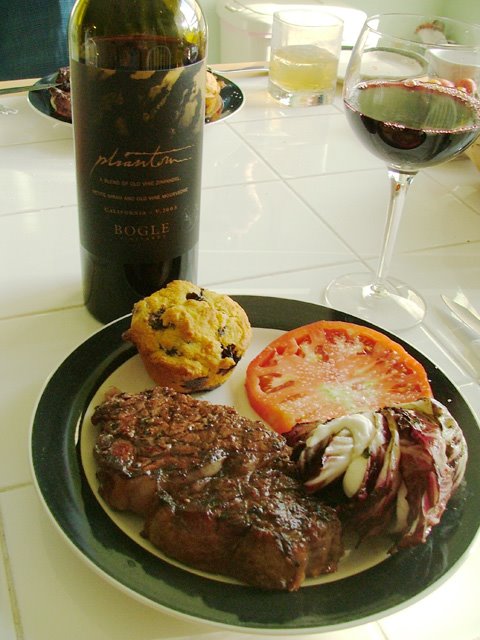 Dinner tonight was a spur of the moment idea. I had a bottle of wine sitting around waiting for the proper meal. I had a 1.25 lb ribeye resting in the fridge. It was my best friend's birthday (or close to it), and my biggest tomato had reached a state of perfect ripeness. Some would call this a perfect storm; I called it dinner. I dropped Paul an e-mail last night, he responded in the affirmative, and dinner was on.
 Nothing special was done with the meat, aside from the usual ground pepper and kosher salt on the outside, as well as letting it rest at room temperature for half an hour before being grilled over hot coals until nicely rare. The tomato shown in the photo is a slice from my biggest Brandy Boy specimen, weighing in at little over a pound (about half a kilogram) and dusted with kosher salt. Also pictured are some blueberry corn muffins (recipe may follow some day), as well as some grilled radicchio quarters with fresh mozzarella, using a recipe from the great Michael Chiarello. Everything had powerful flavors and deep intensity. In the background, you might see the remnants of a mint julep in a highball glass. I had bourbon, and lots of mint, and sugar in the pantry. Plus it's hot outside, so why not?
Paul's a big fan of the Bogle Petite Sirah, so I served the 2003 Bogle Phantom. I've been extremely happy with all of Bogle's $10 offerings, and this was my first foray into their higher end line. The label is dark and mysterious, but it's a really delightful wine. This is a mixture of 59% Petite Sirah, 39% Old Vine Zinfandel, and 2% Old Vine Mourvèdre. Surprisingly mild beginning, with a full bodied mouth feel and a slightly tart finish. 14.6% alcohol, so it's a little strong, but not overly harsh. Deep, dark plum and cherry flavors, some blackberries. The Zinfandel really helps with the body, providing a rich full experience without being too much. Elements of leather and tobacco show up later in the drinking of this wine. I'm really impressed with this wine, and it went exceptionally well with the unique meal at hand.
01 August 2006
Healdsburg Wines
Last November and December, I blogged about three wines that I got from my father. He'd recieved a sampler case from Healdsburg, California, and passed along a few to me. To recap, the wines reviewed were as follows, with pricing that was absent from the initial posting:
2004 Duxinaro Chardonnay $10
2003 Mama Mia Zinfandel $25
2002 Avenue Cabernet Sauvignon $35 (I'm really proud of that article, by the way)
Recently, I got an e-mail from Christie Love, who works in sales for these wines. Here's her contact info. And just to recap, I'd highly recommend all three of these wines, especially teh Avenue Cabernet Sauvignon.
Christie Love
The Wine Shop
331 Healdsburg Ave.
Healdsburg, CA 95448-4105
888-394-9463
707-485-7073 (Direct dial)
2004 Duxinaro Chardonnay $10
2003 Mama Mia Zinfandel $25
2002 Avenue Cabernet Sauvignon $35 (I'm really proud of that article, by the way)
Recently, I got an e-mail from Christie Love, who works in sales for these wines. Here's her contact info. And just to recap, I'd highly recommend all three of these wines, especially teh Avenue Cabernet Sauvignon.
Christie Love
The Wine Shop
331 Healdsburg Ave.
Healdsburg, CA 95448-4105
888-394-9463
707-485-7073 (Direct dial)
Subscribe to:
Posts (Atom)