A day late, but here's the list of wines consumed over the Fourth of July weekend at the R family estate. By the way, I took pictures of all the bottles beforehand, and thus didn't have to take extensive notes on the wine labels. Sometimes people get impatient if you're writing down a ton of information from a French or German wine label and their glass hasn't been filled yet. Also, these notes aren't incredibly detailed, because I was busy cooking, clearing dishes, and talking to everyone as well.
2002 Brau De Bot Vi Jove Blanc. Catalonia, Spain. No online information found, but it's 90% Macabeu and 10% Chardonnay. A nice earthy nose, light acids, full body, and pleasant flavor and finish. Drunk as a cool sipper while hanging out in the afternoon.
2004 Forefathers Sauvignon Blanc. Marlborough, New Zealand. Good and crisp, light lemon flavors. Clean with an even finish. Another sipper.
2004 Vidanueva Rosado. Rueda, Spain. I reviewed this back in June and wasn't impressed, but someone convinced me to try it again. It's pure Tempranillo with some light berry flavors. I enjoyed it better this time around, I think it needed to warm up from the chill at the tasting. Reaction to the wine was mixed, but I'm glad everyone tried it. Part of my continuing rosé ministry.
(Funny thing: at this point in my wine notes, I've got a page with a listing of how everyone wanted their rib roast cooked Friday night for dinner. The following four Bordeaux wines were served with the prime rib and mostly finished after dinner.)
2000 Château D'escurac Médoc Cru Bourgeois. Bordeaux, France. 60% Cabernet Sauvignon and 40% Merlot. My favorite of the evening and perhaps of the weekend. Lovely vegetal nose, with those classic Medoc tomato leaf smells. (I'm intimately familiar with tomato leaves these days, and often finish up in the garden with tomato blossom pollen all over me.) Great dark intense flavor.
2000 L de La Louvière Grand Vin de Graves. Bordeaux, France. 64% Cabernet Sauvignon, 30% Merlot, 3% Cabernet Franc and 3% Petit Verdot. If you don't mind reading in French, here's some more detailed information. This was more tannic than the Medoc, but had a nice and smooth finish. Excellent claret-style flavor. Would that I had taken the time to note all the complexities at work here.
2002 Château Maucaillou Moulis. Bordeaux, France. The name Maucaillou means "bad stones". The link will take you to the official website, but it's one of those annoying Flash jobs. If you want more detailed information--once again en français--you know what to do. This one is 58% Cabernet Sauvignon, 35% Merlot, 7% Petit Verdot. Lighter than the previous two Bordeaux selections, this had great fruit flavors, light tannins, and was a very easy drinker.
1997 Château Mayne Lalande Listrac-Médoc. Bordeaux, France. 45% Cabernet Sauvignon; 45% Merlot; 5% Cabernet Franc; 5% Petit Verdot. Good and peppery, very well balanced. Beautifully aged. Always a pleasure to drink a wine that's been well cared-for.
Fitz-Ritter Riesling Spätlese. Pfalz, Germany. The link takes you to the official website, but you won't find this particular wine there. It was custom made in a limited run for the 1st Battalion, ___th Aviation Regiment of the US Army. (Again, details left out to spare the innocent.) This is a Halbtrocken wine, meaning that it's half dry... or half sweet, depending on your perspective. Clear and crisp, and the light sweetness made this an incredible afternoon sipper.
2004 Pierre Sparr Gewürztraminer. Alsace, France. Lightly sweet, with good spice characteristics. This was served with the root vegetable soup, if I remember correctly.
2004 Black Swan Chardonnay. South Eastern Australia. A standard Chardonnay, with a touch of Verdelho. Used to make the aforementioned soup.
2003 Georges Dubœuf Fleurie. Beaujolais, France. The main site doesn't have much information, but you can always read elsewhere. Fleurie is a wonderful wine, and I smile everytime I drink a higher-end Beaujolais. Very light and dry. A touch of the famous banana aroma, but there are hints of strawberry and cherry. Slightly drying tannins, but those are necessary for aging. Served with the bacon-wrapped scallops and affiliated side dishes.
(Note: the remaining wines were drunk with the pork tenderloin and acorn squash.)
2002 Croix du Mayne Cahors. Cahors, France. 85% Malbec and 15% Merlot. A kind gift from Tom, who knows my love of Malbec and inability to get any French Malbec (pretty much confined to Cahors) here in Memphis. The first Cahors he got me was oxidized, but this bottle was a winner. Light plum flavors, mild tannins, deep dark color. Fantastic structure. If I ever make it to France, I'm going to try to spend a weekend in this region and see what they eat with this style of wine.
2002 Joseph Drouhin Chorey les Beaune. Burgundy, France. Light and mellow, black cherry flavors were prominent. Firm, drying tannins.
2004 Iris Hills Pinot Noir. Willamette Valley, Oregon. Full bodied, strawberry aromas and flavors dominate. I'd suggested Pinot Noir for the pork, and between this and the Burgundy I think we were well covered. If I had unlimited funds, I think I'd drink a lot more Oregon wine than I do right now. So much of it is made in small production runs on small, independent vineyards. Naturally it's more expensive that way, but I love the stuff.
One final wine before we switched to the Ports described in the previous post...
1996 Königshof Riesling Auslese Bopparder Hamm Feuerlay. Mittelrhein, Germany. Couldn't find any solid information on this wine, and I spent fifteen minutes reading in German. Light and crisp, with honey and lemon flavors. Not too sweet. Some apple flavors became present on the finish. It was a lovely color, though I recall that the Riesling experts suggested that it needed some more time on the rack.
That does it for the Fourth of July roundup... With luck we can all get together sometime next year. If not, I'm sure we'll be toasting each other for the next few bottles we all open separately.

08 July 2006


06 July 2006
Fourth of July Weekend
I spent the Fourth of July Weekend near Nashville with the R family (last name truncated to protect the innocent). My buddy Paul grew up with the guys in this family, and we were invited up for the weekend. Part of the bargain was that if I cooked both nights, the family cellar would be open for whatever food was served. With a couple hundred well-aged bottles in wait, how could I say no?
The first night, I slow roasted a prime rib roast. Roughly 12 pounds, about two feet wide. It took me a good five hours just to get it rare, but it was worth it. Served with creamed mashed potatoes and fresh green beans.
We had cold slices of the beef for lunch Saturday (whole wheat bread, horseradish sauce and green leaf lettuce--awesome), and for dinner that night, I started out with a root vegetable soup. It was supposed to be vichyssoise, but I had a few more diners than expected, and it smelled and tasted too good to strain and chill. Essentially, the soup was good chicken stock with three sauteed leeks and some garlic cloves, five russet potatoes, a parsnip, and a good chunk of fresh ginger. After long simmering and immersion blending, I added two cups of cream. This was quite popular, even though I'd never cooked it before that evening.
For the first course, I grilled bacon-wrapped scallops, served with some asparagus and twists of lemon and lime. Jenny was kind enough to make a caprese salad with fresh sliced Ripley tomatoes, garden fresh basil, and some good fresh mozzarella. Yes, it was indeed fresh and delicious.
The main course was roast pork tenderloin, cooked medium rare with just some cracked black pepper and homegrown oregano on top. Some diners were hesitant at the pink middle, but I showed the digital probe thermometer and everyone soon pronounced it the most tender and flavorful pork they'd ever had. On the side, I made some roast acorn squash with butter and sorghum, and as a sauce for the pork (served sliced in medallions), I mixed bourbon, Dijon mustard, and some homemade peach jelly from the Farmer's Market. (That combo is rapidly becoming one of my favorite sauces for grilled pork or lamb.)
But what, you may ask, about the alcohol? I'm getting there... Like I said, it was a long weekend, and I had access to a veritable treasure trove of fermented beverages. So I'm going to be mean and save the wine for last. None of this is in chronological order, or any other order for that matter, but I'm going to group them roughly by categories.
First, I'll start with the cigar. The gentlemen present gathered after dinner on Friday for cigars and fortified beverages. Paul wanted to buy the cigars, so I recommended the Romeo y Julieta Bully, a maduro hand-rolled cigar made from an Indoesian wrapper and Dominican filler. I'm not a cigar expert, but I know what I like: a short, thick, full-flavored cigar. I only smoke a few a year, but when I do, I like it to taste and smell good, and at the same time, I don't want to spend two hours smoking it. Just writing about it makes me crave another one... My precioussssssss...
Next, the beers. For lunch with the cold roast beef sandwich, I grabbed a Sierra Nevada Pale Ale, an old favorite from the company that helped start the microbrewery revolution over two decades ago. Crisp, slightly bitter, and great served cold. Late both evenings, to top things off, we sampled the Flying Dog Gonzo Imperial Porter, which I reviewed back in May. Deep, flavorful, complex, and excellent at room temperature, served in a wine glass or brandy snifter.
Thirdly, the liquor. I brought along a bottle of the 1792 Ridgemont Reserve Bourbon, an eight-year old Bourbon in an attractive bottle with a natural wood/cork stopper and a ring of burlap around the neck. Smooth with classic Bourbon aromas and flavors, and a clean finish. I sipped on this while cooking for much of the weekend. Also very affordable--$20 here in Memphis for a 750 mL bottle.
The only bad liquor I had all weekend was some Courvoisier Napoleon. It smelled like decent Cognac, but tasted like cheap brandy. Strong burning sensation on the way down.
A nice treat: brother Dave had a bottle of Nicaraguan rum. I'm a rum fanatic, and I loved this stuff. As near as I can tell from the native label vs. the website, we were drinking the Ron Flor de Caña 5 Year Old Black Label. It had a delicious sugarcane flavor, but was lightly spiced like cake. Smooth and delicious.
Dave also had a bottle of Grasovka vodka from Poland. It's flavored from buffalo grass. Now, I'm not a vodka fan. I don't mind drinking it, but I prefer something with more flavor. But this was awesome. The bottle actually has a stalk of buffalo grass in it. The flavor is creamy and grainy with light grassy elements. Vanilla hints top off the aroma. Strangely tasty, and I'm really glad I got to try this. Not sure of its availability outside of Europe.
Finally, the absinthe. Tom brought back two bottles of absinthe from Europe, one green, one red. To skirt past customs, he peeled off the labels and attached handwritten ones bearing the titles "Apfel Schnapps" and "Kirsch Wasser". We prepared it in the traditional French manner, five parts cold water poured over a sugar cube into one part absinthe. We only tried the green absinthe. The first couple of sips were fun--strong anise flavor, very bitter. With all the water, it's not that strong in terms of alcohol. As it warmed, it didn't taste as good. I also tried it with more sugar (too sweet) and straight (pretty goddamned strong). I can't say that I'll be drinking it again anytime soon, but I'm definitely glad for the opportunity to try it. And none of us became great artists or went crazy after drinking it.
On to the Ports! We enjoyed the old standby Yalumba's Galway Pipe. This is affordable, tasty, and classy. Available everywhere, mostly 12-14 years old, and fantastic. We all loved this tawny Port, until...
Mike grabbed two bottles of the Penfolds Grandfather Fine Old Liqueur Tawny. It pours sort of a ruby color but the flavor is pure tawny, blended in part from Ports that are 30-40 years old. Great raisin flavors, and very smooth. Made from Shiraz and Mourvèdre. Nice side note: it is plugged with a natural cork (and the top is sealed in wax), but the box also comes with a separate cork-based stopper for plugging the bottle after the initial opening. Friendly touch there. Runs around $70, and we mostly killed a bottle on the second night.
And the wines? But what about the wines? Please, for the love of God, write about the wines! And I will... Sometime Friday.
Tomato Update
 Here's an update of the tomato crop here at Casa de Benito... I don't think I gave the link in my prior posting, but you can click the links for June 12 and today. Right now I've got over 150 tomatoes growing, and can't wait to eat them throughout the summer. After writing up this essay, I picked the two slightly ripe ones and brought them inside to ripen on their own.
04 July 2006
Wine Blogging Wednesday #23
So the theme is pair a wine with BBQ... Luckily, I was doing some barbecuing tonight in honor of the Fourth of July and we were also celebrating my girlfriend's birthday. I smoked ten pounds of Danish spare ribs, using a blend of hickory, apple, cherry, and sassafrass. They sat on the smoker for about four hours, and emerged delicious. Side dishes were simple: store-bought potato salad and cole slaw with some rolls (thanks, Paul!). I made the cake from scratch, and unfortunately don't have any pictures. The bottom layer was chocolate cake, the top layer was white chocolate, and it was covered in buttercream frosting--all made from scratch. I decorated the top with thin slices of kiwi and strawberry.
 For the wine, I chose the Banrock Station Sparkling Chardonnay. This is a longtime favorite of mine, and can generally be found around here for $6-8. I like it with things like BBQ, fried chicken, chicken wings, etc. It's light and crisp, great served cold, and the sparkling character and decent acidity really cut through the grease. I also really like to use it as a starting beverage for casual dinner parties. As soon as everyone shows up, you pop a bottle of bubbly and everyone is immediately interested. It's not New Year's or a wedding, is it OK to drink sparkling wine? Hell yeah, and it goes great with those little fried appetizers.
 For the wine, I chose the Banrock Station Sparkling Chardonnay. This is a longtime favorite of mine, and can generally be found around here for $6-8. I like it with things like BBQ, fried chicken, chicken wings, etc. It's light and crisp, great served cold, and the sparkling character and decent acidity really cut through the grease. I also really like to use it as a starting beverage for casual dinner parties. As soon as everyone shows up, you pop a bottle of bubbly and everyone is immediately interested. It's not New Year's or a wedding, is it OK to drink sparkling wine? Hell yeah, and it goes great with those little fried appetizers.
23 June 2006
Combinations #3: Flatbreads with Spiced Chicken, Pistachios and Roasted Peppers
It's time for Combinations #3, hosted by the chaps from Leeds. I missed the second one--a combination of work and forgetfulness got in the way, but Andrew was kind enough to remind me about it this month.
Speaking of which, if you go to Andrew's site, you can see the official Combinations logo, which I designed. I submitted a handful of designs to Andrew, he picked one, I refined it, and you can see the final result:

And here's my favorite alternate:
And the one that was probably a bad idea from the start:
 On to the food! I managed to find most of the ingredients, even though I came up dry on my first visit to my favorite Persian-Turkish place. The lady of the shop gave me directions to another supplier, and in thanks I bought some baklava and assorted desserts. (I felt bad since upon seeing me enter she almost started making my standard döner kebab.) Upon arrival at the next place, I asked for lavash and za'atar. She didn't know what I was talking about, despite being from the region. I walked down the aisles with her, and found the za'atar. In the frozen section, she pulled out what looked like a baguette, and I said, "No, it's a flat bread." She began to hand me a bag of rolls when I found a few dozen flat bags filled with lavash, and with the word "Lavash" in big letters on the front. At the shop I also picked up some pisatchios sans shells. I couldn't find any sumac, but I could see plenty of the little red bits in the za'atar. I'll be giving the rest of the huge jar of this spice to my Syrian friend.
Way back in the day, my mother and grandmother used to occasionally brew sumac to make a sort of tea or "Indian lemonade", due to it's acidic and bitter flavor before adding sugar. Sumac grows wild all over the Mid-South, and everybody takes it for granted. Though the occasional hippie or art student will grab some for an herbal cure or pigment.
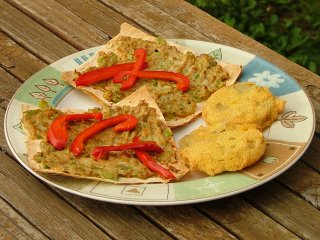
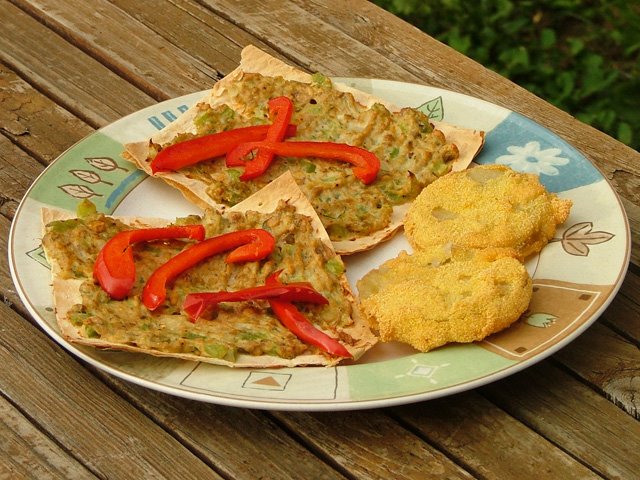
I made some slight modifications to the recipe: I used my homegrown chives instead of green onions, and I used minced green pepper for the chicken mixture rather than red. The original recipe from the New York Times suggests squares of six inches or fifteen centimeters. This provided me with twelve squares, and Paul and I consumed two each. Also, for the yogurt sauce (not pictured), I added a handful of my fresh mint, which provided a nice kick. And just because I could, I decided to pair the meal with fried green tomatoes.
Despite doubling up on all the spices and adding a lot of Tabasco sauce, I still found the meal dull. It wasn't bad, and it was definitely filling, but somehow the chicken mixture just didn't work for me. I really found myself craving a bit of tomato sauce and cheese to help it be more like a pizza. That may have something to do with my childhood friends of Lebanese descent, whose parents used lavash to make all sorts of fun fusion cuisine. (I also think this dish would have been better with lamb than chicken--it just needed more oomph.)
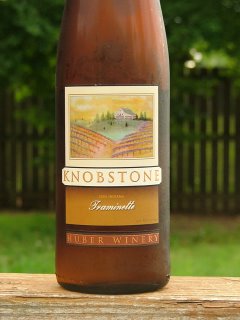 The wine I chose was actually a gift from my friend Tom, who dropped it off on his recent visit. I speak here of the 2005 Knobstone Traminette from Huber Winery in Indiana. Traminette is a Gewürztraminer hybrid. My previous experience with the grape was not pleasant, but this is fantastic. It tastes very much like a classic Gewürztraminer, but with a drier, crisper, and more lemony taste to it. As something of a random choice, it paired quite nicely with the Middle Eastern fare. The aroma is floral and mild, and the taste aside from the aforementioned spice and lemon has good elements of honey, with just a hint of acidity to keep things interesting. An excellent wine all around.
Speaking of which, if you go to Andrew's site, you can see the official Combinations logo, which I designed. I submitted a handful of designs to Andrew, he picked one, I refined it, and you can see the final result:

And here's my favorite alternate:
And the one that was probably a bad idea from the start:
 On to the food! I managed to find most of the ingredients, even though I came up dry on my first visit to my favorite Persian-Turkish place. The lady of the shop gave me directions to another supplier, and in thanks I bought some baklava and assorted desserts. (I felt bad since upon seeing me enter she almost started making my standard döner kebab.) Upon arrival at the next place, I asked for lavash and za'atar. She didn't know what I was talking about, despite being from the region. I walked down the aisles with her, and found the za'atar. In the frozen section, she pulled out what looked like a baguette, and I said, "No, it's a flat bread." She began to hand me a bag of rolls when I found a few dozen flat bags filled with lavash, and with the word "Lavash" in big letters on the front. At the shop I also picked up some pisatchios sans shells. I couldn't find any sumac, but I could see plenty of the little red bits in the za'atar. I'll be giving the rest of the huge jar of this spice to my Syrian friend.
Way back in the day, my mother and grandmother used to occasionally brew sumac to make a sort of tea or "Indian lemonade", due to it's acidic and bitter flavor before adding sugar. Sumac grows wild all over the Mid-South, and everybody takes it for granted. Though the occasional hippie or art student will grab some for an herbal cure or pigment.
I made some slight modifications to the recipe: I used my homegrown chives instead of green onions, and I used minced green pepper for the chicken mixture rather than red. The original recipe from the New York Times suggests squares of six inches or fifteen centimeters. This provided me with twelve squares, and Paul and I consumed two each. Also, for the yogurt sauce (not pictured), I added a handful of my fresh mint, which provided a nice kick. And just because I could, I decided to pair the meal with fried green tomatoes.
Despite doubling up on all the spices and adding a lot of Tabasco sauce, I still found the meal dull. It wasn't bad, and it was definitely filling, but somehow the chicken mixture just didn't work for me. I really found myself craving a bit of tomato sauce and cheese to help it be more like a pizza. That may have something to do with my childhood friends of Lebanese descent, whose parents used lavash to make all sorts of fun fusion cuisine. (I also think this dish would have been better with lamb than chicken--it just needed more oomph.)
 The wine I chose was actually a gift from my friend Tom, who dropped it off on his recent visit. I speak here of the 2005 Knobstone Traminette from Huber Winery in Indiana. Traminette is a Gewürztraminer hybrid. My previous experience with the grape was not pleasant, but this is fantastic. It tastes very much like a classic Gewürztraminer, but with a drier, crisper, and more lemony taste to it. As something of a random choice, it paired quite nicely with the Middle Eastern fare. The aroma is floral and mild, and the taste aside from the aforementioned spice and lemon has good elements of honey, with just a hint of acidity to keep things interesting. An excellent wine all around.
20 June 2006
2004 Cellier des Dauphins Prestige Rosé
Welcome to the Summer of Rosé 2: Electric Boogaloo!
Last summer I burned through as many dry rosés as my wallet and liver could handle. I intend to continue this quest this summer, with the goal as always of buying bottles I've never tried before. I've already had a couple in the past two months, but here's a great one to kick off the summer: the 2004 Cellier des Dauphins Prestige Rosé, a Côtes du Rhône rosé from around Provence that is made of Grenache, Cinsault, and Syrah. $12. The English site refers to the color as "deep rosé", but I prefer the French version, rosé vif, roughly vivid pink. In France, a lot of the same terms are used for describing rosé wines, actual roses, and lipstick. Some might make the association that drinking rosés is an effeminate act; on the contrary, I say that such descriptors are used much in the way that the manliest of men with a good grasp of their mother tongue will describe a car or boat in feminine, often sensual terms.
Rosés often don't have a lot to offer on the nose, and this one is no different. Yet it tastes wonderful. Good crisp berry flavors, bright and lively on the tongue due to some well-balanced acidity. Almost no aftertaste at all, which is perfect for a summer wine. Imagine raspberry lemonade that isn't sweet or overly tart, and you've got a good idea where this wine begins. After coming home from work and tending to the herbs and tomato plants, I drank this wine along with some grilled chicken and chorizo tacos, served on small white corn tortillas. Quite a good pairing, especially with some black beans on the side.
Side note: my bottle was the same old-fashioned shape as the one pictured in the link above, but the label was a little different. Similar design, but instead of a multicolored border, there was a simple and classy gold foil border around the calligraphic text.
19 June 2006
Welcome, Vino Keeno!
Over on the left hand side you'll see a new blogger link... I speak of Vino Keeno. Fun little wineblog, excellent graphics, and I immediately recognized a handful of wines I've tasted in the "Recent Wine Reviews" column. Give it a look, you'll be glad you did. And it really makes me think that I ought to spruce this place up one of these days...
18 June 2006
2004 Coppola Diamond Series Claret
In looking up the link for this wine, I discovered that Niebaum-Coppola is now going by the name Rubicon Estate. And apparently there's nothing on there about the old Coppola wines. A shame, as the Claret was always one of my favorites, as was the Sauvignon Blanc.
Dad took the family out to eat for Father's Day... I know that sounds odd, but he just wanted to see everyone for the day. We had dinner at Carrabba's, a chain Italian restaurant that's fairly decent. Dad had already ordered the 2004 Coppola Claret before I arrived, and I adjusted my entree selection for the wine. He had the sirloin, I had the pork chops marsala. The lentil and sausage soup was excellent, and I'd highly reccommend it to anyone who visits. Plus, their fried calamari is made with very small squid, so you get several tiny clusters of tentacles in addition to the standard rings. I almost made the rest of the table ill by claiming all the tentacles for myself. But truly, they're the best part.
The wine was quite good, full of dark berry flavors and just a hint of herbs and vegetation and leather on the nose. I think this bottle could have used another year, but I was happy with it. And it was good to split the bottle with Dad--no one else was drinking that evening. Dad's really responsible for my love of wine. He started getting a lot of wine as gifts back when I was in high school, and he let me cook with whatever I wanted. I was also encouraged to take a sip from the measuring cup, as long as I didn't tell Mom. (It was in that manner that I discovered the joy of a half glass of wine while cooking a big dinner. Just enough to relax you, but not enough to make you sloppy or forgetful.) Dad and I differ a bit when it comes to drinking: I prefer dark beers and powerful red wines, he prefers lagers and Merlot. However, Dad's a staunch fan of Scotch, and it takes me a while to work up to the point where I can truly enjoy the blessed whisky.
Here's to you, Dad. May we raise many glasses together in the years to come.
Tasting Notes for June 17, 2006
The theme for this tasting was supposed to be "Ugly Labels, Good Wines". I disagree with the statement about the labels for the most part--naturally it's a matter of personal opinion, but I've seen very few labels that are truly ugly. Some are better than others, but as long as it gets the information across and is distinctive enough to make it easy to remember, I don't have a problem with it. Hopefully the links will provide you with a chance to look at the labels, and just for kicks I'll give my opinion on each.
Wine 1: 2002 Rutz Sauvignon Blanc. North Cost, California. Major anise aromas, creamy and fruit-forward. Interesting flavor. $11. The label is obviously inspired by the work of Roy Lichtenstein, which I find cool. The "RVTS" thing is interesting, though I can't stand the font used for the thought bubbles.
Wine 2: 2004 Four Emus "Kylie" Sauvignon Blanc/Semillon. Western Australia. Big round fruit flavor aromas, but ultimately musky tasting and dull. $11. I don't have the huge aversion to animal-based labels that most people have, but a emu heads aren't the most attractive thing in the world. Still clever, and it seems to be successful for the casual wine drinking market.
Wine 3: 2003 Georges Dubœuf Macon Villages Fleur. Macon, France. This is an unoaked Chardonnay. Cake aromas, crisp and clean flavor, yet still elegant. I loved this one. $14. Once again, I'm fond of the floral Dubœuf designs combined with clean, easy to read text.
Wine 4: 2004 White Truck California White Wine. Oakley/Sonoma, California. A blend of Sauvignon Blanc, Viognier, Marsanne, and Roussanne. I enjoyed the Red Truck wine, and found it to be a fun casual sipper for barbecues and the like. This has aromas of apple, peach, and apricot. Pleasant fruit flavors and just a touch of oak. Good basic everyday white. $11. Hey, I've lived my whole live amongst old pickup trucks, and my first car was a 13-year old white pickup truck with large patches of rust and a gray tailgate. This label gets two thumbs up in my book.
Wine 5: Sushiwine. Loire, France. The wine is French, the website is in Italian, and you can read a little about it in English here. This is a Chenin Blanc made with input from Japanese chefs and designed to go with sushi. Specifically, to hold up to the strong flavors of soy sauce. It's also quite possibly the worst wine I've ever smelled or tasted. It smells somewhere between turpentine and a strong medical antiseptic. Really harsh and astringent flavors. One sip and I had to spit, dump the rest, and rinse thoroughly. Everyone else at the tasting had the same reaction, and we even opened a second bottle in case it was a fluke. The second was just as bad. My advice: stick with sake when eating sushi. $13. Despite all of that, I like the minimalist sketch of the fish and mountains on the label, and the Japanese text is a nice touch.
Wine 6: 2005 New Gewürz Gewürztraminer. North Coast, California. One of the driest Gewürztraminers I've ever had, which means I loved it. Very light, with floral and spice aromas dominating. Light spicy flavor. $10. The label's not spectacular but it's far from ugly. Traditional harvest images are used for all sorts of agricultural products with great success.
Wine 7: 2004 Vidanueva Rosado. Rueda, Spain. 100% Tempranillo. A really disappointing rosé. Butter and toast aromas, with wild strawberries, but almost no taste. Mild, no body, flabby acidity. $12. Couldn't find a website, but it's pink and burgundy. Again, not really ugly or beautiful.
Wine 8: 2003 Nobul Red Tempranillo. Madrid, Spain. Pure Tempranillo. It has an alcoholic, Zinfandel or Port-like aroma. Black cherry flavors, but thin and too mild. $11. This label does commit some fundamental graphic design errors: black text and drawings on a red background are difficult to read, and yellow and red can do weird things to the eyes when placed right next to each other.
Wine 9: 2004 Rex Goliath 47 Pound Rooster Cabernet Sauvignon. Central Coast, California. Oddly tastes like Pinot Noir--straweberry flavors and smooth. Nice drying tannins. Pleasant sipper and excellent bargain. I've passed by this wine a million times and never wanted to pick it up. $10. I love this label--it's based on an old circus poster.
Wine 10: 2004 Bodegas y Viñedos de Murcia Jumilla Mad Dogs and Englishmen. Jumilla, Spain. A blend of Monastrell (Mourvedre), Shiraz, and Cabernet Sauvignon. Unusual mix, but a great wine. Dark black cherry flavors, firm tannins, and a mild aftertaste. $11. I consider this a classy label with an allusion to an amusing song.
Wine 11: 2004 Eric Texier Côtes du Rhône. Rhone, France. A blend of Grenache and Gamay. You mostly taste the Grenache, but it's softer than that grape alone. Good raspberry fruit and big tannins. $16. Probably the only truly ugly label out of the bunch. Lots of overlapping text kills the readability factor, and a bunch of ugly colors don't help either. Reminds me of a school textbook cover from the 1970s.
Wine 12: 2004 Laurel Glen Reds. Lodi, California. "A Wine for the People", it claims on the front. A blend of Zinfandel, Carignan, and Petite Syrah. Smells like a white wine, like a light Sauvignon Blanc. Floral and with a little grapefruit. Tastes entirely different--the Zinfandel dominates, and it has a bold full flavor. Really bizarre experience (confirmed by several other tasters and the host), but good wine. $12. The label's not that bad, but I've always found Soviet kitsch to be in poor taste. Plus lower in the page, they show a statue of Mao Tse-Tung and claim "The Chairman would have approved!" Sure, after being responsible for the deaths of tens of millions of Chinese, why not pop open a bottle of wine? It's a screwcap now, but the corks used to bear the images of Lenin and Marx, as well as Americans accused of being Communist sympathizers. Granted, the Soviet Union has collapsed and the Chinese are racing towards capitalism, but you'd never market "Folkswein" with a big swastika on the front and a stern image of Göring on the cork.
16 June 2006
Google Analytics
I'm part of the beta test group for a new service called Google Analytics. It's free, but you have to ask to join and may or not be let in for the beta testing. It provides you with a ton of data about your site and who visits it. I've only been using it for the past week--the first time in a year and a half of running this blog that I've ever tried to track how many readers I've got.
This handy map shows the past 500 visitors, which is about a week's worth. The small dots are one visitor a piece, the largest dots around the Memphis area are 9 and 12 visitors (though most of those have got to be me checking the site or looking up a wine I tasted):
Click to enlarge

And here's a zoomed-in version for North America and Europe. This is just a screenshot--when you mouse over the real report, it shows you the name of the city as well as the number of visitors from that city:
Click to enlarge

I'd just like to thank all the readers and visitors out there, hope y'all enjoy this site, and I look forward to providing wine reviews and random musings for years to come.
12 June 2006
Tomatoes Update
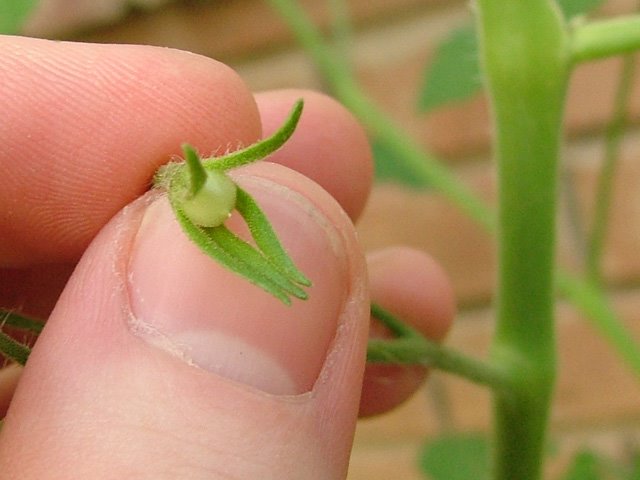 This is an update on my tomato growing project, in which I've got six plants of various varieties planted in the backyard, just on the other side of my kitchen. In fact, in a few of the pictures you can see a glimpse into my tiny kitchen with it's little white tile table and four chairs.
Pictured above is one of my first actual tomato fruits, about an eighth of an inch or 3mm wide. I've had a lot of blossoms, but many of them have dropped off. My red cherry plant has got several of these set, and I'm going to be carefully monitoring the others.
Apparently you can make wine from tomatoes, but I assure you, all of these are intended for fresh consumption, tomato sauces, and the odd roasting as on a pizza.
06 June 2006
2001 Cantina Zaccagnini Montepulciano d'Abruzzo
I had leftover lasagne in the fridge, and on the way home really wanted another Italian wine. Luckily, I stumbled upon an old favorite: the 2001 Cantina Zaccagnini Montepulciano d'Abruzzo. (Say that six times fast!) Affectionately known as "twig wine" in some parts, because of their marketing tactic of using a reed to tie a piece of dried grape vine around the neck of the bottle, fastened underneath the front label. A cheesy bit of marketing, but it's way more classy than the wicker basket Chianti bottles.
This wine tastes incredible right now. Not sure how long it will age, but right now it's silky smooth and full of strawberry flavors and aromas. The tannins are soft, but there's a residual acidity that's fascinating on the tongue. It's hard to get a well-aged, five year old wine for $15. It went well with the lasagne also, and my dining companion loved the wine. I had most of a baguette left over from Sunday night, so I sliced it up and made bread pudding for dessert, topped with a little Godiva Chocolate Liqueur. It was either that or make Italian bread soup, but that seemed kind of redundant to have a starchy tomato dish along with lasagne. No, the pain perdu turned out to be a good idea.
This wine tastes incredible right now. Not sure how long it will age, but right now it's silky smooth and full of strawberry flavors and aromas. The tannins are soft, but there's a residual acidity that's fascinating on the tongue. It's hard to get a well-aged, five year old wine for $15. It went well with the lasagne also, and my dining companion loved the wine. I had most of a baguette left over from Sunday night, so I sliced it up and made bread pudding for dessert, topped with a little Godiva Chocolate Liqueur. It was either that or make Italian bread soup, but that seemed kind of redundant to have a starchy tomato dish along with lasagne. No, the pain perdu turned out to be a good idea.
05 June 2006
2004 Crane Lake Sangiovese
Last September, I ran through a lot of the Crane Lake wines, which are essentially "Two Buck Chuck" relabled for sale outside Trader Joe's. I think by now I've had everything but the Pinot Grigio, and I think I can skip that one. I like the Petit Sirah, the Sauvignon Blanc, and don't mind cooking with the Chardonnay. The Cabernet Sauvignon and Merlot are forgettable. As for the Sangiovese? Eh, not bad, nothing to get excited about. Certainly preferable to really cheap Chianti. I'd say this would be good for an inexpensive Italian restaurant, maybe as a bargain house red. In fact, I served it last night with a vegetarian lasagne (lots of spinach and mushrooms) and some links of grilled sweet salsiccia. It was definitely serviceable.
There's a smoky nose with some blackberry flavors, but mostly it's surprising for having low tannins. You tend to expect young Italian wines (even if you're just using Italian grapes) to be pretty tannic, but apparently they held back on this. So it's smooth, but not complex.
There's a smoky nose with some blackberry flavors, but mostly it's surprising for having low tannins. You tend to expect young Italian wines (even if you're just using Italian grapes) to be pretty tannic, but apparently they held back on this. So it's smooth, but not complex.
Memorial Day Addendum
Here's two more wines and one clarification to add to last week's wine blowout.
First, the clarification. I referred to a Spanish Rioja. The wine we drank with the lamb was in fact the 2001 Sierra Cantabria Rioja Crianza. Beautiful, wonderful Tempranillo with just a dash of Graciano in it. I think I need to drink more Spanish wine this year.
And moving backwards in time, the first wine we cracked open--when I was washing vegetables and prepping sauces--was the 2004 Crossings Sauvignon Blanc from Marlborough, New Zealand. Light and crisp, with a touch of citrus aromas, but it's not overpowering. Sauvignon Blanc is rapidly becoming my favorite white grape.
Finally, on the second day of the festivities, Tom picked up a bottle of the 2004 Marquis Philips Cabernet Sauvignon on my recommendation. I've had this wine in an earlier vintage and loved it, but wasn't as impressed this time around. Good leather and chocolate flavors in addition to abundant dark fruit, but there's a strong vegetal nose that's hard to ignore. Sometimes that's a good thing; I guess I was just in the mood for a big fruit-forward classic Australian red.
04 June 2006
2004 Red Bicyclette Rosé
Last summer I burned through as many dry rosés as I could find... This summer I'm going to continue the voyage, and in my usual style, seek out new bottles that I've not tried before. Last week when I picked up the Cassagne the guy at the wine shop highly recommended the 2004 Red Bicylette Rosé. Don't follow that link, though--the website is annoying and doesn't have any information on this particular wine. If you want information, there are other options. The latter link provides me with what I really wanted to know: the grapes involved. For this little wine, it's a curious mix of Syrah, Grenache, and Pinot Noir.
Funny thing there... Aside from Champagne, are there any traditional wines that involve blending Pinot Noir? For some reason it alone seems to be sacred and thus protected from other grapes. You could say it's just a Burgundy thing, but Chardonnay gets blended with everything from Semillon to peach juice to 7-Up. I guess it's a little too soft and mellow and would disappear into the background of any blend, but that never stopped anyone from blending Merlot.
Anyway, back to the rosé. There's a classic rosé aroma that's hard to pin down. It's a sweet rhubarb-strawberry scent, but it's not overpowering. This wine has that, but it's good and dry. Very soft on the tongue, with a little kick of acidity at the end. Bright lemon and berry flavors abound. The color leans towards the lavender/grey side rather than bright magenta. Definitely a good, serviceable rosé for the summer, a great bargain at $8, and should be available damned near everywhere.
Tasting Notes for June 3, 2006
The theme for this tasting was Sauvignon... Sauvignon Blanc and Cabernet Sauvignon. The word sauvignon means wild, savage, or native plant in French, depending on who you ask. Surprisngly, none of these wines came from Bordeaux, the home of these grapes.
Wine 1: 2005 Zolo Sauvignon Blanc. Argentina. A good way to start the tasting--bold and fruity, with powerful grapefruit flavors and medium acidity. I remember enjoying the Malbec from Zolo, and this one is quite good as well. $13.
Wine 2: 2004 Rodney Strong "Charlotte's Home" Sauvignon Blanc. Sonoma County, California. Light nose, ashy flavor, a little flat. This and the Sancerre probably should have come before the more full-bodied whites. $14.
Wine 3: 2004 Chateau Potelle Sauvignon Blanc. Mendocino County, California. Charming story behind this winery. The husband and wife came over in the early 80s as tasters for the French government, but ended up settling in California and founding a vineyard. Very crisp, light fruit and a mineral quality that combines some of the best elements of California and France. $16.
Wine 4: 2004 Pascal Jolivet Sancerre. Loire Valley, France. Fresh bread aromas on the nose, light and mild. Easy sipper, and elegant. $25.
Wine 5: 2004 Pike & Joyce Sauvignon Blanc. Adelaide Hills, Australia. Citrus and pineapple aromas, similar flavors. Light and well-rounded with a smooth finish. $20.
Wine 6: 2004 The Jibe Sauvignon Blanc. Marlborough, New Zealand. Lots of grapefruit aroma, clean and clear but with mild flavors. $14.
Wine 7: 2005 Verget du Sud Rosé. Côtes du Luberon, France. A nice Provençal ros&0233; made from Cabernet Sauvignon. I don't think I've had Cab Sav as a pink wine before, but I enjoyed it. Lovely light salmon color, cherry tart nose with mild berry flavors and crisp acidity. $15.
Wine 8: 2003 Beringer Founders' Estate Cabernet Sauvignon. Napa Valley, California. Black cherry and cream aromas, jammy with medium tannins. Really impressive for the price. $11.
Wine 9: 2003 Chateau Ste. Michelle Indian Wells Cabernet Sauvignon. Columbia Valley, Washington. Mild spicy nose, very smooth plum flavors. Low tannins and a beautiful deep, dark color. I loved the Indian Wells Merlot, and am equally impressed with this wine. $21.
Wine 10: 2002 Artesa Napa/Sonoma Cabernet Sauvignon. 76% Napa Valley, 24% Sonoma County, California. Dark peppery aroma, fully tannic and dry. A bit too young in my opinion. Heavy red grape skin flavors dominate. $25.
Wine 11: 2003 Chateau la Grande Roche Cabernet Sauvignon. Napa Valley, California. Very little nose, no discernable flavors. Like the previous wine, I think it might need some time. $35.
Wine 12: 2003 Sbragia Family Vineyards Cabernet Sauvignon. Sonoma County, California. Part of the Beringer Reserve Club, made by the head winemaker. Spike cake on the nose, big round cherry flavors, hints of apple. Very dry, but not overly tannic. $35.
30 May 2006
Memorial Day Dinner
This is the first in a series of postings in which I attempt to track down and recall what transpired Monday evening, during a Memorial Day feast. I got to meet a great chap and his wife that I'd previously known only through a mutual friend and e-mail lists. Tom brought down a bunch of wine for his visit, and I brought a few bottles and cooked dinner. To kick things off, I started out with my favorite sparkler, the Domaine Ste. Michelle Blanc de Noirs. The first course consisted of grilled tilapia over blood oranges and bay leaves, fried green tomatoes, and a fire-roasted red pepper cream sauce to go with both, garnished with goat cheese and microgreens. For the wine, I served the 2005 Domaine de la Petite Cassagne, from the great importer Robert Kacher. This is mostly a GSM blend, and has a deep and lovely lavender color. Bright strawberry aromas and flavors with a dry finish. It's also a biodynamic wine, and I think the first one I've knowningly consumed. I don't have anything against the method, I'm just not convinced it does any good. We also opened one of Tom's bottles, the humorously named 2004 Rosenblum California Côte du Bone Roan, Château La Paws. An unusual blend of red grapes, but the Zinfandel gives it some wonderful complexity. Great fruit flavors without heavy tannins. Oddly a great pairing for this first course.
For the second course, I made a deconstructed navarin d'agneau, a traditional lamb stew. But it's too hot here for a stew, and I had a vegetarian present at the meal, so it was more fun to do it in pieces. I slathered the leg of lamb in Dijon mustard, garlic, and fresh mint, and grilled it over hot coals. At the same time, I was roasting a bunch of baby vegetables: potatoes, carrots, turnips, onions, and fennel, all coated in olive oil and fresh rosemary. And off to the side, I was reducing down a hearty sauce of red wine and beef broth. For the wine, we had one of Tom's, a Spanish Rioja by the name of Sierra Cantabria. (I'll double check the name and vintage later, but it was from the late nineties.) We decanted it and let it sit for half an hour before consuming, and it was a thing of beauty. Deep, rich black fruit flavors, with mellowed tannins and a velvety finish.
Beyond that, the evening devolved into a procession of Port and whiskey and me slouched in the chair, stuffed and content that all had gone well.
2000 Skouras Saint George
On the second evening of festivities at Paul's house with Tom and Jenny, we cracked open a bottle of the 2000 Skouras Saint George, a Greek wine from the Peloponessos region. The wine is made from the Saint George grape, known as Αγιωργιτικω in Greece. I have zero experience with Greek wines, aside from hearing rumors of the heavily pine scented retsina reds. And for some reason, I find it hard to think of Greek wine in a modern setting, and imagine togas and Dionysus and lots of half-naked maidens carrying amphorae sloshing over with potent wine... Ahem.
However, this is a light and mild red wine, possibly having benefited from careful aging over time. I get hints of chocolate on top, with milder fruit flavors below. Low tannins--quite light, but with enough acidity to keep things interesting. Fun to try out if you can find a bottle of it. Thanks, Tom!
However, this is a light and mild red wine, possibly having benefited from careful aging over time. I get hints of chocolate on top, with milder fruit flavors below. Low tannins--quite light, but with enough acidity to keep things interesting. Fun to try out if you can find a bottle of it. Thanks, Tom!
24 May 2006
Tennessee Wine Festival
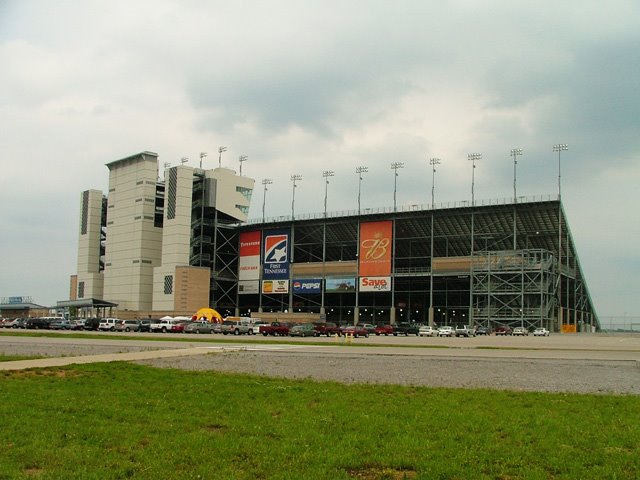 On May 20th, my lovely traveling companion and I attended the A Toast to Tennessee Wine Festival. A good friend in Nashville scored us some tickets to the event, and we spent the day in Middle Tennessee both at the festival and visiting with my friend. The event was held at the Nashville Superspeedway, a NASCAR race track to the east of the city. As of now, I may be the only wine blogger who has attended a tasting at a NASCAR facility.
If you want to try Tennessee wines, this annual event is the place to do it. There's about two dozen wineries in the state, and fourteen of them were present. I tasted at least one wine from each winery, and out of the hundred-odd wines present I sampled 26. I primarily sought out wines made from grapes that were either Native American varieties or French-American hybrids. I tasted a few made from traditional European grapes. There were some more I wanted to try, but I think I reached the limit of my palate. For that reason I also skipped almost all of the fruit-based wines (berries, mostly, with one rhubarb wine). In addition to the wines, Tennessee cheesemakers and other food producers were present, offering samples of their wares. This was a nice treat--I got to try some great artisanal cheeses, as well as fresh salsas, sausages, etc.
There's not a lot of online information on these wines, though I've provided links to contact information. When referencing some of the more unusual grape varieties, I've provided links to the Appellation America Grapes Varieties Index, which provides humorous character profiles and illustrations of each grape in addition to hard information about the background and growing regions of said grapes.
Unless otherwise noted, nearly all wines were fermented in stainless steel. After a dozen unoaked wines, you find yourself craving oak. For those unfamiliar with Tennessee geography, West Tennessee is flat, Middle Tennessee is hilly, and East Tennessee is mountainous.
Lauderdale Cellars, West Tennessee
- Tennessee Peach: A sweet white wine with peach juice added. A really beautiful color--it had that slight blush of salmon you see in homemade peach ice cream. Really sweet, though.
Chateau Ross Vineyard & Winery, Middle Tennessee
- Viognier: Lemon and big fruit flavors, clear and clean.
- Maison Rouge: Cabernet Franc, Cabernet Sauvignon, Merlot. Creamy, spicy, some vegetable elements from the Cabernet Franc. Really quite nice.
- Big Bitch Red: Amusing names were in abundance at this wine festival... A combination of many different red grapes. Soft, not too tannic, but the flavors are too heavily blended for anything to stand above the crowd. Good basic red wine.
- Catawba: Native American grape. Smoky, foxy, but not sweet. I've had Catawba before that was as sweet as pancake syrup, but it was interesting to taste a drier version of the wine. The... earthiness can be offputting to some.
Beans Creek Winery, Middle Tennessee
- Traminette: Very similar to Gewürtztraminer, which is one of the parent grapes of this hybrid. Spicy and sweet, but a rough aftertaste.
- Chardonel: The flavors were similar to Chardonnay, but it needed more acidity. The name reminds me somewhat of the artificial vanilla substitute vanillin, or that it's a grey-market knockoff of Chardonnay.
- Chambourcin Reserve: Wow. Tastes very similar to Merlot, but there's something in the background letting you know it's different. Mellow and fruit-forward, mild tannins. Definitely try a Chambourcin if you get the chance. This was aged in American oak for 8 months.
Keg Springs Winery, Middle Tennessee
- Vidal Blanc: This hybrid grape is commonly used for making ice wine in Canada. Musky nose, semi-dry and lemony. Needs a little more punch, but definitely worth trying.
- Crusade: Made from Concord grapes, which are native to North America. Sweet, but the flavor is a lot of fun. Rather than reminding you of wine, the taste is exactly that of purple grape juice and purple grape jelly. In fact, the flavor threw me back to Sunday School. Concord wines aren't taken seriously, but I found them one of the pleasant surprises of the day.
Sumner Crest Winery, Middle Tennessee
- Sumner Queen: A white blend of Riesling and French hybrids. Very sweet, difficult to discern any dominant flavors. Reminiscent of a late harvest Riesling.
Holly Ridge Winery and Vineyard, Middle Tennessee
- Hogeye Red: A sweet blush wine of unknown grapes. Good summertime wine if you like them sweet.
- Seyval Blanc: A hybrid that's quite popular in England. Overly musky with a thin flavor.
Beachaven Vineyards & Winery, Middle Tennessee
- Barrelhead Red: Chambourcin and Merlot Blend. Dry, mild fruit flavors and medium tannins. Excellent casual drinking red.
Stonehaus Winery, Middle Tennessee
- Fairfield Red: Another Concord that was on the drier side, thanks to blending from some European grapes.
Highland Manor Winery, Middle Tennessee
- Highland Red: Chambourcin and Marechal-Foch blend. Sort of rough, cough syrup flavor.
Mountain Valley Vineyards, East Tennessee
- Cynthiana: Merlot-like, with cherry flavors abounding. Very enjoyable.
- Mountain Valley Blush: Unknown grapes. Semi-dry, no prominent flavors.
Tennessee Valley Winery, East Tennessee
- Appalachian Red: A combination of Cabernet Franc and Cynthiana, oak aged. Solid tannins, black cherry flavors, and decent balance. I'd definitely try this again.
- Captain's Reserve: Chardonnay and Seyval Blanc blend. Burnt match nose, ultimately thin flavors.
Apple Barn Winery, East Tennessee
- Vineyard White: Unknown grapes. Dry, with low fruit flavors and low acids. Similar to Pinot Grigio.
- Applewood White: Made from Winesaps and other apples. I cheated here, because I love apples and really wanted to try an apple wine. It turned out to be my favorite out of the entire tasting. It's hard to describe: not terribly sweet, but amazing apple flavors and aromas. Unique feel and body that is distinct from apple juice, apple cider, and hard cider.
Savannah Oaks Winery, East Tennessee
- Etowah Derailer: Sweet light red blend, bright cherry flavors. Think a sweet Beaujolais, but I'm not sure what grapes were used.
Striker's Premium, East Tennessee
- Cynthiana: Also known as Norton in different parts of the country. Considered to be one of the Native American grapes with the best prospect for serious wine production. Peppery and spicy, low tannins and crisp acidity for a red. Definitely looking forward to trying more of these wines in the future.
- Baco Noir: A hybrid red that I really didn't enjoy. Astringent nose and tasted like thin cough syrup.
21 May 2006
The Wine Century Club
Dr. Vino recently wrote about tasting his 100th grape and joining the Wine Century Club. Membership is free, and you get a certificate honoring your accomplishment. It works on the honor system, so it's mostly for fun. I went to a wine festival this weekend--more on that later--and got to try some unusual grapes. Late last night I decided to go through my notes and figure out how many grapes I've tried.
100.
As in, exactly 100 after yesterday's encounter with some oddballs. I just finished going through the list and auditing it, removing any duplicates (Spanish grapes often have multiple names, and some Italian grapes have different names in Spain and France). But it looks like it's solid. And it may be slightly more--I stopped digging through my notes when I hit Welschriesling and made it to 100. (Of course, I think you could probably spend a month in Italy and hit 200 grapes easy, but most would be unknown outside of their various regions.)
The vast majority of these are from posts on this blog, though sometimes you might have to follow the link to the winemaker to get the grape varieties. A few others are from old handwritten notes before I started the blog, and some include the Port and Sherry grapes, of which I've had a lot but don't blog about often.
My list includes eleven that aren't on the Century Club spreadsheet, mostly French-American hybrids and some obscure Spanish grapes. But I've researched each one, and they appear to be unique varieties, just not terribly popular. Here it is:
- Albarino
- Aligote
- Arinto
- Arneis
- Baco Noir
- Barbera
- Bianca Fernanda
- Blaufrankisch
- Bobal
- Bonarda
- Brachetto
- Cabernet Franc
- Cabernet Sauvignon
- Canaiolo
- Carignane
- Carmenere
- Catawba
- Chambourcin
- Chancellor
- Chardonel
- Chardonnay
- Chenin Blanc
- Colombard
- Colorino
- Concord
- Cortese
- Corvina
- Dolcetto
- Dornfelder
- Gamay
- Garganega
- Gewurtztraminer
- Godello
- Grenache
- Gruner Veltliner
- Kadarka
- Kerner
- Loureiro
- Macabeo
- Malbec
- Malvasia
- Malvasia Nera
- Marechal Foch
- Marsanne
- Melon de Bourgogne
- Merlot
- Meunier
- Molinara
- Montepulciano
- Mourvedre
- Muller Thurgau
- Muscadelle
- Muscadine
- Muscat Blanc
- Muscat of Alexandria
- Muscat Ottonel
- Nebbiolo
- Negroamaro
- Niagara
- Norton
- Palomino
- Parellada
- Pedro Ximenez
- Petit Verdot
- Petite Sirah
- Pinot Blanc
- Pinot Gris
- Pinot Noir
- Pinotage
- Prosecco
- Refosco
- Riesling
- Rondinella
- Roussanne
- Ruby Cabernet
- Sangiovese
- Sauvignon blanc
- Semillon
- Seyval Blanc
- Steuben
- Syrah
- Tannat
- Tempranillo
- Tinta Barroca
- Tinto Cao
- Tocai Fruilano
- Torrontes
- Touriga Franca
- Touriga Nacional
- Traminette
- Trajadura
- Trebbiano
- Trepat
- Verdejo
- Verdelho
- Vidal
- Viognier
- Welschriesling
- Xarel-lo
- Zinfandel
17 May 2006
Galena Cellars General's Reserve Red
Following a trip to Chicago to visit some relatives, my sister-in-law gave me a bottle of the Galena Cellars General's Reserve Red. The label features the visage of Ulysses S. Grant, 18th U.S. president, Union Civil War hero, and favorite son of Galena, Illinois, where this wine is made. (It's basically the etching from the old version of the $50 bill.) Oddly enough, the label features one of my favorite fonts, Souvenir, alongside one of my least favorite, Snell Roundhand. Ah well...
I'm not really sure what grapes are in this. The back label claims that it's made from a blend of European and American Hybrid grapes, while various websites claim that it's a Bordeaux-style blend using grapes from Sonoma. Yet other websites claim that it's an unorthodox blend of Cabernet Sauvignon, Merlot, and Pinot Noir.
As I type this, I'm uncorking the bottle and trying it out... And the damned thing is eaten up with brett. Whenever I bring the glass to my nose all I can smell is rotten asparagus. The wine tastes OK, if a little bitter, but the smell is so overpowering that I can't stand it. I appreciate the gift, and will give this a second try if I come across it, but this bottle's going down the drain. And I've been looking forward to it all day...
15 May 2006
Crops
When it comes to growing plants, I never really had much of an urge. My maternal grandmother was a horticultural wizard, able to grow damned near anything. She had a bamboo grove in her backyard, and growing up my brother and I could have Star Wars-style lightsaber fights with 20 ft. long dried bamboo poles. She grew championship roses and African violets and tulips and daffodils and all sorts of other things. In fact, there wasn't a surface inside or outside that wasn't covered with a growing plant. She passed away a few years ago.
On both the maternal and paternal sides of my family, I'm descended from farmers. Mostly cotton, with some corn and the odd livestock for family provisions. What remains of the family farms are mostly used for cotton, which is still one of the major cash crops of the Mid-South. I never spent any time working on a farm, and aside from one summer when we raised corn and pumpkins in the backyard, I have no experience farming. However, this year I was for some reason compelled to grow things. Here's a list of what's currently growing in my various pots and gardens:
Inside:
Microgreens, Basil, Chives, Rosemary, Greek Oregano
Outside:
Tomatoes: Brandy Boy, Fourth of July, Yellow Pear, Big Mama, Sweet Baby, Sun Gold, Husky Red
Jalapeño Peppers, Cilantro, four colors of carrots (yellow, orange, red, purple)
The herbs are going quite well, and I'm able to harvest them along the way and grow more as needed. It will be a month or two before I harvest any tomatoes, but I'm really looking forward to all of these unusual varieties. As for the carrots, I'll be amazed if any of them make it, but I'd really like to try a purple carrot at some point in my life.
Why am I doing this? There's some things you can't buy in the store or at the farmer's market. For instance, those little yellow pear tomatoes. The size of cherry tomatoes, but shaped like a pear and bright yellow, with a delicious flavor. Stick on a toothpick with a chunk of feta cheese and a basil leaf. Flavor bomb appetizer.
14 May 2006
Tasting Notes for May 13, 2006
I was looking forward to this tasting for a couple of weeks... All of the wines featured were going to be from The Grateful Palate, a popular importer of Australian wines. (The website doesn't have any wine information, but you can see a comprehensive list of the Grateful Palate wines here.)
I got there a little early, and was going over the tasting sheet, checking off the ones I'd tried before. I was certainly going to try them again, but I saw some of my favorite Australian labels on there: Paringa, Marquis Philips, and Trevor Jones. A guy came up, tapped me on the shoulder and asked if I was there alone. I figured he wanted the other seat, which I was more than happy to give up. Instead, he shook my hand and said, "Hi, I'm Dan Philips." As in, the owner of The Grateful Palate. Super nice guy. We talked off and on throughout the tasting, and in particular I asked him about the Nuriootpa High School wines, which are produced by a sort of vocational education program. The students pick the grapes and make the wines, and all proceeds go back to the high school.
I've tasted about half of these wines before. Last year I got to sit down with Trevor Jones at a tasting and go through his entire product line, but I was happy to see those wines again.
Wine 1: 2004 Trevor Jones Boots White. Barossa Valley, Australia. A mix of Riesling and Muscat. Sweet nose with apple aromas and smoky notes on the tongue. Balanced acids and not as sweet as you first think. $13.
Wine 2: 2004 Marquis Philips Holly's Blend. Padthaway, Australia. You know, I forgot to ask for the preferred pronunciation of "Marquis" when referring to this wine. Americans tend to pronounce the first name "mar-KEE" and Australians I've met have called it "MAR-kwiss". I didn't particularly like this wine, it's got a heavy vegetal aroma that was offputting. Rough finish as well. A combination of Semillon and Verdelho. I liked this last year, so I'm willing to bet it was an off bottle. $10.
Wine 3: 2004 Paringa Chardonnay-Semillon-Sauvignon Blanc. South Australia. Grapefruit on the nose, but the creamy feel and taste of Chardonnay. Crisp acidic finish. Interesting little bargain. $10.
Wine 4: 2002 Trevor Jones Boots Grenache. Barossa Valley, Australia. I liked this one so much I took a bottle home and devoured most of it with dinner. It's got a creamy cherry aroma, almost like a cherry tart with whipped cream on it and lots of butter in the crust. Big fruit and soft tannins with a medium finish. Touch of chocolate flavor. Bigger than a Rhone-style wine but not as aggressive as some California Grenache I've had, even though it ranked in at 15% alcohol. $14.
Wine 5: 2004 McLean's Farm Shiraz-Cabernet Sauvignon. Barossa Valley, Australia. Some black cherry and pepper on the nose. Very dry, with mild tannins and a short finish. More alcohol becomes present on the tongue as you go along.
Wine 6: 2001 Alliance Shiraz. South Australia. Plum aromas, with a mild scent of a ruby Port. Delicious, with tannins that melt in your mouth. Quite nice for the price. $14.
Wine 7: 2001 Brothers in Arms Shiraz. Langhorne Creek, Australia. Alcoholic, hot aroma, but with plenty of classic Shiraz flavor. Short finish. I actually preferred the Alliance to this one. $36.
Wine 8: 2004 Marquis Philips S2 Cabernet Sauvignon. South Australia. Buttery aroma, deep and rich feel, very dark and intense color, yet velvety smooth on the tongue. Wow. $35.
Wine 9: Trevor Jones "Jonesy" Tawny Port. Barossa Valley, Australia. An amazing Port for the price. Molasses and raisins dominate the flavor, with some figs and chocolate in the background. Alcohol is subdued, and it's not too thick or sticky. $10.
12 May 2006
Flying Dog Gonzo Imperial Porter
I've got a cool wine tasting to attend Saturday, and then the following Saturday should produce a rather unique wine writeup... And the week after that I've got a big wine-based dinner party planned. But for tonight, it's yet another big beer.
I've always enjoyed the beers of Flying Dog Brewery, and though it's a shallow reason, I've always loved the labels, which are drawn by the great Ralph Steadman. In addition to doing some wine labels for Bonny Doon, he's also written and illustrated several books that take you on a bizarre and irreverent tour through wine country and whiskey country. His writeup on "Brit", a short-lived English version of Port, is hilarious.
Steadman was a longtime friend and collaborator with the immortal Hunter S. Thompson. To commemorate Thompson's death last year, Flying Dog has released the special edition Gonzo Imperial Porter, which features a skeleton dressed as Thompson on the label, as well as an amusing quote from the good Doctor.
This is a hell of a beer. It clocks in at a whopping 9.5% alcohol, surpassing some wines. It's got a slightly sour aroma at first, but don't let that fool you. It's a surprisingly smooth brew, almost solid black with a very light head on it and almost no carbonation. The flavor is dominated by chocolate and coffee, with just enough sweetness to keep it from being too bitter. Still, this is a powerful wine, thick and almost sticky. It actually clings to the side of a glass like brandy (and, in fact, it was consumed out of large red wine glasses). Perfect for relaxing and sipping. A buddy and I consumed one each while watching a movie and could barely move afterwards.
A box of four 12 oz. bottles runs $10, which is a bargain for such a fine beer. A single bottle is plenty to savor over the course of an hour or two following dinner--drinking this with a meal would be like trying to drink espresso syrup. I can't imagine drinking two in a row. You know that lovely golden crema that forms on the top of a properly made espresso? That's exactly what the head on this beer looks like.
I'll close with a classic Thompson quote, the opening lines of Fear and Loathing in Las Vegas:
We were somewhere around Barstow on the edge of the desert when the drugs began to take hold. I remember saying something like "I feel a bit lightheaded; maybe you should drive..." And suddenly there was a terrible roar all around us and the sky was full of what looked like huge bats, all swooping and screeching and diving around the car, which was going about a hundred miles an hour with the top down to Las Vegas. And a voice was screaming: "Holy Jesus! What are these goddamn animals?"
07 May 2006
Two Beers
Fear not, this isn't turning into a beer blog. However, I'm getting access to a lot of fantastic beers these days, and it's a delicious voyage. Eric Asimov has been writing a good bit about fine beer recently, and while addressing wine drinkers' attitudes towards beer, wrote in part:
This replies in reverse as well, beer drinkers ought to be more willing to try wine, but they're generally not snobbish about it.
In my continuing run through the Unibroue product line, I had a bottle of the Don de Dieu. It pours a cloudy golden color, but it's as hearty as many darker beers. When the notes say full-bodied, believe it. There's some spice there, and elements of dried apricot, but mostly you're enjoying a very rich and well-balanced beer. Almost sweet at times. And that 9% alcohol makes you drink this much slower than you would a light lager, for instance.
I also had the Sierra Nevada Bigfoot, which is a barleywine-style ale. Probably the heartiest and fullest beer I've ever had, and this is my second time ordering it at the nearby gourmet beer establishment. Served in a brandy snifter, this is almost solid black and is as strong as espresso. Heavily spiced and not fizzy at all. You get all sorts of wonderful complexity from the malts and hops. I know a lot of people who are terrified to drink Guinness Extra Stout because the strong flavor scares them; Bigfoot makes that Extra Stout taste like skim milk. I love this stuff, but you've really got to enjoy it as a final beverage after a meal or after you've drunk other beers. Afterwards, you're not going to be able to taste anything properly.
Would you only eat meat and never try fish? We all know people like that, and we laugh at them. But people who drink only wine and won't touch beer? They're considered sophisticated. Excuse me while I chuckle.Amen.Now, I'm not attacking preferences here, only the refusal to consider alternatives. If you have explored beer and decided it's not for you, well, I toast your open mind.
This replies in reverse as well, beer drinkers ought to be more willing to try wine, but they're generally not snobbish about it.
In my continuing run through the Unibroue product line, I had a bottle of the Don de Dieu. It pours a cloudy golden color, but it's as hearty as many darker beers. When the notes say full-bodied, believe it. There's some spice there, and elements of dried apricot, but mostly you're enjoying a very rich and well-balanced beer. Almost sweet at times. And that 9% alcohol makes you drink this much slower than you would a light lager, for instance.
I also had the Sierra Nevada Bigfoot, which is a barleywine-style ale. Probably the heartiest and fullest beer I've ever had, and this is my second time ordering it at the nearby gourmet beer establishment. Served in a brandy snifter, this is almost solid black and is as strong as espresso. Heavily spiced and not fizzy at all. You get all sorts of wonderful complexity from the malts and hops. I know a lot of people who are terrified to drink Guinness Extra Stout because the strong flavor scares them; Bigfoot makes that Extra Stout taste like skim milk. I love this stuff, but you've really got to enjoy it as a final beverage after a meal or after you've drunk other beers. Afterwards, you're not going to be able to taste anything properly.
30 April 2006
Leg of Lamb Dinner
I had dinner over at my brother's place with a friend last night. My sister-in-law and niece were out of town, providing the opportunity for a good guys' night. Things were kept pretty simple: I made some roasted potatoes with rosemary (I've just been craving this recently), and while my brother grilled the lamb (boneless, laid flat on the grill), I made a sauce to go with it. A cup of Dijon mustard, a quarter cup of peach jelly, and a half a cup of bourbon. Sounds odd but it was delicious.
The first bottle consumed was the 2003 The Lucky Country GSM from the Barossa Valley in Australia. I had this at a tasting in February and enjoyed it, but it went particularly well with the lamb. Excellent fruit and low tannins. The second bottle was the 2001 Mt. Oso Cabernet Sauvignon - Cellar Select. Lots of blackberries on the nose and palate, and it still tastes like a fairly young wine.
The first bottle consumed was the 2003 The Lucky Country GSM from the Barossa Valley in Australia. I had this at a tasting in February and enjoyed it, but it went particularly well with the lamb. Excellent fruit and low tannins. The second bottle was the 2001 Mt. Oso Cabernet Sauvignon - Cellar Select. Lots of blackberries on the nose and palate, and it still tastes like a fairly young wine.
25 April 2006
2004 The Wishing Tree Shiraz
About a week ago I tried to treat myself to a steak and bottle of red for one... The steak didn't turn out so well, so I tried it again tonight. It had been a rough day at work, and thus on the way home I lucked into a massive T-Bone that had been marked down to a ridiculously low price. Grabbed some small russet potatoes, and headed home. I'd also set out a five-pack of frozen chicken thighs to thaw in the fridge overnight, but upon getting home decided that the combination of meats and nice weather meant it was time for the First Barbeque of the Year.
I roasted the potatoes in the same manner as I did for the Combinations dinner, with some melted butter and fresh rosemary. I smoked the chicken thighs for about an hour on the cool part of the grill, basting occasionally with some leftover hard cider. The steak was a work of art on its own, and really just needed a little salt and pepper and some careful grilling for about twelve minutes (it weighed in at around 1.5 lbs or .68 kg!).
And the wine? I decided to revisit the charmingly named 2004 The Wishing Tree Shiraz. I tasted this back in August, but didn't much care for it at the time. There's a chance that was an off bottle, or that (because it was a blind tasting) the bottle had been misidentified later. I was much happier this time, as it tasted like a good $15 Shiraz oughta. Two thirds Western Australia and one third South Australia... Dark berries and a little leather on the nose, with bold fruit flavors on the tongue and a peppery finish. The tannins give it a nice little bite but aren't mouth-drying or overpowering. Definitely recommended.
I'll also point out that this is the second wine in a row that I've had from The Australian Premium Wine Collection. There's been some good articles written in the past couple of years about finding an importer you like and following his or her wines. Sometimes this takes a bit of work (such as for Dan Phillips' Grateful Palate). However, John Larchet has been kind enough to include a neck label on each bottle in the collection to help identify it. I've been happy with these two wines, and will be on the lookout for more.
21 April 2006
Combinations #1 - Benito Rises to the Challenge
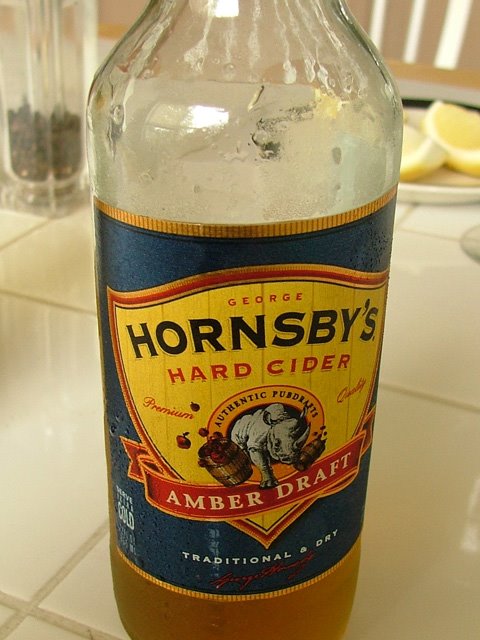 Here's my entry for the First Combinations challenge: Baked Mackerel with Rhubarb Sauce. I couldn't find fresh mackerel anywhere near Memphis, so I decided to substitute rainbow trout fillets. I wanted to use young whole rainbow trout, but one of my regular supply lines dried up. And I had the damnedest time finding cider, so I'll start with that image. I drank a lot of hard cider (as we call it in the states) back in the late 90s, which is when it was really first introduced in this market. That coincided nicely with my turning 21. I was particularly fond of the Woodchuck Granny Smith Draft Cider. But I stopped drinking it at some point, and haven't touched the stuff since. Hey, there's been too much good beer and wine that's come my way recently. Anyway, I picked up a six pack of Hornsby's Cider, bottled by the Gallo wine conglomerate. I had a bottle this afternoon and loved it. Great apple flavor without being sweet or having that vinegar flavor that I grew to despise in hard cider way back when.
 Here's how the meal turned out... Instead of boiled potatoes, I chose to make roasted eighths of new potatoes tossed in butter and fresh rosemary from the kitchen garden. Joining me for this dinner was my longtime friend and fellow blogger Paul. The sauce looked a little limp, but was quite flavorful, and I'm pretty sure this is the first time that I've ever eaten rhubarb. Yeah, I've gobbled up baby octopus and have eaten plenty of live ants, but somehow I never got around to rhubarb. The trout turned out OK in my opinion; I think it would have been better pan-fried or grilled, and I'm sure that this baking method was much more suited to the gutted mackerel than a mostly flat fillet. However, it was all eaten and enjoyed, and the dogs circled the table hungrily.
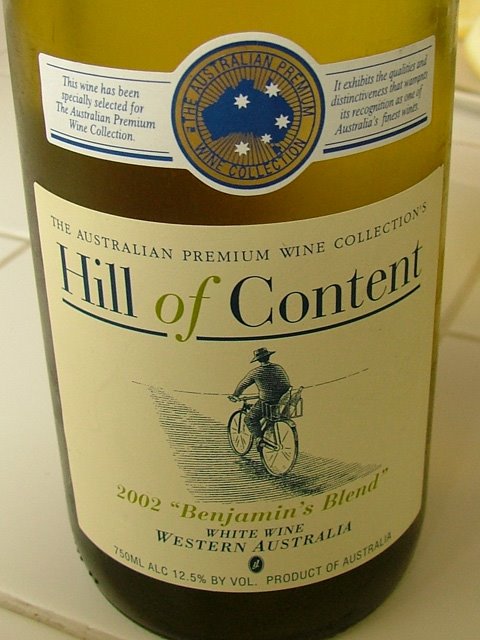 And now for the wine... This afternoon I wandered through the wine shop, looking for something appropriate. I could have gone with a tried and true favorite, but I really enjoy trying a new bottle. So I'm walking along, thinking I'd like an interesting white blend, and what do I find? A wine with my first name on it. (Yes, I'm a Benjamin, Benito is just a nickname.) Thus my wine of choice for this dinner was the 2002 Hill of Content "Benjamin's Blend" from the Margaret River region of Western Australia. Plus, Barbara's from around there, so I figured karma was on my side. The wine is a mix of 50% Chardonnay, 39% Sauvignon Blanc, and 11% Semillon, all unoaked. The wine is all about the peaches: on the nose and on the tongue and on the aftertaste. A nice wine to drink cold with a hearty bit of seafood, and a good bargain at $15. It matched well with the fish--the forward fruit and balanced acidity provided a counter to the sometimes fatty fish, and yet it complemented the sweet rhubarb sauce going along. The roasted potatoes mainly cleansed the palate between fruit explosions.
20 April 2006
Jack Daniel's Distillery
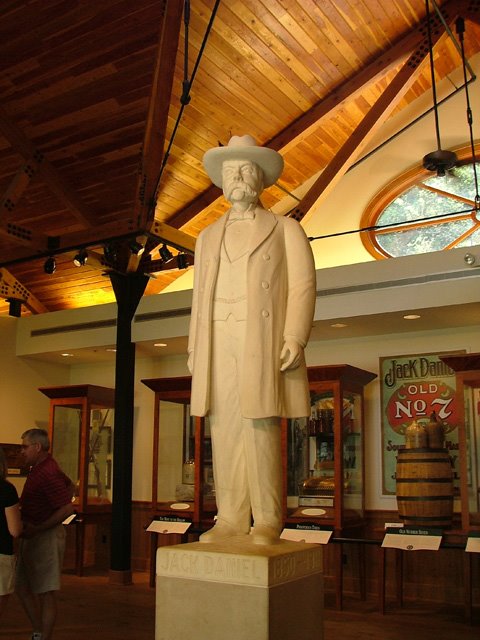 Last weekend the girlfriend and I visited the Jack Daniel's Distillery in Lynchburg, Tennessee. I've got the story and pictures up at my personal site.
Journey to Jack Daniel's Distillery
Unibroue Trois Pistoles
In a followup to the post from two weeks ago, I'm trying another great Canadian beer from Unibroue. Tonight it's the Unibroue Trois Pistoles, a strong dark ale from that great brewery. The malts are really quite prominent in this beer, and that's a good thing. Additionally, there's flavors of dried apple all over the place, with hints of coffee and chocolate. I don't really get the Port comments that everyone makes about this beer, but I certainly agree that it could be enjoyed in the same manner as Port. Certainly at the end of the meal, with some cheese and fruit or even a bit of cheesecake.
It has a slightly sticky feel in the mouth on the aftertaste, with lingering cherry flavors when you lick your lips. At 9% alcohol, you've got to be careful--one regular bottle is basically like half a bottle of a light Riesling or some other mild white wine. As for the name, the English site doesn't give any clues, but the French site seems to hint at the legend of a black horse that signified the devil, which would make sense with the flaming winged equine on the label. You know, these are great beers, but all of the names and labels seem to come straight out of a Goth's daydreams.
I'm still amazed that a single 355mL beer bottle can provoke such thoughtfulness. I just wish it were colder--my AC is out at the moment and it's been up into the 90s this week. But I'd still highly recommend this to anyone that wants to drink a beer that they can savor and taste and appreciate over the course of an hour.
19 April 2006
2002 Bonny Doon Madiran Heart of Darkness
In anticipation of a steak for dinner, I stopped by a newly remodeled wine shop in the area and picked up a bottle of the 2002 Bonny Doon Madiran Heart of Darkness. I hadn't seen or heard of it before. I do love Bonny Doon wines, but they're a little scarce around here. The label bore blood-spattered designs by the great Ralph Steadman, as well as a map on the back that was similarly spattered. It seemed to point to an area in France near the Spanish border, but there was no other information.
The steak turned out OK, but I was really impressed with the wine. I decided to drink it "blind" with dinner and see if I could determine the mystery grape, as I wasn't familiar with the Madiran region. First off, this is a dark wine, almost black. So we're talking about a small grape... But it wasn't herbal enough to be Cabernet Franc or Petite Verdot, and wasn't fruity like Petite Syrah. It made me think a lot of Malbec, though it wasn't quite that either. So after dinner, I raced to the computer to figure out the mystery, and found that it was made up mostly of the oddball Tannat, a grape that is currently enjoying a boom in Uruguay of all places. Appellation America chose to illustrate the grape with a werewolf.
It's definitely tannic, and looking at some pictures, it is indeed a tiny grape with a dark skin. This particular wine is blended with Cabernet Franc and Cabernet Sauvignon, but the percentages tend to vary depending on which site you check. Relatively high alcohol--14.2%. I realize that it's managed by an American company, but this is a four year old French wine that could knock you on your ass if you're not careful. Not subtle in the slightest, but a good match for hearty fare.
Now that I've had time to sit with it for a while, I'm getting some of the vegetal, woody qualities on the nose. Reminds me of woodcutting, oddly enough--fresh cuts into a green tree. There's some black cherry on the tongue, but mostly what you're tasting are tannins and... darkness.
All in all, a fascinating wine, and definitely one for some strong food. Take it along to your next blind tasting party to stump your friends!
16 April 2006
Microgreens Photoessay
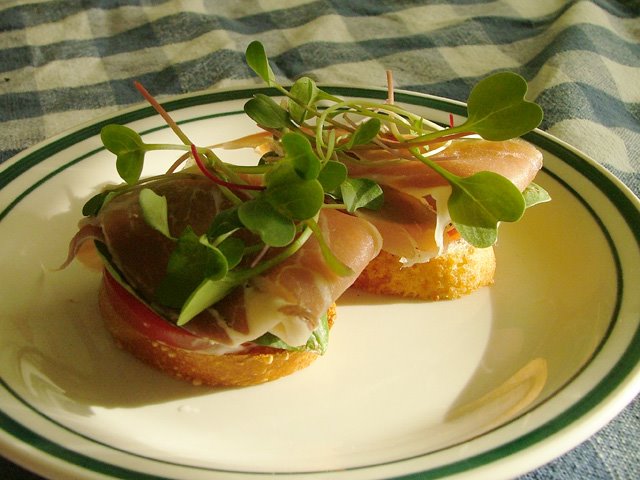 Earlier this month, I got a packet of seeds for growing microgreens, the little infant versions of tasty lettuce varieties. At right is what I made with the first harvest after twelve days of growth, sort of a gourmet appetizer version of the classic BLT sandwich.
On my personal site, I've posted my Photoessay on Microgreens. Enjoy!
15 April 2006
Correction
This review was originally published back in January. The original post is as follows, with the correction in bold.
Wine 9: 2003 Chateau de Mattes-Sabran. Corbières, Languedoc. South of France, probably a lot of Carignan and who knows what else. Soft beginning, some black cherry flavors. Slightly unbalanced, but a good little wine. Really begs for some food. $15. Correction: Syrah, Grenache, and Mourvedre. No Carignane in this wine. The owner of the winery contacted me with the correct information. Thanks!
11 April 2006
Tasting Notes for April 8, 2006
All of the wines listed below came from either Rudolf Müller or Dr. Thanisch, in the Mosel region of Germany. The winemaker for both vineyards is the elegant and charming Barbara Müller, who was there to answer questions. Even though I don't drink a lot of Riesling, I liked just about every wine at the tasting. At the end, I complimented her on the wonderful wines, shook her hand, and then in my most formal Hochdeutsch, I nodded and said, "Danke Schön, Frau Müller." She actually bowed slightly and replied with a smiling "Bitte."
Hey, two years of high school German had to pay off eventually.
Note: Keep in mind that except for one notable exception, all of these wines were of the same grape and of the same vineyards. So a lot of these tasting notes are going to look similar, but there were subtle differences that are sometimes hard to put into words for the amateur blogger and general non-enthusiast of Riesling. Also, these are listed in the order of the printed note sheet, but they were actually tasted in a different order arranged by Frau Müller.
Wine 1: 2004 Rudolf Müller "Bishop of Riesling". This is their most well-known offering, from what I understand. I found it a little thin, but not sweet. Clean and tasty. $12.
Wine 2: 2004 Rudolf Müller Kabinett. Mild and smooth, with some honey flavors involved. $13.
Wine 3: 2003 Rudolf Müller Piesporter Goldtröpfchen Kabinett. Honey sweet, tart beginning and smooth finish. $15.
Wine 4: 2003 Dr. Thanisch Bernkasteler QBA "Classic". Light and lemony, dry and tart. $18.
Wine 5: 2003 Dr. Thanisch Bernkasteler Badstube Kabinett. Musky and sugary, sticky and just a little too sweet for my tastes. $21.
Wine 6: 2004 Rudolf Müller Spätlese. Some lemon, thin yet sweet. $14.
Wine 7: 2003 Dr. Thanisch Gracher Himmelreich Spätlese. Tickles the tongue, some medium acidity. Really enjoyed this one. $24.
Wine 8: 2003 Dr. Thanisch Bernkasteler Graben Spätlese. Similar to the previous wine, but with more fruit flavors. $28.
Wine 9: 2003 Dr. Thanisch Bernkasteler Doctor Spätlese. Very sweet but with a dark flavor, reminded me of peach nectar. Even though I don't normally seek sweet wines these days, I loved this wine. $53.
Wine 10. 2002 Dr. Thanisch Pinot Noir. Actually the first one we tasted, followed by a rinsing of the glasses. What's this? A German Pinot Noir? The next thing you know polar bears will be waddling through the Sahara. Seriously though, this was an awesome wine. Berries all over, slightly tart and ultimately delicious. Assistance provided by a winemaker from New Zealand. I would definitely recommend this wine for a blind tasting to completely screw over your friends. $23.
Wine 11. 2004 Rudolf Müller. Good and well rounded. Honey flavors, but a little too sweet for me.
Wine 12. 2004 Rudolf Müller Eiswein. Not that sweet, but with elements of petrol and minerals on the nose. Delightful dry-style Eiswein. $23.
Wine 13. 2002 Dr. Thanisch Bernkasteler Doctor Auslese. Actually the last wine tasted. Wow. Honeysuckle, firm acids, lemon tart... Utterly wonderful. I was sniffing my glass for a few minutes after I'd wrung out the last drop from the sample. $46.
08 April 2006
Wine Blogging Wednesday #20
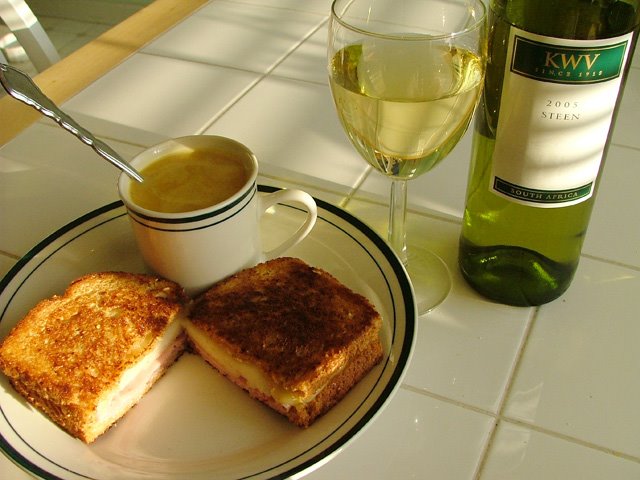 The theme for Wine Blogging Wednesday #20 is to pick a white wine outside of the big three (Chardonnay, Sauvignon Blanc, and Riesling), or any blend using those three. I was going to be a smartass and grab some obscure Hungarian white or perhaps one of the foxy Native American varieties. But instead, I was lured away by something that just came on sale at one of the local shops. For my entry, I present the 2005 KWV Steen, which I picked up for around $7.50.
KWV is the giant wine cooperative of South Africa, and Steen is what they call Chenin Blanc in those parts. There's not much on the nose here--in that respect, it's almost like Pinot Grigio. However, it has a much stronger presence in the mouth. The overwhelming element is firm acidity, with medium tartness and a short finish. No dominant flavors other than the baseline "white wine" taste. The wine on its own isn't that impressive, but it paired quite nicely with dinner: a cup of butternut squash soup and a grilled sandwich containing havarti cheese, thin slices of d'Anjou pears*, and smoked ham.
Not a bad little wine for the beginning of spring.
*A somewhat appropriate pairing, as the Chenin Blanc grapes originally come from around Anjou in France.
07 April 2006
Memphis Zoo Wine Benefit
 Tonight I was fortunate to receive some tickets to the "Wild World of Wines & Beer" benefit at the Memphis Zoo. Now, I've got a membership to the zoo and go there often. It's celebrating its 100th birthday this year, but the past twenty years have been amazing, as they decided to upgrade from the "concrete and cages" model to more natural habitats for the various animals. Over the years they've built Cat Country (all major large cat species), Primate Canyon (everything from lemurs to gorillas), the China Exhibit (pandas and more), and recently they've added the Northwest Passage exhibit (polar bears, black bears, etc.). At the right is a photo I took of one of the polar bears last month.
In honor of the Pacific Northwest theme, most of the wines came from that region. I skipped a few, as I had tried some of them before and they were pouring rather generously. I had to drive myself home, plus I really didn't want to fall in the baboon pit. Also, I was wondering beforehand if my notes would include things like, "this Merlot smells like elephant dung", or "this Riesling has the musky undertones of the tiger habitat". But all of my wine drinking happened indoors, so no outside olfactory influences were involved.
Wine 1: 2003 Foolish Oak Chardonnay. Columbia Valley, Washington. Light and fruity with a crisp finish. Great way to start off the evening. $11.
Wine 2: 2004 Hedges CMS White. Columbia Valley, Washington. I've had this before, but I was able to appreciate it more with a bigger sample. Very crisp, with a clean feel and herbal tones. Mix of Chardonnay, Marsanne, and Sauvignon Blanc. $15.
Wine 3: 2004 Ste. Michelle Riesling. Columbia Valley, Washington. Drier than I expected. Crisp with firm acids. Slightly bitter aftertaste. $10.
Wine 4: 2003 Columbia Crest Two Vines Chardonnay. Columbia Valley, Washington. Oaky and buttery, with some cream and vanilla highlights. $10.
Wine 5: 2003 Foris Pinot Noir. Illinois River Valley, Oregon. Mild cherry and strawberry flavors, with strong tannins and a short finish. $20.
Wine 6: 14 Hands Merlot. Columbia Valley, Washington. Black cherry, spice. Fortified by 22% Cabernet Sauvignon, so it's a surprise on the tongue. $12.
Wine 7: 2002 Red Diamond Shiraz. 3% Viognier blended in there. Berry and pepper flavors with a dry finish. A great little wine. I'm definitely going to give this one a second try when I can really focus on it and enjoy it. $12.
Of the three remaining wines that I didn't try, one was a White Merlot I skipped on purpose, one was a Cabernet Sauvignon I'd had before and enjoyed, and the last was a Fumé Blanc that looked promising, and I'll see if I can find it around here.
Unibroue Maudite
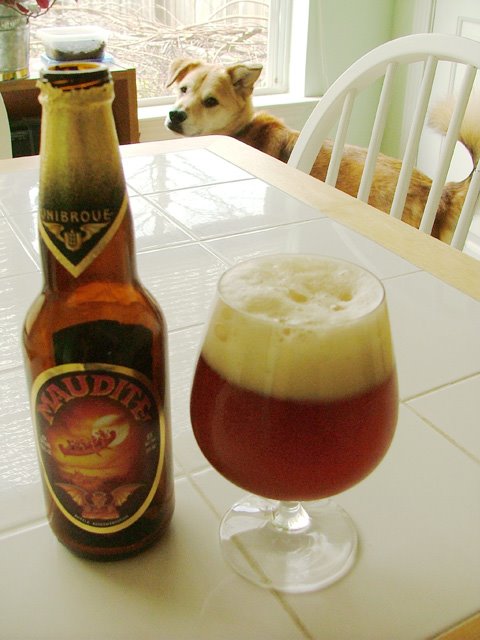 The local wine shop has begun offering "big beers" from the esteemed Quebec brewery Unibroue. A pack of four 12 oz. (355mL) bottles runs around $7.50, which is a good deal for a well made beer. This isn't the kind of thing that you throw back after a long day of yardwork. This is something you pour into the appropriate glass in the Belgian style and savor for a long time.
Pictured at the left is the Unibroue Maudite, a strong dark red beer. My dog Wolfgang looks on approvingly. What's fun with a beer like this is that you can close your eyes and try to pick out all of the subtle flavors and aromas. The Maudite (French for "The Damned") has a lot of nutmeg, with a little orange peel and maybe just a touch of cinnamon. More than anything it reminds me of a really well spiced tea blend. It's mildly bitter, and despite the 8% alcohol, not as strong as you might think.
You can't easily see this in the picture, but the beer itself is a little cloudy. This is due to the presence of yeast, which permits a secondary fermentation in the bottle and will allow the beer to improve with age, much like a fine wine. I'm probably going to do some more reviews of beers like this (including some amazing barleywines I've tried). Seriously, these are beers that a wine lover is really going to appreciate, and there are certain meals where beverages such as the Maudite are going to be a better fit than a particular wine.
05 April 2006
Combinations #1
As a quick followup to the previous post, Andrew has thrown down the gauntlet with the first Combinations challenge:
Baked Mackerel With Rhubarb Sauce
Make the dish and pair it with a wine, and send the results to Andrew by April 24.
As for me, I'm looking forward to trying out this unusual recipe, but I might not be able to get my hands on fresh, small mackerel. If the culinary gods will forgive me, I might have to substitute fresh rainbow trout, which is pretty much the only one-pound full body fish that I see around here on a regular basis. Granted there's some Asian markets where I can get a live catfish or bullfrog butchered on the spot, but the mackerel is going to take a bit of work.
02 April 2006
Combinations
Wine- and food-blogger Andrew left a comment in one of my posts below, and we continued the conversation via e-mail. Andrew has a vision for a new monthly participatory project in the vein of Wine Blogging Wednesday. But instead of a themed wine, the idea is to post a recipe, then everyone cooks it and pairs it with a wine, and reports on how well that wine matched the dish. Andrew calls it Combinations, and has blogged about it here and here.
I think it's important to look at this not only for foodbloggers to think more about wine, but also for winebloggers to think more about food. In the words of Rogers & Hammerstein, "The Farmer and the Cowman Should Be Friends". We've all got the opportunity to learn a lot, broaden our horizons, and have some damned good food and wine in the process.
I fully support this project, will promote it to the best of my ability, and look forward to participating in it in the months to come.
01 April 2006
Segura Viudas Aria NV
So I bought an inexpensive Spanish cava a couple of weeks ago and served it last night. And in doing so, I made some sort of a statement about Spanish politics. Andrew mentioned this a while back, and pointed to an informative article on the subject. Though I'm enchanted by the Catalan language, I really don't have any opinions about the autonomy question and wouldn't stop drinking delicious, affordable cava because of it.
The wine in question was the Segura Viudas Aria, which is a Pinot Noir-based sparkling wine. 100% Pinot Noir, grown in Catalonia and sold just for the American market. It's made by Segura Viudas, but there's nothing about this wine on the website. It's a pretty deep pink, almost red color. Some hints of strawberry, but for the most part it's light, crisp, and refreshing. To be honest, I didn't get to drink much of it--the sparkler was served along with a spread of cheeses and a traditionally prepared Caesar salad, and the ladies drank up most of it before I was able to sit down and think about the various attributes. So for that reason alone the wine gets an A in my book.
The wine in question was the Segura Viudas Aria, which is a Pinot Noir-based sparkling wine. 100% Pinot Noir, grown in Catalonia and sold just for the American market. It's made by Segura Viudas, but there's nothing about this wine on the website. It's a pretty deep pink, almost red color. Some hints of strawberry, but for the most part it's light, crisp, and refreshing. To be honest, I didn't get to drink much of it--the sparkler was served along with a spread of cheeses and a traditionally prepared Caesar salad, and the ladies drank up most of it before I was able to sit down and think about the various attributes. So for that reason alone the wine gets an A in my book.
Subscribe to:
Posts (Atom)