It's been a weird wine weekend--I'll have a bunch of posts in the morning. For now I'm sipping on a Provençal offering, the 2003 Domaine de Camparnaud. Around $10 in the bargain bin of a trusted wine shop, this was tagged by the owner as "Affordable Bordeaux", though apparently it's a blend of Rhone and Bordeaux grapes but not grown in either area. The cork led me to the discovery that the producer is part of the Cave les vins de Roquebrun wine cooperative, and that it's estate bottled near the Orb River.
I wasn't able to find any more information on this wine, as is often the case with these smaller French producers. Most references are in Dutch or German and I'm just too tired to slog through that tonight. If the producer had a website in French, I'd happily muddle through it and find out more, but I'm not interested in going through a dozen websites only to find out that they're all wine lists from restaurants in Munich and Amsterdam. If Google had an option for "wine searches minus restaurant wine lists", these posts would be a lot easier.
As for the wine, it's unremarkable. Not much of an aroma, and some of those vegetal and barnyard characteristics that turn a lot of Americans off French wines. Let me reiterate that it's not bad, just a very basic red wine. There's a good dose of Cabernet Sauvignon but I'm having trouble with the other grapes. The label on mine looks a lot different from the website linked above, leading me to believe that somewhere in this country a restaurant owner is marking this stuff up 400% and presenting it as a serious Bordeaux. Typically I get more fruit, more fun from a Languedoc wine, but this one's just not grabbing my attention.

19 November 2005


18 November 2005
Tom Wark's Fermentation Blog
Just added Tom Wark's Fermentation to the blogroll. In the past couple of months I've been reading his site for a look at wine from a business perspective, and I've gotten to know some other wine bloggers through his insightful comments sections. He's recently had to make a slight change to the name of his blog, so update your bookmarks and spread the word!
Appellation America: Varietal Character Profile
I've recently signed up with Appellation America, and hope to write something for them once I've had some time to go through their site. I got an invitation from Managing Editor Adam Dial to participate in their Varietal Character Profiling Program, which describes wines as unique human characters. Winning entries get added to the list, and their in-house illustrator creates a delightful sketch to accomplany the text. (The one for Concord made me burst out laughing.)
Most of the major grapes are already taken, so from the remaining oddballs I'm going to go with one of my favorites, the underappreciated Montepulciano:
Montepulciano
You are the owner of a small family restaurant in Tuscany--a trattoria, the place where construction workers and other shop owners enjoy a humble but delicious lunch. You're uncomplicated, refreshing, easy going, and always have a smile on your bright red face. You'll never be famous outside of your neighborhood, and your restaurant will probably never get any bigger, but the locals and occasional visitors will always appreciate your contributions to the everyday Italian table. You are equally at ease in your restaurant, in the home kitchen, and on the back porch beside a sizzling grill on a holiday weekend.
Most of the major grapes are already taken, so from the remaining oddballs I'm going to go with one of my favorites, the underappreciated Montepulciano:
Montepulciano
You are the owner of a small family restaurant in Tuscany--a trattoria, the place where construction workers and other shop owners enjoy a humble but delicious lunch. You're uncomplicated, refreshing, easy going, and always have a smile on your bright red face. You'll never be famous outside of your neighborhood, and your restaurant will probably never get any bigger, but the locals and occasional visitors will always appreciate your contributions to the everyday Italian table. You are equally at ease in your restaurant, in the home kitchen, and on the back porch beside a sizzling grill on a holiday weekend.
17 November 2005
2005 Georges Dubœuf Beaujolais Nouveau
Come on, give into the hype... I picked up a bottle of the 2005 Georges Dubœuf Beaujolais Nouveau after work and am drinking it now. There's that classic Dubœuf* banana taffy aroma, but this year's vintage is surprisingly tart. I personally preferred the 2004 and 2003 over this year, and of course the Beaujolais-Villages and crus from 2003 had an amazing longevity. So not my favorite, but I'll polish off the bottle easily. One bit of advice: much better chilled than room temperature.
You see a lot of weird behavior with "Beaujolais Thursday". A few years ago at the airport my father had to deal with an unruly passenger who was devastated that he couldn't get the Beaujolais Nouveau in the airport during his hour layover, and was demanding that an airline employee go forth and fetch him a bottle. Then there are those that refuse to touch the stuff. Others stock up and serve it by the gallon at Thanksgiving (and along with riesling, it's not a bad choice for the wide range of flavors and ingredients found in the average Thanksgiving dinner). Then there are those aficianados who refuse to drink it the first day, but wait until Saturday to avoid bottle shock and then keep a few bottles to try monthly until summer rolls around. Those in the last category will hunt out those offerings from producers other than Georges Dubœuf. I'm not one of those, but I am partial to Louis Jadot, and look forward to trying his Beaujolais this weekend at a tasting.
As for me, I like to throw back a bottle the first day it's available. Even if it's not fantastic, I'm getting to take part in a global wine drinking celebration. We've got Champagne on New Year's Eve and beer on St. Patrick's Day, but this is our only real wine holiday. Yes, there are Jewish holidays that often include wine, and I suppose traditional Sunday communion is technically a mass wine drinking experience (ha ha), but when else are you assured that millions of other wine drinkers are quaffing on the same day?
*How many bloggers and websites will bother to show the œ dipthong properly? Granted, it will probably limit the links I get from Google, but as a former typesetter I just love to use such characters.
You see a lot of weird behavior with "Beaujolais Thursday". A few years ago at the airport my father had to deal with an unruly passenger who was devastated that he couldn't get the Beaujolais Nouveau in the airport during his hour layover, and was demanding that an airline employee go forth and fetch him a bottle. Then there are those that refuse to touch the stuff. Others stock up and serve it by the gallon at Thanksgiving (and along with riesling, it's not a bad choice for the wide range of flavors and ingredients found in the average Thanksgiving dinner). Then there are those aficianados who refuse to drink it the first day, but wait until Saturday to avoid bottle shock and then keep a few bottles to try monthly until summer rolls around. Those in the last category will hunt out those offerings from producers other than Georges Dubœuf. I'm not one of those, but I am partial to Louis Jadot, and look forward to trying his Beaujolais this weekend at a tasting.
As for me, I like to throw back a bottle the first day it's available. Even if it's not fantastic, I'm getting to take part in a global wine drinking celebration. We've got Champagne on New Year's Eve and beer on St. Patrick's Day, but this is our only real wine holiday. Yes, there are Jewish holidays that often include wine, and I suppose traditional Sunday communion is technically a mass wine drinking experience (ha ha), but when else are you assured that millions of other wine drinkers are quaffing on the same day?
*How many bloggers and websites will bother to show the œ dipthong properly? Granted, it will probably limit the links I get from Google, but as a former typesetter I just love to use such characters.
11 November 2005
The Effect of Wine Tastings on Man-in-the-Moon Marigolds
Anyone who gets the subject line reference gets a toast from me the next time I raise a glass, and by the way, I've always hated the smell of marigolds and don't find them particularly attractive in a visual sense. My dearly departed maternal grandmother was a member of multiple flower societies here in town, and I enjoyed looking at and sniffing most of her flowers, but I never liked marigolds. Give me a good hydrangea or a well tended rose and I'm a happy lad.
One weird side effect of going to wine tastings on a regular basis and hunting out subtle scents and flavors is that you get hypersensitive to smells and tastes in everyday life. The first time I experienced this phenomenon was when I used to go on long backpacking trips. Away from car exhaust and urban pollution, I became keenly aware of the olfactory world around me, from the vanilla scent of a Ponderosa Pine to the grassy tang of fresh horse droppings. And since most of us didn't get a shower over the two week trips, I learned to identify my fellow hikers by scent. A guy could walk up behind me and I'd say "Hey Clark, what's up?"
I'm house- and dog-sitting for a friend, and while I used to live in this neighborhood, it's changed a lot in the last ten years. I wandered around a bit, couldn't find what I was looking for, and dipped off into the rougher section of town for some decent Buffalo wings. For my international readers, the standard Buffalo wing is a chicken wing (normally separated into flat and drummie pieces) that is deep fried and then tossed in a hot sauce and butter mixture for a bit before being served with long pieces of carrot and celery and bleu cheese dressing.
I ended up in a bar/chicken wing shack. Needless to say my pasty white face and red beard stuck out like a sore thumb, but I don't care. I ended up drinking beer with a math teacher who was grading papers over a couple of Coronas. I'm not quite 30, but this lady was younger than me and using a freakin' slide rule to grade her papers. The geek in me was greatly impressed. Finally the wings arrived, and I headed back to my friend's place.
Now, a lot of these establishments offer many different sauces. A good restaurant will change bowls between orders. Sadly, this place did not. I went for the original hot, which should have been simply hot sauce and butter, but I could taste honey, barbecue sauce, and teriyaki sauce in various layers. The end result wasn't bad, but not exactly what I was looking for--too sweet for my palate. I was more intrigued by the analysis I did on each wing in trying to discern the multiple layers of flavors.
One weird side effect of going to wine tastings on a regular basis and hunting out subtle scents and flavors is that you get hypersensitive to smells and tastes in everyday life. The first time I experienced this phenomenon was when I used to go on long backpacking trips. Away from car exhaust and urban pollution, I became keenly aware of the olfactory world around me, from the vanilla scent of a Ponderosa Pine to the grassy tang of fresh horse droppings. And since most of us didn't get a shower over the two week trips, I learned to identify my fellow hikers by scent. A guy could walk up behind me and I'd say "Hey Clark, what's up?"
I'm house- and dog-sitting for a friend, and while I used to live in this neighborhood, it's changed a lot in the last ten years. I wandered around a bit, couldn't find what I was looking for, and dipped off into the rougher section of town for some decent Buffalo wings. For my international readers, the standard Buffalo wing is a chicken wing (normally separated into flat and drummie pieces) that is deep fried and then tossed in a hot sauce and butter mixture for a bit before being served with long pieces of carrot and celery and bleu cheese dressing.
I ended up in a bar/chicken wing shack. Needless to say my pasty white face and red beard stuck out like a sore thumb, but I don't care. I ended up drinking beer with a math teacher who was grading papers over a couple of Coronas. I'm not quite 30, but this lady was younger than me and using a freakin' slide rule to grade her papers. The geek in me was greatly impressed. Finally the wings arrived, and I headed back to my friend's place.
Now, a lot of these establishments offer many different sauces. A good restaurant will change bowls between orders. Sadly, this place did not. I went for the original hot, which should have been simply hot sauce and butter, but I could taste honey, barbecue sauce, and teriyaki sauce in various layers. The end result wasn't bad, but not exactly what I was looking for--too sweet for my palate. I was more intrigued by the analysis I did on each wing in trying to discern the multiple layers of flavors.
Freixenet Brut de Noirs NV
Earlier this afternoon I purchased a $10 bottle of the Freixenet Brut de Noirs based on my positive experience at the wedding last weekend. I was going to get one of the standard sparklers, but I came across this bottle and my brain and palate mimicked Strong Bad. I thought, "DRY? SPARKLING? DE NOIRS?" and made appropriate happy grunting noises.
Something I've noticed about Spanish rosés is that they have a lovely salmon/coral color to them. Almost orange, depending on the light. This wine is a half and half blend of Garnacha and Monastrell (Grenache and Mourvèdre, made in the rosé and sparkling styles). This wine barely bubbled in the glass, but fizzed up nicely on the pour and retained firm bubbles on the palate. Flavors tended towards strawberries with a hint of stronger red wine in the background. A decent wine for hanging around the house, listening to music and reading a good book. I know that sounds... less than manly, but a sparkling wine is an ephemeral thing, and I hate to leave an open bottle sitting in the fridge overnight. If you don't have to drive anywhere, why not spend a few hours drinking a tasty sparkler and enjoying life?
Something I've noticed about Spanish rosés is that they have a lovely salmon/coral color to them. Almost orange, depending on the light. This wine is a half and half blend of Garnacha and Monastrell (Grenache and Mourvèdre, made in the rosé and sparkling styles). This wine barely bubbled in the glass, but fizzed up nicely on the pour and retained firm bubbles on the palate. Flavors tended towards strawberries with a hint of stronger red wine in the background. A decent wine for hanging around the house, listening to music and reading a good book. I know that sounds... less than manly, but a sparkling wine is an ephemeral thing, and I hate to leave an open bottle sitting in the fridge overnight. If you don't have to drive anywhere, why not spend a few hours drinking a tasty sparkler and enjoying life?
10 November 2005
Opici Vineyards Homemade Barberone
NOTE: I am just a wine writer, I am not affiliated with Opici, I do not know where to find their wines nor do I have anything to do with the size of the bottles. If you have questions, please ask your local wine retailer.
Here's something from the bargain rack... For five bucks, why not try something odd? I procured a bottle of the Opici Vineyards Homemade Barberone. Now, I don't have any solid information the wine, except that back in the old days a California Barberone was a generic dark blend of Zinfandel and other red grapes. Lighter red blends were marketed as Burgundy. I can definitely taste the Zinfandel in there, but not much else. It's way sweet for my tastes, and a sweet red wine always bugs me (until you move into the Port categories, but that's a different matter entirely).
I'm not really getting much of an Italian feel here, unless we're talking about a flat Lambrusco. No serving suggestions here, although it might be a good transitional wine for someone terrified of making the leap from whites and White Zinfandel. Or for younger, new wine drinkers, as sweetness generally helps make wine seem less threatening in the early days.
Here's something from the bargain rack... For five bucks, why not try something odd? I procured a bottle of the Opici Vineyards Homemade Barberone. Now, I don't have any solid information the wine, except that back in the old days a California Barberone was a generic dark blend of Zinfandel and other red grapes. Lighter red blends were marketed as Burgundy. I can definitely taste the Zinfandel in there, but not much else. It's way sweet for my tastes, and a sweet red wine always bugs me (until you move into the Port categories, but that's a different matter entirely).
I'm not really getting much of an Italian feel here, unless we're talking about a flat Lambrusco. No serving suggestions here, although it might be a good transitional wine for someone terrified of making the leap from whites and White Zinfandel. Or for younger, new wine drinkers, as sweetness generally helps make wine seem less threatening in the early days.
08 November 2005
Questionnaire Responses
Andrew of Spittoon, Andy's Scribblings, and Slashfood has been working on an article for that last website. Here, I'm going to give his full list of questions, along with my responses. And while I haven't changed any of my answers, with Andrew's blessing I'm going to elaborate more here. Questions in bold, responses in normal text.
1) unoaked chardonnay or sauvignon blanc?
Sauvignon Blanc, but particularly those from New Zealand. I also love the Coppola Diamond Sauvignon Blanc for entirely different reasons. This was a tough question, because I love unoaked Chardonnay, but find that the citrus qualities of NZ SB make it a great companion for seafood and spicy dishes. As far as France is concerned, I'd say that I like their implementations of Sauvignon Blanc and unoaked Chardonnay equally.
2) should you/do you/should we write-up poor quality wines?
I think this is important, as it helps steer people away from (to us) obviously bad wine. To avoid snobbery and to be even more helpful, I think it is wise to suggest a similar wine (varietal, price) with much better quality. Let's face it--there are some wines out there that just taste like crap. Granted, if you can taste at least two identical bottles you can mostly rule out any unintentional flaws, but some wines are just bad. But like I said, I think it's very important to offer a reasonable alternative. This is the same thing I do with friends. Oh, you love white zin (but I quietly hate it)? Try this comparatively priced Late Harvest Riesling. You like this (sour) Aussie merlot? Here, try this introductory level wine from the right bank of Bordeaux.
3) where would you say is the epicentre, the spiritual home, the crux of the wine world?
(I was proud that Andrew used this in his article, so I'll leave it as is.) On the tongue of every budding wine enthusiast when he first learns to unlock the various flavors and complexities of good wine. Metaphysics aside, I'd probably say Italy. So many grapes, such great food, and a culture that makes wine a part of everyday life but also provides unlimited opportunities for the most serious wine lovers.
4) have you ever been there?
Yes, and while I drank a lot of wine, I didn't study it much or visit any vineyards. I was 20 at the time, not legally allowed to drink the US, though I'd had my share of wine thanks to the parents and family friends. This was the first time that I was able to drink wine with meals on a regular basis, and was amazed at how it made the food taste so much better. The great thing about Italy is that even the cheap vino della casa is often quite good, and doesn't cost much more than bottled water, so why not? And while I didn't really study wine over there during my three week tour with the girlfriend of the time, I was introduced to Prosecco, Moscato d'Asti, Vin Santo, and other joys that I've recently been able to share with friends. A lot of times, while eating at small trattorias, the wine was served in an earthenware crock and was made by the proprietor's cousin. There's nothing like plopping down $10 for three handmade courses of Tuscan delights along with a half litre of something that's probably part Sangiovese and part unidentified grapes that have been growing wild since the time of the Roman empire.
5) How many corkscrews do you own?
"Three, stationed strategically around the house." For some reason Andrew found this hilarious. Allow me to elaborate. I live in a two story townhouse, with the living room and kitchen downstairs and the bedrooms upstairs. I keep the rabbit-style corkscrew in the kitchen, the two-handles-that-you-force-down-and-bonus-beer-bottle-opener in the living room, and in my upstairs bedroom (or in my pocket) is my 1986 Swiss Army Knife, the Huntsman model which features a bone saw and corkscrew. Believe it or not, I've been opening bottles of wine with that almost since I got it at the age of ten. At parties with my parents or relatives, somebody would be searching for a corkscrew and I'd march up and open the thing. As an adult, I rarely use it, but always bring it along just in case. That knife has been with me on many trips--both overseas and into the backwoods for a long backpacking trip. And all of the utensils still work perfectly.
Seriously, though, why would you only have one corkscrew stashed in the kitchen? One is bound to break at some point, and I think you should have at least one stashed at each place where you normally drink wine. (For me, my bedroom is not the site of romantic wine drinking but more a case of me working on the computer with dinner resting on my lap and a glass of plonk by the mouse.)
6) food blogs - how many do you subscribe to(RSS) or read regularly?
None, really, though I read a dozen or so wine blogs weekly. You can glance at the list to the left for the ones that I read on a regular basis.
7) can you lend me twenty quid, guv?
Original response: "No pounds in my wallet. I've got a lot of defunct Dutch guilders on top of my dresser, will that help? ;)" I was tempted to make some comment about the American Revolution, but didn't want to be an ass.
8) do you read slashfood?
Once in a while, I should read it more often. I have been an avid reader of Slashdot since 1998. Here I let my geek flag fly. Yes, I've installed Linux on more than one machine. Yes, I've argued about the GPL. Yes, I've made my livelihood e-commerce and graphic design and other digital delights. Back to the wine.
9) food and wine matching - is it important?
In a general sense, but it's a lot of fun to break the rules and experiment. I'll give you an example. Here in the Mid-South (a region around Memphis that includes parts of northwest Mississippi, northeast Arkansas, and southeast Missouri), we eat a lot of pork. But it's prepared a lot of different ways: baked, smoked, cured, grilled, boiled, etc. Pork is a difficult meat to match with wine, and I've found that depending on the preparation you can use everything from the most delicate white to the strongest red, with things like an inexpensive California sparkler showing up as an ideal companion for a pulled pork sandwich. I think there are some delicate presentations of beef that would go quite well with a mature, mellow Chardonnay. And there's some hearty chicken dishes that really need a red. While there are some great classic combinations, it's most important to play around and have some fun, like when I found out that sparkling wine and fried chicken are a perfect match.
10) South African Pinotage or Argentinean Malbec?
Argentine Malbec. I like Pinotage, but more in a blend--on its own there's an ashy quality that bugs me, but I can drink Argentine Malbec by the gallon if given the opportunity.
11) bag in box wines - can they ever look stylish on the dining table?
No, especially since you have to hang it over the edge of the table to pour a glass. Though I am fond of the Australian technique of taking the bag out of the box, tying it to a revolving clothesline, and spinning it around. Wherever it stops, that person has to take a drink. Continue until the bag is empty or all participants have passed out. I've tried a lot of boxed or "cask" wines, even supposedly high end ones, and just haven't been impressed. I think that screwcaps or similar synthetic enclosures are a much better solution--at least you can still pour normally, and there's something wonderfully decadent about the sight of several empty wine bottles on a table. It's like the tangled sheets and covers on a bed after several rounds of great sex. Sure it's a mess that will need to be straightened up later, but by God, you're proud of that disorder that displays a great deal of accomplishment.
A box looks the same whether or empty or full, and even if you manage to empty one in a single evening, you've succeeded in just drinking the same wine all night. Moving away from graphic references, I'll state that I really enjoy drinking something new and different as opposed to tried and true. That, and the fact that I don't really have a good storage spot in my house, is why I never really buy wine by the case. I'd really rather try 12 different wines than a dozen of the same. In the future, I'd love to be able to stock away beloved treasures, but I figure there's too many grapes and too many producers out there to stick with one bottling for more than two or three times.
1) unoaked chardonnay or sauvignon blanc?
Sauvignon Blanc, but particularly those from New Zealand. I also love the Coppola Diamond Sauvignon Blanc for entirely different reasons. This was a tough question, because I love unoaked Chardonnay, but find that the citrus qualities of NZ SB make it a great companion for seafood and spicy dishes. As far as France is concerned, I'd say that I like their implementations of Sauvignon Blanc and unoaked Chardonnay equally.
2) should you/do you/should we write-up poor quality wines?
I think this is important, as it helps steer people away from (to us) obviously bad wine. To avoid snobbery and to be even more helpful, I think it is wise to suggest a similar wine (varietal, price) with much better quality. Let's face it--there are some wines out there that just taste like crap. Granted, if you can taste at least two identical bottles you can mostly rule out any unintentional flaws, but some wines are just bad. But like I said, I think it's very important to offer a reasonable alternative. This is the same thing I do with friends. Oh, you love white zin (but I quietly hate it)? Try this comparatively priced Late Harvest Riesling. You like this (sour) Aussie merlot? Here, try this introductory level wine from the right bank of Bordeaux.
3) where would you say is the epicentre, the spiritual home, the crux of the wine world?
(I was proud that Andrew used this in his article, so I'll leave it as is.) On the tongue of every budding wine enthusiast when he first learns to unlock the various flavors and complexities of good wine. Metaphysics aside, I'd probably say Italy. So many grapes, such great food, and a culture that makes wine a part of everyday life but also provides unlimited opportunities for the most serious wine lovers.
4) have you ever been there?
Yes, and while I drank a lot of wine, I didn't study it much or visit any vineyards. I was 20 at the time, not legally allowed to drink the US, though I'd had my share of wine thanks to the parents and family friends. This was the first time that I was able to drink wine with meals on a regular basis, and was amazed at how it made the food taste so much better. The great thing about Italy is that even the cheap vino della casa is often quite good, and doesn't cost much more than bottled water, so why not? And while I didn't really study wine over there during my three week tour with the girlfriend of the time, I was introduced to Prosecco, Moscato d'Asti, Vin Santo, and other joys that I've recently been able to share with friends. A lot of times, while eating at small trattorias, the wine was served in an earthenware crock and was made by the proprietor's cousin. There's nothing like plopping down $10 for three handmade courses of Tuscan delights along with a half litre of something that's probably part Sangiovese and part unidentified grapes that have been growing wild since the time of the Roman empire.
5) How many corkscrews do you own?
"Three, stationed strategically around the house." For some reason Andrew found this hilarious. Allow me to elaborate. I live in a two story townhouse, with the living room and kitchen downstairs and the bedrooms upstairs. I keep the rabbit-style corkscrew in the kitchen, the two-handles-that-you-force-down-and-bonus-beer-bottle-opener in the living room, and in my upstairs bedroom (or in my pocket) is my 1986 Swiss Army Knife, the Huntsman model which features a bone saw and corkscrew. Believe it or not, I've been opening bottles of wine with that almost since I got it at the age of ten. At parties with my parents or relatives, somebody would be searching for a corkscrew and I'd march up and open the thing. As an adult, I rarely use it, but always bring it along just in case. That knife has been with me on many trips--both overseas and into the backwoods for a long backpacking trip. And all of the utensils still work perfectly.
Seriously, though, why would you only have one corkscrew stashed in the kitchen? One is bound to break at some point, and I think you should have at least one stashed at each place where you normally drink wine. (For me, my bedroom is not the site of romantic wine drinking but more a case of me working on the computer with dinner resting on my lap and a glass of plonk by the mouse.)
6) food blogs - how many do you subscribe to(RSS) or read regularly?
None, really, though I read a dozen or so wine blogs weekly. You can glance at the list to the left for the ones that I read on a regular basis.
7) can you lend me twenty quid, guv?
Original response: "No pounds in my wallet. I've got a lot of defunct Dutch guilders on top of my dresser, will that help? ;)" I was tempted to make some comment about the American Revolution, but didn't want to be an ass.
8) do you read slashfood?
Once in a while, I should read it more often. I have been an avid reader of Slashdot since 1998. Here I let my geek flag fly. Yes, I've installed Linux on more than one machine. Yes, I've argued about the GPL. Yes, I've made my livelihood e-commerce and graphic design and other digital delights. Back to the wine.
9) food and wine matching - is it important?
In a general sense, but it's a lot of fun to break the rules and experiment. I'll give you an example. Here in the Mid-South (a region around Memphis that includes parts of northwest Mississippi, northeast Arkansas, and southeast Missouri), we eat a lot of pork. But it's prepared a lot of different ways: baked, smoked, cured, grilled, boiled, etc. Pork is a difficult meat to match with wine, and I've found that depending on the preparation you can use everything from the most delicate white to the strongest red, with things like an inexpensive California sparkler showing up as an ideal companion for a pulled pork sandwich. I think there are some delicate presentations of beef that would go quite well with a mature, mellow Chardonnay. And there's some hearty chicken dishes that really need a red. While there are some great classic combinations, it's most important to play around and have some fun, like when I found out that sparkling wine and fried chicken are a perfect match.
10) South African Pinotage or Argentinean Malbec?
Argentine Malbec. I like Pinotage, but more in a blend--on its own there's an ashy quality that bugs me, but I can drink Argentine Malbec by the gallon if given the opportunity.
11) bag in box wines - can they ever look stylish on the dining table?
No, especially since you have to hang it over the edge of the table to pour a glass. Though I am fond of the Australian technique of taking the bag out of the box, tying it to a revolving clothesline, and spinning it around. Wherever it stops, that person has to take a drink. Continue until the bag is empty or all participants have passed out. I've tried a lot of boxed or "cask" wines, even supposedly high end ones, and just haven't been impressed. I think that screwcaps or similar synthetic enclosures are a much better solution--at least you can still pour normally, and there's something wonderfully decadent about the sight of several empty wine bottles on a table. It's like the tangled sheets and covers on a bed after several rounds of great sex. Sure it's a mess that will need to be straightened up later, but by God, you're proud of that disorder that displays a great deal of accomplishment.
A box looks the same whether or empty or full, and even if you manage to empty one in a single evening, you've succeeded in just drinking the same wine all night. Moving away from graphic references, I'll state that I really enjoy drinking something new and different as opposed to tried and true. That, and the fact that I don't really have a good storage spot in my house, is why I never really buy wine by the case. I'd really rather try 12 different wines than a dozen of the same. In the future, I'd love to be able to stock away beloved treasures, but I figure there's too many grapes and too many producers out there to stick with one bottling for more than two or three times.
Advice
Editorial note: something about drinking rum while listening to jazz really gets my writing juices flowing, so I apologize for the several thousand words I'm spewing upon the blogosphere this evening.
For the first time in my wine blogging career, I got to play the part of advice columnist. A lady who shall remain anonymous e-mailed me with the question "I have two bottles of Coppola Diamond Claret, a 2002 and a 2003. Which one will be better?"
Here was my response:
She has since decided to drink the '02 now and save the '03 for a friend visiting after the first of the year, though she loved the vertical tasting suggestion. I wish her well and hope she enjoys both! And as a side note, unless your local wine shop has the '02 in stock, it's currently only available from the winery in an $80 3-litre bottle, which I would love to tackle over a long afternoon, just to see if I could do it.
If anyone else wishes to be a recipient of dubious long-winded advice, you know where to find me. I'll ask your permission before I blog about your query, but will always try to answer to the best of my abilities.
For the first time in my wine blogging career, I got to play the part of advice columnist. A lady who shall remain anonymous e-mailed me with the question "I have two bottles of Coppola Diamond Claret, a 2002 and a 2003. Which one will be better?"
Here was my response:
I'm assuming you found my post on the 2002 vintage via a Google search... Alas, I have not tried the 2003, but all of the Coppola wines (along with nearly all wines under $30) are released ready-to-drink. Under optimum storage conditions it certainly has the capacity to improve somewhat, but a Claret (from wherever) is generally drunk younger than the more expensive crus from Bordeaux.
If forced to make a decision, I'd say drink the 2002 now and save the 2003 for a couple of months. But since I love this wine so much, here's what I would do in your position: get a half dozen friends that have even a passing interest in wine, and have both wines with a hearty, beef-based dinner (standing rib roast, tenderloin, or simply grilled steaks, or maybe even a leg of lamb). Some fragrant bleu cheese or Stilton will help as well. The composition of both wines is almost identical, just single percent changes to the Cabernet Sauvignon and Malbec.
Open both, and have all of the guests taste small samples of the 2003 and then the 2002 before the food is served. Then pour a bit more with the meal, again starting with the 2003 and following it with the 2002. See if anyone can tell a difference between the two. The 2002 ought to be a little softer, but you'll basically be providing a "vertical tasting" writ small.
Here's the breakdown if you wanted to present the percentages to your friends, and feel free to talk up the 5 red grapes of Bordeaux and what each contributes (Merlot smoothes it a bit, the last three grapes provide deep color and hints of herbs and spice, etc.):
2002
89% Cabernet Sauvignon, 4% Merlot, 3% Cabernet Franc, 2% Malbec, 2% Petit Verdot
2003
88% Cabernet Sauvignon, 4% Merlot, 3% Cabernet Franc, 3% Malbec, 2% Petit Verdot
Talking up a wine will frequently improve the flavor, it's a psychological thing. I'm happy to provide further notes if you'd like, though I might turn the exchange into a blog post (with your permission, and leaving out your name and e-mail address, of course).
If you enjoy the Claret, I'd highly recommend the Coppola Diamond Sauvignon Blanc. It's a delicious, mellow, creamy-style Sauvignon blanc, and fun to serve aside one of the citrusy fruit bomb Sauvignon Blancs from New Zealand. There's rarely much joy in serving a wine in isolation; you need at least one other to allow for comparison and contrast. Either of the Clarets will taste better if you serve a lower grade red wine before it.
* * *
I hope this helps, and let me know how it turns out, whatever you decide to do.
Cheers,
Benito
She has since decided to drink the '02 now and save the '03 for a friend visiting after the first of the year, though she loved the vertical tasting suggestion. I wish her well and hope she enjoys both! And as a side note, unless your local wine shop has the '02 in stock, it's currently only available from the winery in an $80 3-litre bottle, which I would love to tackle over a long afternoon, just to see if I could do it.
If anyone else wishes to be a recipient of dubious long-winded advice, you know where to find me. I'll ask your permission before I blog about your query, but will always try to answer to the best of my abilities.
Wedding Wines
I attended a wedding this weekend... And as I'm dating one of the bridesmaids, that meant that I spent most of Friday and Saturday involved in wedding-related matters. The groom doesn't drink as a general rule, and the bride is a casual wine drinker. Nevertheless, during the rehearsal dinner, we toasted the couple with Freixenet Cordon Negro Brut. In my quest for good bargain sparkling wines, I've somehow always avoided this line. Maybe it was because I could never pronounce the damned name (just looked it up and it's "FRESH-en-ette", which sounds like some sort of feminine hygiene product). Maybe it was because the bottle reminded me of some sort of similarly-packaged ghetto hooch from my childhood. Maybe I thought it was some domestic product trying to sound foreign, like the dreaded "Champale".
Despite those mental roadblocks, I was pleasantly surprised. It's a crisp and bubbly wine, with--and I hate to use this cliché--a touch of lemon squirt acidity. I only had about half a glass (there were many people at the rehearsal dinner), but enjoyed it enough that I'm going to grab a bottle on my next visit to the wine shop.
Now that I've done the research, I find out that it's a traditional Spanish cava from the Catalan region, made from the odd sounding grapes Macabeo, Xarel-lo and Parellada. I'm going to come out and admit to a lot of ignorance when it comes to the thousands of little-known grape varieties of Italy, Spain, and Portugal, even though I love their wines. I've worked my liver hard over the past few years to school myself on the main grapes of all of the major wine producing areas of the world, as well as the second- and third-tier grapes of France, but I'm delighted to know that I have many more worlds to explore.
I didn't drink any regular wine that evening. There was a cash bar, and I looked over a series of opened, probably oxidized bottles of bargain wine being sold for more per glass than the entire bottle is worth in a regular retail setting. Unless I just have money to piss away or am in a restaurant that takes wine seriously, I don't buy wine at dinner in this town. Part of it is the ridiculous taxation scheme that makes a glass prohibitively expensive, and part of it is the fact that people in this city just don't drink much wine. I'm happy to bring a bottle and pay the corking fee, though.
 The wedding was lovely... It was held in St. Peter's, the oldest Catholic church in Memphis and the site of the first Catholic mass in our fair city. As a wee lad in 1984, I was the ring bearer for a very large Italian wedding at this place. The priest was a very friendly and welcoming man, who didn't hold my Protestantism against me. Nor did the current priest, a very young man who is an advisor at the Catholic girls' school where my girlfriend and the bride teach. (The three of them often go out to eat sushi for lunch and discuss philosphy and current events.)
At the reception, a free bar was provided with unidentified beer and three varieites of Lindemann's wine, all from 2003-2004, the Bin 40 Merlot, the Bin 50 Shiraz, and the Bin 65 Chardonnay. Sadly, I have no notes on these, even though I sampled all of them and even bumped into a friend from one of my wine tasting groups. (We talked mostly about the awesome Bell Wine Cellar selections we'd tried earlier in the day, though we'd arrived at different times.) While I don't recall any specific notes, I do remember the Chardonnay as being, surprisingly, my favorite out of the group for that occasion. None of these wines were sweet, and frankly, if I want inexpensive Aussie plonk, I'm much more likely to go for Lindeman's or Penfold's than Yellowtail or Alice White. The Shiraz and Merlot were decent enough (particularly with the beef brisket and toasted ravioli served), but the chilled Chardonnay was ideal for hanging around the sweltering dance floor and mingling with the crowd. Plus, if you accidentally splash a bit of chard on a girl's dress, it's damned near invisible compared to a red wine stain. All three of the wines were served from the 1.5 L bottles, which leads me to believe that they would be excellent selections for large gatherings of non-wine enthusiasts. My only change would be to add a bottle of their Bin 75 Riesling--that's one of my guilty pleasures, a sweeter white that is a perfect accompaniment with a traditional American Thanksgiving dinner. (With some of this and some apple cider added in, you'll have the world's greatest gravy to serve along with the turkey.)
Despite those mental roadblocks, I was pleasantly surprised. It's a crisp and bubbly wine, with--and I hate to use this cliché--a touch of lemon squirt acidity. I only had about half a glass (there were many people at the rehearsal dinner), but enjoyed it enough that I'm going to grab a bottle on my next visit to the wine shop.
Now that I've done the research, I find out that it's a traditional Spanish cava from the Catalan region, made from the odd sounding grapes Macabeo, Xarel-lo and Parellada. I'm going to come out and admit to a lot of ignorance when it comes to the thousands of little-known grape varieties of Italy, Spain, and Portugal, even though I love their wines. I've worked my liver hard over the past few years to school myself on the main grapes of all of the major wine producing areas of the world, as well as the second- and third-tier grapes of France, but I'm delighted to know that I have many more worlds to explore.
I didn't drink any regular wine that evening. There was a cash bar, and I looked over a series of opened, probably oxidized bottles of bargain wine being sold for more per glass than the entire bottle is worth in a regular retail setting. Unless I just have money to piss away or am in a restaurant that takes wine seriously, I don't buy wine at dinner in this town. Part of it is the ridiculous taxation scheme that makes a glass prohibitively expensive, and part of it is the fact that people in this city just don't drink much wine. I'm happy to bring a bottle and pay the corking fee, though.
 The wedding was lovely... It was held in St. Peter's, the oldest Catholic church in Memphis and the site of the first Catholic mass in our fair city. As a wee lad in 1984, I was the ring bearer for a very large Italian wedding at this place. The priest was a very friendly and welcoming man, who didn't hold my Protestantism against me. Nor did the current priest, a very young man who is an advisor at the Catholic girls' school where my girlfriend and the bride teach. (The three of them often go out to eat sushi for lunch and discuss philosphy and current events.)
 At the reception, a free bar was provided with unidentified beer and three varieites of Lindemann's wine, all from 2003-2004, the Bin 40 Merlot, the Bin 50 Shiraz, and the Bin 65 Chardonnay. Sadly, I have no notes on these, even though I sampled all of them and even bumped into a friend from one of my wine tasting groups. (We talked mostly about the awesome Bell Wine Cellar selections we'd tried earlier in the day, though we'd arrived at different times.) While I don't recall any specific notes, I do remember the Chardonnay as being, surprisingly, my favorite out of the group for that occasion. None of these wines were sweet, and frankly, if I want inexpensive Aussie plonk, I'm much more likely to go for Lindeman's or Penfold's than Yellowtail or Alice White. The Shiraz and Merlot were decent enough (particularly with the beef brisket and toasted ravioli served), but the chilled Chardonnay was ideal for hanging around the sweltering dance floor and mingling with the crowd. Plus, if you accidentally splash a bit of chard on a girl's dress, it's damned near invisible compared to a red wine stain. All three of the wines were served from the 1.5 L bottles, which leads me to believe that they would be excellent selections for large gatherings of non-wine enthusiasts. My only change would be to add a bottle of their Bin 75 Riesling--that's one of my guilty pleasures, a sweeter white that is a perfect accompaniment with a traditional American Thanksgiving dinner. (With some of this and some apple cider added in, you'll have the world's greatest gravy to serve along with the turkey.)
06 November 2005
Tasting Notes for November 5, 2005
Everything from this tasting came from Bell Wine Cellars, which owns a couple of vineyards throughout California. Joining us for the tasting was founder and winemaker Anthony Bell, a soft spoken man with a deep love of wine. Originally from South Africa, he's been working in California for nearly three decades. Given his background, I asked him if he's ever experimented with Pinotage in California, but while some have been able to grow the grape there, the ripening schedule really doesn't work with the climate.
Broadly speaking, these are all classic, mature, well-crafted wines. I'd recommend any of them if you're looking for a serious California wine, as opposed to the strange oddballs I write about here. The prices are high, but I think they're worth it. All of the more detailed wine information is available on one page.
Wine 1: 2004 Bell Viognier. Santa Cruz County, California. Slight aroma of honey, with earthy and mild fruit flavors. The first "serious" Viognier I've ever had. $38.
Wine 2: 2004 Bell Chardonnay. Napa Valley, California. There's a light and clean nose, mildly oaked and cream flavors. I had difficulty picking out individual elements in this wine, but it was very balanced and well rounded. $30
Wine 3: 2000 Bell Merlot. Napa Valley, California. By far my favorite out of the tasting. Lots of black cherry, very mellow and delicious. A hint of spice on the finish, and almost no discernable tannins. Probably one of the best Merlots I've ever had. $30.
Wine 4: 2003 Bell Syrah. Sierra Foothills, California. Slight roast lamb scent, with plum jam flavors, but not jammy. Very subtle and restrained for a Syrah. $30.
Wine 5: 2002 Bell Cabernet Sauvignon. Napa Valley, California. Dark fruit, black pepper, and solid tannins. I'd love to revisit this one in a year or two, but it's a solid California Cabernet Sauvignon. $43.
Wine 6: 1999 Bell Clone 6 Cabernet Sauvignon (375mL). Baritelle Vineyard, California. This is the star of the show. There's a lot more information on the website about this particular wine, but it's really spectacular. I would have needed a full glass to really study this wine, but just imagine all elements being in perfect, harmonious balance. I had a smile on my face for an hour afterwards. $35.
Broadly speaking, these are all classic, mature, well-crafted wines. I'd recommend any of them if you're looking for a serious California wine, as opposed to the strange oddballs I write about here. The prices are high, but I think they're worth it. All of the more detailed wine information is available on one page.
Wine 1: 2004 Bell Viognier. Santa Cruz County, California. Slight aroma of honey, with earthy and mild fruit flavors. The first "serious" Viognier I've ever had. $38.
Wine 2: 2004 Bell Chardonnay. Napa Valley, California. There's a light and clean nose, mildly oaked and cream flavors. I had difficulty picking out individual elements in this wine, but it was very balanced and well rounded. $30
Wine 3: 2000 Bell Merlot. Napa Valley, California. By far my favorite out of the tasting. Lots of black cherry, very mellow and delicious. A hint of spice on the finish, and almost no discernable tannins. Probably one of the best Merlots I've ever had. $30.
Wine 4: 2003 Bell Syrah. Sierra Foothills, California. Slight roast lamb scent, with plum jam flavors, but not jammy. Very subtle and restrained for a Syrah. $30.
Wine 5: 2002 Bell Cabernet Sauvignon. Napa Valley, California. Dark fruit, black pepper, and solid tannins. I'd love to revisit this one in a year or two, but it's a solid California Cabernet Sauvignon. $43.
Wine 6: 1999 Bell Clone 6 Cabernet Sauvignon (375mL). Baritelle Vineyard, California. This is the star of the show. There's a lot more information on the website about this particular wine, but it's really spectacular. I would have needed a full glass to really study this wine, but just imagine all elements being in perfect, harmonious balance. I had a smile on my face for an hour afterwards. $35.
02 November 2005
The Wine Swap
Here's a belated review, but it's got a cool story behind it.
A couple of weeks ago, a guy I know named Tom suggested a wine swap, based on our mutual love of wine. Nothing odd about that, right? Except that I've never actually met Tom, and due to Tennessee's wine laws the mail was out of the question.
I know Tom through my friend Paul, who maintains a private e-mail list for friends and family. Taking a break from the discussions of politics and world events, Tom and I would occasionally veer off into separate wine correspondence. I've got a female housemate that doesn't drink and a girlfriend that isn't an enthusiast; wine tastings and the internet are my outlets for long-winded rants on fermented grape juice.
And since Paul was headed up for a visit a few weeks ago, Tom proposed the wine swap--I would send a bottle up with Paul, and Tom would return the favor. Paul, acting as mule, would be rewarded with enjoying the wine at both ends.
I passed along a bottle of the 2002 Tibor Gál Egri Bikavér, which I reviewed earlier. It was well-received and served alongside buffalo and lamb. I included a letter of explanation for my choice, and in the great tradition of Wine X I wove a tale about 80s teen comedies and pegged the wine as the weird foreign exchange student from eastern Europe with the funny name who turns out to be pretty cool.
In return, Tom sent me two bottles and a lovely explanatory letter. I'll get one out of the way. I had been dying to taste a Cahors, to sample my beloved Malbec as done by the French. It's barely produced in France and rarely available here, and Tom managed to track down a reasonably priced bottle from 1997. Sadly, it was oxidized and well past its prime. Note to everyone reading: this is not Tom's fault, and the joy I had upon seeing the Cahors label was more than enough to make up for the sad conclusion. This is truly a case where it was the thought that counted.
He also sent along another bottle: the 2003 Panarroz Jumilla, which hails from Spain. And with this delightful offering, Tom scored a home run. It's a Grenache-Syrah-Mourvèdre blend, though on the Iberian peninsula they call that last grape Monastrell. This wine comes from a small Spanish producer, and I couldn't find a website, but it appears to be quite popular throughout Europe. It got great reviews from Robert Parker, and as such there's a ton of fruit-forward delicious berry flavors, but also a classic European balance between the three grapes. Let's face it: I love GSM blends regardless of origin. France, Spain, California, Australia... I haven't met many that I didn't like.
I served the wine to Paul and my lady friend with an Italian-style pot roast. Yeah, that's what I fixed last weekend as well. It's finally turning chilly here in Memphis, and I've had a bit of a cold, so I'm entitled to my comfort foods.
Fortuitiously, the New York Times has an article this week by Eric Asimov (nephew of Isaac) in which he reviews California Rhone-style blends. I love these wines, and one of my only regrets from California is that Bonny Doon has decided to get expensive. I used to love Le Cigare Volant back when nobody was drinking it and it was $12 a bottle. Now it's $34 and I know I can get similiar and better wines for a third of the price. But I still miss it.
Bonny Doon is the sort of weird, artsy girlfriend you had in college that married some wealthy guy and won't talk to you anymore, but you secretly still yearn for her eclectic charms. And with that, I need a drink.
A couple of weeks ago, a guy I know named Tom suggested a wine swap, based on our mutual love of wine. Nothing odd about that, right? Except that I've never actually met Tom, and due to Tennessee's wine laws the mail was out of the question.
I know Tom through my friend Paul, who maintains a private e-mail list for friends and family. Taking a break from the discussions of politics and world events, Tom and I would occasionally veer off into separate wine correspondence. I've got a female housemate that doesn't drink and a girlfriend that isn't an enthusiast; wine tastings and the internet are my outlets for long-winded rants on fermented grape juice.
And since Paul was headed up for a visit a few weeks ago, Tom proposed the wine swap--I would send a bottle up with Paul, and Tom would return the favor. Paul, acting as mule, would be rewarded with enjoying the wine at both ends.
I passed along a bottle of the 2002 Tibor Gál Egri Bikavér, which I reviewed earlier. It was well-received and served alongside buffalo and lamb. I included a letter of explanation for my choice, and in the great tradition of Wine X I wove a tale about 80s teen comedies and pegged the wine as the weird foreign exchange student from eastern Europe with the funny name who turns out to be pretty cool.
In return, Tom sent me two bottles and a lovely explanatory letter. I'll get one out of the way. I had been dying to taste a Cahors, to sample my beloved Malbec as done by the French. It's barely produced in France and rarely available here, and Tom managed to track down a reasonably priced bottle from 1997. Sadly, it was oxidized and well past its prime. Note to everyone reading: this is not Tom's fault, and the joy I had upon seeing the Cahors label was more than enough to make up for the sad conclusion. This is truly a case where it was the thought that counted.
He also sent along another bottle: the 2003 Panarroz Jumilla, which hails from Spain. And with this delightful offering, Tom scored a home run. It's a Grenache-Syrah-Mourvèdre blend, though on the Iberian peninsula they call that last grape Monastrell. This wine comes from a small Spanish producer, and I couldn't find a website, but it appears to be quite popular throughout Europe. It got great reviews from Robert Parker, and as such there's a ton of fruit-forward delicious berry flavors, but also a classic European balance between the three grapes. Let's face it: I love GSM blends regardless of origin. France, Spain, California, Australia... I haven't met many that I didn't like.
I served the wine to Paul and my lady friend with an Italian-style pot roast. Yeah, that's what I fixed last weekend as well. It's finally turning chilly here in Memphis, and I've had a bit of a cold, so I'm entitled to my comfort foods.
Fortuitiously, the New York Times has an article this week by Eric Asimov (nephew of Isaac) in which he reviews California Rhone-style blends. I love these wines, and one of my only regrets from California is that Bonny Doon has decided to get expensive. I used to love Le Cigare Volant back when nobody was drinking it and it was $12 a bottle. Now it's $34 and I know I can get similiar and better wines for a third of the price. But I still miss it.
Bonny Doon is the sort of weird, artsy girlfriend you had in college that married some wealthy guy and won't talk to you anymore, but you secretly still yearn for her eclectic charms. And with that, I need a drink.
Comments Spam
To the two or three people that actually leave real comments:
I've turned on word verification for the commenting. I know it's a drag--I hate having to do it on other sites, but I don't check this site every day and I hate coming back to find a bunch of pointless spam in the comments.
When I've hit the lottery jackpot and can afford a nubile young secretary to filter unwanted comments, I might get rid of it.
I've turned on word verification for the commenting. I know it's a drag--I hate having to do it on other sites, but I don't check this site every day and I hate coming back to find a bunch of pointless spam in the comments.
When I've hit the lottery jackpot and can afford a nubile young secretary to filter unwanted comments, I might get rid of it.
30 October 2005
Tasting Notes for October 29, 2005
Everything from today's tasting came from the Chilean producer Viña Morandé. One of the winemakers was present to answer questions about the wines and the region. All of these wines are very reasonably priced and easily enjoyable with a wide range of foods. The Pionero wines are the entry level bottles, the Terrarum wines are the reserve offerings, and Vitisterra wines are grand reserve.
Wine 1: 2004 Morandé Pionero Sauvignon Blanc. Grapefruit aromas and flavors, no oak, and tending towards the sweet side. $8.
Wine 2: 2003 Morandé Terrarum Chardonnay. Buttery aroma on top, with touches of oak in the flavor. Crisp acids and a round flavor. $12.
Wine 3: 2001 Morandé Vitisterra Chardonnay. Fruit and floral aromas, a hint of vanilla with a slightly sweet and creamy flavor. Impressive. $17.
Wine 4: 2003 Morandé Pionero Pinot Noir. Yes, that's right, a Pinot Noir from Chile. I found this herbal and vegetal, with medium tannins. Overall unusual experience. $8.
Wine 5: 2002 Morandé Pionero Carmenère. Hints of black cherry, with an enticing fresh baked bread aroma. Inky black with a good round flavor. Good introduction to this grape if you're not familiar with it. $8.
Wine 6: 2002 Morandé Terrarum Carmenère. This has a hotter aroma than previous wine, but with soft tannins and beautiful construction. My favorite of the day, and I picked up a bottle for dinner (Italian-style pot roast). It's got green pepper/tomato leaf flavors, along with herbal complexity. Reminds me of something from Medoc, and along with the deep color, brings to mind Petite Verdot. $12.
Wine 7: 2002 Morandé Pionero Cabernet Sauvignon. A little black cherry aroma, but with strawberry flavors. A little thin for my tastes. $8.
Wine 8: 2002 Morandé Terrarum Cabernet Sauvignon. Similar to the above, but with more oak present and softer tannins. $12.
Wine 9: 2003 Morandé Vitisterra Cabernet Sauvignon. This was a little on the tart side, and the tannins were still a little hard. I think this might need another year in the bottle. $12.
Wine 10: 2003 Morandé Late Harvest Sauvignon Blanc (375mL). Wow. A Sauternes-style dessert wine. Everything you want in a botrytis wine at a great price. Hints of smoke and musk on top, with a delightful flavor of honeysuckle and lychee. Sugary, but with well-balanced acidity. $13.
Wine 1: 2004 Morandé Pionero Sauvignon Blanc. Grapefruit aromas and flavors, no oak, and tending towards the sweet side. $8.
Wine 2: 2003 Morandé Terrarum Chardonnay. Buttery aroma on top, with touches of oak in the flavor. Crisp acids and a round flavor. $12.
Wine 3: 2001 Morandé Vitisterra Chardonnay. Fruit and floral aromas, a hint of vanilla with a slightly sweet and creamy flavor. Impressive. $17.
Wine 4: 2003 Morandé Pionero Pinot Noir. Yes, that's right, a Pinot Noir from Chile. I found this herbal and vegetal, with medium tannins. Overall unusual experience. $8.
Wine 5: 2002 Morandé Pionero Carmenère. Hints of black cherry, with an enticing fresh baked bread aroma. Inky black with a good round flavor. Good introduction to this grape if you're not familiar with it. $8.
Wine 6: 2002 Morandé Terrarum Carmenère. This has a hotter aroma than previous wine, but with soft tannins and beautiful construction. My favorite of the day, and I picked up a bottle for dinner (Italian-style pot roast). It's got green pepper/tomato leaf flavors, along with herbal complexity. Reminds me of something from Medoc, and along with the deep color, brings to mind Petite Verdot. $12.
Wine 7: 2002 Morandé Pionero Cabernet Sauvignon. A little black cherry aroma, but with strawberry flavors. A little thin for my tastes. $8.
Wine 8: 2002 Morandé Terrarum Cabernet Sauvignon. Similar to the above, but with more oak present and softer tannins. $12.
Wine 9: 2003 Morandé Vitisterra Cabernet Sauvignon. This was a little on the tart side, and the tannins were still a little hard. I think this might need another year in the bottle. $12.
Wine 10: 2003 Morandé Late Harvest Sauvignon Blanc (375mL). Wow. A Sauternes-style dessert wine. Everything you want in a botrytis wine at a great price. Hints of smoke and musk on top, with a delightful flavor of honeysuckle and lychee. Sugary, but with well-balanced acidity. $13.
23 October 2005
Tasting Notes for October 22, 2005
Yep, I'm still alive... Here's the notes for Saturday's tasting, which focused on Pinot Noir and Zinfandel.
Wine 1: 2004 Castle Rock Carneros Pinot Noir. Napa Valley, California. Bold and tannic, with a strong strawberry flavor. Somewhat off finish. $10.
Wine 2: 2002 Windy Ridge North Coast Pinot Noir. Victoria, Australia. From the southernmost winery on the Australian mainland. This is a dark wine with a pomegranate flavor, and strong finish. Interesting. $14.
Wine 3: 2003 Mark West Pinot Noir. Central Coast, California. Mellower and rounder than the above selections, but still maybe a little young. $15.
Wine 4: 2004 Edna Valley Vineyard Pinot Noir. A little buttered toast on the top, maybe some strawberry in the flavor. Decent little wine. $17.
Wine 5: 2002 Rodney Strong Estate Bottled Pinot Noir. Russian River, California. An aroma of alcohol and Port, giving way to a mellow flavor with light tannins. Classic, well produced Pinot Noir. $17.
Wine 6: 2002 Clos La Chance Pinot Noir. Santa Cruz Mountains, California. Very soft and rounded, delicate light cherry flavor. $20.
Wine 7: 2004 The Crossings Pinot Noir. Marlborough, New Zealand. Berry flavors abound, almost blueberry on the edge. Slightly tart but still well rounded. Really liked this one. $20.
Wine 8: 2004 Vision Cellars Pinot Noir Chileno Valley Vineyard. Marin County, California. Love the backstory on this guy: "I was born the son of a Texas Moonshine maker... Even though I grew up around distilled spirits and fruit wines, I did not develop a taste for either. It was not until I tasted my first Burgundy, long about 1955, that I fell in love with fine wine." Hints of vanilla and cream, but I found the tannins a little strong. This has a very spicy finish--almost like a chile pepper. $29.
Wine 9: 2001 Montevina Zinfandel. Amador County, California. Every time I try this wine, I get different things from it. This time there was a sort of menthol aroma on top, but the flavor is quite soft and well-aged. It's a good basic Zinfandel and a decent bargain. $13.
Wine 10: 2002 Abundance Old Vine Zinfandel. Lodi, California. Raspberry flavors, thin but fruity. This wine actually tasted a bit watered down to me, and aren't we supposed to get more concentrated flavors from old vines? $15.
Wine 11: 2002 Clos La Chance Zinfandel. El Dorado County, California. This one wasn't remarkable, but not bad either. I guess it would be a good neutral Zinfandel. $16.
Wine 12: 2004 Seghesio Family Vineyard Zinfandel. Sonoma County, California. Good tradtional Zinfandel, with plum and gingerbread flavors. Would be excellent around Christmas. $23.
Wine 1: 2004 Castle Rock Carneros Pinot Noir. Napa Valley, California. Bold and tannic, with a strong strawberry flavor. Somewhat off finish. $10.
Wine 2: 2002 Windy Ridge North Coast Pinot Noir. Victoria, Australia. From the southernmost winery on the Australian mainland. This is a dark wine with a pomegranate flavor, and strong finish. Interesting. $14.
Wine 3: 2003 Mark West Pinot Noir. Central Coast, California. Mellower and rounder than the above selections, but still maybe a little young. $15.
Wine 4: 2004 Edna Valley Vineyard Pinot Noir. A little buttered toast on the top, maybe some strawberry in the flavor. Decent little wine. $17.
Wine 5: 2002 Rodney Strong Estate Bottled Pinot Noir. Russian River, California. An aroma of alcohol and Port, giving way to a mellow flavor with light tannins. Classic, well produced Pinot Noir. $17.
Wine 6: 2002 Clos La Chance Pinot Noir. Santa Cruz Mountains, California. Very soft and rounded, delicate light cherry flavor. $20.
Wine 7: 2004 The Crossings Pinot Noir. Marlborough, New Zealand. Berry flavors abound, almost blueberry on the edge. Slightly tart but still well rounded. Really liked this one. $20.
Wine 8: 2004 Vision Cellars Pinot Noir Chileno Valley Vineyard. Marin County, California. Love the backstory on this guy: "I was born the son of a Texas Moonshine maker... Even though I grew up around distilled spirits and fruit wines, I did not develop a taste for either. It was not until I tasted my first Burgundy, long about 1955, that I fell in love with fine wine." Hints of vanilla and cream, but I found the tannins a little strong. This has a very spicy finish--almost like a chile pepper. $29.
Wine 9: 2001 Montevina Zinfandel. Amador County, California. Every time I try this wine, I get different things from it. This time there was a sort of menthol aroma on top, but the flavor is quite soft and well-aged. It's a good basic Zinfandel and a decent bargain. $13.
Wine 10: 2002 Abundance Old Vine Zinfandel. Lodi, California. Raspberry flavors, thin but fruity. This wine actually tasted a bit watered down to me, and aren't we supposed to get more concentrated flavors from old vines? $15.
Wine 11: 2002 Clos La Chance Zinfandel. El Dorado County, California. This one wasn't remarkable, but not bad either. I guess it would be a good neutral Zinfandel. $16.
Wine 12: 2004 Seghesio Family Vineyard Zinfandel. Sonoma County, California. Good tradtional Zinfandel, with plum and gingerbread flavors. Would be excellent around Christmas. $23.
09 October 2005
2003 Wild Bunch California Red
 The 2003 Wild Bunch California Red is another crazy Cali $10 red blend like my last single wine post... This one is made by Montevina, which is now owned by Trinchero. According to one article:
The screw cap brand is touting, for example, that its winemaker Chris Leamy has purple hair and its label design is "more Harley than Hamptons."So it's part Zinfandel, Syrah, and Barbera. Zinfandel is really the dominant flavor here, although it doesn't have a Zin finish. I've been drinking it with some cheap pizza, which is probably appropriate. Not a bad wine. I enjoyed the Fess Parker blend better--this one is off balance, but at the same time could stand as the house wine of any neighborhood Italian/pizza joint here in the States, and that's an honest compliment/suggestion. Cheap Chianti tastes like crap, and at least this has some residual sweetness that would appeal to the American palate.
A brief word on the label design... My grastronomic curiosity was greater than my aesthetic taste. If I had a nickel for ever time that I've seen that general design as a tattoo on the exposed bosom of an aging biker woman, I'd have... several dollars. Ah, the joys of life in the south. But, once again, it's liable to bring previously wine-scared folks into the fold, and that's not a bad thing. As an editorial once posited, Yellowtail might not be great wine, but it succeeded in putting bottles of wine on the tables of people that would have never enjoyed wine otherwise. And heck, if the Wild Bunch tastes better with a gas station hot dog and the scent of 89 octane in the air, then more power to them.
Tasting Notes for October 8, 2005
All of the wines for this tasting came from Argentinian producer Luigi Bosca, a 100 year old winery.
Wine 1: Finca La Linda Extra Brut. Non vintage sparkler, made of equal parts Chardonnay and Semillon. Dry, crisp aroma, with equally crisp flavor. Just a little yeast, firm acidity, but none of the citrus you'd expect from the Semillon. $19.
Wine 2: 2004 Luigi Bosca Reserva Sauvignon Blanc. Slightly harsh aroma, with a touch of lemon, but very soft and not tart at all. Unusual wine. Also, just for kicks the winemaker decided to put Sauvignon Blanc in a Burgundy-style bottle instead of the usual Bordeaux. $19.
Wine 3: 2004 Finca La Linda Chardonnay. Thin, unoaked, no clearly discernable flavors. Basically a blank slate Chardonnay. And like the above, this was placed in the "wrong" bottle--Bordeaux in this case instead of the traditional Burgundy. I don't get bent out of shape about bottle styles, but it does make it easy to look at a large number of bottles and pick out the Pinot Noirs versus the Cabernet Sauvignons, for instance. $12.
Wine 4: 2004 Luigi Bosca Reserva Chardonnay. Much better. Slightly musky aroma, something like gingerbread. There was a buttery flavor, evidence of oak, and a general well-rounded, fruit-forward feel in the mouth. $19.
Wine 5: 2002 Luigi Bosca Reserva Pinot Noir. One of my favorites out of the tasting--a slight aroma of strawberry jam on top, but with very soft tannins and a mellow flavor. Really reminded me of an Oregon Pinot Noir. $19.
Wine 6: 2003 Finca La Linda Cabernet Sauvignon. Not a big hit at our table. Some black cherry aromas and flavor, with a little bite, but ultimately disappointing. $12.
Wine 7: 2004 Finca La Linda Tempranillo. I thought this one needed maybe another year to mature. Bold and tannic, some dark fruit and just a touch of leather. $12.
Wine 8: 2003 La Linda Malbec. Hurrah for Malbec! Plum flavors and aromas, touch of smoke, and a short finish. Good bargain, great wine for pizza, burgers, etc. $12.
Wine 9: 2002 Luigi Bosca Reserva Merlot. Black cherry flavors, some strong tannins and a dry finish. Reminded me of a heartier California Merlot. $19.
Wine 10: 2002 Luigi Bosca Reserva Cabernet Sauvignon. Not much of a nose on this one, very subtle flavors. Decent, but not spectacular. However, one of the tasting hosts was blown away by this wine, finding hints of figs and all sorts of things. $19.
Wine 11: 2002 Luigi Bosca Reserva Malbec. Ah, a properly aged Malbec. Very soft, but with good dark fruit flavors and aromas. Very classy, and should be perfect for converting any serious wine drinker to the joys of Malbec. $19.
Wine 1: Finca La Linda Extra Brut. Non vintage sparkler, made of equal parts Chardonnay and Semillon. Dry, crisp aroma, with equally crisp flavor. Just a little yeast, firm acidity, but none of the citrus you'd expect from the Semillon. $19.
Wine 2: 2004 Luigi Bosca Reserva Sauvignon Blanc. Slightly harsh aroma, with a touch of lemon, but very soft and not tart at all. Unusual wine. Also, just for kicks the winemaker decided to put Sauvignon Blanc in a Burgundy-style bottle instead of the usual Bordeaux. $19.
Wine 3: 2004 Finca La Linda Chardonnay. Thin, unoaked, no clearly discernable flavors. Basically a blank slate Chardonnay. And like the above, this was placed in the "wrong" bottle--Bordeaux in this case instead of the traditional Burgundy. I don't get bent out of shape about bottle styles, but it does make it easy to look at a large number of bottles and pick out the Pinot Noirs versus the Cabernet Sauvignons, for instance. $12.
Wine 4: 2004 Luigi Bosca Reserva Chardonnay. Much better. Slightly musky aroma, something like gingerbread. There was a buttery flavor, evidence of oak, and a general well-rounded, fruit-forward feel in the mouth. $19.
Wine 5: 2002 Luigi Bosca Reserva Pinot Noir. One of my favorites out of the tasting--a slight aroma of strawberry jam on top, but with very soft tannins and a mellow flavor. Really reminded me of an Oregon Pinot Noir. $19.
Wine 6: 2003 Finca La Linda Cabernet Sauvignon. Not a big hit at our table. Some black cherry aromas and flavor, with a little bite, but ultimately disappointing. $12.
Wine 7: 2004 Finca La Linda Tempranillo. I thought this one needed maybe another year to mature. Bold and tannic, some dark fruit and just a touch of leather. $12.
Wine 8: 2003 La Linda Malbec. Hurrah for Malbec! Plum flavors and aromas, touch of smoke, and a short finish. Good bargain, great wine for pizza, burgers, etc. $12.
Wine 9: 2002 Luigi Bosca Reserva Merlot. Black cherry flavors, some strong tannins and a dry finish. Reminded me of a heartier California Merlot. $19.
Wine 10: 2002 Luigi Bosca Reserva Cabernet Sauvignon. Not much of a nose on this one, very subtle flavors. Decent, but not spectacular. However, one of the tasting hosts was blown away by this wine, finding hints of figs and all sorts of things. $19.
Wine 11: 2002 Luigi Bosca Reserva Malbec. Ah, a properly aged Malbec. Very soft, but with good dark fruit flavors and aromas. Very classy, and should be perfect for converting any serious wine drinker to the joys of Malbec. $19.
08 October 2005
2004 Fess Parker Winery Lot 51 Frontier Red
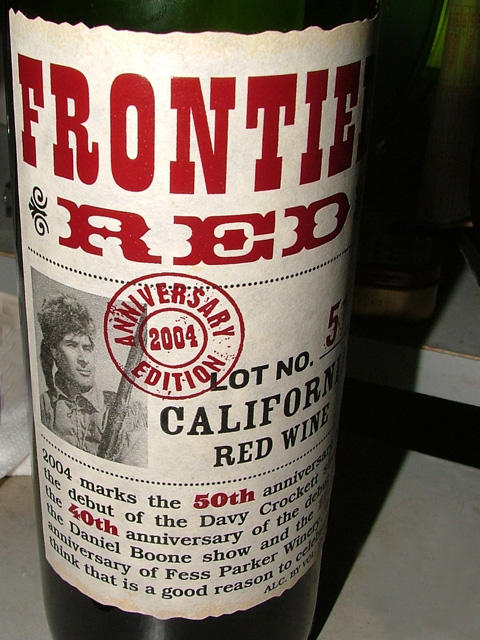 No, this isn't a joke. The 2004 Fess Parker Winery Lot 51 Frontier Red is from vinyards actually owned and operated by the great Fess Parker, who starred on TV as Davy Crockett and Daniel Boone.
 Perhaps this and the Desolation Flats red are attempts to court men who are afraid of wine? The bottles practically beg for grilled beef and casual attire. The owner of the local shop that carries these wines claims it has more to do with other wineries attempting to jump on the Folie à Deux Menage à Trois bandwagon. Mix a few grapes together, make it big and fruit-forward, and slap an irreverent name and label on the bottle. Then sell it for $10 or less.
This is actually Lot 51, despite the Lot 41 link. A combination of six southern French grapes: Syrah, Grenache, Petite Sirah, Mourvèdre, Cinsault and Carignane. Despite what you might think about the Rhône, this is not a mild and sippable wine. Instead, it is a bold and powerful red, dark and tannic with lots of deep fruit flavors. And to top it off, a hot aroma that points to the whopping 15.5% alcohol content.
So it had been a rough day at the end of a long week. For reasons I won't go into, I was in a bad mood. But I had the house to myself, aside from the two trusty dogs. I poured myself a delicious rum punch of my own creation (post to follow?), put some Russian piano music on, and sat in the kitchen reading through old cookbooks. Once the melancholy had dissipated, I made up some tomato soup, a bit of bruschetta, and grilled up a boneless ribeye in the pan. Deglazed the juices with a bit of the above wine, poured the sauce over the steak and bruschetta, and enjoyed a relaxing dinner. A pleasant end to the day.
02 October 2005
2002 Alexander Valley Two Barrel Red
I don't have a website on this, but I grabbed a bottle of the 2002 Alexander Valley Two Barrel Red ($16), which is produced by the Wetzel Family Estate. It's a 50/50 blend of Syrah and Merlot. The end result: you get the classic Syrah flavor without the bite, and a smooth finish thanks to the Merlot. Some berry aromas, a little pepper and spice, delightful fruit-forward flavors.
In keeping with the half and half theme, I grilled some burgers for dinner that were half ground beef and half ground lamb. Quite good, especially with some baby Swiss cheese and sautéed cremini mushrooms.
In keeping with the half and half theme, I grilled some burgers for dinner that were half ground beef and half ground lamb. Quite good, especially with some baby Swiss cheese and sautéed cremini mushrooms.
Tasting Notes for October 1, 2005
This tasting featured Spanish and French wines from Vincent Garnier.
Wine 1: 2004 2004 Viña Vilano Rosado. Ribera del Duero, Spain. I recently reviewed this wine and Saturday's second taste was just as good as the first. $9.
Wine 2: 2001 Domaine Marcel Deiss Muscat Bergheim. Alsace, France. Sweet, musky aroma, classic Muscat, but not as sweet tasting as you'd expect. A bit of pear and apple are in there. $25.
Wine 3: 2004 Château Pennautier Viognier Vin de Pays d'Oc. Languedoc, France. The website appears to be down at the moment, but this was a lovely little wine. Slight lemon and grass aromas, dry but fruit filled, a touch of apricot. I love Viognier, but there's not a lot of it here in Memphis. $11.
Wine 4: 2001 Domaine Marcel Deiss Pinot Blanc Bergheim. Alsace, France. Another one from Marcel Deiss, but I didn't enjoy this one as much--there was a hard aroma, with an almost brett like flavor. $26.
Wine 5: 2004 Château Haut Rian Bordeaux Blanc. Bordeaux, France. Mostly Sauvignon Blanc, probably some Semillon as well. There's a wonderful bright fruit flavor with a touch of lemon and a short finish. Great bargain, and a fun summer wine. $13.
Wine 6: 2004 Château Pennautier Chardonnay Vin de Pays d'Oc. Languedoc, France. Mild, unoaked Chardonnay. Nothing particularly special, a neutral wine. $12.
Wine 7:
2003 Bodegas Javier Asensio Torsa Tinto. Navarra, Spain. I'm linking to another blog post here. Mostly Tempranillo with some Cabernet Sauvignon and Merlot. I got black cherry flavors with mild tannins. Full fruit and a short finish made me think I was drinking an Australian wine. $11.
Wine 8: 2002 Canforrales Joven Roble. La Mancha, Spain. Tempranillo, I got an aroma of raw beef on top, with good plum flavor, maybe just a little bit of toast. Really nice little wine. $13.
Wine 9: 2000 Javier Asensio Crianza Cabernet Sauvignon. Navarra, Spain. 100% Cabernet Sauvignon. There's herb and grass aromas on top, with a dry feel and not much strength of flavor. I would have liked to have tried it earlier. $17.
Wine 10: 2000 La Fleur Montagne St. Emilion. Bordeaux, France. Didn't find a website, but this is mostly Merlot. To me, it smelled like cherry cough syrup. The flavor was milder than that, but overall I found it an odd wine. $23.
Wine 11: 2000 Grand Clocher St. Emilion. Bordeaux, France. Another one without a website. This one had barnyard and hay aromas--that classic French smell that turns off some people. There were medium tannins with some cherry flavors. Quite good--I don't know if I would get a bottle of it, but I was impressed. $28.
Wine 1: 2004 2004 Viña Vilano Rosado. Ribera del Duero, Spain. I recently reviewed this wine and Saturday's second taste was just as good as the first. $9.
Wine 2: 2001 Domaine Marcel Deiss Muscat Bergheim. Alsace, France. Sweet, musky aroma, classic Muscat, but not as sweet tasting as you'd expect. A bit of pear and apple are in there. $25.
Wine 3: 2004 Château Pennautier Viognier Vin de Pays d'Oc. Languedoc, France. The website appears to be down at the moment, but this was a lovely little wine. Slight lemon and grass aromas, dry but fruit filled, a touch of apricot. I love Viognier, but there's not a lot of it here in Memphis. $11.
Wine 4: 2001 Domaine Marcel Deiss Pinot Blanc Bergheim. Alsace, France. Another one from Marcel Deiss, but I didn't enjoy this one as much--there was a hard aroma, with an almost brett like flavor. $26.
Wine 5: 2004 Château Haut Rian Bordeaux Blanc. Bordeaux, France. Mostly Sauvignon Blanc, probably some Semillon as well. There's a wonderful bright fruit flavor with a touch of lemon and a short finish. Great bargain, and a fun summer wine. $13.
Wine 6: 2004 Château Pennautier Chardonnay Vin de Pays d'Oc. Languedoc, France. Mild, unoaked Chardonnay. Nothing particularly special, a neutral wine. $12.
Wine 7:
2003 Bodegas Javier Asensio Torsa Tinto. Navarra, Spain. I'm linking to another blog post here. Mostly Tempranillo with some Cabernet Sauvignon and Merlot. I got black cherry flavors with mild tannins. Full fruit and a short finish made me think I was drinking an Australian wine. $11.
Wine 8: 2002 Canforrales Joven Roble. La Mancha, Spain. Tempranillo, I got an aroma of raw beef on top, with good plum flavor, maybe just a little bit of toast. Really nice little wine. $13.
Wine 9: 2000 Javier Asensio Crianza Cabernet Sauvignon. Navarra, Spain. 100% Cabernet Sauvignon. There's herb and grass aromas on top, with a dry feel and not much strength of flavor. I would have liked to have tried it earlier. $17.
Wine 10: 2000 La Fleur Montagne St. Emilion. Bordeaux, France. Didn't find a website, but this is mostly Merlot. To me, it smelled like cherry cough syrup. The flavor was milder than that, but overall I found it an odd wine. $23.
Wine 11: 2000 Grand Clocher St. Emilion. Bordeaux, France. Another one without a website. This one had barnyard and hay aromas--that classic French smell that turns off some people. There were medium tannins with some cherry flavors. Quite good--I don't know if I would get a bottle of it, but I was impressed. $28.
Subscribe to:
Posts (Atom)