Yep, I'm still alive... Here's the notes for Saturday's tasting, which focused on Pinot Noir and Zinfandel.
Wine 1: 2004 Castle Rock Carneros Pinot Noir. Napa Valley, California. Bold and tannic, with a strong strawberry flavor. Somewhat off finish. $10.
Wine 2: 2002 Windy Ridge North Coast Pinot Noir. Victoria, Australia. From the southernmost winery on the Australian mainland. This is a dark wine with a pomegranate flavor, and strong finish. Interesting. $14.
Wine 3: 2003 Mark West Pinot Noir. Central Coast, California. Mellower and rounder than the above selections, but still maybe a little young. $15.
Wine 4: 2004 Edna Valley Vineyard Pinot Noir. A little buttered toast on the top, maybe some strawberry in the flavor. Decent little wine. $17.
Wine 5: 2002 Rodney Strong Estate Bottled Pinot Noir. Russian River, California. An aroma of alcohol and Port, giving way to a mellow flavor with light tannins. Classic, well produced Pinot Noir. $17.
Wine 6: 2002 Clos La Chance Pinot Noir. Santa Cruz Mountains, California. Very soft and rounded, delicate light cherry flavor. $20.
Wine 7: 2004 The Crossings Pinot Noir. Marlborough, New Zealand. Berry flavors abound, almost blueberry on the edge. Slightly tart but still well rounded. Really liked this one. $20.
Wine 8: 2004 Vision Cellars Pinot Noir Chileno Valley Vineyard. Marin County, California. Love the backstory on this guy: "I was born the son of a Texas Moonshine maker... Even though I grew up around distilled spirits and fruit wines, I did not develop a taste for either. It was not until I tasted my first Burgundy, long about 1955, that I fell in love with fine wine." Hints of vanilla and cream, but I found the tannins a little strong. This has a very spicy finish--almost like a chile pepper. $29.
Wine 9: 2001 Montevina Zinfandel. Amador County, California. Every time I try this wine, I get different things from it. This time there was a sort of menthol aroma on top, but the flavor is quite soft and well-aged. It's a good basic Zinfandel and a decent bargain. $13.
Wine 10: 2002 Abundance Old Vine Zinfandel. Lodi, California. Raspberry flavors, thin but fruity. This wine actually tasted a bit watered down to me, and aren't we supposed to get more concentrated flavors from old vines? $15.
Wine 11: 2002 Clos La Chance Zinfandel. El Dorado County, California. This one wasn't remarkable, but not bad either. I guess it would be a good neutral Zinfandel. $16.
Wine 12: 2004 Seghesio Family Vineyard Zinfandel. Sonoma County, California. Good tradtional Zinfandel, with plum and gingerbread flavors. Would be excellent around Christmas. $23.

23 October 2005


09 October 2005
2003 Wild Bunch California Red
 The 2003 Wild Bunch California Red is another crazy Cali $10 red blend like my last single wine post... This one is made by Montevina, which is now owned by Trinchero. According to one article:
The screw cap brand is touting, for example, that its winemaker Chris Leamy has purple hair and its label design is "more Harley than Hamptons."So it's part Zinfandel, Syrah, and Barbera. Zinfandel is really the dominant flavor here, although it doesn't have a Zin finish. I've been drinking it with some cheap pizza, which is probably appropriate. Not a bad wine. I enjoyed the Fess Parker blend better--this one is off balance, but at the same time could stand as the house wine of any neighborhood Italian/pizza joint here in the States, and that's an honest compliment/suggestion. Cheap Chianti tastes like crap, and at least this has some residual sweetness that would appeal to the American palate.
A brief word on the label design... My grastronomic curiosity was greater than my aesthetic taste. If I had a nickel for ever time that I've seen that general design as a tattoo on the exposed bosom of an aging biker woman, I'd have... several dollars. Ah, the joys of life in the south. But, once again, it's liable to bring previously wine-scared folks into the fold, and that's not a bad thing. As an editorial once posited, Yellowtail might not be great wine, but it succeeded in putting bottles of wine on the tables of people that would have never enjoyed wine otherwise. And heck, if the Wild Bunch tastes better with a gas station hot dog and the scent of 89 octane in the air, then more power to them.
Tasting Notes for October 8, 2005
All of the wines for this tasting came from Argentinian producer Luigi Bosca, a 100 year old winery.
Wine 1: Finca La Linda Extra Brut. Non vintage sparkler, made of equal parts Chardonnay and Semillon. Dry, crisp aroma, with equally crisp flavor. Just a little yeast, firm acidity, but none of the citrus you'd expect from the Semillon. $19.
Wine 2: 2004 Luigi Bosca Reserva Sauvignon Blanc. Slightly harsh aroma, with a touch of lemon, but very soft and not tart at all. Unusual wine. Also, just for kicks the winemaker decided to put Sauvignon Blanc in a Burgundy-style bottle instead of the usual Bordeaux. $19.
Wine 3: 2004 Finca La Linda Chardonnay. Thin, unoaked, no clearly discernable flavors. Basically a blank slate Chardonnay. And like the above, this was placed in the "wrong" bottle--Bordeaux in this case instead of the traditional Burgundy. I don't get bent out of shape about bottle styles, but it does make it easy to look at a large number of bottles and pick out the Pinot Noirs versus the Cabernet Sauvignons, for instance. $12.
Wine 4: 2004 Luigi Bosca Reserva Chardonnay. Much better. Slightly musky aroma, something like gingerbread. There was a buttery flavor, evidence of oak, and a general well-rounded, fruit-forward feel in the mouth. $19.
Wine 5: 2002 Luigi Bosca Reserva Pinot Noir. One of my favorites out of the tasting--a slight aroma of strawberry jam on top, but with very soft tannins and a mellow flavor. Really reminded me of an Oregon Pinot Noir. $19.
Wine 6: 2003 Finca La Linda Cabernet Sauvignon. Not a big hit at our table. Some black cherry aromas and flavor, with a little bite, but ultimately disappointing. $12.
Wine 7: 2004 Finca La Linda Tempranillo. I thought this one needed maybe another year to mature. Bold and tannic, some dark fruit and just a touch of leather. $12.
Wine 8: 2003 La Linda Malbec. Hurrah for Malbec! Plum flavors and aromas, touch of smoke, and a short finish. Good bargain, great wine for pizza, burgers, etc. $12.
Wine 9: 2002 Luigi Bosca Reserva Merlot. Black cherry flavors, some strong tannins and a dry finish. Reminded me of a heartier California Merlot. $19.
Wine 10: 2002 Luigi Bosca Reserva Cabernet Sauvignon. Not much of a nose on this one, very subtle flavors. Decent, but not spectacular. However, one of the tasting hosts was blown away by this wine, finding hints of figs and all sorts of things. $19.
Wine 11: 2002 Luigi Bosca Reserva Malbec. Ah, a properly aged Malbec. Very soft, but with good dark fruit flavors and aromas. Very classy, and should be perfect for converting any serious wine drinker to the joys of Malbec. $19.
08 October 2005
2004 Fess Parker Winery Lot 51 Frontier Red
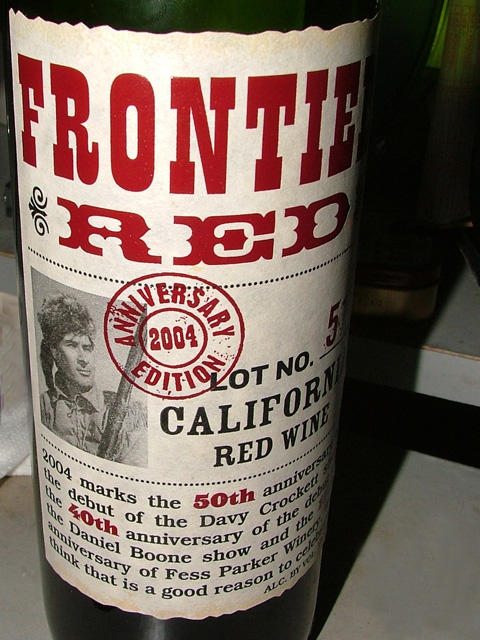 No, this isn't a joke. The 2004 Fess Parker Winery Lot 51 Frontier Red is from vinyards actually owned and operated by the great Fess Parker, who starred on TV as Davy Crockett and Daniel Boone.
Perhaps this and the Desolation Flats red are attempts to court men who are afraid of wine? The bottles practically beg for grilled beef and casual attire. The owner of the local shop that carries these wines claims it has more to do with other wineries attempting to jump on the Folie à Deux Menage à Trois bandwagon. Mix a few grapes together, make it big and fruit-forward, and slap an irreverent name and label on the bottle. Then sell it for $10 or less.
This is actually Lot 51, despite the Lot 41 link. A combination of six southern French grapes: Syrah, Grenache, Petite Sirah, Mourvèdre, Cinsault and Carignane. Despite what you might think about the Rhône, this is not a mild and sippable wine. Instead, it is a bold and powerful red, dark and tannic with lots of deep fruit flavors. And to top it off, a hot aroma that points to the whopping 15.5% alcohol content.
So it had been a rough day at the end of a long week. For reasons I won't go into, I was in a bad mood. But I had the house to myself, aside from the two trusty dogs. I poured myself a delicious rum punch of my own creation (post to follow?), put some Russian piano music on, and sat in the kitchen reading through old cookbooks. Once the melancholy had dissipated, I made up some tomato soup, a bit of bruschetta, and grilled up a boneless ribeye in the pan. Deglazed the juices with a bit of the above wine, poured the sauce over the steak and bruschetta, and enjoyed a relaxing dinner. A pleasant end to the day.
02 October 2005
2002 Alexander Valley Two Barrel Red
I don't have a website on this, but I grabbed a bottle of the 2002 Alexander Valley Two Barrel Red ($16), which is produced by the Wetzel Family Estate. It's a 50/50 blend of Syrah and Merlot. The end result: you get the classic Syrah flavor without the bite, and a smooth finish thanks to the Merlot. Some berry aromas, a little pepper and spice, delightful fruit-forward flavors.
In keeping with the half and half theme, I grilled some burgers for dinner that were half ground beef and half ground lamb. Quite good, especially with some baby Swiss cheese and sautéed cremini mushrooms.
In keeping with the half and half theme, I grilled some burgers for dinner that were half ground beef and half ground lamb. Quite good, especially with some baby Swiss cheese and sautéed cremini mushrooms.
Tasting Notes for October 1, 2005
This tasting featured Spanish and French wines from Vincent Garnier.
Wine 1: 2004 2004 Viña Vilano Rosado. Ribera del Duero, Spain. I recently reviewed this wine and Saturday's second taste was just as good as the first. $9.
Wine 2: 2001 Domaine Marcel Deiss Muscat Bergheim. Alsace, France. Sweet, musky aroma, classic Muscat, but not as sweet tasting as you'd expect. A bit of pear and apple are in there. $25.
Wine 3: 2004 Château Pennautier Viognier Vin de Pays d'Oc. Languedoc, France. The website appears to be down at the moment, but this was a lovely little wine. Slight lemon and grass aromas, dry but fruit filled, a touch of apricot. I love Viognier, but there's not a lot of it here in Memphis. $11.
Wine 4: 2001 Domaine Marcel Deiss Pinot Blanc Bergheim. Alsace, France. Another one from Marcel Deiss, but I didn't enjoy this one as much--there was a hard aroma, with an almost brett like flavor. $26.
Wine 5: 2004 Château Haut Rian Bordeaux Blanc. Bordeaux, France. Mostly Sauvignon Blanc, probably some Semillon as well. There's a wonderful bright fruit flavor with a touch of lemon and a short finish. Great bargain, and a fun summer wine. $13.
Wine 6: 2004 Château Pennautier Chardonnay Vin de Pays d'Oc. Languedoc, France. Mild, unoaked Chardonnay. Nothing particularly special, a neutral wine. $12.
Wine 7:
2003 Bodegas Javier Asensio Torsa Tinto. Navarra, Spain. I'm linking to another blog post here. Mostly Tempranillo with some Cabernet Sauvignon and Merlot. I got black cherry flavors with mild tannins. Full fruit and a short finish made me think I was drinking an Australian wine. $11.
Wine 8: 2002 Canforrales Joven Roble. La Mancha, Spain. Tempranillo, I got an aroma of raw beef on top, with good plum flavor, maybe just a little bit of toast. Really nice little wine. $13.
Wine 9: 2000 Javier Asensio Crianza Cabernet Sauvignon. Navarra, Spain. 100% Cabernet Sauvignon. There's herb and grass aromas on top, with a dry feel and not much strength of flavor. I would have liked to have tried it earlier. $17.
Wine 10: 2000 La Fleur Montagne St. Emilion. Bordeaux, France. Didn't find a website, but this is mostly Merlot. To me, it smelled like cherry cough syrup. The flavor was milder than that, but overall I found it an odd wine. $23.
Wine 11: 2000 Grand Clocher St. Emilion. Bordeaux, France. Another one without a website. This one had barnyard and hay aromas--that classic French smell that turns off some people. There were medium tannins with some cherry flavors. Quite good--I don't know if I would get a bottle of it, but I was impressed. $28.
25 September 2005
Wine & Cheese
Barbara had a post today about a delightful bleu cheese from New Zealand, which in the comments she admits to pairing with a 10-year old Italian Valpolicella. The main point of her post was about restrictive regulations on unpasteurized cheeses and whatnot, but when she mentioned the wine, it hit me like a ton of bricks...
December 1996. I'm only 20, and I'm in Italy for a three-week long tour of the country with my girlfriend at the time. There's an entire book that could be written about that relationship debacle, but I'm going to focus on one thing here. We were in Assisi for Christmas, and had been told by various travelers that this city like many throughout the country shut down on major religious holidays. We had booked a dinner through our youth hostel (which turned out to be amazing--handmade tortellini, white bean soup, smoked salmon, panettone, and all the wine you could drink), but needed something for lunch. So the day before, we stocked up at the local markets: some sliced Genoa salami, a fresh loaf of bread, a hearty chunk of Gorgonzola cheese, and a bottle of inexpensive Valpolicella made by the cousin of the pizza shop owner.
Now, Gorgonzola is not exactly a "bleu" cheese, it's a little more on the green side, and tends to be softer at room temperature. Though we lucked out, as rustic youth hostels in Italy tend to be around 50 degrees Fahrenheit in the winter, practically a refrigerator. But let me digress a bit before talking about the wine and cheese combination.
After dinner at a trattoria, we attended Midnight Mass on Christmas Eve at the Basilica of St. Francis. Funny tradition there--at 11:30 p.m., they start ringing the church bells, and everyone finishes their drinks or coffee at the bar. At 11:45, they ring again, and everyone begins walking up the hills to the Basilica. The church service was lovely (even for this Presbyterian), and was delivered in a variety of languages.
The next morning, we had Christmas breakfast with the family running the hostel, which was delightful because we got to watch the kids open their Christmas presents over fresh rolls and coffee. And like I said, we were going to have dinner at the hostel that evening. But for lunch, we had our meat, cheese, bread and wine, and were on our own. It was a little chilly--not cold. As we were locked out of the hostel for most the day and the city was shut down, there wasn't much to do. We milled about the old city and finally found a church that was holding an afternoon service. It was an ancient building, originally a Roman temple to Minerva that still had bas relief carvings of the twelve signs of the Zodiac. On the steps of that temple, my girlfriend and I had our simple, elemental lunch. The bread and meat were nourishing and delicious, but the cheese was divine. I'd kept it close to me to warm up, and it was soft and malleable, showing rich veins of mold throughout the pure white cheese. And when washed down with the red Valpolicella--consumed with alternating swigs straight from the bottle--it provided for one of the most memorable lunches of my life.
Shortly afterwards, we attended the afternoon mass, conducted in the tiny room by two Franciscan monks, one who read the service and the other who played the acoustic guitar during the songs. The two dozen or so attendees--mostly locals--huddled together with us for warmth during the service, and my halfway decent Italian was enough to make us part of the family.
Gorgonzola isn't seen a lot in these parts unless it's one of the milder varients used sparingly in a salad or something, but the combination of a good moldy cheese and an Italian wine is one that is always going to throw me back into the gentle embrace of fond memories.
December 1996. I'm only 20, and I'm in Italy for a three-week long tour of the country with my girlfriend at the time. There's an entire book that could be written about that relationship debacle, but I'm going to focus on one thing here. We were in Assisi for Christmas, and had been told by various travelers that this city like many throughout the country shut down on major religious holidays. We had booked a dinner through our youth hostel (which turned out to be amazing--handmade tortellini, white bean soup, smoked salmon, panettone, and all the wine you could drink), but needed something for lunch. So the day before, we stocked up at the local markets: some sliced Genoa salami, a fresh loaf of bread, a hearty chunk of Gorgonzola cheese, and a bottle of inexpensive Valpolicella made by the cousin of the pizza shop owner.
Now, Gorgonzola is not exactly a "bleu" cheese, it's a little more on the green side, and tends to be softer at room temperature. Though we lucked out, as rustic youth hostels in Italy tend to be around 50 degrees Fahrenheit in the winter, practically a refrigerator. But let me digress a bit before talking about the wine and cheese combination.
After dinner at a trattoria, we attended Midnight Mass on Christmas Eve at the Basilica of St. Francis. Funny tradition there--at 11:30 p.m., they start ringing the church bells, and everyone finishes their drinks or coffee at the bar. At 11:45, they ring again, and everyone begins walking up the hills to the Basilica. The church service was lovely (even for this Presbyterian), and was delivered in a variety of languages.

The next morning, we had Christmas breakfast with the family running the hostel, which was delightful because we got to watch the kids open their Christmas presents over fresh rolls and coffee. And like I said, we were going to have dinner at the hostel that evening. But for lunch, we had our meat, cheese, bread and wine, and were on our own. It was a little chilly--not cold. As we were locked out of the hostel for most the day and the city was shut down, there wasn't much to do. We milled about the old city and finally found a church that was holding an afternoon service. It was an ancient building, originally a Roman temple to Minerva that still had bas relief carvings of the twelve signs of the Zodiac. On the steps of that temple, my girlfriend and I had our simple, elemental lunch. The bread and meat were nourishing and delicious, but the cheese was divine. I'd kept it close to me to warm up, and it was soft and malleable, showing rich veins of mold throughout the pure white cheese. And when washed down with the red Valpolicella--consumed with alternating swigs straight from the bottle--it provided for one of the most memorable lunches of my life.
Shortly afterwards, we attended the afternoon mass, conducted in the tiny room by two Franciscan monks, one who read the service and the other who played the acoustic guitar during the songs. The two dozen or so attendees--mostly locals--huddled together with us for warmth during the service, and my halfway decent Italian was enough to make us part of the family.
Gorgonzola isn't seen a lot in these parts unless it's one of the milder varients used sparingly in a salad or something, but the combination of a good moldy cheese and an Italian wine is one that is always going to throw me back into the gentle embrace of fond memories.
Beer Review: Shiner Kölsch
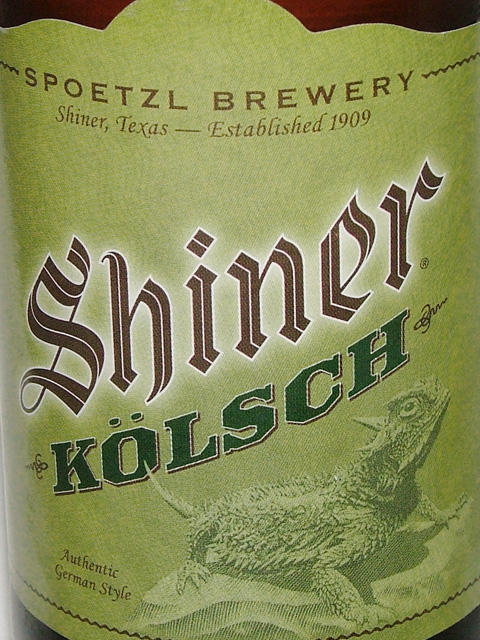 A brief departure... Tonight I'm drinking Shiner Kölsch produced by the Spoetzl Brewery in Shiner, Texas. I've long been a fan of the Shiner Bock made by the same brewery. Who would have thought that Czech and German immigrants to Texas could have joined forces to make such good beers? The Shiner Bock is a medium dark beer that has a great nutty flavor and goes down smooth. The brewery makes a half dozen or so beers, but aside from the Bock, the one other one to reach the Memphis market is the Kölsch, and that was just last month.
(For my international readers, that creature on the label is a horned toad, actually a lizard. They're angry little things that can swell up and shoot blood from their eyes, and live in the deserts of the American Southwest.)
Kölsch is a light, mildly bitter beer from Köln (Cologne), Germany. Even though that's a controlled appellation for the region, the folks at Shiner are still using it. That kind of thing happens here... we've got loads of terrible wines that go by the names Burgundy and Champagne, but this is a decent beer. It has an appealing, smooth aroma, with a slightly bitter, crisp flavor and great hops and malt tastes on the back end. Somewhere in there is just a tiny bit of lemon.
It's light and refreshing enough for summer consumption, but amazingly, the weather finally shifted to something fall-like here in Memphis, due to the arrival of the remnants of Hurricane Rita. I used one bottle in the beef stew and quaffed two bottles with dinner. Although this isn't as strong as an India Pale Ale, I still love a good bitter beer. Tea and coffee are bitter, but are frequently softened with sugar or cream, and neither are really drunk with meals (except for iced tea, the staple of Southern restaurants, but it's almost always modified with sugar or artificial sweeteners). So the only option for a bitter beverage for dinner is a hoppy beer. Sometimes you're in the mood for it, and why deprive yourself?
Tasting Notes for September 24, 2005
This tasting was devoted to wines from all over Spain. Many of these appear to come from small wineries without websites--in some cases I've substituted reviews or catalog entries for links. Most of these were scored around 90 by Robert Parker. I don't pay a lot of attention to the scoring scales, which is why I don't use them on my blog. I'm more interested in how it tastes, smells, and feels in the mouth, which tends to be more useful in matching a wine to a food or an occasion than a score.
Wine 1: Segura Viudas Reserva Heredad Brut. Ribera del Duero, Spain. From the northwest corner near Barcelona. Two thirds Macabeo and one third Parrellada, this sparkling wine had a bright, fruity aroma with a crisp and yeasty flavor. Very interesting bottle design--a metal ring on the bottom and a metal seal on the side. This would be a fun presentation for some sort of medieval/Renaissance-themed dinner. $23.
Wine 2: 2004 Hermanos Lurton Blanco. Rueda, Spain. Sort of between Barcelona and Madrid. This is a white blend of Verdejo and Viura. Grapefruit pith and peel all over the place. Slightly sweet but surprisingly not tart. Lovely little white to serve chilled in the summer. $12.
Wine 3: 2003 Pazo de Señorans Albariño. Galicia, Spain. Same area as above. There was a slight musky aroma, no oak present, and delectible well-rounded construction. Not complex, but a pleasant and mellow wine. $20.
Wine 4: 2003 Vina Mein Blanco. Ribeiro, Spain. Northeast corner near Portugal. 70% Treixadura, 15% Godello, 10% Loureira, and 5% Albariño. I'm really not familiar with those first three grapes, but I wasn't impressed by the wine. It was thin, no dominant flavors, and maybe just a hint of lemon. $18.
Wine 5: 2003 Bodegas Luan Red "Equis Viñas Viejas". Vino de Tierra Castilla, Spain. Sort of in the center near Madrid. "The wine is a blend of Bobal, Mazuelo (the local term for Carignan), Garnacha (Grenache) and Cencibel (Tempranillo)." Strawberry jam on the nose, with matching flavor but dry and with a short finish. Really Surprising. $10.
Wine 6: 2003 Venta Mazzaron Tempranillo. Toro, Spain. Around the center of the country. There's a touch of toast on the top, with heavy tannins that arrive in mid-taste. Very dry. $12.
Wine 7: 2002 Bodegas Castano Solanera. Yecla, Spain. Southeast. The aroma was alcoholic, with dark berry notes like a Zinfandel or Port. Surprisngly soft tannins. Made from Monsatrell, the Spanish name for Mourvèdre. $15.
Wine 8: 2002 Abadia Retuerta "Rivola". Sardon del Duero, Spain. Northeast Spain. 60% Tempranillo and 40% Cabernet Sauvignon. A little too mellow for me--I really wonder if I tasted the same wine as mentioned in the review. There's a chance that the alcohol in the previous wine hampered my tasting ability, but I was still able to pick out lots in the next wine... $14.
Wine 9: 1999 Sierra Cantabria Crianza. Rioja, Spain. North Central Spain. Tempranillo. Big black cherry aroma, soft fruit flavors with hints of vanilla and hazelnuts. Nicely aged with a lovely garnet color. Great wine at a spectacular price. $15.
Wine 10:
1999 Fernando Remirez de Ganuza Rioja Reserva. Rioja, Spain. Another Tempranillo from the North Central region of Rioja. Deep purple color with concentrated flavors. Dry and distinguished, and while I was having a difficult time picking out any individual flavor elements, it was an amazing wine. $60.
23 September 2005
2003 Desolation Flats "Rustler's Red"
 An odd selection that caught my eye... The 2003 Desolation Flats "Rustler's Red", a blended California table red that combines Petite Sirah, Cabernet, Petite Verdot, Malbec and Refosco. The last grape was used to produce the favorite wine of Augustus Caesar's second wife. Unlike some other "kitchen sink" red blends, this one has a solid character--I got a lot of the Petite Sirah and Cabernet Sauvignon, but the other grapes obviously added complexity and I'm sure the Malbec did wonders to soften the edges.
It's a strange little wine, and a good bargain at $9. There's a hot, alcoholic aroma on top (13.9%), tinged with dark plum, but the flavor is remarkably soft and well rounded... yet the finish is surprisingly tannic and dry. I served it with beef and noodles in a cream sauce, earthy country fare for a hardscrabble wine. Highly recommended for both the interesting palate sensations and the lovely logo design.
22 September 2005
23rd Post, 5th Sentence
Barbara tagged me for one of the recent blogging memes/challenges. This one requires that you look at the fifth sentence from your 23rd post and elucidate on its meaning. My 23rd post on this blog was a review of the 2002 Turning Leaf Sonoma Reserve North Coast Pinot Noir. And my fifth sentence was "Fairly well balanced and drinkable."
So what do I think about that? Well, I'm glad it was a wine I enjoyed, and good balance and drinkability are factors that every good wine should include. It's not the kind of thing I'd want on my tombstone, but it certainly could have been worse.
As for tagging others... I'm going to pass for the moment. Might update this later.
19 September 2005
Wine Blogging Wednesday Contest
Lenn recently announced a contest to design a logo for Wine Blogging Wednesday. I've got a half dozen ideas, but this was my first submission. There's a couple of others that will be more interesting, and even if I don't officially submit them, I might post them on this site.

Though the jpg here is only low-res, I built this in Illustrator, so it can easily be sized to make a crisp and clear wine label for any empty bottles lying around.

Though the jpg here is only low-res, I built this in Illustrator, so it can easily be sized to make a crisp and clear wine label for any empty bottles lying around.
2004 Viña Vilano Rosado
Last night with a dinner of roast chicken thighs in a savory sauce and some pine nut couscous, I served a bottle of the 2004 2004 Viña Vilano Rosado, a $9 Spanish rosé from the Ribera del Duero region in the north. It's 100% Tinto Fino and the flavor is all about the berries--strawberry and raspberry mostly. There's a crisp, almost effervescent feel on the tongue. It's a great bargain, but I was personally wanting a softer finish. Good entry-level rosé for picnics or casual occasions.
18 September 2005
Tasting Side Note
There might not be any large wine tasting notes in the next two weeks--my usual places are taking a break, though I'll probably stumble into something before the end of the month. I will continue to post notes on the wines I drink and serve for friends, and might expand a bit with some beer or liquor reviews depending on what I'm in the mood for.
2003 Crane Lake Petite Sirah
Continuing my run through the bargain offerings from Crane Lake, I decided to give the 2003 Petite Sirah a try. This isn't on the floor at our local shop, but the owner is keeping a couple of cases in the back for friends. And who couldn't resist the temptation to try a $4 Petite Sirah? I've got to say that it's quite good. Not as good as the $10 bottles from Bogle or Concannon, but a solidly built wine in its own right. Blackberry aromas with a matching, jammy flavor. Deep purple color, and well-rounded tannins. And yes, it stains your tongue dark blue if you have more than a glass.
I had two bottles this weekend, one with New York-style pizza and one with some boneless ribeyes. Three other people tasted this wine with me and were very impressed even before I told them about the price. I doubt that it will age well, but this is a fun little wine, particularly if you haven't had any prior experience with this grape.
I had two bottles this weekend, one with New York-style pizza and one with some boneless ribeyes. Three other people tasted this wine with me and were very impressed even before I told them about the price. I doubt that it will age well, but this is a fun little wine, particularly if you haven't had any prior experience with this grape.
14 September 2005
Cuban Sandwich
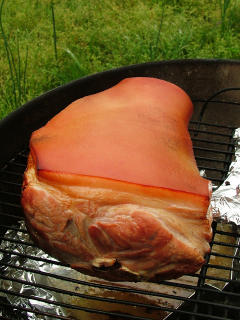
This doesn't really have much to do with wine (except for the splash of white wine I used in the black beans), but I enjoy linking my photoessays here. As a native of Memphis, Tennessee, the smoking of lots of pork products is in my blood... and my arteries, I suppose. If you watch the stores well, you can almost always find some part of the pig on sale. In this I smoked a picnic roast (lower half of the front leg of the pig)--I got it for 99¢ a pound, and slow smoked it for about six hours. I know it's not genteel to discuss such matters among the wineblogosphere, but in past years I've stayed up all night tending the coals of a whole hog roasting in a pit dug out of the ground:
A week later I used some of the frozen leftover pork to make dense, delicious Cuban sandwiches. Obviously here I drank the great Red Stripe beer, but if I had to pick a wine to go with this, I'd go with an inexpensive California sparkling wine or a New Zealand Sauvignon Blanc. You need something cold and crisp to cut through the grease, and anything with good citrus notes would enhance the flavors of the sandwich and side dishes (hence the lime in the Red Stripe).
Click here for more details!
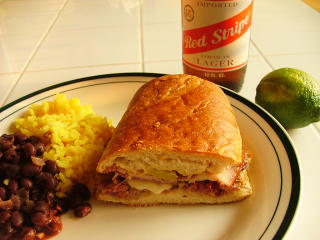

A week later I used some of the frozen leftover pork to make dense, delicious Cuban sandwiches. Obviously here I drank the great Red Stripe beer, but if I had to pick a wine to go with this, I'd go with an inexpensive California sparkling wine or a New Zealand Sauvignon Blanc. You need something cold and crisp to cut through the grease, and anything with good citrus notes would enhance the flavors of the sandwich and side dishes (hence the lime in the Red Stripe).
Click here for more details!

2002 Crane Lake Cabernet Sauvignon
My second wine from this bargain label... I found the 2002 Crane Lake Cabernet Sauvignon to be interesting, but not terribly satisfying. There's a unique aroma of chocolate and molasses on top, which is quite alluring, but the wine itself doesn't deliver. There's a quick, crisp flavor with no real tannins and an impossibly short finish. It ain't bad, but it's not great either. Still, it's unoffensive for $4.
11 September 2005
Tasting Notes for September 10, 2005
All of the wines at today's tasting came from winemaker Lionello Marchesi of Castello di Monastero. Signore Marchesi was present for the tasting, and I was delighted to dust off my college Italian. The winery is located near Siena in Tuscany, and the wines tasted were a combination of I.G.T., D.O.C., and D.O.C.G. classifications. The wines are also produced under a couple of different labels, the names of which I'll include below.
The three Chiantis (wines 1, 2, and 4) are 85% Sangiovese with 15% Cabernet Sauvignon and Merlot, the quantities of the latter two grapes varying with each year. This smooths out the flavor somewhat, and makes the wines more appealing to the US market.
Wine 1: 2002 Montetondo Chianti Superiore D.O.C.G. Firm tannins, a rich, dark aroma, and a soft finish. $15.
Wine 2: 2002 Castello di Monastero Chianti Classico D.O.C.G. Hint of tobacco on the nose, softer tannins than the first one with mild cherry flavors and a soft finish. $18.
Wine 3: 2002 Poggio Sughere Morellino di Scansano D.O.C. Very mellow aroma, and amazingly smooth. This one is 90% Sangiovese and 10% Cabernet Sauvignon. If you ever wanted to convert someone with a fear of Italian wines based on a lifetime of cheap jug Chianti, this would be a perfect wine. This would be mild enough to serve with hearty chicken dishes but is still strong enough to stand up to roasted beef. $18.
Wine 4: 2000 Castello di Monastero Chianti Riserva D.O.C.G. Oak and plum aromas, great fruit forward flavor, with a short finish. Really nice wine here. $34.
Wine 5: 2002 Coldisole Rosso di Montalcino D.O.C. 100% Sangiovese Grosso. Good balance, more restrained than some of the other offerings. A hint of tannins left on the tongue, and a faint taste of licorice. $27.
Wine 6: 2001 Poggio Sughere Splendido 2001 I.G.T. 70% Sangiovese, 30% Merlot. Black cherry, almost no tannins. Short finish with just a tiny bite on the end. A great wine. $45.
Wine 7: 2001 Castello di Monastero Infinito I.G.T. 60% Sangiovese, 40% Cabernet Sauvignon. Soft and well rounded, well aged enough that the more mellow and flavorful elements of the two grapes are really able to shine. $50.
Wine 8: 2000 Coldisole Brunello di Montalcino D.O.C.G. 100% Sangiovese Grosso. A touch of toast on the aroma, with dark, slightly oaky flavors. The color, intensity, and flavor of this wine really showed proper aging. $45.
Wine 9: 1999 Lunanuova Vin Santo di Chianti D.O.C. 80% Malvasia, 20% Trebbiano. Vin Santo is an Italian fortified wine, somewhere between a tawny Port and a sherry and only 16% alcohol. It's got that great Port aroma but a feel and taste closer to sherry or Madeira. I first had Vin Santo in a trattoria near Florence, where it was served with dessert. The waiter brought out an entire bottle of Vin Santo, some small almond biscotti, and almost thimble-sized cups. It's sweet and strong, but warms you from the inside out. This tasting brought back some really fond memories. $60 (375 mL).
10 September 2005
2004 Crane Lake Chardonnay

I haven't found any solid information about Crane Lake Cellars, but they produce bargain table wines in California. Supposedly the grapes come from the Central Valley and are bottled in Napa. I grabbed a bottle of the Cabernet Sauvignon and the Chardonnay, and here I'm talking about the latter. Again, at $4, I'm happy to use it for everyday cooking and casual quaffing. (Supposedly they make a Petite Syrah at the same price point--the manager of a local shop is getting a case of it based on my interest, and if I like it I'll certainly spread the word.)
This Chardonnay really isn't a bad wine. It's unoaked, and has a crisp initial feel with a mellow following. A slightly floral nose with some apple and pear flavors. I used it to enhance some slow simmered black beans to accompany a homemade Cuban Sandwich (more on that in a future post).
I'm really pleasantly surprised by this wine. It's not sour, it doesn't have a harsh aftertaste, and while it's not the most complex wine out there, I've had California Chardonnays costing five times as much that were terrible. This is definitely a good picnic wine, or something to sip beside the pool, or something to bring along to an informal gathering of non-serious wine drinkers.
The background and taste of this wine really remind me of the bargain Burgundy Roncier Blanc de Blancs. I've also got to give them credit for a classy label--simple and elegant text, with an dictionary-style etching of a crane.
09 September 2005
2003 Hayman & Hill Edna Valley Pinot Noir
Based on my experience two weeks ago with this venture's Shiraz-Viognier, I decided to try the 2003 Hayman & Hill Edna Valley Pinot Noir. (No link because I didn't even see a review.) Around $12, I figured it was worth a shot.
I really need a tattoo on my right hand that says "Do Not Buy Pinot Noir Under $20". Perhaps in gothic script with thorny vines going around it. I worked in graphic design for 8 years, maybe I can work up something.
As my blog shows, I'm a big fan of inexpensive (but well-made) table wines, but I don't think it's really possible with this grape. I did devote a good bit of time in the evaluation of this wine, giving it a lot of consideration. Though it's only 13.5% alcohol, the aroma is predominantly alcohol with just a touch of black cherry or plum. A garnet color, nothing surprising for a two year old Pinot. The taste is smooth on the beginning with a harsh, tannic finish. Not much fruit in the flavor, nor is there that subtle, mellow loveliness that you get from a well-balanced Pinot Noir.
I tried it alone and then with a simple but delicious dinner, roast pork/potatoes au gratin/broccoli. My dinner host had similar opinions about the wine, and I left the remaining third with him. It's a bad sign when I can't kill off a bottle of wine, but I just wasn't up to it tonight. (And yes, my nose is working fine. Had a martini earlier in the evening and had no problem picking out all of the herbal elements as well as those of the garnish.)
And where is the Edna Valley? It's in the Central Coast of California, around San Luis Obispo. Doesn't have quite the same ring as Napa or Sonoma, but I'm not willing to hold the geographic name against a wine. There's a town not far from Memphis called Bucksnort, and a friend of mine was born in the local hamlet of Frog Jump.
However, I can still vividly remember Hayman & Hill's Shiraz-Viognier, and they've bought themselves a great deal of goodwill in my book. I'm willing to give their Zinfandel a chance sometime in the near future.
Quick Update
Sorry I skipped Wine Blogging Wednesday... I've had a little summer cold all week and haven't been in the mood for wine (or food for that matter). Plus, up through yesterday I couldn't smell anything, which would have made for pretty dull wine notes. I'm feeling much better though, and should have some reviews up this weekend.
01 September 2005
Comments
By popular demand, comments will be enabled for the next couple of posts. If I have any problems with spam, I might turn on the "word verification" feature. I know it's a pain, but hopefully it won't come to that. Just a couple of caveats: I tend to post at weird hours, and don't necessarily look at the posts every day. So if you ask a direct question, I'll try to answer it when I get around to it, but if there's any sort of lively discussion I probably won't be participating. In good conscience I try not to visit or think about this blog at work--when reading and writing about wine I really prefer to be relaxed and not handling an e-commerce problem with a client in Brazil.
One other thing: I've already heard from a couple of wineries that disagreed with my reviews and have offered to send me a free bottle for re-evaluation. First off, I'm deeply flattered, but due to laws here in the highly enlightened state of Tennessee, I can't receive wine or liquor through the mail. All shipments that cross state lines have to pass through the hands of a distributor. I weep at the thought of some generous gift being intercepted at the post office and being ceremoniously poured down the drain. However, if you want me to give your wine a second shot and you're friendly about it, let me know anyway and I'll try to get around to it in the next couple of months at my own expense. I do realize that there's dozens of things that can make a single bottle go off and that it's not indicative of the vintage as a whole.
It's fun hearing from wineries, particularly the ones where I gave positive reviews. And if I didn't like your wine, don't take it personally--I'm not an expert, and this blog has a lot more to do with my personal tastes and quest for wine education. I also think that wine can be much better evaluated with food, whereas the majority of wines listed here are based off small samples at wine tastings. Even if I say I'm not enthusiastic about a particular wine, it doesn't mean that it's bad, just that it didn't pique my interest. I don't think there's many terrible wines out there, most stuff on the market tends to be average and drinkable with a few that stand out above the herd.
31 August 2005
Corks Redux
Barbera over at winosandfoodies.com was kind enough to participate in my earlier, mostly ignored cork photo/statistics challenge. Thanks for playing! Any future contributors will be listed in this post.
Huzzah for the Wineblogs!
I've been writing this thing since January... At first, it began as only a convenient way for me to keep notes on wines I've liked or disliked, combined with a strong desire to link to the producers of the wine as well as making sure that I spell the damned thing right, regardless of how many special characters I hâvè tó üsê. After an e-mail session with the Professor resulted in a link, I decided to spruce it up a bit and publicize the blog. Thus far it has been an informative and rewarding experience.
For instance, my last post on a Shiraz-Viognier blend resulted in several e-mails, including one who had tasted that very wine from the barrel in California, and another who opined on a Shiraz-Viognier blend in Australia. And since I liked it so much, a bit of research turned up the fact that this is the combination used in the classic Rhone appellation Côte Rôtie. Though I'm anxious to explore that wine region, it's fun to try the less expensive versions from other parts of the world. For instance, as much as I love Malbec, I've still never seen a Cahors here in Memphis.
Since I've lurking about the wine blogs for a couple of months, I haven't seen a lot of drama, animosity, wine snobbery, or infighting. There's a chance I've missed it, but things seem to be pretty amiable. Is it because the community is so small, or is it because we're all focused on a delicacy that makes social occasions convivial, and that there's a good chance that we post with a glass of wine beside the keyboard?
Regardless, it's been fun, and I look forward to many more posts here. And for all new readers, feel free to nose through the archives.
28 August 2005
2002 Hayman & Hill Shiraz-Viognier
I've heard good things about the Shiraz-Viognier blends out of Australia, but I don't think I've had one before. A local shop just got in a few cases of the 2002 Hayman & Hill Shiraz-Viognier from Monterey County, California. It's 93% Shiraz and 7% Viognier. I couldn't find a separate website for this wine, but it appears to be made at Blackstone by two of the vintners.
This is definitely a fruit bomb. Raspberry dominates, with maybe a bit of cherry or blackberry in the background. Low tannins, so it's a good summertime sipper. The viognier I think softens the edge while providing just a little herbal complexity. Retails for around $14, but I got it for $11. I served it with a rich chuck roast/cream sauce casserole.
This is definitely a fruit bomb. Raspberry dominates, with maybe a bit of cherry or blackberry in the background. Low tannins, so it's a good summertime sipper. The viognier I think softens the edge while providing just a little herbal complexity. Retails for around $14, but I got it for $11. I served it with a rich chuck roast/cream sauce casserole.
27 August 2005
Wine-Food Pairing Challenge: Grilled Cheese Sandwich
I received a challenge from the author of the Spittoon wine blog: match a wine with your favorite grilled cheese recipe.
Now, as a lifelong resident of Memphis, Tennessee, I have to admit that I was partially raised on the following recipe: two slices of generic grocery store wheat bread, slathered with cheap margarine, with one slice of Kraft American cheese and four dill pickle slices, grilled in a skillet. Cut in half horizontally or diagonally depending on mood. It's honestly one of the first things I remember learning how to cook. I remember making it for my Dad after he came home from the night shift, after long hours of loading bags at the airport.
(Years later, Dad once woke me up in the middle of the night to eat smoked salmon and drink Cognac when I was about 15. The salmon was less than 48 hours out of the seas off Norway, and had skipped customs in several places. The Cognac was a gift from some Japanese businessmen. Dad did move up in the company, but never forgot his roots.)
But these days, here's my favorite grilled cheese recipe... Take two pieces of decent sourdough, some good unsalted butter, and equal amounts of Norwegian Jarlsberg and good sharp Vermont cheddar, both thinly sliced. Now, you'll make it similar to the above--coat the outside of the sandwich with a thin layer of soft butter, and cook in the skillet until nice and brown on each side. Don't be afraid to flip often, just make sure the cheese doesn't run everywhere. For an added flair, if using an electric stove, take the finished sandwich and just kiss it to the hot eye for a second or two on each side to get some nice grill marks. Serve with some kosher pickle spears or a good, homemade tomato soup.
As for the wine? Buttered toast and cheese really cries out for a California Chardonnay. And since this is something that I'd definitely be eating alone and not serving as a meal for others, I'd go with one of my long time favorite table whites: the 2003 Hess Select Chardonnay. This is a great $10 or less California Chardonnay that I've been drinking over many vintages. It's never complicated or surprising, but rather reliable and delicious. And again, the toast aromas and buttery texture really go great with this kind of food. Since I often cook with this wine (it's amazing in soups and sauces), it's not unusual for me to have some leftover in the fridge for a late night snack... such as a grilled cheese sandwich.
25 August 2005
2004 Concha y Toro Frontera Cabernet Sauvignon-Merlot
Another cheap $4 table wine here... the 2004 Concha y Toro Frontera Cabernet Sauvignon-Merlot. There's some chocolate and earth on the nose, but you really have to hunt for it. As for the flavor, it's odd. There's barely a hint of tannins, maybe a touch of stewed fruit. All in all, there's nothing to get excited about in this wine, but it's not bad for a table wine. If it's any indication, I'm drinking this with some shredded pork tamales and a couple of clementines. As unexciting as the wine is, it would probably still make a good house red for any mom and pop restaurant. I've certainly had worse at higher prices.
24 August 2005
Corks
 After having a half dozen corks fall off my computer desk, I decided it was time to round all of them up... See the pile in the photo. I'd been stashing a bunch of them with the corkscrew and in kitchen drawers, with a few scattered here and there. (One of my dogs has eaten a few, so I try to keep them off the floor.) I counted them up and threw all of them in a box. The totals: 54 standard corks, 11 synthetics, and 14 Champagne/sparkler corks. And while I'm fine with screwcaps for everyday table wine and young whites, I don't tend to keep those--they're kind of flimsy and don't survive well like old beer or soda bottle caps.
I'm not consciously saving these things, I just tend to stick them in my pocket or in a drawer after opening wine. Last year, I saved a bunch for a friend of a friend, who is covering his entire kitchen walls with corks. I might make a trivet or something out of these things... And while I probably ought to just throw them away, there's something nice about touching them, seeing the stain on one end, and remembering that wine.
I could make this a sort of Wine Blogger Challenge--gather your corks and sort them out, but I don't think I'm that well known yet... However, if anyone else feels like participating, link back to this post.
2004 Concha y Toro Frontera Sauvignon Blanc
Back in January, I blogged about drinking the lowest and highest wines from the Concha y Toro vineyards in a single evening. I've always enjoyed their products, particularly the Marques line. Even though I've been drinking a lot more Argentinian wine recently, I still have a soft spot for Chile.
One of my local tiny wine shops often has a pallet of inexpensive table wine near the front door, and the selection is constantly changing. Sometimes it's great, sometimes it's boring, but they're usually worth having for the price. (Here in Memphis we don't get "Two Buck Chuck", but this is pretty close.) Obviously lots of places do this, but with this particular store, due to the limited space and high turnover, inexpensive wines don't sit around forever slowly turning into undrinkable swill. And the owners typically do a decent job of picking out stuff that's halfway decent.
So I got a couple of the Concha y Toro Frontera wines, their bargain table wine label. Tonight I'm sipping on the 2004 Concha y Toro Frontera Sauvignon Blanc. At $4 a bottle, it's hard to pass up for casual summer consumption. Initially it has a harsh nose, not flawed, but fortunately it mellows out by the second glass. It's slightly tart but not crisp, with mild lemon flavors and a soft finish. (I think the splash of Sémillon makes a pleasant addition.) Would be a good casual party or picnic wine if you're not amongst serious wine drinkers. In fact, I'm having it with some leftover potato salad and fresh local tomatoes.
After a long day at work, it was a pleasant way to grab a snack and unwind... I grabbed my beloved copy of the Larousse Gastronomique and just bounced around to random entries, finding the wine and history of French cooking to be a great way to get e-commerce and malfunctioning printer problems out of my head.
21 August 2005
Tasting Notes for August 20, 2005
This week's theme was "forgotten reds". Not forgotten on my table or in the hearts of my countrymen, but simply not covered in this summer's single-grape tastings. Again, all were tasted blind, and I accurately guessed the grape on about half of them.
Wine 1: 2002 Magpie Estate "The Fakir" Grenache. Barossa Valley, Australia. Good round fruit, a touch of raspberry with a dry finish. Seems like this variety can be a little sweet coming from Down Under, but this one wasn't. $23.
Wine 2: 2002 Abundance Old Vine Zinfandel. Lodi, California. Luscious, strong wine with firm tannins and a bold finish. Needs a hearty meal. $15.
Wine 3: 2000 Rust en Vrede Shiraz. Stellenbosch, South Africa. Well rounded and soft, with great black cherry and plum flavors. The lack of pepper threw me off and made me think that it was an older Zinfandel. $24.
Wine 4: 2004 The Wishing Tree Shiraz. Western Australia. Looks like it comes from near Perth, which my grandfather once described as "way on the other side of nowhere". Strange nose, almost medicinal. Herbal notes on the palate. Strange little wine. $15.
Wine 5: 2000 Mazzocco Zinfandel. Dry Creek Valley, California. Light with an excellent red cherry flavor and a short, tannic finish. Has definitely mellowed well with age. $16.
Wine 6: 2002 Morande Terrarum Carménère. Maipo Valley, Chile. Used to be one of the blending grapes of Bordeaux until phylloxera killed it off. However, it had survived in Chile from plantings back in the mid-19th century. Dark earth and leather aromas, with full dark plum flavors. An amazing wine for the price, and it would be great to bring to a blind tasting to throw everyone off. $12.
Wine 7: 2002 Peju Zinfandel. Napa Valley, California. A confusing wine on the palate, but not bad. I got heavy tannins with a long finish, and wasn't able to discern any major fruit tastes or aromas. $26.
Wine 8: 2001 Lolonis Winegrower Selection Syrah. Redwood Valley, California. A Syrah that stands up and proudly announces its identity. Peppery black cherry, excellent fruit forward flavors. Delicious wine. $30.
Wine 9: 2003 Yalumba Bush Vine Grenache. Barossa Valley, Australia. A little bite on the beginning, with dark fruit flavors and a hint of spice. Would taste better in a blend. $17.
Wine 10: 2003 Concannon Petite Sirah. Central Coast, California. Another wine that was unmistakeable on first taste. Blackberry and blueberry on the tongue, surprisingly soft tannins for the grape and age. Excellent balance and great price. $12.
Wine 11: 2003 Antis Malbec. Mendoza, Argentina. Mild and mellow, slightly bitter. I picked it out as a Malbec, but wasn't overly enthusiastic. $15.
Wine 12: 2002 Jade Mountain Mourvèdre. Contra Costa, California. The first pure Mourvèdre I've ever had. Firm tannins, dark fruit, and very dry. Interesting. I was neutral on the wine itself, but it would be fun to get a bottle of this plus a pure Grenache and a pure Syrah to make your own Rhône-style blends.
19 August 2005
A few oddballs...
From a gathering at a friend's house before heading out for dinner...
The woman I'm dating brought back a couple of bottles of wine from a recent trip to Germany. We had one tonight: 2003 Klaus Zimmerling Kerner Trocken Landwein. Basically that means that it's a dry high-quality table wine made from a grape that's a hybrid of Trollinger (a red) and Riesling, from the estate of Klaus Zimmerling. More info? It's estate bottled ( Erzeugerabfullung), from Dresden-Pillnitz in the region of Sachsen in the former East Germany, near the Czech border. Finally, the high school German classes are useful. As for the wine? Basically like a very dry riesling, with a unique flavor that's very hard to pinpoint. Slightly sour in a very pleasing manner. Acidic without crispness. I don't even know if this stuff is available over here in any quantities, but it's a nice little wine. Comes in a half liter bottle, no idea about the price.
Our hostess poured some other leftover wines she had on hand... Not sure how long these had been uncorked, recorked and left out (several days or a week?), but I don't think I could give them fair reviews. However, keeping with the odd theme of the evening, these were two Italian wines using grapes one normally doesn't associate with the region. The second wine of the evening was the 2002 Morassutti Merlot from the Friuli region in northern Italy. Retails for around $6. Hey, I'm getting to use my college Italian tonight as well.
The third and final was a Sicilian Shiraz--I kid you not. The 2002 Mandrarossa Shiraz was reminiscent of the hotter vineyards of Australia, with a bit more tannins to please the Italian palate. I'd actually like to try this one again with some grilled meat. Retails for $8 or so.
15 August 2005
The Woes of a Tennessee Wine Drinker
As I might be getting some traffic this week from the Wine Blogging Wednesday, I thought I might expound a bit on what it means to be a wine drinker in Tennessee, specifically the Memphis area. Some of this I covered before, but I'll expound on the issue:
- I can't buy wine anywhere other than a wine/liquor store or an in-state vineyard. I can't order it online or through the mail, and I sure as hell can't get it in a supermarket. Some of the purists amongst you might find this a silent blessing, but there are many liquor stores that are horrible places to buy wine--a five year old Yellowtail merlot will sit on the shelf slowly oxidizing and waiting for the first unsuspecting customer. There are some good wine-focused shops, but you really have to get in good with the local "wine underground" to know where to go and who to talk to. I've been very fortunate to have good friends and connections in this regard.
- In line with the above, all wine in this state has to go through a distributor. Individuals or store owners can't order wine directly from the producer. This may change due to the recent Supreme Court ruling, but I doubt it--if anything, our wine laws will probably get more strict. I'm good friends with some distributors, but at the same time, the system is rough if you want to try something from a vineyard that isn't popular locally. Of course, I can ask any of those distributors to order a case for me as a favor, but I'm not a teenager passing a handful of bills to a homeless guy with strict instructions to pick up a dry, claret-style young Bordeaux.
- Though I enjoyed getting decent wines from grocery stores in Europe when I was 19 and on a few subsequent trips, it was only recently that I discovered that much of the nation is able to buy booze at the supermarket. I am 28.
- I can't purchase wine after eleven at night, before ten in the morning, or on Sunday at all. I can get wine at pretty much any hour from a restaurant (though our local wine taxes border on criminal--a glass of the cheapest, crappiest table wine will set you back at least five or six bucks, enough to buy an entire magnum retail).
- Beer's a bit different, but like I said before, you can't get it in a liquor store unless it's a "big beer". In theory you can buy beer in supermarkets or convenience stores 24/7, but in reality it's illegal to buy it between two and eight a.m., or noon on Sunday, something like that. This generally isn't a problem, but I discovered once after an 18-hour shift at work that I couldn't get a cold one at the 24-hour grocery store. Damn the state government!
- Outside of the "wine underground", wine drinking in this town seems to be considered a women's thing, and then only within the bounds of white zin and affiliated sweet wines. I've actually known guys who loved wine in private who wouldn't dare drink it in public. I've made some converts through my dinner parties, but it's a hard sell in this part of the world. I try to tell them that the goddamned Vikings drank wine out of the skulls of their enemies, but somehow it's still an effeminate beverage.
- Given the strict regulations regarding wine and stronger beverages, it is inevitable that homegrown solutions would emerge over the years. I'm proud to say that I've had many fine homebrewed beers. And I've had one or two hombrewed wines that weren't terrible. And I've had some moonshine and affiliated beverages that could strip the paint off a boat--viscous, evil liquids that I'd really rather forget.
14 August 2005
Tasting Notes for August 13, 2005
Today's themed grape was Chardonnay... I don't drink a lot of Chardonnay, because a good oaked one is going to cost at least $20 (such as a decent Pouilly-Fuissé), and inexpensive oaked Chardonnay (I'm looking at you, California) can taste awful. On the other end, inexpensive unoaked Chardonnay is often delightful--there are some good table-variety white Burgundies and similar wines from Australia. However, I was pleasantly surprised by several of Saturday's selections.
Wine 1: 2003 Cambria Katherine's Vineyard Chardonnay. Santa Maria Valley, California. A little buttered toast aroma on top, fruity and acidic. Really powerful flavor. $24.
Wine 2: 2002 Louis Latour Pouilly-Vinzelles "En Paradis". Burgundy, France. Clean and crisp aroma, watery and just too mild. This is an unoaked wine, but it really could have used just a bit more punch. $16.
Wine 3: 2002 Chateau Reynella Chardonnay. McLaren Vale, Australia. The winery is owned by Hardy Wine Company, which is owned by Pacific Wine Partners, which is owend by the Constellation conglomerate. I was able to find a little more information on the winemaker, but not much about the specific wine. I found it lemony and slightly sweet, with firm acids. A well balanced wine. Probably fantastic with a spicy seafood dish. $16.
Wine 4: 2003 Elderton Unwooded Chardonnay. This had a really strong, musky aroma--not corked, but more like overripe fruit. However, it had good citrus flavors and a decent finish. $14.
Wine 5: 2003 Ste. Michelle Indian Wells Chardonnay. Columbia Valley, Washington. Mild butter flavors and an overall mellow impact on the mouth. Really delightful. $20.
Wine 6: 2003 Catena Chardonnay. Mendoza, Argentina. This is the biggest wine producer in Argentina, responsible for several different product lines. This bottle had soft fruit nose, very mild, well rounded flavors. It's always nice to find a well-balanced wine. $19.
Wine 7: 2004 Red Bicyclette Chardonnay. Vin de Pays d'Oc, France. Very fruity aroma, though I got apples where others smelled peaches. Lightly oaked, not overly powerful or weak. I've only had this on one or two occasions, but I recognized it immediately. I know it's fashionable to hate the Red Bicyclette wines, but they're not bad for the price. $11.
Wine 8: 2004 Glen Carlou Chardonnay. Paarl, South Africa. Melony, musky aroma. A little sweet with a harsh aftertaste. Not enthusiastic about this one. $14.
Wine 9: 2003 Sonoma-Loeb Private Reserve Chardonnay. Sonoma, California. Some ripe fruit flavors, but an aftertaste that made me want to quit and brush my teeth. The only wine out of the tasting that I really couldn't stand. $30.
Wine 10: 2002 Ruffino Libaio Chardonnay Toscana I.G.T.. Tuscany, Italy. Oak and butter, with hints of stewed fruit on the tongue. A good little wine. $12.
Wine 11: 2003 Morandé Terrarum Chardonnay. Maipo Valley, Chile. Great aroma of raisins on top, with good full fruit and a slightly crisp finish. $12.
Wine 12: 2004 Chehalem "INOX" Chardonnay. Willamette Valley, Oregon. Fruit all over the place, though a slightly bitter aftertaste. Would probably work better with food. The name INOX refers to inoxidable, the French word for stainless steel. $19.
12 August 2005
Bachelor Dinner
It's a week late, but here's the photoessay of the Bachelor Dinner I cooked for my brother, the fathers, and the groomsmen. A great time was had by all. Here's a shot of the seafood course, grilled bacon-wrapped scallops with asparagus and heirloom tomatoes:

I've also got a separate page up with all of the wines that were drunk that evening (including photos of the labels). Most of them have been reviewed here at one time or another, and I try not to repeat myself too often.
It should be noted that most of those in attendance weren't big wine drinkers, so I tried to stick with fun, flavorful, and inexpensive wines, but ones that are solidly put together. I did a little presentation on each one, just thirty seconds or so to tell them a little about what they were drinking.
10 August 2005
Wine Blogging Wednesday
Over at Dr. Vino's blog, I saw a post about Wine Blogging Wednesday, an occasion for wine bloggers to post on the same topic on the same day. This month's charge is to drink a wine from the nearest winery and post on the results. I won't be drinking any of their wine today, but I can tell you a lot about my closest winery.
Tennessee isn't a big wine-growing state. There's a lot of fruit wines and cordials made throughout the state, but none that are really popular or move far beyond their home towns. I almost went to a Tennessee wine festival in Nashville a couple of months ago, but work got in the way. I live at the far southwestern end of the state, in a suburb of Memphis called Cordova. And there's a winery almost within walking distance of my house.
Cordova Cellars is a nice place to visit. The buildings look great, it's fun to take the tour and see how grapes become wine, and the cellar is certainly a cool place to hang out during our hot summer days. They occasionally have concerts, parties, and picnics out on the lawn.
They don't actually grow grapes there anymore--some disease killed off the vines one year and they didn't want to start over with all new plants. Instead, the grapes come from farms around the Mid-South. Obviously this is nothing compared to a tour through Napa or Sonoma, but there's just not a lot of wineries in this part of the country.
As for the wines, they tend to be very sweet, though the lineup changes every year. I seem to recall the Merlot being pretty rough, but I have a soft spot for the dark and smoky sweet flavors of their Muscadine wine (in small quantities). There's a sort of novelty wine they make called Spring Fling, that incorporates a bit of peach nectar with the grape juice. Years ago I really enjoyed some of the whites, but my tastes have changed and refined over the years. Ain't much, but it's all we've got.
Odd side note: it's the only retail establishment in Memphis where you can purchase a bottle of wine on a Sunday. You can get wine in a restaurant (or in church, I suppose), and of course you can drink it from sunup to sundown. The winery gets an exemption because it's technically a farm and is subject to different laws from liquor stores. In Tennessee you can't buy wine or liquor in the grocery stores, only beer. And beer isn't sold in the liquor stores, unless it's a "big beer".
09 August 2005
Folie à Deux Menage à Trois... ou neuf?
For my brother's wedding reception, we took advantage of our friendship with a local distributor, who got us a great deal on everything. I've already talked about the amazing Saint-Meyland, but what about the other wines for the reception?
Most of the guests were beer and vodka drinkers; we went for Heineken, Bud Light, and Ketel One. For others, we had some decent single malt whisky Glenfiddich and a surprisingly smooth and tasty French gin by the name of Citadelle. (Full disclosure: I'm drinking straight ice cold Citadelle as I type this. Can't wait to try it in a traditional martini.) It's distilled four times, and the herbal components are based on a recipe from 1771.
The grubby-faced kid tugs at my pant leg. "But mister, what about the wine?" All right...
Again, the number of serious and casual wine drinkers at this wedding could be counted on one hand. A hand that belonged to a particularly inept high school shop teacher. But instead of going cheap, we just went fruit-forward and a bit on the sweet side. For that reason, we used all three varieties of the Folie à Deux Menage à Trois. Now let the record show that I think their Amador County Zinfandel is one of the greatest wines under $20 to hit the market in years. The Menage à Trois line is a little sweet for my tastes: the white is comprised of Moscato, Chardonnay, and Chenin Blanc, though the musky sweet flavor of the Moscato tends to overwhelm the other whites; the rosé is made out of the unholy but tasty combination of Merlot, Syrah, and Gewurztraminer (actually a bit drier than the white, has a nice apple flavor to it); and the red is made from Zinfandel, Merlot, and Cabernet Sauvignon.
Out of the three, the red is my favorite with the rosé a close second. The red, while a bit too much for casual sipping, makes a great wine to pair with smoked pork barbecue (an important matching tip here in the South) or as a non-threatening introduction for those who say they hate red wine. The rosé goes great with Mexican, Indian, or anything spicy, plus it has an absolutely gorgeous color--sort of a desert rose with just a hint of lavender during the pour. (The French have dozens of words to describe pink wines, all of them quite poetic. None of them are useful outside of the backroads of Provence.)
I'm not a fan of the white, but that doesn't mean it's not a good wine. In fact, it's an excellent stepping stone if you want to wean anyone off White Zinfandel. Might be a good match for Thai cuisine as long as you're not eating something with a sweet coconut milk sauce.
All three went over quite well, and as last man standing at the end of the reception, I took home the majority of the alcholic leftovers. I did leave the catering staff with every bottle that was less than half full plus a case of beer, and told them to drink and be merry.
07 August 2005
Tasting Notes for August 6, 2005
Just because I had a wedding to attend in the evening didn't mean that I couldn't make it to the early afternoon tasting, particularly because the grape of the week was Pinot Noir. A lot of these wines were delicate, and would probably come through with stronger flavors over the course of a full glass or two. Most of the wines poured on this day were fantastic. As usual, everything was tasted blind and then matched up to the labels afterwards.
Wine 1: 2003 Laetitia Pinot Noir Estate. Arroyo Grande Valley, California. A slightly harsh nose, but with a strong start and mild finish. Didn't pick up any outstanding flavors, but it's a solid wine. $26.
Wine 2: 2003 Domaine Serene Yamhill Cuvée Pinot Noir. Willamette Valley, Oregon. Light cherry flavors, very mild and mellow. Great example of Oregon Pinot Noir, just wish the region wasn't so pricy. $33.
Wine 3: 2003 Louis Latour Marsannay. Burgundy, France. I got flavors and aromas of stewed fruit and dried cranberries. Good balance with a dry finish. $23.
Wine 4: 2002 Block 13 Pinot Noir. Sonoma, California. Amazing black cherry flavors with firm tannins. $20.
Wine 5: 2002 Saintsbury Carneros Pinot Noir. Carneros, California. This was another powerful one, with full flavor and reminiscent of Shiraz at moments. $26
Wine 6: 2003 Nobilo Icon Pinot Noir. Marlborough, New Zealand. I think this is the first NZ Pinot Noir I've ever tried. Mild cherry, very light, maybe too thin. $20.
Wine 7: 2003 Ninth Island Pinot Noir. Tasmania, Australia. Another first, in this case the first wine of any type that I've tried from Tasmania. It's a small growing region, and not a lot gets exported to the US. By far my favorite of the tasting. Great balance of dark fruit with a hint of pepper, and firm tannins on the long finish. A big, fruit forward wine as opposed to some of the thinner selections of the day. $18.
Wine 8: 2002 Gérard Bertrand Vin de Pays d'Oc. Languedoc, France. Thin with just a small bite on the finish. Not bad, but I was wanting more fruit flavor. $17.
Wine 9: 2002 Bourgogne Roncevie Domaine Arlaud. Burgundy, France. Raisins and dried cranberries. Sounds odd, but tasted great. Well rounded with a soft edge from start to finish. $23.
Wine 10: 2003 Mirassou Pinot Noir. Monterey, California. I think this is the third or fourth time I've had this wine, and it's tasted different on each occasion. There's a touch of stewed fruit with a little spice on the finish. Easily drinkable and a good bargain. $10.
Wine 11: 2002 Bottega Vinaia Pinot Noir. Trentino, Italy. Another Italian wine from the upper northeast near Austria. Seems like we've had a lot of those recently. I also realized this was probably an oddball, as it was the only wine in a Bordeaux-style bottle as opposed to the Burgundy-style you see with most Pinot Noirs. As for the wine? I found it watery with no prominent flavors or aromas. Not bad, but just too light for my tastes. $20.
Saint-Meyland Brut NV
For the wedding toast last night, we used the Saint-Meyland Brut, a non-vintage sparkling wine from Burgundy. Made in the méthode champenoise style, it contains Pinot Noir, Chardonnay, Gamay & Aligote. A bargain at around $10 a bottle, this is a surprisingly good wine. The Pinot Noir really stands out, giving the wine just a hint of a salmon color. It's got a slightly yeasty nose, lots of bubbles, and good crisp fruit flavors like apple and pear. Of course, I had been drinking Glenfiddich with my father for most of the evening, so don't take too much stock in my tasting notes there.
05 August 2005
Broquel Wines
Tonight at the rehearsal dinner, I had two glasses of wine from the Broquel line of the Trapiche winery out of Argentina. I've commented before on their inexpensive Malbec and Pinot Noir, the former of which I used for a reduction sauce last night.
I had the Malbec and the Cabernet Sauvignon, both from 2002 and retailing for around $15 a bottle. I preferred the Malbec, but I'm pretty biased there. It's a deliciously jammy dark wine that isn't overly fruity. Lovely plum aromas. The Cabernet Sauvignon was surprising, with some chocolate and tobacco, but I think it would be better in a year or two of mellowing. Strangely, I don't recall seeing these wines on the shelf in the Memphis area, but I'll be on the lookout.
I've said it before and I'll say it again, Argentina remains a great source of bargain table reds that don't taste like crap. Sort of like Australia ten years ago if you knew where to look.
Thanks, Professor!
The great legal scholar and wine blogger Professor Bainbridge was kind enough to link to this blog, so here's a hearty thanks and a welcome to all new visitors. I'll try to reciprocate and start a blogroll on the side of this site.
My brother's getting married tomorrow, so I should have a bunch of wine reviews to post on Sunday. (Dad just picked up cases and cases of wine, vodka, and other goodies for the reception.) And I might link to a couple of my food/wine photoessays where I get to show off my cooking skills... This isn't something I've blogged about before, but I might as well share it with the world. For example, the recent Rack of Lamb Dinner. For those who don't feel like reading the whole thing, here's what the final plate looked like:

I'll probably have a similar writeup about last night's Bachelor Dinner.
In the meantime, Cheers!
My brother's getting married tomorrow, so I should have a bunch of wine reviews to post on Sunday. (Dad just picked up cases and cases of wine, vodka, and other goodies for the reception.) And I might link to a couple of my food/wine photoessays where I get to show off my cooking skills... This isn't something I've blogged about before, but I might as well share it with the world. For example, the recent Rack of Lamb Dinner. For those who don't feel like reading the whole thing, here's what the final plate looked like:
I'll probably have a similar writeup about last night's Bachelor Dinner.
In the meantime, Cheers!
31 July 2005
Tasting Notes for July 30, 2005
My usual tasting featured nothing but Pinot Grigio (or Pinot Gris) and Pinot Blanc (or Pinot Bianco). Two different kinds of grapes, pretty similar as far as I'm concerned. I damned near skipped it. In fact, I didn't show up until halfway through the scheduled time. Even though I don't particularly like this grape, I finally decided to go and see if something surprised me. And while I had fun at the tasting (seeing the gang, trying to guess regions), I experienced my standard Pinot Grigio disappointment: there's just not much flavor. Given that, if you're a fan of this grape these reviews will be completely useless for you.
Wine 1: 2003 Nobilo Icon Pinot Gris. Marlborough, New Zealand. Sweet and acidic, a bit surprising, but not enjoyable. $19.
Wine 2: 2002 Firesteed Pinot Gris. Oregon. A lot of people liked this one--it's dry and slightly musky, but I didn't find it memorable. Good bargain, though. $10.
Wine 3: 2004 Adelsheim Pinot Blanc. Oregon. Dry and lemony, very short finish. Probably a good solid Pinot Blanc, but this grape just doesn't click with me. $18.
Wine 4: 2004 Luna Pinot Grigio. Napa, California. Lovely label. I found it dusty, but with a more concentrated flavor than some of the other wines. $20.
Wine 5: 2002 Trimbach Pinot Blanc. Alsace, France. Tasted like a watered down Chardonnay with a squirt of lemon juice. $14.
Wine 6: 2003 Chateau Ste. Michelle Pinot Gris. Yakima Valley, Washington. Really harsh flavors, it almost tasted like it had been oaked, but it's all stainless steel fermentation. $14.
Wine 7: 2003 Tiefenbrunner Pinot Bianco. Delle-Venezie, Italy. From the upper northeast where things start to turn German. This wine tasted like watery ash. Blech. $17.
Wine 8: 2002 Trimbach Pinot Gris Reserve. Alsace, France. Another one from Trimbach, and this is one that nearly every person had a bad reaction to. There was a really horrible smell coming from the wine--I think it was brettanomyces, but no one present was familiar enough with the scent to back me up. Other people smelled ammonia, and one guy described it as "a high school science experiment gone horribly wrong". All of that aside, it didn't taste too bad. $20.
Wine 9: 2003 Bollini Pinot Grigio. Trentino, Italy. Soft and rounded, with some decent fruit, but lacks punch. $13.
Wine 10: 2004 Benton Lane Pinot Gris. Willamette Valley, Oregon. Sweet, but not overpowering. This is one that I'd actually like to drink with a good seafood meal. $15.
Wine 11: 2004 Au Bon Climat Pinot Gris/Binot Blanc. Santa Barbera, California. I enjoyed this one. Hints of raw sugar and caramel on top, but it's not sweet. Good round flavor. Definitely my favorite of the bunch. $20.
Wine 12: 2004 Geretto Pinot Grigio. Delle Venezie, Italy. Sweet and musty, almost like a Riesling. Not bad, definitely unusual and a decent price. $12.
Wine 13: 2003 King Estate Pinot Gris. Willamette Valley, Oregon. Aromas and flavors of apple and pear, but way too watery. $16.
2004 Marqués de Cáceres Rioja Rosé
Continuing with the Summer of Dry Rosés, I tried the 2004 Marqués de Cáceres Rioja Rosé. From Spain, it's a blend of 80% Tempranillo and 20% Garnacha. Perhaps the most striking thing about this wine is the color--I haven't seen a good example of it online, but it's got an orange tint to it that's really captivating. As for the wine itself, it's not bad, but not impressive either. I actually thought that it would make a really interesting sangria.
24 July 2005
Tasting Notes for July 23, 2005
Today's competitive blind tasting was all about Merlot...
Wine 1: Terre Palladiane White Merlot. Veneto, Italy. This is the first White Merlot I've had, and I'm not anxious to try another. The Merlot grape has a sort of delicate flavor to begin with; made like White Zin, it's very watery, with just a touch of pink color. Slightly musky aroma with a medium sweet flavor. A lot of people seemed to enjoy it, though. $10.
Wine 2: 2002 McWilliam's Hanwood Estate Merlot. Southeast Australia. Bright and slightly sweet, tart with a bit of plum flavor. Really enjoyed this one. $11.
Wine 3: 1999 L'Ecole 41 Columbia Valley Merlot. Washington. Dark cherry aromas and flavors, good fruit and slightly sweet. Not bad, but not spectacular. $33.
Wine 4: 2002 Chateau Ste. Michelle Indian Wells Merlot. Columbia Valley, Washington. I've had this before, and it's a big wine. Softer now than when I first tried it, but still deep and dark with solid fruit flavors. $20.
Wine 5: 2000 Chateau Siaurac Lalande-de-Pomerol. Bordeaux, France. From the right bank, this is a combination of Merlot and Cabernet Franc with a splash of Cabernet Sauvignon. Herbal nose, strong tannins. Would probably survive for quite a while longer in the cellar. $19.
Wine 6: 1999 Artesa Napa Valley Merlot. California. Great dark fruit aromas and fresh strawberry flavors. Good little wine. $19.
Wine 7: 2002 Toad Hollow McDowell Vineyard Reserve Merlot. Sonoma, California. Dark cherry flavors, a bit of sweetness, with a delightfully soft finish. Enjoyed this, but I prefer the lower-end offerings from this winery. $20.
Wine 8: 2002 Eyzaguirre Merlot. Colchagua Valley, Chile. A wine that comes wrapped in a burlap sack for safe transport. I found this wine almost like Beaujolais, but not sweet. Very soft and delicate, with almost no tannins. Fun little wine. $10.
Wine 9: 2001 Zenato Merlot. Delle Venezie, Italy. Dark cherry, short finish. Showing a bit of age. $20.
Wine 10: 2003 Bogle Merlot. California. Almost French tasting. Crisp tannins on the front, but softens out. Very well rounded. $12.
Wine 11: 2003 Bianchi Particular Merlot. Mendoza, Argentina. Not much of a nose, and a short finish. Well rounded, but not worth the price in my opinion. $30.
Wine 12: 2003 Domaine La Milliere VDP. Vaucluse, France. An off aroma--there's something like licorice that I can't quite put my finger on. Huge tannins in this wine. $13.
Wine 13: 2002 Blackstone Napa Valley Merlot. California. Definitely a step up from the standard Blackstone line. This has great sour cherry flavors and firm tannins. Would love to try this in a couple of years. $18.
2004 Clos LaChance Estate Central Coast Rosé
Continuing with my love of dry rosés, I picked up a bottle of the 2004 Clos LaChance Estate Central Coast Rosé. It's a bright red cherry color, made from Grenache and Syrah. Pleasantly dry with a crisp acidity and great berry flavors. I had it with a chicken sandwich. It's an easy drinker as well--I was surprised at how quickly the bottle disappeared. Highly recommended. $11.
Tasting Notes for July 21, 2005
All of the wines tonight came from the same producer, Trinchero Family Estates out of California. This is the family that is responsible for first creating white zinfandel back in the 50s. Under their Sutter Home label they're one of the largest producers of table wine in the world. The revenues from that business are used to make smaller, higher quality wines, using grapes sourced from all over the state. (Each of these bottles listed the percentages from Napa, Sonoma, etc.)
Wine 1: 2004 Trinchero Sauvignon Blanc. A bit of a toasted almond aroma on top. It's quickly bottled after fermentation in stainless steel, so it's got a thin feel to it. I found the wine a little sour. Also contains about 15% Semillon. $15.
Wine 2: 2003 Trinchero Chardonnay. Apple aromas, but a normal California Chardonnay flavor. Boring, forgettable. $15.
Wine 3: 2002 Trinchero Merlot. Sort of a strawberry cheesecake aroma. Good black cherry flavors. Nice and light with mellow tannins. $15.
Wine 4: 2003 Trinchero Cabernet Sauvignon. High alcohol smell, dark fruit aromas and flavors. Short finish with a good balance. $15.
Wine 5: 2002 Trinchero Petite Verdot. Wow! This is one that is not commercially available around here, the distributor just happened to bring a bottle by. It's 100% Petite Verdot, one of the five red Bordeaux grapes. I've had it in blends several times, but only in trace amounts. It was a dark purple color, with incredible plum and smoke flavors. Dry and with surprisngly balanced tannins. Probably around $30.
17 July 2005
Tasting Notes for July 16, 2005
Similar to last week, this was a blind tasting of 12 Sauvignon Blancs. I wasn't overly impressed with most of them, and a few had really horrible aftertastes. Some of these I've tasted before, but they're scattered all over the place, and none really merit metalinks.
Wine 1: 2004 Kim Crawford Sauvignon Blanc. Marlborough, New Zealand. A lot of grapefruit with a good rounded flavor. Fruit explosion. $15.
Wine 2: 2004 Mulderbosch Sauvignon Blanc. South Africa. Just a bit of lemon flavor and aroma, but with a thin feel. Not bad, but pricy. $20.
Wine 3: 2004 Nobilo Sauvignon Blanc. Marlborough, New Zealand. Grapefruit flavors, but a little boring. Rough aftertaste. $11.
Wine 4: 2004 Charles Krug Sauvignon Blanc. Napa, California. This may have been an off bottle, but I was getting this weird sweaty, musky aroma off the top of the glass. It wasn't me or anyone around me, and the wine didn't taste weird, but it was hard to get past that smell. $16.
Wine 5: 2004 Famiglia Bianchi Sauvignon Blanc. Mendoza, Argentina. I've had this wine before and enjoyed it, but this bottle fell flat. $15.
Wine 6: 2003 Yorkville Sauvignon Blanc. Mendocino, California. Powerful aroma of motor oil, with terrible chemical flavors. Oddly, this is a certified organic wine. $13.
Wine 7: 2003 Vacheron Sancerre. Loire Valley, France. Well balanced, a bit of a rough aftertaste. Otherwise a solid but uninteresting wine. $30.
Wine 8: 2004 Ferrari-Carano Fumé Blanc. Sonoma, California. I found this one sour and bitter, with a very harsh aftertaste. My previous experience with this bottle was far more positive. $17.
Wine 9: 2004 Kathryn Kennedy Sauvignon Blanc. Santa Cruz, California. Good grapefruit flavors, tart and dry. Very refreshing, but that price... $25.
Wine 10: 2003 Castle Rock Sauvignon Blanc. Napa, California. Little bits of butter and toasted marshmellow aromas on top, but the wine overall doesn't really stand out. $10.
Wine 11: 2003 Verget St. Bris. Burgundy, France. No real aroma, no fruit, tasted thin and bitter. Maybe I was just way off this day... $20.
Wine 12: 2003 Paradise Ridge Sauvignon Blanc. Sonoma, California. Sweet and tart, with bright citrus flavors and aromas. Good one. $18.
2004 Goats Do Roam Rosé
Hurrah! Another rosé from a beloved producer... As soon as I saw it I had to grab the 2004 Goats Do Roam Rosé. Had it for dinner with a turkey sandwich and caesar salad. Great little wine with a ton of grapes in it. It's dry, but has a pleasant red berry flavor to it. Perfect summertime wine, highly recommended. $10.
10 July 2005
Weekend Wines
For dinner Friday night, Paul and I split a bottle of the 2003 Zolo Malbec from Argentina. A good bargain at $10, but with great leather and dark fruit aromas. Solid flavor, but the tannins were easy enough not to overwhelm the roast rack of lamb and broiled goat cheese that formed the basis of dinner. Definitely recommended.
I used a $7 bottle of 2002 Hogue Cellars Cabernet Sauvignon-Merlot as the basis for a sauce. It wasn't bad, but I think it was a year past its prime. It's almost half and half of the named grapes with a splash of Cabernet Franc in there. I'd like to try a newer vintage of this.
On a whim, I picked up a $6 bottle of the 2003 NO Sauvignon Blanc. I don't have a link, and it's damned near impossible to find any information on it. You can read a review here if you like, but I can tell you now: don't bother. The label says "NO oak aging. NO cork. NO malolactic fermentation. NO attitude. NO kidding." Might I add "NO flavor, NO good". It's an inexpensive screwcap white with a funky aroma and little or no flavor. Think about drinking Pinot Grigio while wondering if there's a peach rotting in the garbage can. Blech.
Tasting Notes for July 9, 2005
This is the first of eight rounds of blind tastings at the local wine shop... Each week they'll focus on a single grape or varietal, allow the tasters to vote on their favorite, and then towards the end of the summer, all of the big winners will be tasted together. Saturday's grape of choice was Cabernet Sauvignon. Cab Sav is great, but I get kind of bored with it. To get a good one, it costs more than I'm willing to spend on a regular basis, and I have a lot of fun with the lesser-appreciated grapes and regions. I've also had several of these wines before and wasn't just thrilled with them.
Wine 1: 2001 Red Diamond Cabernet Sauvignon. Washington. High alcohol smell and taste, a little sweet with just a bit of black cherry flavors. Not impressed. $11.
Wine 2: 2002 Franciscan Napa Valley Cabernet Sauvignon. California. Actually a claret-style blend using four Bordeax grapes. Very dry with solid tannins. I think this will age pretty well. $32.
Wine 3: 2001 Chateau Souverain Alexander Valley Cabernet Sauvignon. California. High tannins, a bit harsh and almost Italian tasting. $20.
Wine 4: 2001 Recanati Reserve Cabernet Sauvignon. Israel. This is the second wine I've had from this producer. There's some nice complexity here, and definite potential for aging. Plus, it's kosher, and you're supporting Israeli agriculture. $27.
Wine 5: 2002 Paul Hobbs Cocodrilo Cabernet Sauvignon. Argentina. High alcohol with a port like aroma, but dry and short on fruit flavors. $15.
Wine 6: 2003 Los Vascos Cabernet Sauvignon. Chile. Good plum flavors, low tannins, and delightful youthfulness. Fun little wine and a good bargain. $11.
Wine 7: 2002 Henry's Drive Cabernet Sauvignon. Australia. Sweet and fully rounded, with medium tannins. Decent wine, not sure about the price. $37.
Wine 8: 2002 Bell Napa Valley Cabernet Sauvignon. California. Lightly sweet and fruit-forward with good plum and black cherry flavors. A little thin. $41.
Wine 9: 2003 Marquis Philips Southeast Australia Cabernet Sauvignon. Lots of great fruit, smooth tannins, always a delight. $18.
Wine 10: 2002 Liberty School Cabernet Sauvignon. California. Smoky and slightly herbal nose but not much in the way of flavor. $15.
Wine 11: 2002 Penfolds Thomas Hyland South Australia Cabernet Sauvignon. Firm beginning and smooth finish, very dark but not too heavy on the flavor. Well balanced. $15.
Wine 12: 2000 Javier Asensio Cabernet Sauvignon. Spain. The one wine that I really loved, and there's nothing on the website. This wine has left bank Bordeaux written all over it. Loved the aroma (green tomato leaves and spices), beautiful dark color, and great flavor. $24.
Wine 13: 2002 Block 13 Sonoma County Cabernet Sauvignon. Sweeter, with soft tannins but a surprisingly firm finish. An odd duck, but not bad. $20.
28 June 2005
2004 Trapiche Malbec
A cheap import from Argentina, much like one of those amazingly well-engineered vintage cameras you can grab from Buenos Aires, as long as you are willing to believe that it was engineered in South America and not in Germany between 1939 and 1945. Anyway, this is a fun little wine... the 2004 Trapiche Malbec. It's 100% Malbec from Mendoza, one of my favorite grape/region combinations, close to the NZ Sauvignon Blanc/Marlborough.
There's not a lot on the nose here, but it's a very smooth drinking red wine. Just a hint of tannins on the finish, you get dark fruit and leather flavors on the amazingly soft beginning. Not sweet, sour, or otherwise tainted by the usual flaws of cheap wine (only $6 per bottle). My only question is, why use a natural cork? This one really deserves a screwcap. Not only would it knock fifty cents or so off the price, but it would make it a perfect wine for outdoor BBQs, tailgate parties, and other events where you might be without a corkscrew. As much of a wine geek as I am, I have found myself in places without corkscrews before, and it's never pleasant. One hates to take the sorority girl route and use a butter knife to drive the cork deep enough into the bottle that one is able to pour easily.
There's not a lot on the nose here, but it's a very smooth drinking red wine. Just a hint of tannins on the finish, you get dark fruit and leather flavors on the amazingly soft beginning. Not sweet, sour, or otherwise tainted by the usual flaws of cheap wine (only $6 per bottle). My only question is, why use a natural cork? This one really deserves a screwcap. Not only would it knock fifty cents or so off the price, but it would make it a perfect wine for outdoor BBQs, tailgate parties, and other events where you might be without a corkscrew. As much of a wine geek as I am, I have found myself in places without corkscrews before, and it's never pleasant. One hates to take the sorority girl route and use a butter knife to drive the cork deep enough into the bottle that one is able to pour easily.
Subscribe to:
Posts (Atom)