24 May 2006

Tennessee Wine Festival

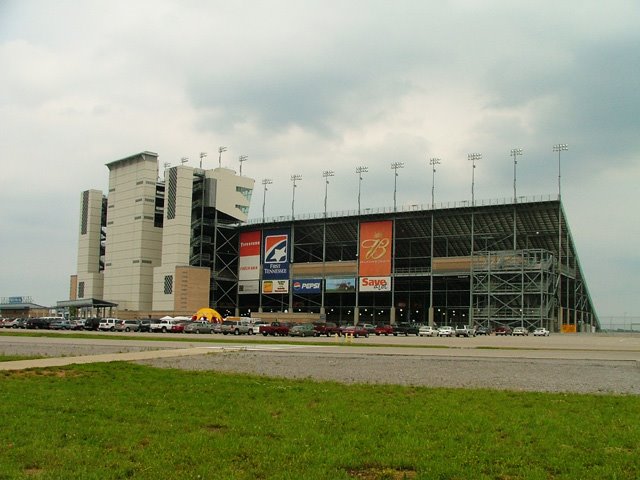
On May 20th, my lovely traveling companion and I attended the A Toast to Tennessee Wine Festival. A good friend in Nashville scored us some tickets to the event, and we spent the day in Middle Tennessee both at the festival and visiting with my friend. The event was held at the Nashville Superspeedway, a NASCAR race track to the east of the city. As of now, I may be the only wine blogger who has attended a tasting at a NASCAR facility.

If you want to try Tennessee wines, this annual event is the place to do it. There's about two dozen wineries in the state, and fourteen of them were present. I tasted at least one wine from each winery, and out of the hundred-odd wines present I sampled 26. I primarily sought out wines made from grapes that were either Native American varieties or French-American hybrids. I tasted a few made from traditional European grapes. There were some more I wanted to try, but I think I reached the limit of my palate. For that reason I also skipped almost all of the fruit-based wines (berries, mostly, with one rhubarb wine). In addition to the wines, Tennessee cheesemakers and other food producers were present, offering samples of their wares. This was a nice treat--I got to try some great artisanal cheeses, as well as fresh salsas, sausages, etc.

There's not a lot of online information on these wines, though I've provided links to contact information. When referencing some of the more unusual grape varieties, I've provided links to the Appellation America Grapes Varieties Index, which provides humorous character profiles and illustrations of each grape in addition to hard information about the background and growing regions of said grapes.

Unless otherwise noted, nearly all wines were fermented in stainless steel. After a dozen unoaked wines, you find yourself craving oak. For those unfamiliar with Tennessee geography, West Tennessee is flat, Middle Tennessee is hilly, and East Tennessee is mountainous.

Lauderdale Cellars, West Tennessee
  • Tennessee Peach: A sweet white wine with peach juice added. A really beautiful color--it had that slight blush of salmon you see in homemade peach ice cream. Really sweet, though.

Chateau Ross Vineyard & Winery, Middle Tennessee
  • Viognier: Lemon and big fruit flavors, clear and clean.
  • Maison Rouge: Cabernet Franc, Cabernet Sauvignon, Merlot. Creamy, spicy, some vegetable elements from the Cabernet Franc. Really quite nice.
  • Big Bitch Red: Amusing names were in abundance at this wine festival... A combination of many different red grapes. Soft, not too tannic, but the flavors are too heavily blended for anything to stand above the crowd. Good basic red wine.
  • Catawba: Native American grape. Smoky, foxy, but not sweet. I've had Catawba before that was as sweet as pancake syrup, but it was interesting to taste a drier version of the wine. The... earthiness can be offputting to some.

Beans Creek Winery, Middle Tennessee
  • Traminette: Very similar to Gewürtztraminer, which is one of the parent grapes of this hybrid. Spicy and sweet, but a rough aftertaste.
  • Chardonel: The flavors were similar to Chardonnay, but it needed more acidity. The name reminds me somewhat of the artificial vanilla substitute vanillin, or that it's a grey-market knockoff of Chardonnay.
  • Chambourcin Reserve: Wow. Tastes very similar to Merlot, but there's something in the background letting you know it's different. Mellow and fruit-forward, mild tannins. Definitely try a Chambourcin if you get the chance. This was aged in American oak for 8 months.

Keg Springs Winery, Middle Tennessee
  • Vidal Blanc: This hybrid grape is commonly used for making ice wine in Canada. Musky nose, semi-dry and lemony. Needs a little more punch, but definitely worth trying.
  • Crusade: Made from Concord grapes, which are native to North America. Sweet, but the flavor is a lot of fun. Rather than reminding you of wine, the taste is exactly that of purple grape juice and purple grape jelly. In fact, the flavor threw me back to Sunday School. Concord wines aren't taken seriously, but I found them one of the pleasant surprises of the day.

Sumner Crest Winery, Middle Tennessee
  • Sumner Queen: A white blend of Riesling and French hybrids. Very sweet, difficult to discern any dominant flavors. Reminiscent of a late harvest Riesling.

Holly Ridge Winery and Vineyard, Middle Tennessee
  • Hogeye Red: A sweet blush wine of unknown grapes. Good summertime wine if you like them sweet.
  • Seyval Blanc: A hybrid that's quite popular in England. Overly musky with a thin flavor.

Beachaven Vineyards & Winery, Middle Tennessee
  • Barrelhead Red: Chambourcin and Merlot Blend. Dry, mild fruit flavors and medium tannins. Excellent casual drinking red.

Stonehaus Winery, Middle Tennessee
  • Fairfield Red: Another Concord that was on the drier side, thanks to blending from some European grapes.

Highland Manor Winery, Middle Tennessee
  • Highland Red: Chambourcin and Marechal-Foch blend. Sort of rough, cough syrup flavor.

Mountain Valley Vineyards, East Tennessee
  • Cynthiana: Merlot-like, with cherry flavors abounding. Very enjoyable.
  • Mountain Valley Blush: Unknown grapes. Semi-dry, no prominent flavors.

Tennessee Valley Winery, East Tennessee
  • Appalachian Red: A combination of Cabernet Franc and Cynthiana, oak aged. Solid tannins, black cherry flavors, and decent balance. I'd definitely try this again.
  • Captain's Reserve: Chardonnay and Seyval Blanc blend. Burnt match nose, ultimately thin flavors.

Apple Barn Winery, East Tennessee
  • Vineyard White: Unknown grapes. Dry, with low fruit flavors and low acids. Similar to Pinot Grigio.
  • Applewood White: Made from Winesaps and other apples. I cheated here, because I love apples and really wanted to try an apple wine. It turned out to be my favorite out of the entire tasting. It's hard to describe: not terribly sweet, but amazing apple flavors and aromas. Unique feel and body that is distinct from apple juice, apple cider, and hard cider.

Savannah Oaks Winery, East Tennessee
  • Etowah Derailer: Sweet light red blend, bright cherry flavors. Think a sweet Beaujolais, but I'm not sure what grapes were used.

Striker's Premium, East Tennessee
  • Cynthiana: Also known as Norton in different parts of the country. Considered to be one of the Native American grapes with the best prospect for serious wine production. Peppery and spicy, low tannins and crisp acidity for a red. Definitely looking forward to trying more of these wines in the future.
  • Baco Noir: A hybrid red that I really didn't enjoy. Astringent nose and tasted like thin cough syrup.

21 May 2006

The Wine Century Club

Dr. Vino recently wrote about tasting his 100th grape and joining the Wine Century Club. Membership is free, and you get a certificate honoring your accomplishment. It works on the honor system, so it's mostly for fun. I went to a wine festival this weekend--more on that later--and got to try some unusual grapes. Late last night I decided to go through my notes and figure out how many grapes I've tried.

100.

As in, exactly 100 after yesterday's encounter with some oddballs. I just finished going through the list and auditing it, removing any duplicates (Spanish grapes often have multiple names, and some Italian grapes have different names in Spain and France). But it looks like it's solid. And it may be slightly more--I stopped digging through my notes when I hit Welschriesling and made it to 100. (Of course, I think you could probably spend a month in Italy and hit 200 grapes easy, but most would be unknown outside of their various regions.)

The vast majority of these are from posts on this blog, though sometimes you might have to follow the link to the winemaker to get the grape varieties. A few others are from old handwritten notes before I started the blog, and some include the Port and Sherry grapes, of which I've had a lot but don't blog about often.

My list includes eleven that aren't on the Century Club spreadsheet, mostly French-American hybrids and some obscure Spanish grapes. But I've researched each one, and they appear to be unique varieties, just not terribly popular. Here it is:

  1. Albarino
  2. Aligote
  3. Arinto
  4. Arneis
  5. Baco Noir
  6. Barbera
  7. Bianca Fernanda
  8. Blaufrankisch
  9. Bobal
  10. Bonarda
  11. Brachetto
  12. Cabernet Franc
  13. Cabernet Sauvignon
  14. Canaiolo
  15. Carignane
  16. Carmenere
  17. Catawba
  18. Chambourcin
  19. Chancellor
  20. Chardonel
  21. Chardonnay
  22. Chenin Blanc
  23. Colombard
  24. Colorino
  25. Concord
  26. Cortese
  27. Corvina
  28. Dolcetto
  29. Dornfelder
  30. Gamay
  31. Garganega
  32. Gewurtztraminer
  33. Godello
  34. Grenache
  35. Gruner Veltliner
  36. Kadarka
  37. Kerner
  38. Loureiro
  39. Macabeo
  40. Malbec
  41. Malvasia
  42. Malvasia Nera
  43. Marechal Foch
  44. Marsanne
  45. Melon de Bourgogne
  46. Merlot
  47. Meunier
  48. Molinara
  49. Montepulciano
  50. Mourvedre
  51. Muller Thurgau
  52. Muscadelle
  53. Muscadine
  54. Muscat Blanc
  55. Muscat of Alexandria
  56. Muscat Ottonel
  57. Nebbiolo
  58. Negroamaro
  59. Niagara
  60. Norton
  61. Palomino
  62. Parellada
  63. Pedro Ximenez
  64. Petit Verdot
  65. Petite Sirah
  66. Pinot Blanc
  67. Pinot Gris
  68. Pinot Noir
  69. Pinotage
  70. Prosecco
  71. Refosco
  72. Riesling
  73. Rondinella
  74. Roussanne
  75. Ruby Cabernet
  76. Sangiovese
  77. Sauvignon blanc
  78. Semillon
  79. Seyval Blanc
  80. Steuben
  81. Syrah
  82. Tannat
  83. Tempranillo
  84. Tinta Barroca
  85. Tinto Cao
  86. Tocai Fruilano
  87. Torrontes
  88. Touriga Franca
  89. Touriga Nacional
  90. Traminette
  91. Trajadura
  92. Trebbiano
  93. Trepat
  94. Verdejo
  95. Verdelho
  96. Vidal
  97. Viognier
  98. Welschriesling
  99. Xarel-lo
  100. Zinfandel

17 May 2006

Galena Cellars General's Reserve Red

Following a trip to Chicago to visit some relatives, my sister-in-law gave me a bottle of the Galena Cellars General's Reserve Red. The label features the visage of Ulysses S. Grant, 18th U.S. president, Union Civil War hero, and favorite son of Galena, Illinois, where this wine is made. (It's basically the etching from the old version of the $50 bill.) Oddly enough, the label features one of my favorite fonts, Souvenir, alongside one of my least favorite, Snell Roundhand. Ah well...

I'm not really sure what grapes are in this. The back label claims that it's made from a blend of European and American Hybrid grapes, while various websites claim that it's a Bordeaux-style blend using grapes from Sonoma. Yet other websites claim that it's an unorthodox blend of Cabernet Sauvignon, Merlot, and Pinot Noir.

As I type this, I'm uncorking the bottle and trying it out... And the damned thing is eaten up with brett. Whenever I bring the glass to my nose all I can smell is rotten asparagus. The wine tastes OK, if a little bitter, but the smell is so overpowering that I can't stand it. I appreciate the gift, and will give this a second try if I come across it, but this bottle's going down the drain. And I've been looking forward to it all day...

15 May 2006

Crops

When it comes to growing plants, I never really had much of an urge. My maternal grandmother was a horticultural wizard, able to grow damned near anything. She had a bamboo grove in her backyard, and growing up my brother and I could have Star Wars-style lightsaber fights with 20 ft. long dried bamboo poles. She grew championship roses and African violets and tulips and daffodils and all sorts of other things. In fact, there wasn't a surface inside or outside that wasn't covered with a growing plant. She passed away a few years ago.

On both the maternal and paternal sides of my family, I'm descended from farmers. Mostly cotton, with some corn and the odd livestock for family provisions. What remains of the family farms are mostly used for cotton, which is still one of the major cash crops of the Mid-South. I never spent any time working on a farm, and aside from one summer when we raised corn and pumpkins in the backyard, I have no experience farming. However, this year I was for some reason compelled to grow things. Here's a list of what's currently growing in my various pots and gardens:

Inside:
Microgreens, Basil, Chives, Rosemary, Greek Oregano

Outside:
Tomatoes: Brandy Boy, Fourth of July, Yellow Pear, Big Mama, Sweet Baby, Sun Gold, Husky Red
JalapeƱo Peppers, Cilantro, four colors of carrots (yellow, orange, red, purple)

The herbs are going quite well, and I'm able to harvest them along the way and grow more as needed. It will be a month or two before I harvest any tomatoes, but I'm really looking forward to all of these unusual varieties. As for the carrots, I'll be amazed if any of them make it, but I'd really like to try a purple carrot at some point in my life.

Why am I doing this? There's some things you can't buy in the store or at the farmer's market. For instance, those little yellow pear tomatoes. The size of cherry tomatoes, but shaped like a pear and bright yellow, with a delicious flavor. Stick on a toothpick with a chunk of feta cheese and a basil leaf. Flavor bomb appetizer.

14 May 2006

Tasting Notes for May 13, 2006

I was looking forward to this tasting for a couple of weeks... All of the wines featured were going to be from The Grateful Palate, a popular importer of Australian wines. (The website doesn't have any wine information, but you can see a comprehensive list of the Grateful Palate wines here.)

I got there a little early, and was going over the tasting sheet, checking off the ones I'd tried before. I was certainly going to try them again, but I saw some of my favorite Australian labels on there: Paringa, Marquis Philips, and Trevor Jones. A guy came up, tapped me on the shoulder and asked if I was there alone. I figured he wanted the other seat, which I was more than happy to give up. Instead, he shook my hand and said, "Hi, I'm Dan Philips." As in, the owner of The Grateful Palate. Super nice guy. We talked off and on throughout the tasting, and in particular I asked him about the Nuriootpa High School wines, which are produced by a sort of vocational education program. The students pick the grapes and make the wines, and all proceeds go back to the high school.

I've tasted about half of these wines before. Last year I got to sit down with Trevor Jones at a tasting and go through his entire product line, but I was happy to see those wines again.

Wine 1: 2004 Trevor Jones Boots White. Barossa Valley, Australia. A mix of Riesling and Muscat. Sweet nose with apple aromas and smoky notes on the tongue. Balanced acids and not as sweet as you first think. $13.

Wine 2: 2004 Marquis Philips Holly's Blend. Padthaway, Australia. You know, I forgot to ask for the preferred pronunciation of "Marquis" when referring to this wine. Americans tend to pronounce the first name "mar-KEE" and Australians I've met have called it "MAR-kwiss". I didn't particularly like this wine, it's got a heavy vegetal aroma that was offputting. Rough finish as well. A combination of Semillon and Verdelho. I liked this last year, so I'm willing to bet it was an off bottle. $10.

Wine 3: 2004 Paringa Chardonnay-Semillon-Sauvignon Blanc. South Australia. Grapefruit on the nose, but the creamy feel and taste of Chardonnay. Crisp acidic finish. Interesting little bargain. $10.

Wine 4: 2002 Trevor Jones Boots Grenache. Barossa Valley, Australia. I liked this one so much I took a bottle home and devoured most of it with dinner. It's got a creamy cherry aroma, almost like a cherry tart with whipped cream on it and lots of butter in the crust. Big fruit and soft tannins with a medium finish. Touch of chocolate flavor. Bigger than a Rhone-style wine but not as aggressive as some California Grenache I've had, even though it ranked in at 15% alcohol. $14.

Wine 5: 2004 McLean's Farm Shiraz-Cabernet Sauvignon. Barossa Valley, Australia. Some black cherry and pepper on the nose. Very dry, with mild tannins and a short finish. More alcohol becomes present on the tongue as you go along.

Wine 6: 2001 Alliance Shiraz. South Australia. Plum aromas, with a mild scent of a ruby Port. Delicious, with tannins that melt in your mouth. Quite nice for the price. $14.

Wine 7: 2001 Brothers in Arms Shiraz. Langhorne Creek, Australia. Alcoholic, hot aroma, but with plenty of classic Shiraz flavor. Short finish. I actually preferred the Alliance to this one. $36.

Wine 8: 2004 Marquis Philips S2 Cabernet Sauvignon. South Australia. Buttery aroma, deep and rich feel, very dark and intense color, yet velvety smooth on the tongue. Wow. $35.

Wine 9: Trevor Jones "Jonesy" Tawny Port. Barossa Valley, Australia. An amazing Port for the price. Molasses and raisins dominate the flavor, with some figs and chocolate in the background. Alcohol is subdued, and it's not too thick or sticky. $10.

12 May 2006

Flying Dog Gonzo Imperial Porter

I've got a cool wine tasting to attend Saturday, and then the following Saturday should produce a rather unique wine writeup... And the week after that I've got a big wine-based dinner party planned. But for tonight, it's yet another big beer.

I've always enjoyed the beers of Flying Dog Brewery, and though it's a shallow reason, I've always loved the labels, which are drawn by the great Ralph Steadman. In addition to doing some wine labels for Bonny Doon, he's also written and illustrated several books that take you on a bizarre and irreverent tour through wine country and whiskey country. His writeup on "Brit", a short-lived English version of Port, is hilarious.

Steadman was a longtime friend and collaborator with the immortal Hunter S. Thompson. To commemorate Thompson's death last year, Flying Dog has released the special edition Gonzo Imperial Porter, which features a skeleton dressed as Thompson on the label, as well as an amusing quote from the good Doctor.

This is a hell of a beer. It clocks in at a whopping 9.5% alcohol, surpassing some wines. It's got a slightly sour aroma at first, but don't let that fool you. It's a surprisingly smooth brew, almost solid black with a very light head on it and almost no carbonation. The flavor is dominated by chocolate and coffee, with just enough sweetness to keep it from being too bitter. Still, this is a powerful wine, thick and almost sticky. It actually clings to the side of a glass like brandy (and, in fact, it was consumed out of large red wine glasses). Perfect for relaxing and sipping. A buddy and I consumed one each while watching a movie and could barely move afterwards.

A box of four 12 oz. bottles runs $10, which is a bargain for such a fine beer. A single bottle is plenty to savor over the course of an hour or two following dinner--drinking this with a meal would be like trying to drink espresso syrup. I can't imagine drinking two in a row. You know that lovely golden crema that forms on the top of a properly made espresso? That's exactly what the head on this beer looks like.

I'll close with a classic Thompson quote, the opening lines of Fear and Loathing in Las Vegas:

We were somewhere around Barstow on the edge of the desert when the drugs began to take hold. I remember saying something like "I feel a bit lightheaded; maybe you should drive..." And suddenly there was a terrible roar all around us and the sky was full of what looked like huge bats, all swooping and screeching and diving around the car, which was going about a hundred miles an hour with the top down to Las Vegas. And a voice was screaming: "Holy Jesus! What are these goddamn animals?"

07 May 2006

Two Beers

Fear not, this isn't turning into a beer blog. However, I'm getting access to a lot of fantastic beers these days, and it's a delicious voyage. Eric Asimov has been writing a good bit about fine beer recently, and while addressing wine drinkers' attitudes towards beer, wrote in part:
Would you only eat meat and never try fish? We all know people like that, and we laugh at them. But people who drink only wine and won't touch beer? They're considered sophisticated. Excuse me while I chuckle.

Now, I'm not attacking preferences here, only the refusal to consider alternatives. If you have explored beer and decided it's not for you, well, I toast your open mind.

Amen.

This replies in reverse as well, beer drinkers ought to be more willing to try wine, but they're generally not snobbish about it.

In my continuing run through the Unibroue product line, I had a bottle of the Don de Dieu. It pours a cloudy golden color, but it's as hearty as many darker beers. When the notes say full-bodied, believe it. There's some spice there, and elements of dried apricot, but mostly you're enjoying a very rich and well-balanced beer. Almost sweet at times. And that 9% alcohol makes you drink this much slower than you would a light lager, for instance.

I also had the Sierra Nevada Bigfoot, which is a barleywine-style ale. Probably the heartiest and fullest beer I've ever had, and this is my second time ordering it at the nearby gourmet beer establishment. Served in a brandy snifter, this is almost solid black and is as strong as espresso. Heavily spiced and not fizzy at all. You get all sorts of wonderful complexity from the malts and hops. I know a lot of people who are terrified to drink Guinness Extra Stout because the strong flavor scares them; Bigfoot makes that Extra Stout taste like skim milk. I love this stuff, but you've really got to enjoy it as a final beverage after a meal or after you've drunk other beers. Afterwards, you're not going to be able to taste anything properly.

30 April 2006

Leg of Lamb Dinner

I had dinner over at my brother's place with a friend last night. My sister-in-law and niece were out of town, providing the opportunity for a good guys' night. Things were kept pretty simple: I made some roasted potatoes with rosemary (I've just been craving this recently), and while my brother grilled the lamb (boneless, laid flat on the grill), I made a sauce to go with it. A cup of Dijon mustard, a quarter cup of peach jelly, and a half a cup of bourbon. Sounds odd but it was delicious.

The first bottle consumed was the 2003 The Lucky Country GSM from the Barossa Valley in Australia. I had this at a tasting in February and enjoyed it, but it went particularly well with the lamb. Excellent fruit and low tannins. The second bottle was the 2001 Mt. Oso Cabernet Sauvignon - Cellar Select. Lots of blackberries on the nose and palate, and it still tastes like a fairly young wine.

25 April 2006

2004 The Wishing Tree Shiraz

About a week ago I tried to treat myself to a steak and bottle of red for one... The steak didn't turn out so well, so I tried it again tonight. It had been a rough day at work, and thus on the way home I lucked into a massive T-Bone that had been marked down to a ridiculously low price. Grabbed some small russet potatoes, and headed home. I'd also set out a five-pack of frozen chicken thighs to thaw in the fridge overnight, but upon getting home decided that the combination of meats and nice weather meant it was time for the First Barbeque of the Year.

I roasted the potatoes in the same manner as I did for the Combinations dinner, with some melted butter and fresh rosemary. I smoked the chicken thighs for about an hour on the cool part of the grill, basting occasionally with some leftover hard cider. The steak was a work of art on its own, and really just needed a little salt and pepper and some careful grilling for about twelve minutes (it weighed in at around 1.5 lbs or .68 kg!).

And the wine? I decided to revisit the charmingly named 2004 The Wishing Tree Shiraz. I tasted this back in August, but didn't much care for it at the time. There's a chance that was an off bottle, or that (because it was a blind tasting) the bottle had been misidentified later. I was much happier this time, as it tasted like a good $15 Shiraz oughta. Two thirds Western Australia and one third South Australia... Dark berries and a little leather on the nose, with bold fruit flavors on the tongue and a peppery finish. The tannins give it a nice little bite but aren't mouth-drying or overpowering. Definitely recommended.

I'll also point out that this is the second wine in a row that I've had from The Australian Premium Wine Collection. There's been some good articles written in the past couple of years about finding an importer you like and following his or her wines. Sometimes this takes a bit of work (such as for Dan Phillips' Grateful Palate). However, John Larchet has been kind enough to include a neck label on each bottle in the collection to help identify it. I've been happy with these two wines, and will be on the lookout for more.

21 April 2006

Combinations #1 - Benito Rises to the Challenge

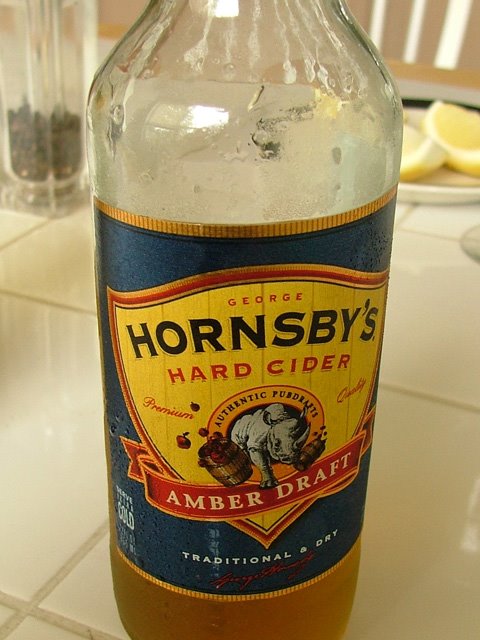
Here's my entry for the First Combinations challenge: Baked Mackerel with Rhubarb Sauce. I couldn't find fresh mackerel anywhere near Memphis, so I decided to substitute rainbow trout fillets. I wanted to use young whole rainbow trout, but one of my regular supply lines dried up. And I had the damnedest time finding cider, so I'll start with that image. I drank a lot of hard cider (as we call it in the states) back in the late 90s, which is when it was really first introduced in this market. That coincided nicely with my turning 21. I was particularly fond of the Woodchuck Granny Smith Draft Cider. But I stopped drinking it at some point, and haven't touched the stuff since. Hey, there's been too much good beer and wine that's come my way recently. Anyway, I picked up a six pack of Hornsby's Cider, bottled by the Gallo wine conglomerate. I had a bottle this afternoon and loved it. Great apple flavor without being sweet or having that vinegar flavor that I grew to despise in hard cider way back when.

Here's how the meal turned out... Instead of boiled potatoes, I chose to make roasted eighths of new potatoes tossed in butter and fresh rosemary from the kitchen garden. Joining me for this dinner was my longtime friend and fellow blogger Paul. The sauce looked a little limp, but was quite flavorful, and I'm pretty sure this is the first time that I've ever eaten rhubarb. Yeah, I've gobbled up baby octopus and have eaten plenty of live ants, but somehow I never got around to rhubarb. The trout turned out OK in my opinion; I think it would have been better pan-fried or grilled, and I'm sure that this baking method was much more suited to the gutted mackerel than a mostly flat fillet. However, it was all eaten and enjoyed, and the dogs circled the table hungrily.

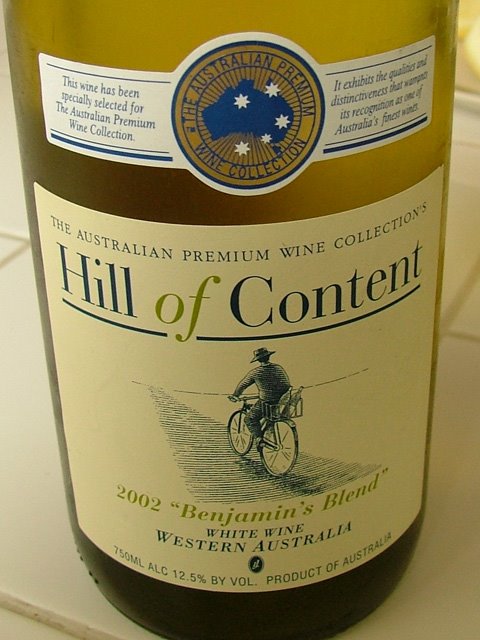
And now for the wine... This afternoon I wandered through the wine shop, looking for something appropriate. I could have gone with a tried and true favorite, but I really enjoy trying a new bottle. So I'm walking along, thinking I'd like an interesting white blend, and what do I find? A wine with my first name on it. (Yes, I'm a Benjamin, Benito is just a nickname.) Thus my wine of choice for this dinner was the 2002 Hill of Content "Benjamin's Blend" from the Margaret River region of Western Australia. Plus, Barbara's from around there, so I figured karma was on my side. The wine is a mix of 50% Chardonnay, 39% Sauvignon Blanc, and 11% Semillon, all unoaked. The wine is all about the peaches: on the nose and on the tongue and on the aftertaste. A nice wine to drink cold with a hearty bit of seafood, and a good bargain at $15. It matched well with the fish--the forward fruit and balanced acidity provided a counter to the sometimes fatty fish, and yet it complemented the sweet rhubarb sauce going along. The roasted potatoes mainly cleansed the palate between fruit explosions.

20 April 2006

Jack Daniel's Distillery

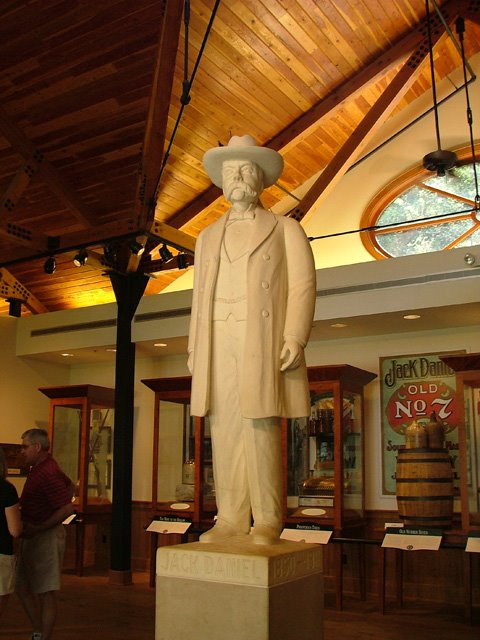
Last weekend the girlfriend and I visited the Jack Daniel's Distillery in Lynchburg, Tennessee. I've got the story and pictures up at my personal site.

Journey to Jack Daniel's Distillery

Unibroue Trois Pistoles

In a followup to the post from two weeks ago, I'm trying another great Canadian beer from Unibroue. Tonight it's the Unibroue Trois Pistoles, a strong dark ale from that great brewery. The malts are really quite prominent in this beer, and that's a good thing. Additionally, there's flavors of dried apple all over the place, with hints of coffee and chocolate. I don't really get the Port comments that everyone makes about this beer, but I certainly agree that it could be enjoyed in the same manner as Port. Certainly at the end of the meal, with some cheese and fruit or even a bit of cheesecake.

It has a slightly sticky feel in the mouth on the aftertaste, with lingering cherry flavors when you lick your lips. At 9% alcohol, you've got to be careful--one regular bottle is basically like half a bottle of a light Riesling or some other mild white wine. As for the name, the English site doesn't give any clues, but the French site seems to hint at the legend of a black horse that signified the devil, which would make sense with the flaming winged equine on the label. You know, these are great beers, but all of the names and labels seem to come straight out of a Goth's daydreams.

I'm still amazed that a single 355mL beer bottle can provoke such thoughtfulness. I just wish it were colder--my AC is out at the moment and it's been up into the 90s this week. But I'd still highly recommend this to anyone that wants to drink a beer that they can savor and taste and appreciate over the course of an hour.

19 April 2006

2002 Bonny Doon Madiran Heart of Darkness

In anticipation of a steak for dinner, I stopped by a newly remodeled wine shop in the area and picked up a bottle of the 2002 Bonny Doon Madiran Heart of Darkness. I hadn't seen or heard of it before. I do love Bonny Doon wines, but they're a little scarce around here. The label bore blood-spattered designs by the great Ralph Steadman, as well as a map on the back that was similarly spattered. It seemed to point to an area in France near the Spanish border, but there was no other information.

The steak turned out OK, but I was really impressed with the wine. I decided to drink it "blind" with dinner and see if I could determine the mystery grape, as I wasn't familiar with the Madiran region. First off, this is a dark wine, almost black. So we're talking about a small grape... But it wasn't herbal enough to be Cabernet Franc or Petite Verdot, and wasn't fruity like Petite Syrah. It made me think a lot of Malbec, though it wasn't quite that either. So after dinner, I raced to the computer to figure out the mystery, and found that it was made up mostly of the oddball Tannat, a grape that is currently enjoying a boom in Uruguay of all places. Appellation America chose to illustrate the grape with a werewolf.

It's definitely tannic, and looking at some pictures, it is indeed a tiny grape with a dark skin. This particular wine is blended with Cabernet Franc and Cabernet Sauvignon, but the percentages tend to vary depending on which site you check. Relatively high alcohol--14.2%. I realize that it's managed by an American company, but this is a four year old French wine that could knock you on your ass if you're not careful. Not subtle in the slightest, but a good match for hearty fare.

Now that I've had time to sit with it for a while, I'm getting some of the vegetal, woody qualities on the nose. Reminds me of woodcutting, oddly enough--fresh cuts into a green tree. There's some black cherry on the tongue, but mostly what you're tasting are tannins and... darkness.

All in all, a fascinating wine, and definitely one for some strong food. Take it along to your next blind tasting party to stump your friends!

16 April 2006

Microgreens Photoessay

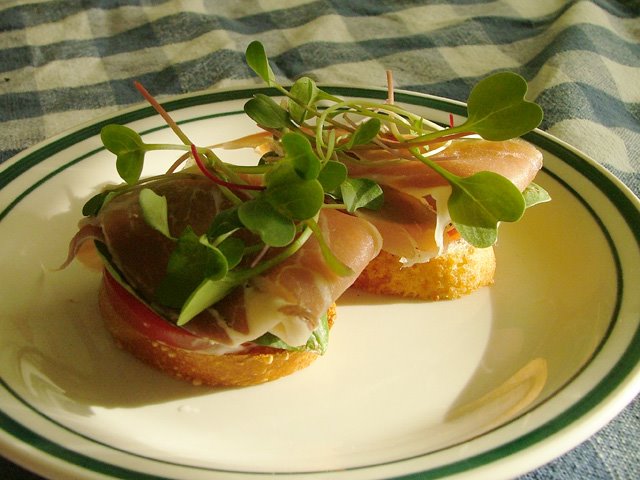
Earlier this month, I got a packet of seeds for growing microgreens, the little infant versions of tasty lettuce varieties. At right is what I made with the first harvest after twelve days of growth, sort of a gourmet appetizer version of the classic BLT sandwich.

On my personal site, I've posted my Photoessay on Microgreens. Enjoy!

15 April 2006

Correction

This review was originally published back in January. The original post is as follows, with the correction in bold.
Wine 9: 2003 Chateau de Mattes-Sabran. Corbières, Languedoc. South of France, probably a lot of Carignan and who knows what else. Soft beginning, some black cherry flavors. Slightly unbalanced, but a good little wine. Really begs for some food. $15. Correction: Syrah, Grenache, and Mourvedre. No Carignane in this wine. The owner of the winery contacted me with the correct information. Thanks!

11 April 2006

Tasting Notes for April 8, 2006

All of the wines listed below came from either Rudolf Müller or Dr. Thanisch, in the Mosel region of Germany. The winemaker for both vineyards is the elegant and charming Barbara Müller, who was there to answer questions. Even though I don't drink a lot of Riesling, I liked just about every wine at the tasting. At the end, I complimented her on the wonderful wines, shook her hand, and then in my most formal Hochdeutsch, I nodded and said, "Danke Schön, Frau Müller." She actually bowed slightly and replied with a smiling "Bitte."

Hey, two years of high school German had to pay off eventually.

Note: Keep in mind that except for one notable exception, all of these wines were of the same grape and of the same vineyards. So a lot of these tasting notes are going to look similar, but there were subtle differences that are sometimes hard to put into words for the amateur blogger and general non-enthusiast of Riesling. Also, these are listed in the order of the printed note sheet, but they were actually tasted in a different order arranged by Frau Müller.

Wine 1: 2004 Rudolf Müller "Bishop of Riesling". This is their most well-known offering, from what I understand. I found it a little thin, but not sweet. Clean and tasty. $12.

Wine 2: 2004 Rudolf Müller Kabinett. Mild and smooth, with some honey flavors involved. $13.

Wine 3: 2003 Rudolf Müller Piesporter Goldtröpfchen Kabinett. Honey sweet, tart beginning and smooth finish. $15.

Wine 4: 2003 Dr. Thanisch Bernkasteler QBA "Classic". Light and lemony, dry and tart. $18.

Wine 5: 2003 Dr. Thanisch Bernkasteler Badstube Kabinett. Musky and sugary, sticky and just a little too sweet for my tastes. $21.

Wine 6: 2004 Rudolf Müller Spätlese. Some lemon, thin yet sweet. $14.

Wine 7: 2003 Dr. Thanisch Gracher Himmelreich Spätlese. Tickles the tongue, some medium acidity. Really enjoyed this one. $24.

Wine 8: 2003 Dr. Thanisch Bernkasteler Graben Spätlese. Similar to the previous wine, but with more fruit flavors. $28.

Wine 9: 2003 Dr. Thanisch Bernkasteler Doctor Spätlese. Very sweet but with a dark flavor, reminded me of peach nectar. Even though I don't normally seek sweet wines these days, I loved this wine. $53.

Wine 10. 2002 Dr. Thanisch Pinot Noir. Actually the first one we tasted, followed by a rinsing of the glasses. What's this? A German Pinot Noir? The next thing you know polar bears will be waddling through the Sahara. Seriously though, this was an awesome wine. Berries all over, slightly tart and ultimately delicious. Assistance provided by a winemaker from New Zealand. I would definitely recommend this wine for a blind tasting to completely screw over your friends. $23.

Wine 11. 2004 Rudolf Müller. Good and well rounded. Honey flavors, but a little too sweet for me.

Wine 12. 2004 Rudolf Müller Eiswein. Not that sweet, but with elements of petrol and minerals on the nose. Delightful dry-style Eiswein. $23.

Wine 13. 2002 Dr. Thanisch Bernkasteler Doctor Auslese. Actually the last wine tasted. Wow. Honeysuckle, firm acids, lemon tart... Utterly wonderful. I was sniffing my glass for a few minutes after I'd wrung out the last drop from the sample. $46.

08 April 2006

Wine Blogging Wednesday #20

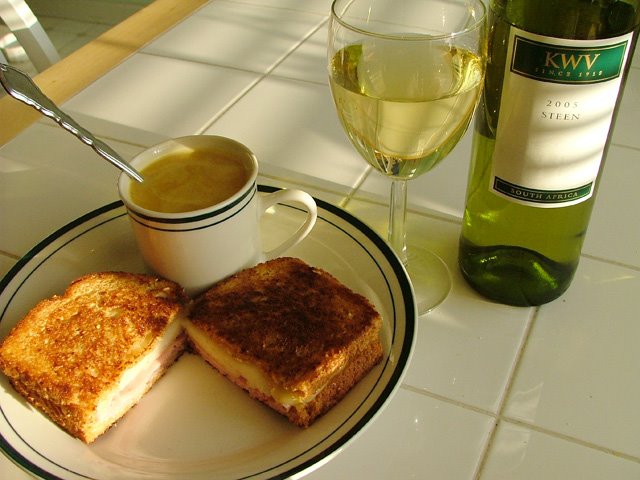
The theme for Wine Blogging Wednesday #20 is to pick a white wine outside of the big three (Chardonnay, Sauvignon Blanc, and Riesling), or any blend using those three. I was going to be a smartass and grab some obscure Hungarian white or perhaps one of the foxy Native American varieties. But instead, I was lured away by something that just came on sale at one of the local shops. For my entry, I present the 2005 KWV Steen, which I picked up for around $7.50.

KWV is the giant wine cooperative of South Africa, and Steen is what they call Chenin Blanc in those parts. There's not much on the nose here--in that respect, it's almost like Pinot Grigio. However, it has a much stronger presence in the mouth. The overwhelming element is firm acidity, with medium tartness and a short finish. No dominant flavors other than the baseline "white wine" taste. The wine on its own isn't that impressive, but it paired quite nicely with dinner: a cup of butternut squash soup and a grilled sandwich containing havarti cheese, thin slices of d'Anjou pears*, and smoked ham.

Not a bad little wine for the beginning of spring.

*A somewhat appropriate pairing, as the Chenin Blanc grapes originally come from around Anjou in France.

07 April 2006

Memphis Zoo Wine Benefit

Tonight I was fortunate to receive some tickets to the "Wild World of Wines & Beer" benefit at the Memphis Zoo. Now, I've got a membership to the zoo and go there often. It's celebrating its 100th birthday this year, but the past twenty years have been amazing, as they decided to upgrade from the "concrete and cages" model to more natural habitats for the various animals. Over the years they've built Cat Country (all major large cat species), Primate Canyon (everything from lemurs to gorillas), the China Exhibit (pandas and more), and recently they've added the Northwest Passage exhibit (polar bears, black bears, etc.). At the right is a photo I took of one of the polar bears last month.

In honor of the Pacific Northwest theme, most of the wines came from that region. I skipped a few, as I had tried some of them before and they were pouring rather generously. I had to drive myself home, plus I really didn't want to fall in the baboon pit. Also, I was wondering beforehand if my notes would include things like, "this Merlot smells like elephant dung", or "this Riesling has the musky undertones of the tiger habitat". But all of my wine drinking happened indoors, so no outside olfactory influences were involved.

Wine 1: 2003 Foolish Oak Chardonnay. Columbia Valley, Washington. Light and fruity with a crisp finish. Great way to start off the evening. $11.

Wine 2: 2004 Hedges CMS White. Columbia Valley, Washington. I've had this before, but I was able to appreciate it more with a bigger sample. Very crisp, with a clean feel and herbal tones. Mix of Chardonnay, Marsanne, and Sauvignon Blanc. $15.

Wine 3: 2004 Ste. Michelle Riesling. Columbia Valley, Washington. Drier than I expected. Crisp with firm acids. Slightly bitter aftertaste. $10.

Wine 4: 2003 Columbia Crest Two Vines Chardonnay. Columbia Valley, Washington. Oaky and buttery, with some cream and vanilla highlights. $10.

Wine 5: 2003 Foris Pinot Noir. Illinois River Valley, Oregon. Mild cherry and strawberry flavors, with strong tannins and a short finish. $20.

Wine 6: 14 Hands Merlot. Columbia Valley, Washington. Black cherry, spice. Fortified by 22% Cabernet Sauvignon, so it's a surprise on the tongue. $12.

Wine 7: 2002 Red Diamond Shiraz. 3% Viognier blended in there. Berry and pepper flavors with a dry finish. A great little wine. I'm definitely going to give this one a second try when I can really focus on it and enjoy it. $12.

Of the three remaining wines that I didn't try, one was a White Merlot I skipped on purpose, one was a Cabernet Sauvignon I'd had before and enjoyed, and the last was a Fumé Blanc that looked promising, and I'll see if I can find it around here.

Unibroue Maudite

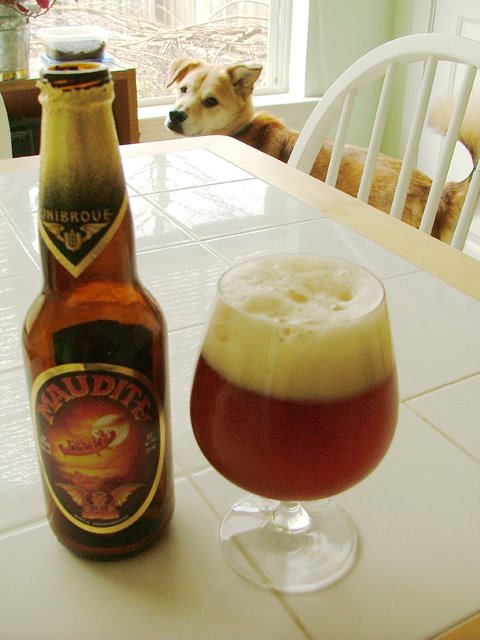
The local wine shop has begun offering "big beers" from the esteemed Quebec brewery Unibroue. A pack of four 12 oz. (355mL) bottles runs around $7.50, which is a good deal for a well made beer. This isn't the kind of thing that you throw back after a long day of yardwork. This is something you pour into the appropriate glass in the Belgian style and savor for a long time.

Pictured at the left is the Unibroue Maudite, a strong dark red beer. My dog Wolfgang looks on approvingly. What's fun with a beer like this is that you can close your eyes and try to pick out all of the subtle flavors and aromas. The Maudite (French for "The Damned") has a lot of nutmeg, with a little orange peel and maybe just a touch of cinnamon. More than anything it reminds me of a really well spiced tea blend. It's mildly bitter, and despite the 8% alcohol, not as strong as you might think.

You can't easily see this in the picture, but the beer itself is a little cloudy. This is due to the presence of yeast, which permits a secondary fermentation in the bottle and will allow the beer to improve with age, much like a fine wine. I'm probably going to do some more reviews of beers like this (including some amazing barleywines I've tried). Seriously, these are beers that a wine lover is really going to appreciate, and there are certain meals where beverages such as the Maudite are going to be a better fit than a particular wine.

05 April 2006

Combinations #1

As a quick followup to the previous post, Andrew has thrown down the gauntlet with the first Combinations challenge:

Baked Mackerel With Rhubarb Sauce

Make the dish and pair it with a wine, and send the results to Andrew by April 24.

As for me, I'm looking forward to trying out this unusual recipe, but I might not be able to get my hands on fresh, small mackerel. If the culinary gods will forgive me, I might have to substitute fresh rainbow trout, which is pretty much the only one-pound full body fish that I see around here on a regular basis. Granted there's some Asian markets where I can get a live catfish or bullfrog butchered on the spot, but the mackerel is going to take a bit of work.

02 April 2006

Combinations

Wine- and food-blogger Andrew left a comment in one of my posts below, and we continued the conversation via e-mail. Andrew has a vision for a new monthly participatory project in the vein of Wine Blogging Wednesday. But instead of a themed wine, the idea is to post a recipe, then everyone cooks it and pairs it with a wine, and reports on how well that wine matched the dish. Andrew calls it Combinations, and has blogged about it here and here.

I think it's important to look at this not only for foodbloggers to think more about wine, but also for winebloggers to think more about food. In the words of Rogers & Hammerstein, "The Farmer and the Cowman Should Be Friends". We've all got the opportunity to learn a lot, broaden our horizons, and have some damned good food and wine in the process.

I fully support this project, will promote it to the best of my ability, and look forward to participating in it in the months to come.

01 April 2006

Segura Viudas Aria NV

So I bought an inexpensive Spanish cava a couple of weeks ago and served it last night. And in doing so, I made some sort of a statement about Spanish politics. Andrew mentioned this a while back, and pointed to an informative article on the subject. Though I'm enchanted by the Catalan language, I really don't have any opinions about the autonomy question and wouldn't stop drinking delicious, affordable cava because of it.

The wine in question was the Segura Viudas Aria, which is a Pinot Noir-based sparkling wine. 100% Pinot Noir, grown in Catalonia and sold just for the American market. It's made by Segura Viudas, but there's nothing about this wine on the website. It's a pretty deep pink, almost red color. Some hints of strawberry, but for the most part it's light, crisp, and refreshing. To be honest, I didn't get to drink much of it--the sparkler was served along with a spread of cheeses and a traditionally prepared Caesar salad, and the ladies drank up most of it before I was able to sit down and think about the various attributes. So for that reason alone the wine gets an A in my book.

27 March 2006

Wine Library TV

I think this might be the first wine-related video podcast out there... Gary Vaynerchuk of the New Jersey-based Wine Library (online and brick & mortar store) puts out a series of informational videos on various wine topics. In an e-mail, I told Gary that watching the videos felt like the conversations I have with the more experienced personnel at my local wine shops.

So without further ado, I present Wine Library TV. Check it out and let Gary know what you think in the comments.

Side note: Wine Blogging Wednesday is a lot of fun, but I've always thought it would be cool to do a sort of "book club" thing. Announce a widely available wine, have everyone buy it ahead of time, and then at some designated date and time, everyone uncorks the bottle and starts posting their opinions in the same thread.

26 March 2006

2004 Chalone Vineyard Monterey County Chardonnay

I'm reading Jeremiah Tower's California Dish : What I Saw (and Cooked) at the American Culinary Revolution. Like Anthony Bourdain's Kitchen Confidential: Adventures in the Culinary Underbelly, it's a look at the sex, drugs, and rock & roll atmosphere of fine dining back in the late 70s and 80s. Bourdain's book was angrier; Tower's book is somewhat more fun, and even includes recipes featuring marijuana. Bourdain's book goes all over the place, Tower focuses mostly on the birth of California Cusine.

Anyway, there's a brief passage about trying to start a culinary arts program at Antioch College in Ohio in 1980, and he mentions the committee going through a case of Dick Graff's Chalone Chardonnay, Graff being the founder and chairman of Chalone Vineyard. He didn't say much about the wine, but I'd been impressed with other wines he'd mentioned that I've tried.

A few hours after reading that, I was doing the regular trip from grocery story to wine shop, and while browsing around the racks I came across the 2004 Chalone Vineyard Monterey County Chardonnay. I've always enjoyed serendipity, and for $12 it was hard to pass up.

I cracked it open today, and served it with a French bread pizza. No, I'm not talking about the Stouffer's frozen variety we all loved as kids. I took about a foot of a French bread loaf and sliced it lengthwise. On each half I smeared a generous portion of pesto, topped it with shredded mozzarella, sautéed cremini mushrooms, grilled orange bell pepper strips, and topped off with a healthy portion of herbed goat cheese. Bake at 350° F for ten to fifteen minutes, and slide it under the broiler for a few minutes if desired. I'm in heaven right now, and my breath is atrocious.

I did sample the wine before the garlic bomb, and found it to be quite nice. It's not overly oaked, but instead has a crisp and firmly acidic flavor to it. It's a Chardonnay with some body and sass that will leave your lips tingling for a few seonds after every sip.

The Pour

I've added a blogroll link to Eric Asimov's The Pour. I've enjoyed reading his wine articles and restaurant reviews over the years in the New York Times, and I'm anxious to see how he does in a more relaxed environment.

Of course, the first thing I think of is that I'd like to see Arthur C. Clarke's nephew start a competing wine blog so that the friendly rivalry could survive in this generation.

47 Wine Reviews

That's how far behind I am in typing up my notes from tastings. In order to keep the recent posts here at top, I'm backposting these reviews in one huge post. I realize these laundry lists of wines with brief reviews aren't that exciting to read--I use them more for my own reference that I can check anywhere I've got web access. So if you're interested, click here.

P.S. It took 3 hours to write those up... Good incentive to keep up to date in the future.

24 March 2006

2003 Grizz Red

Here's a wine that's been popping up all over town, generally sold near the register for around $10. It comes in a white variety, but tonight I opened a bottle of the 2003 Grizz Red, a Washington State blend. The bottle doesn't say anything about the contents, but looking at the website reveals the following unusual breakdown: 41.5% Cabernet Franc, 39.5% Cabernet Sauvignon, 10.6% Syrah, 6% Pinot Noir, 2.2% Merlot. Quite an unusual blend. You never see Pinot Noir mixed with anything (unless we're talking Champagne), and it's rare to see that much Cabernet Franc in anything at this price level. I honestly expected a fairly powerful, tannic red (and naming it after a large and dangerous predator suggests a strong wine). Yet I was surprised at how smooth it was.

A lot of the vegetal characteristics of the Cabernet Franc come through on the nose, as well as providing a deep color. Prominent dark berry flavors abound, with some peppery tones, medium tannins that dissipate quickly, and a medium aftertaste. Very easy going down. I'm still amazed that something with only 8.2% "soft grapes" is this smooth at such a young age.

I served it along with some Wisconsin goat cheese I recently acquired--a nice little sampler pack of four 4 oz. buchettes from Montchevre. I was really impressed with the cheese as well. Very creamy and savory. In fact, the guests have left and I'm writing this while drinking the last of the wine and snacking on some more goat cheese and crackers. Had I been thinking, I could have incorporated agricultural products from Wyoming and West Virginia to cover all of the "W" states.

Oh, and why is Grizz wine being sold all over town? Well, this is Memphis, home to the Memphis Grizzlies NBA team, formerly of Vancouver. I'm not much of a sports fan, but they are quite popular around here (Memphis is a basketball town), and though the wine is completely unrelated, I'm sure that the name connection hasn't hurt sales. And speaking of basketball, the team from my alma mater has reached the Elite Eight and tomorrow night goes up against UCLA for a spot in the Final Four. So for what it's worth, GO TIGERS!

Beef Stew, North African-style

This post doesn't involve wine, but is one of my briefer food photoessays. My North African Beef Stew isn't purely authentic--the use of bacon and beer are notable breaks from tradition--but making the broth really savory and spicy and serving the resulting stew with couscous certainly makes it stand above a can of Dinty Moore. Some variations are offered in the article.

22 March 2006

The Mystery of The Four Emus

Astute New Zeland blogger Barbara pointed out in the last post that the Four Emus wine is from South Australia. I could have sworn that the website and promotional literature said Western Australia, so I went back to check. And sure enough, I was right. But I happen to do e-commerce work for a living, have an international user base, and have seen many strange things happen. So I logged back into the site, but picked Australia as my country of origin rather than the USA. Sure enough, the Australian website talks about South Australia complete with pictures and text about the region, while the American website has a similar profile of Western Australia. It's more than a mere typo, they're markedly different. And in case anyone is curious, the UK login is identical to the Australian one.

I find this kind of odd--Western Australian wine is kind of a niche product in the States, and someone really interested in that region probably wouldn't be buying an inexpensive table wine. I'd reckon that the majority of Americans (and even those that enjoy bargain Aussie wines) aren't aware of the different states and territories of Australia, much less the specific wine region names. So why would the winery market the wine differently? Is it actually sourced from different regions for different markets, or is it blended from all over?

I've e-mailed the winery for more information--I'll let everyone know what I find out.

16 March 2006

2003 Four Emus Cabernet Sauvignon Shiraz Merlot

Here's a review of yet another novelty bargain wine that's hit the local shop... Tonight I'm quaffing the 2003 Four Emus Cabernet Sauvignon Shiraz Merlot with a vegetarian pizza. How long will the "cute Australian animal" trend continue with wine? I think it's marketing genius and am glad that it's helped demystify wine and make it seem less threatening. The first time someone comes out with "Thundering Wombat Shiraz" I'm buying a case. I fear that "Bandicoot Barbera" and "Numbat Nebbiolo" might not look as adorable on a label.

It's made in Western Australia, is connected to the Constellation conglomerate, and is made up of 58% Cabernet Sauvignon, 27% Shiraz, and 15% Merlot. Personally I think they should have switched the Cab Sav and Shiraz. As it is, it suffers from the inexpensive Cabernet Sauvignon curse, which means very simple "red wine" aroma, big mouth-drying tannins, and little flavor. Don't get me wrong, it's not bad, it just reminds me of one of dozens of generic red wines that fail to stand out of the crowd. For $7, it wasn't a bad deal, but I probably won't be getting it again.

This wine is also a screwcap, which was sort of amusing to me on the way home. Not that I have anything against screwcaps--in fact, I love them more and more every day. But after work I first stopped off to buy a new rabbit-style corkscrew. The old rabbit died recently, since it was an early model made with some stress-bearing plastic parts. So I got a new all-metal one, and decided to grab an inaugaral bottle of wine to go with it. So what did I do? I bought a screwcap wine.

13 March 2006

2003 Hayman & Hill Meritage

Does the word Meritage rhyme with heritage or triage? According to the Meritage Association, it rhymes with heritage. In any event, it's basically a Bordeaux or claret blend made in California. Typically a Meritage starts at around $20 and goes up, but tonight I found one for $12 from a producer I've enjoyed in the past: the 2003 Hayman & Hill Meritage. (No website found.)

This Monterey County blend is 41% Merlot, 38% Cabernet Sauvignon, 10% Cabernet Franc, 7% Petite Verdot, and 4% Malbec. There's a little tobacco on the nose, good black cherry flavors on the tongue, and surprisingly firm tannins. I think it could do with another year in the bottle, but it's definitely drinkable now. Good to go with a steak, a burger, or similar hearty fare. I really love Bordeaux-style blends but don't always feel like spending $20-40 to satisfy that craving. This is a nice alternative.

I still prefer their Shiraz-Viognier, but this is a close second.

04 March 2006

47 Wine Reviews - Long Post

Tasting Notes for Saturday, January 28, 2006
Theme: "Wines from Places Where It's Warm"

Wine 1: Finca La Linda Brut NV. Argentina. Made by Luigi Bosca. This is the second time I've had this, and I wasn't as impressed. Yeasty and crisp, but too tart for my tasts. Ashy aftertaste. Very well could have been an off bottle or a bad temperature. $19.

Wine 2: 2004 La Bamba Chenin Blanc-Riesling. Argentina. What an odd combination. It's got a Riesling nose, though it's very thin and slightly tart. Not sweet, but overall dull. $8.

Wine 3: 2004 Redbank Sauvignon Blanc. Victoria, Australia. Some grapefruit flavors, but thin for a Sauvignon Blanc. Tastes more like a Pinot Grigio. $11.

Wine 4: 2005 Elderton Unwooded Chardonnay. Barossa, Australia. This white had more body than the previous bottles, but very acidic. I found it off balance, and I generally like unoaked Chardonnays. $14.

Wine 5: 2004 White Knot Chardonnay. McLaren Vale, Australia. Better balance, mild acids. Good fruit flavors, probably great for fish. Well rounded finish. Good little wine. Also, this is the first wine I've seen in person that featured a Zork enclosure. $12.

Wine 6: 2005 Craneford Viognier. Adelaide Hills, Australia. Hints of spice cake on the nose, bold fruit flavors on the tongue. No touches of grass or herbs, but I liked it a lot. Almost like a Riesling. $18.

Wine 7: 2004 Kim Crawford Pinot Noir. Marlborough, New Zealand. Strawberry and cream aromas, light and fruity, tart and delicious. $16.

Wine 8: 2004 Boekenhoutskloof "The Wolftrap". Franschhoek, South Africa. Get this: a combination of Merlot, Grenache Noir, Malbec, Syrah, Ruby Cabernet, Cabernet Sauvignon, and Cinsault. We were all pretty excited about tasting this oddball, but I was a little disappointed. It had a woody, toasty aroma, a surprisingly light beginning and slight bite on the finish. Ultimately thin tasting. $11.

Wine 9: 2004 Terrazas Alto Malbec. Argentina. From the Argentine outpost of Moet Hennessey. Plum flavors, mild tannins. Well balanced with a slightly bitter finish. A great bargain Malbec. $12.

Wine 10: 2000 Bleasdale Cabernet-Shiraz. Langhorne Creek, Australia. Light mint aromas, full bodied with black cherry flavors. Well rounded and balanced--an excellently crafted wine. $18.

Wine 11: 2003 Antis Cabernet Sauvignon. Argentina. Roast beef aromas, slight peppery flavor and a short finish. Interesting and affordable Cabernet Sauvignon. $15.

Wine 12: 2001 Bellevue Estate Tumara Titan. Stellenbosch, South Africa. Deep cherry aromas, forward fruit and mild tannins. Really wonderful. A Bordeaux blend, broken down as 66% Cabernet Sauvignon, 15% Merlot, 4% Cabernet Franc, 10% Malbec, and 5% Petit Verdot. $17.

Tasting Notes for February 11, 2006
Theme: Valentine's Day

Wine 1: Villa Giada Moscato d'Asti. Piedmont, Italy. Not too sweet, some honeysuckle and apple flavors. Moscato d'Asti was one of the first wines I fell in love with, and though I don't drink it much these days it always brings a smile to my face. $18.

Wine 2: 2001 Argyle Brut. Oregon. Sparkling wine made from 45% Pinot Noir & 55% Chardonnay. No real nose, little bitter, tart and crisp. Not overwhelmed, particularly at the price. $23.

Wine 3: Bouvet-Ladubay Rosé Excellence NV. Loire, France. Made from Cabernet Franc. Herbal and bitter, not great. This was my second tasting of this wine, and my opinion has remained the same. $16.

Wine 4: 2004 Solitude Chardonnay. Carneros, California. Butter and oak, a little vanilla and cake. A classic California Chardonnay. $28.

Wine 5: 2003 Georges Dubœuf Borgogne AligotĆ©. Burgundy, France. I sampled this back in November, but today it was served as a Kir, with a splash of Crème de Cassis. Odd flavor, I wasn't really impressed. I wasn't a fan of the wine on its own either. $14.

Wine 6: 2003 Georges Dubœuf Saint-Amour Domaine de la Pirolette. Beaujolais, France. Some strawberry flavors, soft tannins, mild and drinkable. Good example of a Cru Beaujolais. $15.

Wine 7: 2004 Queen of Hearts Pinot Noir. Santa Barbera, California. Soft tannins, light berry flavors, really not bad for a bargain Pinot Noir. $15.

Wine 8: 2002 Raymond Reserve Merlot. Napa, California. Raspberry flavors, thin, not exciting. Very short finish. $20.

Wine 9: Folie à Deux Menage à Trois Red. Amador, California. A blend of Zinfandel, Cabernet, and Merlot. Strawbery jam dominates, though this isn't as sweet as previous years. Better balance. $12.

Wine 10: 2001 Terra Valentine Spring Mountain District Cabernet Sauvignon. Napa, California. Black cherry nose, deep composition, dry and with lovely tannins. A spectacular wine. $35.

Wine 11: 2003 Novelty Hill Syrah. Columbia Valley, Washington. Peppery aroma, very light tannins for its age, delicious berry flavors. Wonderful wine. $20.

Wine 12: Le Rive Birbet Frizzante NV. Piedmont, Italy. Made from Red Muscat, this is sweet, almost like grape juice, slightly syrupy. Apple and cranberry flavors were lovely. I found myself really liking this unique wine. $18.

Tasting Notes for Saturday, February 25, 2006
Theme: Blends

Wine 1: 2004 Kitfox Foxy White. Salado Creek, California. An interesting white blend of 50% Chenin Blanc, 20% Chardonnay, 15% Viognier, 10% Sauvignon Blanc, and 5% Orange Muscat. Muscat on the nose, some pear flavors. I found it a little too sweet. Short finish, medium tartness. $13.

Wine 2: 2004 Basa. Rueda, Spain. Combination of Sauvignon Blanc, Verdejo, and Viura. Very grassy nose, taste, and finish. Some lemon, very herbal. Fascinating wine. $10.

Wine 3: 2003 Chateau Bonnet Entre-Deux-Mers. Bordeaux, France. A white Bordeaux made from Semillon, Sauvignon Blanc, and Muscadelle. Very mild, soft and with a short finish. Not exciting, too thin. $14.

Wine 4: 2004 Hedges Cellars CMS. Columbia Valley, Washington. Chardonnay, Marsanne, Sauvignon Blanc. Bigger fruit flavors than the previous wines. Tastes mostly of Chardonnay. Short finish. $13.

Wine 5: 2001 Louis Bernard Châteauneuf-du-Pape. Rhone, France. I think this might be the first white Châteauneuf-du-Pape I've had. Made from Grenache Blanc, Rousanne, Marsanne, and Viognier. Odd aroma of candied peel and fruit, apple cider. Unique flavor and full bodied feel. Quite nice. $29.

Wine 6: 2001 Chateau de Callac. Bordeaux. France. Merlot, Cabernet Sauvignon, Cabernet Franc. Lovely deep color, crisp cherry flavors, tart and mouth-drying tannins. $20.

Wine 7: 2002 Ferrari-Carano Siena. Sonoma, California. Interesting combination of Sangiovese, Malbec, and Cabernet Sauvignon. Deep plum and dark fruit aromas, succulent fruit forward flavor, mild tannins and easy finish. Well crafted wine. $20.

Wine 8: 2003 The Lucky Country GSM. Barossa, Australia. Grenache, Syrah, Mourvedre. Not much of a nose, but full fruit flavor. Easy drinking and not too heavy, but I thought it needed more Syrah. $15.

Wine 9: 2002 Hendry Meritage. Napa, California. Cabernet Sauvignon, Merlot, Malbec, Cabernet Franc, and Petite Verdot. Inky dark purple, full fruit with lots of dark plum and some cherry. Good claret-style wine. $33.

Wine 10: 2004 Boekenhoutskloof "The Chocolate Block". South Africa. Syrah, Grenache, Cabernet Sauvignon, Cinsault, Viognier. Deep full colors, little too bitter and tannic for me. Something is off balance, but it might be better with food. $33.

Wine 11: 2002 Ridge Geyserville. Sonoma, California. Great combination of Zinfandel, Carignane, and Petite Sirah. Cranberry juice nose, black currant flavors, deep dark color. All in all a wonderful wine. I'd really love to just sit and enjoy this for an hour or so after dinner. $30.

Tasting Notes for Saturday, March 25, 2006
Theme: Italy (and I forgot to jot down the years on every one of these)

Wine 1: Vernaccia di San Gimignano S. Quirico. Tuscany, Italy. Made from Trebbiano, supposedly the favorite wine of Michelangelo. Slight lemon flavor, barely tart. Nice and refreshing. Makes me long for summer. $15.

Wine 2: Principessa Gavia Gavi. Piedmont, Italy. Made from Cortese. A little grapefruit, but otherwise a clean, thin white. $15.

Wine 3: Giovanni Almondo Roero Arneis. Piedmont, Italy. Arneis is the grape. Clean and fruity, not tart but a little bitter. $20.

Wine 4: Bollini Pinot Grigio. Trentino, Italy. Mild lemon flavors, some minerality, ends up like a flat mineral water with a slice of lemon in it. $13.

Wine 5: Di Majo Norante Cabernet Sauvignon. Osci, Italy. Jammy Zinfandel-style nose. Mild tannins, creamy flavor with good spice notes. Fun wine. $13.

Wine 6: A Mano Primitivo. Puglia, Italy. The ancestor of Zinfandel. Black cherry, good fruit forward wine. Medium tannins. $13.

Wine 7: Virna Dolcetto d'Alba. Piedmont, Italy. I think this is the first Dolcetto I've had, and it wasn't anywhere near as sweet as I'd heard. Mild and dry, with plum peel flavors. The host suggested serving it with Indian food. $15.

Wine 8: Dante Rivetti Barbera d'Alba. Piedmont, Italy. Mild, a little thin, not really complex. I was left wanting more. $24.

Wine 9: Monte Antico. Tuscany, Italy. 100% Sangiovese. Nice dark color, big tannins and mild fruit flavor. $13.

Wine 10: Falesco Vitiano. Sangiovese, Merlot, and Cabernet Sauvignon. Raspberry aromas, medium tannins, well balanced. $17.

Wine 11: Colognole Chianti Ruffina. 95% Sangiovese and 5% Colorino. Smoky tones on the nose, dark berry flavors. Well balanced. $17.

Wine 12: Castello di Lucignano Chianti Classico. Tuscany, Italy. 95% Sangiovese and 5% Canaiolo. Nice and dry, good fruit with medium tannins. $23.

01 March 2006

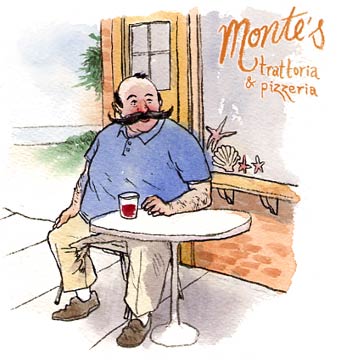
Montepulciano Profile

Several months ago I submitted a brief description of the grape Montepulciano for the website Appellation America, comparing the grape to the proprietor of a little family restaurant in Italy. And the profile is up with a fitting illustration to boot. I like how the guy looks like a friendly Tony Soprano.


Which puts an odd thought in my head... It wouldn't really fit with the idea of the show, but imagine if Tony and crew met at a cellar housing old and incredible Italian wines instead of Satriale's butcher shop. And instead of talking about the quality of the mortadella, they were arguing with one another over the Barolo. Actually, they could have done something like this and have it fit in with the Furio character that was on for a while. Mainly I'm just glad that the Sopranos is coming back on the air, and even though the series is ending I can't wait to see it.

28 February 2006

A glass raised to Joey's dad...

I mostly post about wine here, though I read a lot of non wine-related blogs. I also read about two dozen webcomics a day (plus things like the archived L'il Abner comics), and several other websites. The good Lord blessed me with the ability to skim things pretty quickly, so I can whip through my daily intake of 118 websites in an hour or two. (Hey, as a kid I used to read two or three newspapers a day.) One website I've enjoyed for the past couple of years is run by Joey deVilla. He's a Canadian/Filipino web programmer by day, accordion player by night. Just got married to a beautiful redhead from Boston. He's a damned good writer and has some amazing stories. He has almost convinced me to take up an obscure instrument and head downtown to get free drinks and kisses from the ladies.

Today, Joey's father passed away. His father was a doctor, a man who worked hard throughout his life and helped untold numbers of people throughout his life. By all accounts a man admired by friends, family, and everyone else. And I have to admit, though I've been following the tales of his declining health over the past few months, when I opened that tab tonight and saw the picture and text, I started to cry.

So tonight, I, like I hope many bloggers, am hoisting my glass to the memory of Joey's dad. Here's to you, and the wonderful legacy you've left.

* * *

I know I've done this in the past, but in the midst of our quibblings over various grapes, we sometimes forget that wine and other alcoholic beverages are traditionally associated with various spiritual rituals: Champagne at the marriage, a beer on the 21st birthday, wine at the anniversary, spirits at the death. Let us not forget that the beverages we celebrate are sometimes meant for joy and sometimes meant for sorrow, but will always provide markers in our memory of taste and emotion.

26 February 2006

Farmer's Markets

I got an e-mail from Adam Mahler asking me to blog about a House of Representatives bill that would involve government support/funding of Farmer's Markets nationwide. I'm in a weird position, as I love Farmer's Markets but disagree with the bill. Allow me to explain.

If the idea is to use such legislation to improve the eating habits and educate the palates of the American populace, this is going to fail. You can't force people to eat good food anymore than you can force them to drink decent wine or beer. Look at the most popular wines and beers in this country, and then imagine legislation that would try to steer them towards better quality, locally produced alternatives. I'll pause for laughter.

Farmer's Markets are generally cheaper than supermarkets, but quality varies wildly depending on where you are. For instance, here in the Mid-South area, I'm limited to fruits, vegetables, and honey for local produce. The honey is great, the tomatoes are awesome (more on that in a moment), and you can't buy freshly shucked crowder peas or purple hull peas in the grocery store. During the spring, summer, and fall, I buy as much as I can from the Farmer's Market, though I tend to focus on peppers, onions, potatoes, tomatoes, melons, and various peas. Most of the other fruits and vegetables actually come from out of state and have stickers on them like you get at the grocery store. I've seen commercial Hawaiian produce at my local Farmer's Market. Outside of those items listed above, most of the offerings at the Market tend to be inferior to the supermarket varieites. Hey, we're in a cotton-growing region; what do you expect?

I don't think federal money is going to help Farmer's Markets much, nor is it going to change eating habits. But if they want to make more money, here's what I'd suggest, and it's something that I plan on trying this spring. I happen to live near a major tomato growing region. Aside from the standard Ripley tomato, it's known that these farmers also plant rows of heirloom tomatoes for restaurants and special clients. Last summer I lucked out and was able to gorge myself on incredible Brandywine tomatoes. This spring, I intend to make friends with a tomato seller (they always send their pretty daughters to market in the big city), and will offer bribes and the promise to pay double the usual rate for any heirloom tomatoes they bring me. If I could get a sampler basket of things like little yellow Tommytoes and zesty Green Zebras and other varieties I'd consider proposing marriage.

Let's note that I always overpay at the Farmer's Market. If it's just a staple item, I let them keep the change. If it's something I really like or can't get in the grocery store, I pay double or toss in a few extra bills. If I find a vendor I like, I reccomend them to friends and family. That's the way a community market is supposed to work.

Quick tips for Farmer's Markets:

1. Focus on crops that thrive in or are unique to your area, such as muscadine grapes here in the South.

2. Sell heirloom or unusual varieties that you can't get in the grocery store, and advertise this somewhere so that the gourmands in the area know about it.

3. Offer samples for God's sake. A piece of cheesecloth will keep the flies off, and don't be afraid to cook something if your local food service regulations aren't too harsh.

25 February 2006

2003 Renwood Syrah Rosé

And for this evening's sipping wine, I'm drinking the 2003 Renwood Syrah Rosé from Amador County, California. Though it was warm and springlike yesterday, it's turned cold again and is currently below freezing. Not exactly ideal rosé weather. But I went ahead with it.

It's got good strawberry notes to it, and all around tastes like a Syrah. However, I find that it's a little strong for a rosé. In fact, it could almost pass for a CDR. I found myself wanting a little more of the full strength of a regular Syrah or more of the light fruit playfulness of a traditional rosé. I guess that's a roundabout way of saying that the balance was off. Still, not a bad wine by any stretch of the imagination, just not my favorite pink wine.

I'll also point out in this review that I recently did something stupid with a wine. I won't say which one, because honestly it didn't impact my feelings on the wine. I'd already had a glass and had written up my notes. But I was going in for a second deep sniff, and since I was watching TV at the time and not paying close attention, I treated the glass as if it were a standard one ounce sample. Force of habit from tastings. But no, it was a full glass. So I sniffed deeply as I dipped my nose into the glass and managed to snort wine up my nose. It burned, I cursed loudly, and it took a few tissues and glasses of water before I was back to normal.

For the record, I really would not recommend trying this.

2004 Rock Rabbit Sauvignon Blanc

Dinner last night was vaguely Italian: campanelle (little bell shaped pasta) with roast chicken thighs, a savory cream sauce, green peas, pearl onions, and quartered campari tomatoes. However for the wine I went for something from California: the 2004 Rock Rabbit Sauvignon Blanc. Their Syrah is one of my all-time favorite wines; versatile, tasty, and affordable. The Sauvignon Blanc did not let me down.

Made in the Central Coast/Sonoma region, Rock Rabbit only produces those two wines. And while it's cool to have a dozen varietals and various price levels (table/estate/reserve/etc.), it's also amazing to find a winery that's so committed to producing two wines so well.

The Sauvignon Blanc is light and fruity, in the style of New Zealand but without the grapefruit flavors. Instead, we tasted peach and hints of lemon. It's an easy drinking wine, and while I served it chilled, it was also delicious at room temperature. And at $10, it's a classy bargain.

I think this would really shine with shellfish, pasta, and a salad including fresh fruit.

24 February 2006

2003 Elsa Chardonnay Semillon

Famigilia Bianchi in Argentina is going through a label change for its entry-level Elsa wines. So a local shop managed to pick up some of the last of the old labels at a bargain price, and has passed on the savings. I was able to get the 2003 Elsa Chardonnay Semillon for a mere $6. I got it primarily for cooking purposes, but it's still a good drinking wine. When I buy wines for cooking, I generally look for something delicious under $10. It's nice to cook with something more expensive (or ideally with the wine you're serving with that dish), but that's not always the best budgetary choice. So whenver I refer to using a wine for cooking on this blog, I'm not insulting it--I only cook with stuff I like to drink, even if it is on the less expensive side.

And I got to meet the winemaker last year. From my notes I liked this wine back then as well.

One odd note: it's got a synthetic cork, which I like, but this cork is solid black. It's not bad or offputting or anything, just odd. It's classier than the neon versions, but I tend to prefer the "cork" colored synthetics.

It's 60% Chardonnay and 40% Semillon. I love this particular blend of grapes, especially coming out of Australia. It's an unoaked, slightly crisp and medium fruit wine, but it's not too heavy. It's got a lovely white gold color, and reduced down nicely for a cream sauce I'm making for some chicken.

I don't generally get excited about South American whites--I have nothing against them, but rarely seek them out. In fact, I think that these days I drink more white wine in sparkling varieties than I do in the still varieties. I'm sure this will change as summer approaches. Today it was in the 60s here in Memphis, so I'm doing chicken and pasta with a Sauvignon Blanc tonight. More on that one after I get a chance to try it.

20 February 2006

2003 Banfi Centine

When you really want a food that you haven't had in a long time, it's a powerful force. Here in my home region of the Southern United States, there's a way to phrase such a longing. For instance, I've recently had a strong desire for lasagne. So in the appropriate company I might say, "I done had a cravin' flung on me for some lasagne." (To all of my readers: please note that I don't normally talk like this. Only while inebriated and around a BBQ grill, smoker, or on a camping trip. My everyday speaking voice is neutral Midwestern.)

Of course, around here we mostly spell it lasagna, but four semesters of Italian have a stronger impact on my orthography. Lasange is quite popular here in the Mid-South, and it was certainly a staple item on my childhood dinner table. It's certainly the easiest Italian casserole out there; one of my favorite Italian dishes is crespelle, but it's hard to build enough enthusiasm to make crepes after getting home from work. My Mom always used the same recipe: lots of onion, ground beef, ricotta, mozzarella, and plenty of tomato sauce.

I was in the mood for comfort food. We had a recent ice storm here in Memphis, and I've been really wanting some hearty casserole dishes. So it was chicken thighs in savory sauce and green beans over the weekend, and I had to have some lasagne tonight. So I used a similar method to my Mom's but some alternate ingredients. I used ground turkey instead of beef; it's lighter yet still provides the texture and protein. I added in a ton of leaf spinach to the two eggs and 15 oz. of ricotta cheese. And I used two different tomato sauces: a mushroom one and a garden one. I think the added veggies help.

Though I've made lasagne many times in my life, this was my first attempt at making one without boiling the noodles first. You just layer the noodles as you normally would, but cover the dish with tight aluminum foil before baking. The result: fantastic. The noodles were perfectly al dente, and it was a hell of a lot easier to build the thing using dry noodles. And I've got leftovers for the next few days.

Oh, and the wine?

So last Friday during my wine-buying excursion I picked up a bottle of the 2003 Catello Banfi Centine. It's a red "Super Tuscan" made of 60% Sangiovese, 20% Cabernet Sauvignon, and 20% Merlot. While cooler this drinks like a Merlot, but once it comes up to temperature the Sangiovese really shines through. There's not a lot on the nose, but a slurping sip reveals some black cherry flavors and some medium tannins. It's hard to describe, but it smells like an Italian red and tastes like an Italian red, but doesn't have the heavy tannic bite and strong aftertaste of similar young Italian reds.

At this point, I've just enjoyed my second helping of lasagne and am in heaven. The wine is matching perfectly. I'm now ready to crawl into bed and call in sick for the next two days so that I can curl up next to my dogs and sleep all day.

18 February 2006

Weekend Wines

I've got Fridays and Saturdays off work... So I tend to do a lot of wine shopping on Friday morning. I picked up a few bottles Friday, and here's the report:

2001 Familia Zuccardi Santa Julia Malbec. Mendoza, Argentina. I'm a sucker for $8 Malbecs from Argentina. This one was a little older than most bargain Malbecs, but despite a ton of sediment around the synthetic cork and shoulders of the bottle, it was a delightful afternoon wine. Still good and plummy, fruit forward and easily drinkable. It's not often than you can drink such a cheap wine after five years of aging and have it still be pleasing. I'd love to try a more recent vintage, or the reserve.

2003 The Lucky Country Shiraz-Cabernet Sauvignon. Barossa Valley, Australia. This is a second-tier wine from the distinguished Australian producer Two Hands. Funny story behind this one. I walked into the store eager to get a cheap Bordeaux that was on special that week. A couple of cases had been lost in the back of a warehouse for a few years and they were eager to unload it. I grabbed a bottle, and one of the seasoned employees that I know well urged me against it. I promised to buy something of equal value as thanks, and asked for a fun Shiraz. He pointed me to this little gem. For $15, this was an amazing wine. Big fruit, medium tannins, great berry flavors and an easy finish. A dear friend of mine treated the girlfriend and me to dinner. I took the bottle with us, and we had the wine over dishes like beef tenderloin and glazed pork chops and risotto. An excellent choice, and a classy looking bottle. 55% Shiraz and 45% Cabernet Sauvignon.

2004 Three Blind Moose Chardonnay. Central Coast, California. I needed an inexpensive cooking wine, and I fell in love with the label. How can you resist a name like Three Blind Moose? It's part of the giant Constellation wine conglomerate. It looks like they're marketing to a young, hip crowd, and maybe it will work... As for the wine itself, it's a fairly standard California Chardonnay, which is what I figured when looking for something to boost a chicken casserole. Lightly oaked and not buttery in the slightest. Big and fruity. Reminds me somewhat of Fat Bastard or Red Bicyclette. Sort of a baseline Chardonnay that's not going to offend the casual drinker, though I think that the tartness and heavy acidity would be a little rough if you were drinking more than one glass. Runs around $10 for a bottle, but it made the sauce taste great.

I'm also sitting on about 30 reviews from tastings that I haven't got around to posting... Maybe tomorrow?

10 February 2006

Barefoot Cellars Cabernet Sauvignon

In my continuing fascination with the bargain rack near the register, I picked up a bottle of the Barefoot Cellars Cabernet Sauvignon. Also got a Chardonnay for cooking purposes tomorrow. I've heard a lot about this wine--I've often heard it referred to as an inexpensive, non-threatening wine for newcomers.

It's non-vintage, and a little sweet. Heavy on the jam and berry flavors, too much for me. Little to no tannins. Welch's grape juice aftertaste. About what I expected for $5. And incidentally, I'm currently drinking it barefooted.

08 February 2006

Links

Three new links this week. The first is from Ricardo Brizuela of Andes Wine Zone, focusing on wines of Chile and Argentina. We had a brief e-mail exchange in broken English and my terrible Spanish. But I love the wines of that region, and he's using the same Blogger.com template as me, so how could I not link him?

The second link is a little closer to home. I got an e-mail from Fredric Koeppel of Koeppel on Wine, and decided to link him here on the site, as I always love a good story. Fredric was the restaurant reviewer for the primary Memphis newspaper for most of my childhood, my teen years, and even those young adult years until the Internet managed to wean me off the daily fishwrap. (Though I've got to admit I still enjoy the Sunday editions of papers like the Boston Globe, the New York Times, and the Washington Post, particularly over a long leisurely lunch at a Mexican restaurant with plenty of chips, salsa, and beer.)

Koeppel's got a professional site, and can obviously afford much nicer wine than the stuff I drink. I also commend him for the almost 100% use of wine label photos to accompany the reviews--if only I had the time!

The third link is to the blog of the talented Alyce Mantia. She's a wonderful woman and great cook who runs a little specialty food store here in Memphis. Pretty much THE place to go for interesting cheeses, such as the lemon Stilton and the "Purple Haze" goat cheese. She's got a great food blog that showcases creative recipes involving wonderful ingredients.

Super Bowl Wines Redux

I'm not much of a sports fan, and neither are the rest of my family. However, we gathered at my brother's house for a party. It was a little funny that we had plenty of wine and no beer, even though the latter probably would have been a better fit for the bratwurst on hoagies. Good bratwurst, though, covered in caramelized onions and mushrooms, with mustard and provolone cheese... slobber slobber...

We drank Yellow Tail Merlot and Chardonnay for a while, and I used the latter for a pan sauce for the brats. Dad brought along a bottle of the 2003 Jacob's Creek Cabernet Merlot. A really nice balance of the two grapes, I thought. Great for casual drinking and having fun. On the grill we also cooked a little meatloaf of sorts, ground venison topped with bacon and onions, wrapped in foil, and cooked over indirect heat on the fire for half an hour or so. Back when I was in Scouts, we called this a "Hobo Dinner". So now I'm going to go into storytelling mode...

Hobo Dinners were interesting yet rarely satisfying meals on camping trips. The adult leaders loved them because the boys did all the work. You'd get a half pound of low-grade, high-fat and gristle ground beef (or elk or deer or buffalo). You'd shape this into a ball or loaf on a sheet of aluminum foil. Then you'd add in some chopped carrots, onion, celery, and potato, obviously meant to simulate a beef stew. Then you'd wrap it up tight, do something with the foil to identify it as your own, and put it on a bed of hot coals. 45 minutes to an hour later, you were ready to eat.

They rarely tasted good. No one ever brought salt or pepper, and the carrots and potatoes somehow never got cooked. The beef tasted pretty bland, not picking up any smoke or caramelization from the fire. It was also easy to poke a hole in your foil and thus let all of the juices out. I even remember one time when it was raining too hard and I ended up eating a baseball-sized lump of raw ground beef and half a raw potato for dinner. In the rain, with the prospect of a night spent in a wet sleeping bag. I'd like to think that experience made me a better man.

It was generally better when we made chili or spaghetti for dinner, though burgers were always incredible. But it was breakfast that was always my favorite. I did a lot of cooking for my patrol, and I'd have multiple burners going with eggs, bacon, sausage, pancakes, toast, biscuits (in a Dutch oven, in the fire), all washed down with slightly-below-room-temperature whole milk, just like God intended. We would go through amazing amounts of food, and yet somehow we were always hungry in time for the next meal.

Man, this is bringing back some great memories. I remember being on top of a mountain in New Mexico, huddled over a one burner stove so that the hailstorm wouldn't put it out or knock it over as I reconsituted some turkey soup from a dried packet. Or the time I made tacos with ground buffalo. Roasting whole eggs in a fire. Roasting a haunch of venison and eating it with friends by just tearing out chunks with knife and hand. Making a cobbler with wild blackberries.

Good times.

01 February 2006

Super Bowl

I'm not a sports fan, but I've got invites to several parties for Sunday, including one from my brother. He jokingly suggested that I bring a special wine, like Boone's Farm. My reply:
Boone's Farm is actually a bit of overkill for Frito Pie. To bring out the nuanced flavors of mass-manufactured corn chips, what you really need is something along the lines of Mad Dog 20/20 Hawaiian Blue, commonly sold within easy walking distance of the hobo community. The sweet flavors of coconut and pineapple (as well as the sharp tang of the blue food coloring) complement the metallic aftertaste of canned chili and the fumes from slowly melting plastic (assuming that you're serving the treat in-bag).

On a serious note, I might bring something. You'd be surprised--a sparkling white wine is the perfect match for things like hot dogs, popcorn, and general snacking. I've seen Andrea Immer on TV drink a $100 champagne with a bowl of popcorn (tossed with black pepper and shredded Parmesan). In fact, I know of a slightly sweet sparkling Chardonnay from the Savoy region of France that tastes like green apples and lemon that would be a lot of fun.

28 January 2006

Jean-Paul Trocadero Blanc de Blancs NV

Rainy afternoon, good book, why not settle back with a bargain sparkler... The Jean-Paul Trocadero Blanc de Blancs is $8 of fun in traditional packaging. It comes from the Savoie (Savoy) region in southeast France near the Alps. It's interesting how whenever we think about French wines we're thinking about regions that relate to ancient kingdoms and principalities, yet how many of us can name any of the actual departments where the wine is made? Anyway, this is all Chardonnay, a bit on the sweet side, but pleasant. The aroma and flavor are overwhelmingly comprised of green apples and lemon, sort of like when I was a kid and Mom would cut up a Granny Smith apple, squirt lemon juice over it, and put it in a bag for my school lunch. Slightly musky finish. Really begs for a firm, sharp English cheddar. An excellent wine for any fan of hard cider.

23 January 2006

2005 Roundup

A look back at 2005... In the US, "roundup" either refers to the gathering of cattle or a particularly potent herbicide used to kill weeds (and which, as a child, made my little brother break out in hives). I'm sticking to the metaphorical usage of the first definition.

A quick glance over the reviews of 2005 reveals that I wrote about some 450 wines. That's not an exact count; a couple were duplicates, yet others were wines I used for dinner parties whose reviews aren't directly linked by this blog anymore and thus weren't counted. So I think 450 is a good number, and damn, what a number! And that's not even counting the various liquors and beers that I sampled over the year... I either need to write a book or enter a 12 step program.

To concerned friends, relatives, and potential parole officers: almost all of those were tasted in one-ounce portions.

I'd like to think that the past year has been an incredible education into the world of wine. If I were referring to a language, I'd say that at the beginning I knew basic phrases, yet now I can carry on a detailed conversation. I'm by no means fluent yet, but I'm working on it.

Cheers to all of my readers, and here's to the rest of 2006!